Carl Chun
Carl Chun | |
|---|---|
 | |
| Born | 1 October 1852 |
| Died | 11 April 1914 (aged 61) |
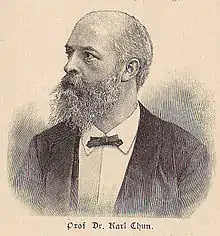
Carl Chun (1 October 1852 – 11 April 1914) was a German marine biologist.
Chun was born in Höchst, today a part of Frankfurt, and studied zoology at the University of Leipzig, where from 1878 to 1883 he was privat-docent of zoology and an assistant to Rudolf Leuckart. After professorial posts in Königsberg (1883–1891) and Breslau (1891–1898), he returned to Leipzig as a professor of zoology.[1]
He initiated and led the German deep sea expedition (1898/99 "Valdivia" Expedition),[1] which set out on 31 July 1898 from Hamburg to explore the deep sea in the subantarctic seas. They visited Bouvetøya, the Kerguelen Islands, and other islands, before returning to Hamburg, where they arrived on 1 May 1899.[2]
Chun was a specialist on cephalopods and plankton. He discovered and named the vampire squid (Vampyroteuthis infernalis, which means "vampire squid from hell"). Chun was also interested in making science accessible to larger audiences. He published in a popular style a narrative of the "Valdivia" expedition, which found a wide resonance (Aus den Tiefen des Weltmeeres, 1900).[3]
He died on 11 April 1914 in Leipzig, Germany, aged 61.
Selected works
See also
- European and American voyages of scientific exploration
- Category:Taxa named by Carl Chun
References
- UNI Leipzig Professorenkatalog (biographical sketch)
- Chun, Carl (1903). Aus den Tiefen des Weltmeeres. Jena: Gustav Fischer. pp. V, 12. doi:10.18452/2.
- Andreas W. Daum, Wissenschaftspopularisierung im 19. Jahrhundert: Bürgerliche Kultur, naturwissenschaftliche Bildung und die deutsche Öffentlichkeit, 1848–1914. Munich: Oldenbourg, 1998, ISBN 3-486-56337-8, pp. 330, 428, 480 (2nd ed. 2002 with the same page numbers).
Further reading
Ilse Jahn, ed., Geschichte der Biologie: Theorien, Methoden, Institutionen, Kurzbiographien. 3. ed., Berlin: Spektrum, 2000, ISBN 978-3-8274-1023-8, pp. 798, 867, 881, 900, 996.
Authority control  | |
|---|---|
| General | |
| National libraries | |
| Art galleries and museums | |
| Art research institutes | |
| Other | |