Palace of Laeken
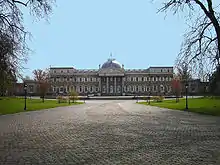
The Palace of Laeken (Dutch: Kasteel van Laken; French: Château de Laeken) is the official residence of the King of the Belgians and the royal family. It lies in the Brussels region, 5 km (3 mi) north of the city centre in the municipality of the City of Brussels. It sits in a large park called the Royal Domain of Laeken, which is off-limits to the public. It was originally named the Castle of Schonenberg and is often referred to as the Royal Palace.
| Palace of Laeken | |
|---|---|
Kasteel van Laken (in Dutch) Château de Laeken (in French) Schloss Laeken (in German) | |
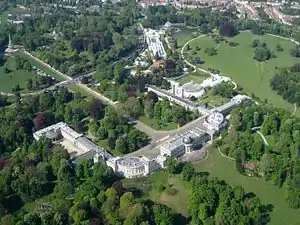 The Palace of Laeken and park from the air | |
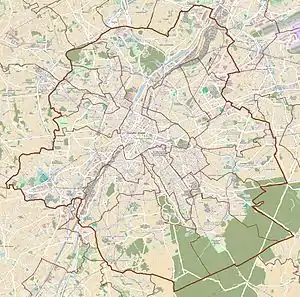  Location within Brussels | |
| General information | |
| Town or city | Laeken (Brussels) |
| Country | Belgium |
| Construction started | 1782 |
| Client | Governors of the Habsburg Netherlands, Archduchess Maria Christina of Austria and her husband Albert of Saxe-Teschen |
| Owner | Belgian State |
| Design and construction | |
| Architect | Charles de Wailly |
| Engineer | Louis Montoyer |
The palace at Laeken should not be confused with the Royal Palace of Brussels, in central Brussels, which is the official palace (not residence) of the King of the Belgians and from which state affairs are handled.
History


The palace was built at Laeken, then outside of Brussels, between 1782 and 1784 after the plans of the French architect Charles de Wailly under supervision of Louis Montoyer as a summer residence for the Governors of the Habsburg Netherlands, Archduchess Maria Christina of Austria and her husband Albert of Saxe-Teschen. Jean-Joseph Chapuis provided the royal furniture.
On 21 July 1803, Nicolas-Jean Rouppe, as commissioner of the department of the Dyle, received Napoleon at the Palace of Laeken. Napoleon stayed at Laeken with the Empress Josephine in August 1804 on his way from awarding the first Légion d'honneur to his invasion troops at Boulogne to his progress along the Rhine, and later during the Hundred Days in 1815 dated this proclamation prematurely from the palace:
To the Belgians and the inhabitants of the left bank of the Rhine. The ephemeral success of my enemies detached you for a moment from my empire. In my exile, upon a rock in the sea, I heard your complaint; the God of Battles has decided the fate of your beautiful provinces; Napoleon is among you; you are worthy to be Frenchmen. Rise in a body; join my invincible phalanxes to exterminate the remainder of these barbarians, who are your enemies and mine: they fly with rage and despair in their hearts.
— The Imperial Palace of Lacken, 17 June 1815. (Signed) Napoleon, The Imperial Palace of Lacken, 17 June 1815. By the Emperor, The Major-General of the Army, Count Bertrand."[1]
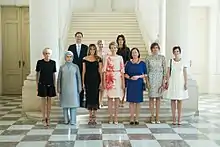
.jpg.webp)
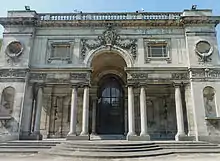
After Belgian independence, Rouppe, as mayor of Brussels, received the new king Leopold I at the Palace of Laeken on 21 July 1831; the day of Leopold's coronation. The palace was partly destroyed by fire in 1890 and was rebuilt by Alphonse Balat. The French architect Charles Girault gave it its present outline in 1902. It has been the royal residence since Leopold I's accession to the throne in 1831. The domain also contains the magnificent Royal Greenhouses of Laeken, a set of monumental dome-shaped constructions, accessible to the public for a few days each year. They were designed as well by Alphonse Balat, with the cooperation of the young Victor Horta.
Upon their accession to the throne in 1993, King Albert II and Queen Paola preferred to remain living at Belvédère, a château on the grounds of the park surrounding the palace. The current occupants of the palace are King Philippe, Queen Mathilde and their four children.
Royal Garden of Laeken
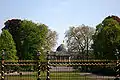
The royal gardens of Laeken are extensive, about 460 acres (190 ha), or slightly smaller than Monaco.[2] The garden is surrounded by walls and iron gates.[2] The garden is closed to the public, although there have been calls for the king to open at least a portion of the park for public use amid the COVID-19 pandemic in Belgium.[2]
The gardens are designed in English style; the vast parks of the Royal Domain include lakes, a golf course and artworks. Leopold II of Belgium was very closely connected with the designs of his private gardens. In the gardens his only son, Prince Leopold, Duke of Brabant, fell in a pond, and died subsequently from pneumonia, aged only nine. The king had trees planted for his newborn children, which still stand in the park.
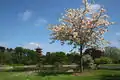
There are various pavilions, including the Chinese Pavilion and the Japanese Tower. They were commissioned by King Leopold II and now form part of the Museums of the Far East. The rooms of the Chinese Pavilion are designed in a chinoiserie Louis XIV and Louis XVI Style. They are decorated with Chinese motifs, chinaware and silverware. The Japanese Tower is a pagoda.
In the gardens several colonies of wild Canada geese, hundreds of cormorants and other large birds live. The gardens are home to one of the biggest colonies of herons in the country.[3]
Royal greenhouses
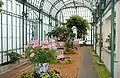
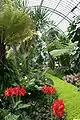
The Royal Greenhouses of Laeken are located within the park and are attached to the palace via the orangery. The complex was commissioned by King Leopold II and designed by architect Alphonse Balat. They were built between 1874 and 1895. The total floor area of the immense complex of 2.5 hectares (270,000 square feet). The main greenhouses, such as the Congo greenhouse and the iron church, are all linked by flowered corridors spanning hundreds of meters. The complex is also home to the famous royal botanic collection which includes large collections of Camellias, orange trees and many plants originating from the African parts of the Belgian Empire. Many sculptures and Chinese vases can also be found within the greenhouses.
Modern day Function
The Castle of Laeken is mainly a residential castle and has a more sober and intimate character than the Royal Palace of Brussels. Since 1999 it has been the residence of King Philippe and Queen Mathilde with their family.
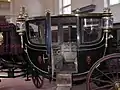
The Royal Greenhouses of Laeken are open to the public for three weeks each year during the flowering period. The castle is also known for its stables, the Chinese pavilion and the Japanese tower. The painting studio of Elisabeth of Bavaria, Queen of Belgium can also be admired.
At the request of Queen Paola, the play pavilion in which the children of Leopold III grew up has been restored, so that Crown Princess Elisabeth, Duchess of Brabant could play here with her brothers and sister and cousins.
Other
Mobutu Sese Seko, the dictator of Zaire (the modern-day Democratic Republic of the Congo), built a palace in his hometown of Gbadolite modelled upon the Royal Palace of Laeken.[4]
Gallery
.jpg.webp)
References
- Memoirs of Napoleon Bonaparte, p. 129, at Google Books
- Raf Casert, Some Belgians shout: 'King! Tear down your garden walls!', Associated Press (4 March 2021).
- "DPG Media Privacy Gate".
- Recovering stolen assets: Making a hash of finding the cash, The Economist
External links
 |
Wikimedia Commons has media related to Royal Castle of Laeken. |
- The Royal Castle of Laeken at Visit Brussels
Royal palaces and residences in Belgium | ||
|---|---|---|
| Occupied |
|  |
| Historical | ||
| Abroad |
| |
