Catch Me If You Can (book)
Catch Me If You Can is a semi-autobiographical book about criminal exploits allegedly engaged in by Frank Abagnale Jr., a onetime con artist. Abagnale claims that as a young man, he cashed $2.5 million worth of bad checks while impersonating a Pan Am pilot, a doctor, a teacher, and an attorney. The book is acknowledged to have been partly fictionalized, and the factual basis for the events contained in the book has been challenged. Co-written by Abagnale and Stan Redding, Catch Me If You Can was adapted into a 2002 film of the same name by director Steven Spielberg; the film starred Leonardo DiCaprio as Abagnale and Tom Hanks as an FBI agent who pursued him.
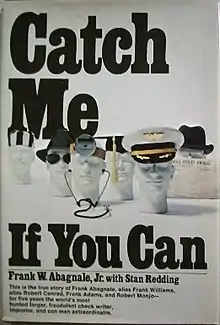 First hardcover edition (1980) | |
| Author | Frank Abagnale Jr. Stan Redding |
|---|---|
| Country | United States |
| Language | English |
| Publisher | Grosset & Dunlap |
Publication date | 1980 |
| Media type | Print (hardcover) |
| Pages | 253 |
| ISBN | 0-448-16538-4 |
Plot
Summary
The book is loosely based on the life of Frank Abagnale, a con artist. It is written in the first person and describes how Abagnale cashed $2.5 million worth of bad checks. He assumed various jobs, such as pretending to be a Pan Am pilot, a doctor, a teacher, and an attorney. Abagnale was eventually caught by the FBI while living in France and served approximately five years in prison — six months in France, six months in Sweden, and four years in the United States. The book ends with an epilogue telling the story of Abagnale's final capture and his rehabilitation, which resulted in the creation of his security firm.
Details
Frank W. Abagnale's parents discover his scheme to profit from a line of credit for auto work that was never done and car parts that were never sold. His father forgives him, but his mother sends him to boarding school for boys.
Between school terms, Frank is devastated when his parents decide to divorce. He runs away and takes up forging checks. He is easily mistaken for an adult, and uses this to his advantage by impersonating a 26-year-old in New York. Inspired when he sees smiling pilots and pretty stewardesses leaving a hotel, Frank does some research on airline work culture. After some time, he successfully fakes a pilot's license and lies his way into a warehouse to get a tailored uniform identifying him as first officer for a commercial airline. Frank begins passing himself off as a deadhead (a pilot riding along in cockpits on the way to scheduled takeoff points), conning his way into obtaining free air travel. He explores cities throughout the U.S. and stays well ahead of his expenses with increasingly innovative check fraud.
Eventually, Abagnale uses his profits to advance a year's worth of rent in the city of River Bend. He whimsically claims to be a doctor on his rental application. At his first opportunity, he forges physician's credentials to supplement his cover. At first, the local medical community members respect his preference not to work. However, when a position opens for head of a hospital, they insist Frank is the best temporary fit. Frank accepts the job and comes up with tricks to improve his facade. He forms a relationship with one Brenda Strong, but the romance is overshadowed by his fear that the FBI may be getting close to tracking him down. On one mortifying occasion, he is relieved that a tragedy is averted (no thanks to him) after he did not know what "blue baby" meant.
After relocating, Frank poses as an attorney and pretends to be a graduate of Harvard Law School. He is again implored to fill a job opening and has the hiring conditions finagled for him. One requirement is that he pass the state bar exam, which he manages to do without cheating on the third try.
When Frank resumes his pilot persona, he recruits his own fake airplane crew at a flight attendant school on pretense of needing advertising stills. As his confidence increases, so do the amounts on his forged checks.
At one point, investigators unwittingly have a face-to-face encounter with Frank. Keeping his cool, he flashes his wallet open and shut as if showing credentials, then acts like he is another member of law enforcement until he can make an inconspicuous exit from the scene. On another occasion, police have a chance to arrest Frank but lack grounds to do so for his known crimes. Instead, they invent a vagrancy charge and arrest him. Frank is bailed out by a bondsman who goes by the name "Bail-Out" Bailey. FIB Agent O'Riley arrives after Frank has departed and angrily informs Bailey that, having been paid by check, he has just become a fraud victim. Frank later takes measures to ensure that Bailey actually gets paid.
Meanwhile, Frank's wanderlust extends to international horizons. He forges a passport, then flies to France and explores other parts of Europe. One day while grocery shopping, Frank finds himself surrounded by police holding him at gunpoint. He has a moment of genuine mortal terror because they bark contradictory surrender commands at him, and he surrenders. He serves a long sentence at Perpignan's prison, aghast at the subhuman living conditions typical for inmates. Frank is later transferred to Sweden, where the prison system is much more livable. Frank is later extradited to North America. Frank escapes from the plane by unbolting the toilet. He is later arrested again, but convinces prison officials that he is a prison inspector and that he needs to be released to attend a meeting. He is arrested again in Canada and resolves to become a law-abiding person. He finally changes his life by offering his services (for free, at first) as a security consultant on a specialized lecture tour. He speaks to bank personnel, fully disclosing his forgery methods and ways to detect them. He goes on to found a real-life firm that has been famous ever since.
Veracity
The book is prefaced with the statement: "This book is based on the true-life exploits of Frank Abagnale. To protect the right of those whose paths have crossed the author's, all of the characters and some of the events have been altered, and all names, dates and places have been changed."[1] The character of FBI Agent O'Riley is known to be based on Joseph Shea, with whom Abagnale went on to form a lifetime friendship.[2]
After Abagnale spoke at a seminar in 1978, two years before the book's publication, a San Francisco Chronicle reporter phoned a number of institutions that Abagnale mentioned to confirm his claims and found no evidence for them. Abagnale responded that he doubted anyone would confirm them due to embarrassment. He later said he had changed the names.[1]
In 2002, Abagnale addressed the issue of the book's truthfulness with a statement posted on his company's website which said (in part): "I was interviewed by the co-writer only about four times. I believe he did a great job of telling the story, but he also over-dramatized and exaggerated some of the story. That was his style and what the editor wanted. He always reminded me that he was just telling a story and not writing my biography." Specifically he addressed details such as the amount of money he wrote in bad checks, and the years in which his crimes took place.[3]
In 2020, journalist Alan C. Logan made an in-depth investigation as part of publishing a book on Abagnale's life story, finding earlier newspaper articles that cast doubt on Abagnale's story and locating numerous administrative documents that contradicted many of Abagnale's claims.[4] Logan's investigation found that Abagnale's claims were, for the most part, fabrications. Documents show that Abagnale was in Great Meadow Prison in Comstock, New York, between the ages of 17 to 20 (July 26, 1965, and December 24, 1968) as inmate #25367, the time frame during which Abagnale would claim to have committed his most significant scams. Logan's investigation uncovered numerous petty crimes that Abagnale has never acknowledged, and with Logan giving evidence to argue that many of Abagnale's most famous scams in fact never occurred.[4][5]
Film adaptation
The 2002 film Catch Me If You Can, directed by award-winning director Steven Spielberg, stars Leonardo DiCaprio as Abagnale and Tom Hanks as his FBI pursuer, renamed Hanratty in the adaptation.[6] The film is based upon his life and the autobiography and is mainly true to the source as Abagnale was a consultant to the writers, but some of the details were changed to create a more dramatic narrative for film.[7]
Musical adaptation
Abagnale's life was adapted into a musical of the same name, which previewed on March 11, 2011, and opened on April 10 at the Neil Simon Theatre on Broadway. The show stars Aaron Tveit, Norbert Leo Butz, Tom Wopat and Kerry Butler. Butz won the Tony Award for Best Actor in a Musical at the 65th Tony Awards in 2011.
References
- Baker, Bob (28 December 2002). "The truth? Just try to catch it if you can". Los Angeles Times. Retrieved 25 December 2018.
- "Joseph Shea's Obituary on Atlanta Journal-Constitution". Atlanta Journal-Constitution. Retrieved 2021-03-01.
- "Abagnale & Associates, Comments". Retrieved March 1, 2021.
- "Could this famous con man be lying about his story? A new book suggests he is". WHYY. Retrieved 2021-07-25.
- "New book further debunks myth of scam artist Frank Abagnale, Jr. of 'Catch Me if You Can' book and movie". Louisiana Voice. 2021-04-27. Retrieved 2021-07-25.
- "Movie won't bring fame or fortune to FBI agent". Deseret News. November 11, 2002. Retrieved 2021-03-01.
- ISBN 0-06-052971-7 by Frank Abagnale, Jr. and Stan Redding