Université catholique de Lille
Founded in 1875, the Université Catholique de Lille (also known as Lille Catholic University) is a multidisciplinary institution with 5 faculties, 20 schools, institutes, and grandes écoles, a hospital group, retirement homes, an ITEP (an institute for special needs education), and two 'living labs' for social innovation, with a cumulative student body of 38,500 in 2021.
Université Catholique de Lille | |
 Coat of arms | |
| Latin: Universitas Catholica Insulensis | |
| Motto | In fide ad scientam (Latin) |
|---|---|
Motto in English | In faith, to knowledge |
| Type | Private |
| Established | 1875 (146 years ago)[1] |
| Affiliation | University of Lille Nord de France, International Federation of Catholic Universities, Union of Catholic Higher Education Institutions (UDESCA) |
Religious affiliation | Roman Catholicism |
| Chancellor | Lawrence Ulrich |
| President-Rector | Patrick Scauflaire (2020–2025)[2] |
Academic staff | 1000 permanent 2500 visiting |
Administrative staff | 700 (2021) |
| Students | 38,500 (2021) |
| 220 (2021) | |
| Location | , , |
| Campus | Urban (10ha) |
| Founder | Philibert Vrau |
| Colors | |
| Website | univ-catholille.fr |
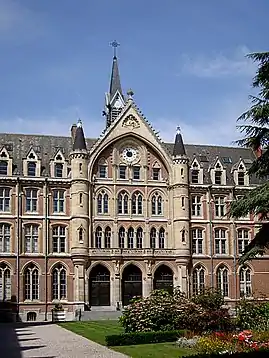
Now the largest private, not-for-profit university in France, the Université Catholique de Lille was from its beginnings grounded in humanistic and Christian values, which continue to inform its work in the fields of higher education, research, and healthcare.
With creativity and innovation as its polestars, in close association with the region as well as with their institutional partners around the world, the Université Catholique de Lille is highly implicated in the evolution of the contemporary world through research, entrepreneurship, active involvement in the social and energy transition, and care for the most vulnerable in society.
History
The year of the Wallon Law of 12 July 1875 freeing up higher education, the Catholic University of Lille was founded by a committee of lay Ultramontanes[3] including Philibert Vrau, "embarrassed" by the absence of such a structure in Lille while public schools were established in Lille since 1854. This was amidst a national debate on secularism before the church-state separation in France.
The Faculty of Medicine was created in 1876[4] and the College of Theology in 1877.[5] The official inauguration took place on 15 January 1877, upon receipt of the papal bull which gave the Lille Catholic University canonical status.
A new law on 19 March 1880 provided funding for private institutions of higher education, but denied them the use of the term "university".[6] The young "free university" became officially the Lille Catholic Institute. In 1973, Lille and Polytechnic University Federation was created, bringing together some forty private institutions of higher education.
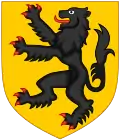
Coat of arms
The coat of arms was developed during the founding period, the 1870s. It highlights the institution's academic and ecclesial character, the tradition in which it is rooted, and the part played by the two northern provinces in its creation. It has four sections.
- The first offers a gules field with two keys in saltire: these are the weapons of the ancient Collège Saint-Pierre de Lille and Lille Cathedral, which represented the university's origins and union with the Chair of Peter.
- The second section is an ermine field with open book, distinguishing symbols of the science doctorate.
- The third section represents the Lion of Flanders.
- The fourth is a recent change, the starry field of flag of Europe.
Structure
The Lille Catholic University includes:
- Lille Catholic Institute, the "Faculties of the Université catholique de Lille", a private institute of higher education with five faculties;
- twenty schools and institutes, with the Junia engineering schools (HEI, ISA, ISEN) and ICAM;
- 3 transversal institutes;
- a hospital group, the Hospital Group at UCL (GHICL), the CMP Cross;
- about 40 research teams (400 research professors and 140 PhD students);
- Vauban University Library, created in partnership with EDHEC, the IÉSEG, the FLSEG, the FLSH, and FLD, 12 area libraries, a digital library network (BNR);
- a sports center of 7 hectors, established in the center of Lille and at Ennetières-en-Weppes.
Its campus, which covers 10 hectares in the city, includes 1,300 student rooms on campus, chaplaincy, and a cultural center.
The Lille Catholic University is chaired by Patrick Scauflaire since September 2020.[7] His administration is composed of several boards and commissions: the University Council, Supervisory Board, and the board including the bishops of Arras, Cambrai, and Lille. There are also five Advisory Committees, (e.g., the Cultural Commission).
The federation has 38,500 students in 2021 (including 10,000 in faculties) with more than 5,500 international students on campus, from at least 120 different countries. The teaching staff consists of 1,000 permanent and 2,500 temporary lecturers.
The Lille Catholic University is a founding member of the public ComUE (Commonwealth of Universities and Institutions of Lille Nord de France), University of Lille Nord de France.
The areas of study are Law, Economics, Management; Science and Technology; Arts, Humanities, Theology and Religious Studies, Ethics; Health and Social Care.
Faculties
The faculties are :
Schools and institutes
Law, economics, management
Science and technologyEducation and training
|
Health and welfare
Associated high schools
|
Research
In 2014, the research activity of the Lille Catholic University included nearly 440 teachers and researchers and 130 doctoral students (enrolled in the PhD Doctoral Schools Public University), which corresponds approximately to 240 ETP research. This workforce is spread over fifty research units in disciplines as diverse as nanoscience, psychology, economics, law, or theology. Some Catho research units are labeled and carried under joint supervision with public universities. These are of two mixed units: CNRS (LEM[10] - UMR 8179, IEMN[11] - UMR 8520) and two host teams (EA - LGCgE,[12] EA - L2EP[13]). There is also a Clinical Research Center.[14] And the medical school maintains a center for Economic Geology, Jardin botanique Nicolas Boulay.
For about ten years, Lille Catholic University institutions worked at structuring and strengthening their research activity. At the federation level, this focused on the organization of research, with the appointment of a Vice-president for Research – Cailliez Jean-Charles (2003–2012) and Nicolas Vaillant (2012 - ) – and the creation of a research council of the University. This organization induced structuring of research areas covered by the centers and the faculty of the federation, fostering the emergence of major cross-cutting themes. They share concern for the betterment of life in contemporary society: responsibilities and risks; ethics, care, and loss of autonomy; energy, housing, environment, and sustainable development; innovation, collective intelligence, and new human interactions.
Student life
Student Federation
The Federation of Lille Catholic University students (or FEUCL)[15] created in 1926 coordinates the 300 campus organizations and represents 17,000 students in the assemblies of Catho at CROUS[16] or FAGE.[17]
Internal associations in schools and faculties
Most schools and faculties have a student office (BDE) or a corporation that deals with both solidarity and culture. BDE and corporations represent their school or faculty to FEUCL. For example, ACEM (Corporate Association of Medical Students), created in 1910, lays claim to being the oldest French student corporation. In addition to the BDE and corporations, schools and faculties of Catho include associations for sports and for humanitarian, cultural, and festive events.
Student Life Services (All, tous les services de la vie étudiante)
All, tous les services de la vie étudiante offers a variety of services for students :
- Housing: with 1,300+ rooms in Lille
- University restaurants: 2500 meals served every day in its 7 restaurants
- Sport activities: fitness room, sports complex and gymnasium available for students at any time and/or with certified coaches.
- Health center (CPSU - Centre Polyvalent de Santé Universitaire): offers general medical consultations, gynaecology consultations, nurse appointments, dietitian consultations and psychological support.
Fondation de la Catho de Lille (University Foundation)
The Foundation of the Lille Catholic University was created under the aegis of the Fondation de France to support the general activities of the University: support for teaching and research, support of students, and heritage restoration. The foundation also awards scholarships and supports solidarity projects run by students.
References
- History
- Welcome
- It brought together three faculties: Law (founded by Gabriel de Vareilles-Sommières, with lawyers like Henri-Constant Groussau), Letters, and Sciences. This fulfilled the condition to be called a "free university" as stipulated in Article 5 of the Walloon law.
- "Medicine". Archived from the original on 19 January 2016. Retrieved 24 January 2016.
- Theology
- This prohibition of using the university name now appears in Article L731-14 of the Code of Education - Education Code, Article L731-14 of Law.
- "Patrick Scauflaire est le nouveau patron de l'Université Catholique de Lille".
- History of free Lille Faculty of Medicine
- EDHEC
- LEM Archived 1 May 2017 at the Wayback Machine
- IEMN Archived 29 March 2016 at the Wayback Machine
- LGCgE
- L2EP
- Clinical Research Center Archived 5 March 2016 at the Wayback Machine
- Student clubs
- CROUS
- FAGE
Further reading
- Catherine Masson La Catho. "A Century of History of the Catholic University of Lille, 1877-1977" in History and Civilization. University Press of the North: Villeneuve d'Ascq, January 2011.
- List of modern universities in Europe (1801–1945)
External links
|

Authority control  | |
|---|---|
| General | |
| National libraries | |
| Other | |
| Main members |
| ||||||||||||||||
|---|---|---|---|---|---|---|---|---|---|---|---|---|---|---|---|---|---|
| Associate members |
| ||||||||||||||||
| European doctoral college |
| ||||||||||||||||
| Competitiveness clusters |
| ||||||||||||||||
| |||||||||||||||||