Cattedown
Cattedown is an inner city suburb of Plymouth, Devon. Its position beside the River Plym estuary just short of the mouth led to its early settlement.
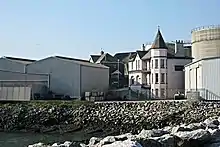

It is said that its name came from a rocky outcrop in this area that overlooked the Plym estuary and mouth of the river which looked like a cat, lending its name to the area and the area of water around it — the "Cattewater".
In 1886, two archaeologists discovered human bones while mining in a quarry.
They included the remains of many strange creatures – hyenas, bison, woolly rhinoceros and cave lions. Among the partial skeletons of 15 early humans was the famous ‘Cattedown Man’ – believed to be the city’s earliest known inhabitant and dating back up to 140,000 years. Archaeologists say he could potentially be the oldest ever human found in Britain. -[1]
Today the caves – listed as a national monument by Historic England – remain fenced off and kept well out of sight. Plans to turn the area into a tourist and visitor attraction have not yet publicly progressed, more than a decade after they were first mooted.
It was the autumn of 1886 when the limestone cave system was explored by workers quarrying in the Cattedown area. Intermixed with fossils of Ice Age woolly rhinoceroses, reindeer, hyenas and a woolly mammoth were human bones. The cave is still getting examined to this day and is locked from the public.
References