Cellular shades
Cellular shades or cellular blinds, sometimes referred to as honeycomb shades, are a type of window blind made of a long and continuous fabric with a cellular structure when opened and fold onto themselves when closed. The fabric is often made from soft paper or cloth-like material and is available in a variety of different structures including single cell, double cell or triple cell. Cellular blinds work by trapping air inside the cell structure once opened and create a barrier between the window surface and the room. Due to the unavailability of standardized tests, no ranking system currently exists to compare the efficacy of these blinds.
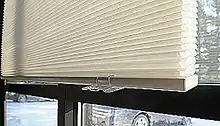
Windows and doors make up for almost one-third of a home’s total thermal loss, according to the Department of Energy (United Kingdom).[1] This applies to heat loss in winter as well as entry of undesired heat in summer. When air inside the room comes in contact with windows, it is cooled or warmed. By convection, this air then circulates around the room. Cell shapes in the blinds hold trapped air and create a barrier between the window surface and the room, thus lessening the transfer of heat. Shades, however, provide only slight control of air infiltration.[2]
In common with all blinds, cellular shades can reduce solar gain in summer and provide room darkening or blackout for sleeping. Like most other window treatments, they are raised and lowered with a string. Cordless cellular shades are available to reduce the risk of strangulation for small children.[3] Or you can also have the option of lowering the top of the shade down, and/or the bottom of the shade up; commonly referred to as a Top-Down-Bottom-Up mechanism.
References
- "Update or replace windows". energy.gov. Retrieved 9 December 2021.
- "Energy Efficient Window Coverings". Retrieved 9 December 2021.
- Safety Alert: Are Your Window Coverings Safe?, U.S. Consumer Product Safety Commission (retrieved 15 April 2015)