Central binomial coefficient
In mathematics the nth central binomial coefficient is the particular binomial coefficient

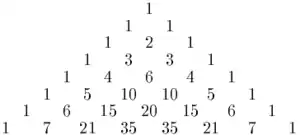
They are called central since they show up exactly in the middle of the even-numbered rows in Pascal's triangle. The first few central binomial coefficients starting at n = 0 are:
Properties
The central binomial coefficients represent the number of combinations of a set where there are an equal number of two types of objects.
For example, represents AABB, ABAB, ABBA, BAAB, BABA, BBAA.

The number of factors of 2 in is equal to the number of ones in the binary representation of n,[1] so 1 is the only odd central binomial coefficient.

Generating function
The central binomial coefficients satisfy the recurrence
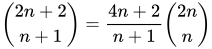
Since (and so ), we prove
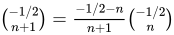

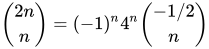
by induction.
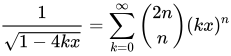
Together with the binomial series we obtain the generating function

and exponential generating function
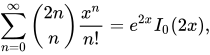
where I0 is a modified Bessel function of the first kind.[2]
The generating function of the squares of the central binomial coefficients gives the complete elliptic integral of the first kind:

Asymptotic growth
The Wallis product can be written using limits:

because .

Taking the square root of both sides gives the asymptote for the central binomial coefficient:
- .
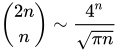
The latter can also be established by means of Stirling's formula. On the other hand, it can also be used as a means to determine the constant in front of the Stirling formula.

Approximations
Simple bounds that immediately follow from are
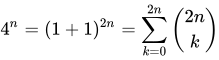

Some better bounds are

Related sequences
The closely related Catalan numbers Cn are given by:

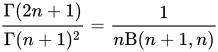
A slight generalization of central binomial coefficients is to take them as , with appropriate real numbers n, where is the gamma function and is the beta function.


The powers of two that divide the central binomial coefficients are given by Gould's sequence, whose nth element is the number of odd integers in row n of Pascal's triangle.
Squaring the generating function gives

Comparing the coefficients of gives

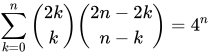
For example, . (sequence A000302 in the OEIS)

A combinatorial interpretation of this uses the fact that the number of paths on the binomial triangle that start at the origin, never cross the central line again, and terminate at level n, is given by for n=2k+1, and for n=2k.


As the row sum of level 2n is , each path from the origin to level 2n can be considered to be a path which crosses the central line with a path that doesn't appended to it after the last crossing of the central line.

Other information
Half the central binomial coefficient (for ) (sequence A001700 in the OEIS) is seen in Wolstenholme's theorem.
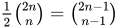

By the Erdős squarefree conjecture, proved in 1996, no central binomial coefficient with n > 4 is squarefree.
is the sum of the squares of the n-th row of Pascal's Triangle:[2]

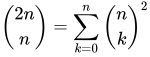
For example, .

Erdos uses central binomial coefficients extensively in his proof of Bertrand's postulate.
Substituting in the generating function gives

.
References
- Sloane, N. J. A. (ed.). "Sequence A000120". The On-Line Encyclopedia of Integer Sequences. OEIS Foundation.
- Sloane, N. J. A. (ed.). "Sequence A000984 (Central binomial coefficients)". The On-Line Encyclopedia of Integer Sequences. OEIS Foundation.
- Koshy, Thomas (2008), Catalan Numbers with Applications, Oxford University Press, ISBN 978-0-19533-454-8.