Pilosocereus leucocephalus
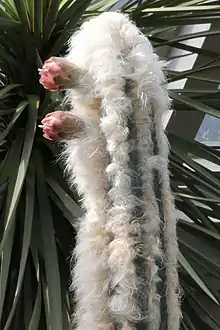
Pilosocereus leucocephalus, called old man cactus (along with a number of similar species), old man of Mexico, tuno, and woolly torch, is a species of cactus in the genus Pilosocereus, native to Mexico and Central America.[2] It has gained the Royal Horticultural Society's Award of Garden Merit.[3] Pilosocereus leucocephalus functions as a keystone species in dry landscapes found in Mesoamerica.[4] This cactus produces fruit, and frugivores such as birds, bats, and even some reptiles, rely on this fruit as a source of hydration and sugar in arid ecosystems.[5]
| Pilosocereus leucocephalus | |
|---|---|
 | |
Scientific classification  | |
| Kingdom: | Plantae |
| Clade: | Tracheophytes |
| Clade: | Angiosperms |
| Clade: | Eudicots |
| Order: | Caryophyllales |
| Family: | Cactaceae |
| Subfamily: | Cactoideae |
| Genus: | Pilosocereus |
| Species: | P. leucocephalus |
| Binomial name | |
| Pilosocereus leucocephalus | |
| Synonyms[2] | |
|
List
| |
References
- Pilosocereus (Cactac.) Gen. Revis. Ampl.: 119 (1994)
- "Pilosocereus leucocephalus (Poselg.) Byles & G.D.Rowley". Plants of the World Online. Board of Trustees of the Royal Botanic Gardens, Kew. 2017. Retrieved 4 November 2020.
- "Pilosocereus leucocephalus". The Royal Horticultural Society. Retrieved 4 November 2020.
- Vázquez‐Castillo, S., Miranda‐Jácome, A., & Ruelas Inzunza, E. (2019). Patterns of frugivory in the columnar cactus Pilosocereus leucocephalus. Ecology and Evolution, 9(3), 1268–1277. https://doi.org/10.1002/ece3.4833
- Vázquez‐Castillo, S., Miranda‐Jácome, A., & Ruelas Inzunza, E. (2019). Patterns of frugivory in the columnar cactus Pilosocereus leucocephalus. Ecology and Evolution, 9(3), 1268–1277. https://doi.org/10.1002/ece3.4833
This article is issued from Wikipedia. The text is licensed under Creative Commons - Attribution - Sharealike. Additional terms may apply for the media files.