Chalie Kevichüsa
Thechazelhu Chalie Kevichüsa (13 May 1943 – 23 September 1992) was a Naga journalist who was also involved in politics. He was the executive editor and publisher of Ura Mail from June 1976 until his assassination in September 1992.[1][2]
Chalie Kevichüsa | |
|---|---|
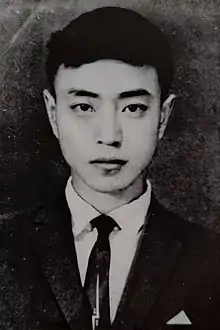 Kevichüsa as a young man | |
| Born | Thechazelhu Chalie Kevichüsa 13 May 1943 |
| Died | 23 September 1992 (aged 49) Dimapur, Nagaland |
| Education | St. Edmund's College, Shillong (BA) |
| Occupation | Executive editor and Publisher, Ura Mail |
| Spouse(s) | Seyievino Kevichüsa (m. 1971) |
| Parent(s) |
|
| Relatives | Tubu Kevichüsa (brother) |
Kevichüsa belonged to a prominent family with significant political influence in Nagaland throughout the last part of the 20th century. He was assassinated on 23 September 1992 in Dimapur, Nagaland on the orders of NSCN-IM General Secretary Thuingaleng Muivah. The assassination was strongly condemned on media and a large number of people turn out at his funeral.
Early life
Thechazelhu Chalie Kevichüsa was born on 13 May 1943 at Mission Compound, Kohima. His mother and father were Germanthangi and A. Kevichüsa. His mother is Mizo originating from present-day Mizoram. His father is Angami Naga originating from Khonoma.[1]
In 1967, he completed his graduation with a Bachelor of Arts degree from St. Edmund's College, Shillong.[1]
Career
He first began his Political career in 1968 when you join United Front of Nagaland (UFN) as a voluntary party worker. In March 1973, he was elected as Joint Secretary of the United Democratic Front (UDF) following change of its name from UFN to UDF.
When the Emergency of India was proclaimed in 1975, Chalie along with other party leaders were imprisoned in the Nowgaon Special Jail from November 1976 to March, 1977. He served as General Secretary of the United Democratic Front (UDF), Naga National Democratic Party (NNDP), Nagaland People's Council (NPC) from 1976 to 1987 and also of the Forum of North Eastern Regional Political Parties during the Presidency of B.B. Lyngdoh.
He later served as the Chairman of the Board of Directors of MARCOFED, Vice-Chairman of Nagaland State Co-operative Bank, Member of the Urban Bank and Advisor to Chakhro Angami Kuda Union.
He was the Editor and Publisher of Ura Mail from June 1976 till his death in September 1992. During this time he was also serving as a deacon at Town Baptist Church, Dimapur.
Assassination
Chalie Kevichüsa was assassinated on Wednesday, 23 September 1992. He was dropping his daughter for her tuition class, when armed men from the NSCN-IM opened fire on his vehicle after several days of tracking his movements at Fellowship Colony, Dimapur. Kevichüsa was killed and his daughter was wounded.[3][4]
Reactions
Large protest processions were held in Dimapur and Kohima against his killing, and a large number of people turned out at his funeral.[4]
NSCN-IM's response
In his interview with Deepak Dewan, the Political Editor of North-East Sun Magazine on 28 November 1998 when asked about Chalie Kevichüsa, Muivah said:
“You know his father Kevichüsa was the main architect of Naga Statehood. After that Mr. Chalie joined politics and started propagating the Shillong Accord very actively. There were some persons who had been given the authority of settling the Indo–Naga issue among themselves, sidelining most other forces. We have to make them realise their mistakes. In the process many will die. Chalie's killing, whether by us or by anyone else will not be a surprise. Thousands of Nagas are dying and many more will die. There is not much reason why Kevichüsa and Chalie be singled out or Lungshim should be singled out ”
— (Quote: North East Sun Magazine, from 28 November 1998 interview)
Personal life
Family
Kevichüsa married Seyievino on 20 January 1971. Together the couple had three daughters and two sons.
References
- "A tribute to Chalie Kevichusa". Nagaland Post. 22 September 2018. Retrieved 16 October 2021.
- Haralu, Lhusi and Chandola, Mene.: Chalie, A Life Remembered, 1943–1992, 2012.
- "Lament for a Tree – Chalie Kevichusa". Eastern Mirror. 22 September 2017. Retrieved 16 October 2021.
- Hazarika, Sanjoy.: Strangers Of The Mist: Tales of War and Peace from India's Northeast, 2000. Penguin UK.