Choking
Choking, or foreign body airway obstruction (FBAO), is the "fourth leading cause of unintentional injury death." It is typically common among older people.[1] Over 4,000 choking-related deaths occur in the United States every year.[2] It occurs when breathing is impeded by a constricted or obstructed throat or windpipe.[3] In some cases, the airflow is completely blocked, and in other cases, insufficient air passes through to the lungs, resulting in oxygen deprivation. Although oxygen stored in the blood and lungs can keep a person alive for several minutes after breathing stops,[4] choking often leads to death. Choking was the fourth most common cause of unintentional injury-related deaths in the US in 2011.[5]
| Choking | |
|---|---|
| Other names | Foreign body airway obstruction |
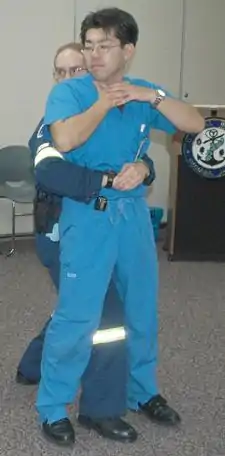 | |
| A demonstration of abdominal thrusts on a person showing signs of choking | |
| Specialty | Emergency medicine |
Deaths from choking most often occur in the very young (children under 2 years old) and in the elderly (adults over 75 years).[3] Obstruction of the airway can occur in the pharynx or the trachea. Foods that can adapt their shape to that of the pharynx (such as bananas, marshmallows, or gelatinous candies) commonly cause choking in people of all ages.[6]
Choking is one type of airway obstruction; others include blockage due to tumors, swelling of the airway tissues, and compression of the laryngopharynx, larynx, or vertebrate trachea in strangulation.
Providing immediate, appropriate first aid against choking can save a victim from death.
Cause
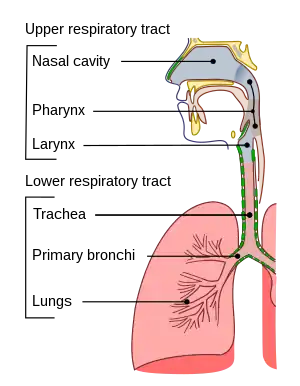
Choking is often caused by a foreign body blocking the airway;[7] it can block the upper or lower airway passages.[8] The airway obstruction is often partial, but can be complete.[8]
Among children, the most common causes of choking are food, coins, toys, and balloons.[7] In one study, peanuts were the most common object found in the airway of children evaluated for suspected foreign body aspiration.[9] Foods that pose a high risk of choking include hot dogs, hard candy, nuts, seeds, whole grapes, raw carrots, apples, popcorn, peanut butter, marshmallows, chewing gum, and sausages.[7] In a 1984 US study, 29% of choking deaths in children were associated with latex balloons, making them the leading cause of choking deaths among children's products.[7] Small, round non-food objects such as balls, marbles, toys, and toy parts are also associated with a high risk of choking death because of their potential to completely block a child's airway.[7]
Children younger than age three are especially at risk of choking because they explore their environment by putting objects in their mouths,[7] and they are still developing the ability to chew food completely.[7] Molar teeth, which come in around 1.5 years of age, are necessary for grinding food.[7] Even after molars are present, children continue to develop the ability to chew food completely and swallow throughout early childhood.[7] A child's airway is smaller in diameter than an adult's airway, which means that smaller objects can cause airway obstruction in children. Infants and young children generate a less-forceful cough than adults, so coughing may not be as effective in relieving airway obstruction.[7] Children with neuromuscular disorders, developmental delay, traumatic brain injury, and other conditions that affect swallowing are at an increased risk of choking.[7]
In adults, choking usually involves food blocking the airway.[10] Risk factors include the use of alcohol or sedatives, procedures involving the oral cavity or pharynx, oral appliances, or medical conditions that cause difficulty swallowing or impair the cough reflex;[10] conditions that can cause difficulty swallowing and/or impaired coughing include neurological conditions such as strokes, Alzheimer's disease, or Parkinson's disease.[11] In older adults, risk factors also include living alone, wearing dentures, and having difficulty swallowing.[10]
Children and adults with neurological, cognitive, or psychiatric disorders may experience a delay in diagnosis because there may not be a known history of a foreign body entering the airway.[10]
Prevention
Warning Labels
Warning labels are an effective preventive measure against choking accidents. Items that contain many parts may include pieces that are considered choking hazards. Warning labels are clearly placed and written in bold letters sometimes including an image. There are also labels that state recommended age ranges like on children's toys as well as labels warning parents to keep certain items out of the reach of children to prevent choking hazards[12]
Primary prevention
Choking often happens when large or abundant mouthfuls of food are poorly chewed and swallowed. This risk is minimized by adopting the discipline of cutting food into moderately sized pieces and chewing them completely before swallowing. Whenever a food can be chewed, it must be chewed – even if it is very soft or gelatinous (such as spreads and soft desserts).
It is helpful to have some liquid available to drink to make swallowing easier. To swallow well, it is recommended that the neck be in a normal position, with the head looking forward and aligned with the eater's body, and that the eater be seated or standing rather than reclining. Eating in handfuls (as with foods such as popcorn, nuts, etc.), requires chewing with more control than normal. Excessive amounts of food should not enter the mouth.
Dangerous foods
The foods that produce the worst cases of choking are those whose shapes adapt to the shape of the pharynx or trachea (such as hot dogs, sausages, bananas and food in blocks).
Other foods increase the risk of choking. That is the case of foods that are dry in the mouth (overcooked meat, sponge cake, cold pizza, etc.), which require the help of drinking liquid, or to be accompanied by purees or sauces. The risk is also higher in tough foods (for example: meat of octopus, cuttlefish, reptiles or big animals). So it is recommended cutting them into smaller chunks or thinner slices. It is also useful to eat themhrm together with something that helps the teeth to grind them (like breadand or cingked in a way that softens them.
In 2002, candy containing konjac gel was banned by the Food and Drug Administration due to several high-profile choking cases.
Groups at risk
Some population groups have a higher choking risk, such as the elderly, children, persons with disabilities (physically or mentally), people under the effects of alcohol or drugs, people who have taken medications that reduce the ability to salivate or react, patients with difficulties in swallowing (dysphagia), suicidal individuals, epileptics, and people on the autism spectrum. They may require more assistance to feed themselves, and it may be necessary to supervise them while they eat. People who are unable to chew properly should not be served hard food. In cases where a person is unable to safely eat, food can be given by feeding syringes. People who have taken any medication that reduces saliva should not eat solid food until their salivation is restored.
In babies and children
All young children require care in eating, and they must learn to chew their food completely to avoid choking. Feeding them while they are running, playing, laughing, etc. increases the risk of choking. Caregivers must supervise children while eating or playing.[13] Pediatricians and dentists can provide information on various age groups to parents and caregivers about what food and toys are appropriate to prevent choking.[7] The American Academy of Pediatricians recommends waiting until 6 months of age before introducing solid foods to infants.[14] Caregivers should avoid giving children younger than 5 years old foods that pose a high risk of choking, such as hot dog pieces, bananas, cheese sticks, cheese chunks, hard candy, nuts, grapes, marshmallows, or popcorn.[13] Later, when they are accustomed to these foods, it is recommended to serve them split into small pieces. Some foods as hot dogs, bananas, or grapes are usually split lengthwise, sliced, or both. Parents, teachers, and other caregivers for children are advised to be trained in choking first aid and cardiopulmonary resuscitation (CPR).[7]
Children readily put small objects into their mouths (deflated balloons, marbles, small pieces, buttons, coins, button batteries, etc.), which can lead to choking. A complicated obstruction for babies is choking on deflated balloons (including preservatives) or plastic bags. This also includes the nappy sacks, used for wrapping the dirty diapers, which are sometimes dangerously placed near the babies.[15] To prevent children from swallowing things, precautions should be taken in the environment to keep dangerous objects out of their reach. Small children must be supervised closely and taught to avoid putting things into their mouths. Toys and games may indicate on their packages the ages for which they are safe. In the US, children's toy and product manufacturers are required by law to apply appropriate warning labels to their packaging,[7] but toys that are resold may not have them.[7] Caregivers can try to prevent choking by considering the features of a toy (such as size, shape, consistency and small parts) before giving it to a child.[7] Children's products that are found to pose a choking risk can be taken off the market.[7]
Symptoms and signs
The symptoms of choking include:
- Difficulty or inability to speak or yell
- Inability to breathe or difficulty in breathing. Labored breathing, including gasping or wheezing, may be present.
- Violent and largely involuntary coughing, gurgling, or vomiting noises may be present.
- Clutching of the throat (universal sign of choking). Maybe attempting to vomit by putting fingers down the throat.
- The face turning blue (cyanosis) from lack of oxygen if breathing is not restored.
- Falling unconscious if breathing is not restored
Times in asphyxia
The time a choking victim is still alive without brain damage[16] can vary, but typically:
- Brain damage can occur when the victim remains without air for approximately three minutes (it is variable).
- Death can occur if breathing is not restored in six to ten minutes (varies depending on the victim). However, life can be extended by using cardiopulmonary resuscitation (CPR) on the unconscious victims of choking (see more details further below).
Treatment
Choking is treated with different procedures, which form the airway management. In a general view, this consists of the anti-choking techniques, available for those providing first aid in the stage of a basic airway management, and of complex methods available for health professionals working in an advanced airway management.

Basic treatment (First aid)
Basic treatment of choking includes several non-invasive techniques to help remove foreign bodies from the airways.
For a conscious choking victim, most protocols recommend encouraging the victim to cough, followed by hard back slaps and, if none of these techniques are effective, abdominal thrusts (the Heimlich maneuver) or chest thrusts (see details further below). Modern protocols, including those of the American Heart Association and the American Red Cross, recommend alternating series of back slaps and thrusts for a better effect.
It is mandatory that, if the choking is not being solved, somebody calls for emergency medical services, and continuing the administration of first aid until they arrive.
If the choking victim loses consciousness, a cardiopulmonary resuscitation (CPR) is recommended.[17]
First aid methods against choking include the following:
Cough
If the choking individual is conscious and can cough, the American Red Cross and the Mayo Clinic[18] recommend encouraging the individual to stay calm and continue coughing freely. It may be easier to take air through the nose to refill the lungs.
Back blows (back slaps)
_against_choking_for_adult_people.jpg.webp)
Many associations, including the American Red Cross and the Mayo Clinic,[18][19] recommend the use of back blows (back slaps) to aid a choking victim. This technique starts by bending the choking victim forward as much as possible, even trying to place their head lower than the chest, to avoid the blows driving the object deeper into the person's throat (a rare complication, but possible). The bending is in the back, while the neck should not be excessively bent. It is convenient that one hand supports the victim's chest. Then the back blows are performed by delivering forceful slaps with the heel of the hand on the victim's back, between the shoulder blades.
The back slaps push behind the blockage to expel the foreign object out. In some cases, the physical vibration of the action may cause enough movement to clear the airway.
Abdominal thrusts (Heimlich maneuver)
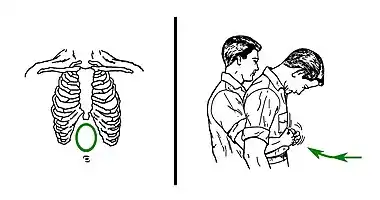
Abdominal thrusts[20] are performed with the rescuer standing behind the choking victim. The rescuer closes the own dominant hand, grasps it with the other hand, and presses forcefully inwards and upwards with both hands on the area located between the chest and the belly button of the victim. The pressure is not focused directly against the ribs to avoid breaking them. If the first thrust does not solve the choking, it can be repeated several times.
The use of abdominal thrusts is not recommended for infants under 1 year of age due to risk of causing injury, so there are adaptations for babies (see more details further below), but a child that is too big for the babies' adaptations would require normal abdominal thrusts (according to the size of the body). Besides, abdominal thrusts should not be used when the victim's abdomen presents problems to receive them, such as pregnancy or excessive size; in these cases, chest thrusts are advised (see more details further below).
In the case of choking alone, abdominal thrusts are one of the possibilities that can be tried on oneself (see more details further below).
The purpose of abdominal thrusts is to create enough pressure to expel the object lodged upwards in the airway, relieving the obstruction. This method was discovered by doctor Henry Heimlich in 1974. Heimlich claimed that his maneuver was better than back blows, arguing that back blows could cause the obstruction to become more deeply lodged in the victim's airway. That started a debate into the medical community,[21] that ended up with the recommendation of alternating both techniques, but making the patient to bend the back before receiving the slaps.[22][23][24]
Although it is a well known method for choking intervention, the Heimlich Maneuver is backed by limited evidence and unclear guidelines. Use of the maneuver has saved many lives but can produce dire consequences if not performed correctly. This includes rib fracture, perforation of the jejunum, diaphragmatic herniation, etc.[25]
Chest thrusts
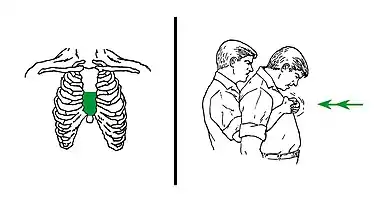
When abdominal thrusts cannot be performed on the victim (such as pregnant or obese victims), chest thrusts are advised instead.[26]
Chest thrusts are performed with the rescuer standing behind the choking victim. The rescuer closes the own dominant hand and grasps it with the other hand. This can produce several kinds of fists, but any of them can be valid if they can be placed on the victim's chest without sinking a knuckle too painfully. Keeping the fist with both hands, the rescuer uses it to press forcefully inwards on the lower half of the chest bone (sternum). The pressure is not focused on the very endpoint (named xiphoid process) to avoid breaking it. When the victim is a woman, the zone of the pressure of the chest thrusts would be normally upper than the level of the breasts. If the first thrust does not solve the choking, it can be repeated several times.
"Five and Five" strategy
The American Red Cross recommends a protocol of alternating five back blows and five abdominal thrusts for conscious choking victims until the object blocking the airway is dislodged.[19] For pregnant or obese victims, the protocol is the same, but chest thrusts are advised instead of the abdominal ones.
If the victim becomes unconscious, an anti-choking CPR method is recommended[27] (see more details further below). Emergency medical services should be called if such a situation happens, or before.
The Red Cross protocol differs from the Heimlich maneuver, since it includes administering back blows to the victim, contrary to Heimlich's procedure, which was based only on his technique.
Anti-choking devices
Since 2015, several anti-choking devices were developed and released to the market. The design of these devices is based on a vacuum mechanical effect, with no need for batteries or electric current. They usually include an attached mask to make a vacuum from the patient's nose and mouth. The current models of anti-choking devices are quite similar: a direct plunger tool (LifeVac),[28] and a vacuum syringe (backward syringe) that also keeps the tongue in place by inserting a tube in the mouth (Dechoker).[29] Both of them have received certifications, and its effectiveness is proven in real cases, some of them appeared in the media.[30][31] Other mechanical models are in development, such as Lifewand,[32] which creates a vacuum by direct pressure against the patient's face.
The use of approved devices can provide some advantages including: ease of usage, convenience in public places, being helpful for difficult cases (unconscious victims, disabled patients, elderly people, or when the victim is oneself), and achieving levels of pressure in suction that cannot be matched by manual methods. In the worst choking cases, no manual technique would dislodge the foreign object, being necessary the usage of one of these devices or a sort of surgery. Such physical complications are one of the reasons why physicians recommend some care in eating.
Nevertheless, according to a 2020 systematic review of the effectiveness of those three devices, "there are many weaknesses in the available data and few unbiased trials that test the effectiveness of anti-choking suction devices resulting in insufficient evidence to support or discourage their use. Practitioners should continue to adhere to guidelines authored by local resuscitation authorities which align with ILCOR recommendations."[33]
Unconscious victims
A choking victim that becomes unconscious must be gently caught before falling and placed lying on a surface. That surface should be appropriated for the victim's anatomy, and not too hard or too soft (it is possible to put a layer of something between the floor and the victim). Emergency medical services must be called, if this has not already been done.
While waiting for emergency services to arrive, e unconscious choking victim should receive a cardiopulmonary resuscitation (CPR) for choking victims, that is quite similar to the CPR for any other non-breathing patient. Infants less than one year old require a special adaptation of the procedure (described further below).
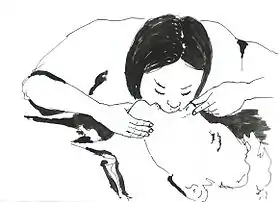
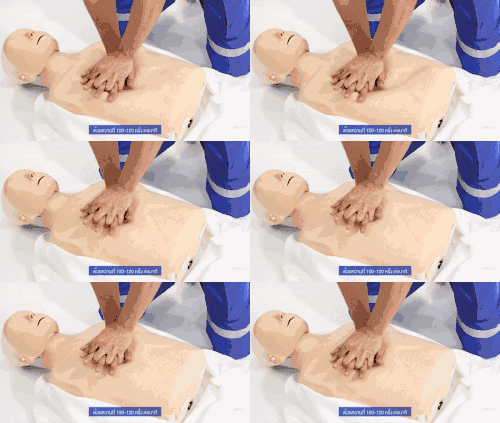
The anti-choking CPR is a cycle that alternates series of compressions with series of breaths. Each round of compressions applies 30 rhythmic compressions on the lower half of the chest bone (sternum). At the end of each round of compressions, the rescuer looks for the obstructing object and tries to remove it, usually by using a finger sweeping when the object is already visible (a difference between anti-choking CPR and normal CPR). If there is no success, two rescue breaths are applied, pinching the victim's nose and puffing air inside of the mouth. It is recommended, at the end of the series of breaths, to tilt the victim's head up or down and give two extra breaths to allow air to find an entrance through the blockage. The cycle of compressions and breaths repeats continuously. If the object is expelled and removed, CPR must continue until the victim recovers breathing.[34]
An anti-choking device can unblock the airway on unconscious victims, but does not necessarily remove the obstructing object from the mouth, which may need a manual removal. The victim will then require a normal cardiopulmonary resuscitation (CPR), in the manner that has been described above but only alternating the 30 compressions and the two rescue breaths.
When a person is conscious while choking, it is important to get their consent before tending to them. They may be unable to cough, speak, cry, or breathe so one should make quick use of nonverbal communication. If the person becomes unconscious, they should be gently lowered to the ground treated for unconscious choking.[35]
About finger sweeping
In unconscious choking victims, the American Medical Association advocates sweeping the fingers across the back of the throat to attempt to dislodge airway obstructions.[36] However, many modern protocols recommend against it. Red Cross procedures specifically direct rescuers not to perform a finger sweep unless an object can be clearly seen in the victim's mouth to prevent driving the obstruction deeper into the victim's airway. Other protocols suggest that if the patient is conscious they will be able to remove the foreign object themselves, or if they are unconscious, the rescuer should place them in the recovery position to allow the drainage of fluids out of the mouth instead of down the trachea due to gravity. There is also a risk of causing further damage (inducing vomiting, for instance) by using a finger sweep technique. There are no studies that have examined the usefulness of the finger sweep technique when there is no visible object in the airway. Recommendations for the use of the finger sweep have been based on anecdotal evidence.[17]
Babies (under 1 year old)
For babies (infants under 1 year old), the American Heart Association recommends some adapted procedures.[37] Children who are too big for the babies' procedures require the normal first aid techniques against choking, according to the size of their bodies.
First aid for babies alternates an special cycle of back blows (five back slaps) followed by chest thrusts (five adapted chest compressions).
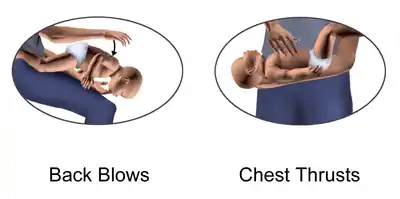
In the back blows maneuver, the rescuer slaps on the baby's back. It is recommended that the baby receive them being slightly leaned upside-down on an inclination. There exist several ways to achieve this:
In one of the most depicted, the rescuer sits down on a seat with the baby, and supports the baby with a forearm and its respective hand. The baby's head must be carefully held with that hand, usually by the jaw. Then the baby's body can be leaned forward upside-down along the rescuer's thighs and receive the slaps.
As an easier alternative, the rescuer can sit on a bed or sofa, or even the floor, carrying the baby. Next, the rescuer should support the baby's body on the own lap, to lean the baby upside-down at the right or the left of the lap. Then the slaps would be applied on the back of the baby.
If the rescuer cannot sit down, at least it is possible to attempt the maneuver at a low height and over a soft surface. Then the rescuer would support the baby with a forearm and the hand of that side, holding the baby's head with that hand, usually by the jaw. The baby's body would be leaned upside-down in that position to receive the slaps.
In the chest thrusts maneuver, the baby's body is placed lying on a surface. Then the rescuer does the compressions on the chest bone (sternum), pressing with only two fingers on its lower half (the nearest to the abdomen). Abdominal thrusts are not recommended in children less than one year old because they can cause liver damage.[38]
The back blows and chest thrusts are alternated in cycles of five back blows and five chest compressions until the object comes out of the infant's airway or until the infant becomes unconscious.[38]
If the infant becomes unconscious, emergency medical services must be called (if this has not been done yet). While they come, the American Heart Association[38] recommends starting a cardiopulmonary resuscitation (CPR) which must be adapted to babies. In that procedure, the baby is placed face-up on a horizontal surface (preferably not too hard or too soft). The baby's head must be in a straight position, looking frontally, because tilting too much a baby's head backward can close the access to the trachea. Then it is applied a cycle of alternating 30 chest compressions and 2 rescue breaths, like in a normal CPR, but with some differences:
The rescuer presses rhythmically about 30 times with only two fingers in the lower half of the chest bone (sternum). At the end of the round of compressions, the rescuer looks into the mouth to see if the obstructing object has come out. If it is visible, the rescuer attempt to extract it (mainly using a finger sweep). But, if there is no success, the baby is given two rescue breaths covering the baby's mouth and nose simultaneously. The cycle of chest compressions and rescue breaths repeats continuously. When the object is extracted, CPR continues until the baby's breath is successfully recovered or until emergency medical services arrive.
Pregnant or obese people
The American Heart Association recommends changing the abdominal thrusts for chest thrusts in the case of pregnant or obese persons who are choking.[17]
Chest thrusts are performed in a similar way to the abdominal thrusts, but with the fist placed on the lower half of the chest bone (sternum), rather than over the middle of the abdomen. Strong inward thrusts are then applied.[18] As a reference, in women, the zone of pressure of the chest thrusts would be normally higher than the breasts.
In wheelchair, disabled victim
If the choking victim is a disabled person in a wheelchair, the procedure is quite similar than in the case of the other victims. The difference is in trying to apply the techniques directly, while the victim is seated on the wheelchair.[39] It is recommended alternating series of back blows and thrusts, as in other cases.[40][41]
Back blows (back slaps) can be used after bending forward the back of the victim very much, as much as possible.
Abdominal and chest thrusts can also be used. To perform the abdominal thrusts, the rescuer must get behind the wheelchair and bend the back of the victim forward. Then the rescuer can embrace the victim's abdomen from behind and above, leaning over the top of the wheelchair's backrest. If this is too difficult, the rescuer can get down and embrace from behind the victim's abdomen and the wheelchair's backrest all together. In narrow spaces that can not be opened, the position can be achieved by turning the victim to one side. Next, the rescuer would grasp the own hand with the other, and use them to apply sudden inward and upward pressures between the chest and the belly button of the victim. It must be remembered that, if the victim cannot receive abdominal thrusts (in the case of pregnant or too obese people, or other problems), chest thrusts must be used instead. They are applied while the victim is in the wheelchair too, but making sudden inward pressures on the lower half of the breast bone (sternum). If the space is too narrow and impossible to widen, the abdominal or chest thrusts can be tried by turning the victim to one side.
When a victim of choking in wheelchair becomes unconscious, it is required an anti-chocking cardiopulmonary resuscitation (CPR), that it is exactly the same one than in the case of non-disabled victims. Anyway, it can be noted that the victim needs to be taken from the wheelchair to be placed lying face-up on an appropriated surface (not too hard or too soft, and it is possible to put a layer of something between the floor and the victim). Somebody must call to the emergency medical services, if this has not already been done. While they arrive, the rescuer has to apply the anti-choking CPR for unconscious victims (see details further above).
As a preventive measure, it is convenient to avoid placing the disabled in narrow and encased spaces at mealtimes. More open spaces allow easier access for rescuers.
In bed, disabled victim
Rarely, the choking victim lays in bed, but is conscious and unable to sit up (such as in disabilities or injuries).Then the first aid would be the same, but after sitting the victim on the bed's edge.
This can be achieved[42] grasping the victim by the legs (behind of the knees, or by the calves or ankles) and rotating them until they are out of the bed. Next, the rescuer would sit the victim up on the edge, pulling the shoulders or arms (in the forearms or wrists). Then it is possible to apply the anti-choking techniques[19] from behind: series of back slaps (after bending very much the back of the victim) and abdominal thrusts (sudden compressions on the victim's belly, between the chest and the belly button). When the victim cannot receive abdominal thrusts (as the pregnant or too obese people), they must be changed for chest thrusts (sudden inward pressures on the lower half of the breast bone).
If a rescuer cannot sit the victim up, it is possible to perform chest or abdominal thrusts frontally, while the victim is laying on the bed, by putting one hand on the top of the other and making with both of them strong pressures downwards on the lower half of the breast bone (sternum), or in a downward-and-frontward direction between the chest and the belly button. But, if the victim is already unconscious, it is needed an anti-choking CPR for unconscious victims (see details further above).
Eating while laying in bed increases the risk of choking.
On the floor, disabled victim
In very rare cases, the choking victim would be laying on the floor but conscious, having a disability that makes impossible to sit up and to keep standing up on the feet. Then the first aid is the same, but after sitting the victim on the floor.
So a rescuer would sit the victim up, pulling the shoulders or arms (in the forearms or wrists). Being the victim already sitting up, the rescuer can sit behind to apply the anti-choking maneuvers, back slaps (after bending very much the back of the victim) and abdominal thrusts (sudden compressions on area that is between the chest and the belly button). Some victims cannot receive abdominal thrusts (as the pregnant or too obese people), needing to change them for chest thrusts (sudden pressures on the lower half of the breast bone).
In some situations it is impossible for a rescuer to sit the victim up, and then the rescuer can try one of the thrusts techniques frontally on the laying victim, putting one hand on the top of the other and using them to make strong pressures downwards on the lower half of the breast bone (sternum), or downwards-and-frontwards on the abdomen (between the chest and the belly button). But, in case of the victim is unconscious, it is needed an anti-choking CPR for unconscious victims (see details further above).
Seizing victim
Seizing can occur for a multitude of reasons but is primarily common in those suffering from epilepsy. During a seizure, victims may experience strangulation or throat constriction during consciousness.[43] The victim will not have control of their bodily functions and will need someone to create a safe area for them. One should clear a space where the victim can lay down and remove or loosen anything that is around their neck. Then one should turn them on their side as to help them breathe and to avoid potential choking on the saliva.[44]
Self-treatment (First Aid)
Some first aid anti-choking techniques can be applied on oneself. One of the most realistic options when choking alone is having a approved anti-choking device nearby. But it is also possible to try the first aid techniques on oneself, by hand and without any device.
Abdominal thrusts can be self-applied with the hands by making a fist, grasping it with the other hand, and pressing forcefully, inwards and upwards, with both of them on the area located between the chest and the belly button. It can be repeated as many times as needed. This serves as a substitute for the thrusts of another person. One study showed that these self-administered abdominal thrusts were just as effective as those performed by another person, although obese individuals were not included in the study.[45]
Another manner of self-administration of this maneuver requires positioning of one's own abdomen over the border of an object: a chair, railing, or countertop, and driving the abdomen upon the border with sharp, upward thrusts. It is possible to try to fall on the edge to increase pressure.

Other variation of the self-administration of abdominal thrusts include pressing one's own belly inwards and upwards with an appropriated object.
When a problem makes impossible to receive pressures on the belly, it is possible to try to apply the chest thrusts on oneself, despite it would be more difficult. The chest thrusts would be self-applied making a fist, grasping it with the other hand, and pressing inwards forcefully on the lower half of the chest bone. They can be repeated as many times as needed
Making attempts to cough, when it is possible, can also clear the airway.
Alternatively, multiple sources of evidence suggest that one of promising approaches for self-treatment during choking could be applying the head-down (inverse) position.[46][47][17] To make that position, it is possible to put the hands on the floor and then place the knees on an upper seat (as on a bed, a sofa, or an armchair).
Advanced treatment
There are many advanced medical treatments to relieve choking or airway obstruction, including the removal of a foreign object with the help of a laryngoscope or bronchoscope. When the object cannot be removed, cricothyrotomy may be required, which involves making an incision in a patient's neck and inserting a tube into the trachea to bypass the upper airways.[48] The procedure is usually only performed when other methods have failed.
Epidemiology
Choking is the fourth leading cause of unintentional injury death in the United States.[5] Many episodes go unreported because they are brief and resolve without needing medical attention.[7] Of the reported events, 80% occur in children younger than 15 years, and 20% occur in children older than 15 years.[5] Choking on a foreign object resulted in 162,000 deaths (2.5 per 100,000) in 2013, compared with 140,000 deaths (2.9 per 100,000) in 1990.[49]
Notable cases
See also
References
- Pavitt, Matthew J.; et al. (2017). "Choking on a foreign body: a physiological study of the effectiveness of abdominal thrust maneuvers to increase thoracic pressure". Thorax. 72 (6): 576–78. doi:10.1136/thoraxjnl-2016-209540.
- Chillag, Shawn; Krieg, Jake; Bhargava, Ranjana (2010-02-01). "The Heimlich Maneuver: Breaking Down the Complications:". Southern Medical Journal. 103 (2): 147–150. doi:10.1097/SMJ.0b013e3181c99140. ISSN 0038-4348.
- National Safety Council. Research and Statistics Department. (2015). Injury facts (2015 ed.). Itasca, IL. ISBN 9780879123345. OCLC 910514461.
- Ross, Darrell Lee; Chan, Theodore C (2006). Sudden Deaths in Custody. ISBN 978-1-59745-015-7.
- "Injury Facts 2015 Edition" (PDF). National Safety Council. Archived from the original (PDF) on 26 September 2017. Retrieved 1 December 2017.
- Sayadi, Roya (May 2010). Swallow Safely: How Swallowing Problems Threaten the Elderly and Others (First ed.). Natick, MA: Inside/Outside Press. pp. 46–47. ISBN 9780981960128.
- Committee on Injury, Violence (2010-03-01). "Prevention of Choking Among Children". Pediatrics. 125 (3): 601–607. doi:10.1542/peds.2009-2862. ISSN 0031-4005. PMID 20176668.
- Dominic Lucia; Jared Glenn (2008). CURRENT Diagnosis & Treatment: Emergency Medicine. New York: McGraw-Hill. ISBN 978-0-07-184061-3.
- Yadav, S. P.; Singh, J.; Aggarwal, N.; Goel, A. (September 2007). "Airway foreign bodies in children: experience of 132 cases". Singapore Medical Journal. 48 (9): 850–853. ISSN 0037-5675. PMID 17728968.
- Warshawsky, Martin (31 December 2015). "Foreign Body Aspiration". Medscape. Retrieved 1 December 2017.
- Boyd, Michael; Chatterjee, Arjun; Chiles, Caroline; Chin, Robert (2009). "Tracheobronchial Foreign Body Aspiration in Adults". Southern Medical Journal. 102 (2): 171–174. doi:10.1097/smj.0b013e318193c9c8. PMID 19139679. S2CID 5401129.
- Langlois, Jean A. (1991-06-05). "The Impact of Specific Toy Warning Labels". JAMA: The Journal of the American Medical Association. 265 (21): 2848. doi:10.1001/jama.1991.03460210094036. ISSN 0098-7484.
- "Choking Prevention for Babies". Safe Kids Worldwide. Retrieved 2017-12-15.
- "Infant Food and Feeding". www.aap.org. Retrieved 2017-12-15.
- "Campaign Against Nappy Sacks". Royal Society for the Prevention of Accidents.
- "How Long Can the Brain Be without Oxygen before Brain Damage?". 2021-04-06. Archived from the original on 2021-04-06. Retrieved 2021-05-22.
- "Part 5: Adult Basic Life Support and Cardiopulmonary Resuscitation Quality – ECC Guidelines". eccguidelines.heart.org. Retrieved 4 December 2017.
- Mayo Clinic. "Choking: First aid". Mayo Foundation for Medical Education and Research (MFMER). Archived from the original on 7 January 2019. Retrieved 4 December 2017.
- "Conscious Choking" (PDF). American Red Cross. Archived (PDF) from the original on 2020-01-31.
- "First Aid Tips". Red Cross. Archived from the original on 2009-02-03.
- Mills Senn, Pamela (April 2007). Cincinnati Magazine. Emmis Communications. p. 92.
- American Red Cross. "New First Aid and CPR/AED Training Programs". Archived from the original on 2006-04-29. Retrieved 2021-11-07.
- "Choking: First aid". Mayo Clinic. Retrieved 2021-11-07.
- "Conscious Choking" (PDF). Archived (PDF) from the original on 2020-01-31. Retrieved 2021-11-07.
- Fearing, Nicole M.; Harrison, Paul B. (2002-11-02). "Complications of the Heimlich Maneuver: Case Report and Literature Review". The Journal of Trauma: Injury, Infection, and Critical Care. 53 (5): 978–979. doi:10.1097/00005373-200211000-00026. ISSN 0022-5282.
- "Choking and CPR safety talk". Oklahoma State University. Archived from the original on 2020-01-30.
- "STEP 3: Be Informed – Conscious Choking | Be Red Cross Ready". www.redcross.org. Retrieved 4 December 2017.
- "How to use LifeVac". Lifevac.life. 2016-08-02. Retrieved 2020-01-20.
- Dechoker. "How to Use Dechoker Anti-Choking Device (ACD)". Dechoker. Retrieved 2020-01-20.
- "Advocates say anti-choking device saved two lives in Idaho | Local | idahostatejournal.com". 2019-02-03. Archived from the original on 2019-02-03. Retrieved 2021-09-25.
- "Carers used suction device to save woman who choked on sausage". Kidderminster Shuttle. Retrieved 2021-09-25.
- "lifewand - keep kids safe". lifewand.com. Retrieved 2020-01-20.
- Dunne, Cody (2020). "A systematic review on the effectiveness of anti-choking suction devices and identification of research gaps". Resuscitation. 153: 219–226. doi:10.1016/j.resuscitation.2020.02.021. PMID 32114068. S2CID 211725361.
- "Instructor's Corner". americanredcross.force.com. Retrieved 2020-01-19.
- H R H (2021-10-26). "The American Medical Association??s Handbook of First Aid and Emergency Care". Journal of Occupational and Environmental Medicine. 23 (2): 74. doi:10.1097/00043764-198102000-00004. ISSN 1076-2752.
- American Medical Association (2009-05-05). American Medical Association Handbook of First Aid and Emergency Care. Random House. ISBN 978-1-4000-0712-7.
dislodge the object.
- Wilkins, Lippincott Williams (2010-11-02). "Editorial Board". Circulation. 122 (18_suppl_3): S639. doi:10.1161/CIR.0b013e3181fdf7aa.
- Wilkins, Lippincott Williams & (2010-11-02). "Editorial Board". Circulation. 122 (18 suppl 3): S639. doi:10.1161/CIR.0b013e3181fdf7aa. ISSN 0009-7322.
- "Choking Awareness, wheelchair user" (PDF). Belfast Health and Social Care Trust.
- "Conscious Choking" (PDF). American Red Cross. Archived (PDF) from the original on 2020-01-31.
- "Choking Awareness, wheelchair user" (PDF). Belfast Health and Social Care Trust.
- "Assisting a Patient to a Sitting Position and Ambulation". Medicine LibreTexts. 2018-12-22. Retrieved 2021-11-07.
- Nimeshan, Geevasinga (2000-12-08). "Choking, Asphyxiation, and the Insular Seizure". Journal of Clinical Neuroscience. 0 (0): 1–16. doi:10.1054/jocn.1999.0776. ISSN 0967-5868.
- "Seizure First Aid | Epilepsy | CDC". www.cdc.gov. 2020-09-30. Retrieved 2021-12-08.
- Pavitt MJ, Swanton LL, Hind M, et al. (12 April 2017). "Choking on a foreign body: a physiological study of the effectiveness of abdominal thrust manoeuvres to increase thoracic pressure". Thorax. 72 (6): 576–578. doi:10.1136/thoraxjnl-2016-209540. PMC 5520267. PMID 28404809.
- Luczak, Artur (2019). "Effect of body position on relieve of foreign body from the airway†". AIMS Public Health. 6 (2): 154–159. doi:10.3934/publichealth.2019.2.154. ISSN 2327-8994. PMC 6606524. PMID 31297401.
- Luczak, Artur (June 2016). "Head-down self-treatment of choking". Resuscitation. 103: e13. doi:10.1016/j.resuscitation.2016.02.015. ISSN 0300-9572. PMID 26923159.
- "What is a trachceostomy?". Retrieved 25 February 2014.
- GBD 2013 Mortality and Causes of Death, Collaborators (17 December 2014). "Global, regional, and national age-sex specific all-cause and cause-specific mortality for 240 causes of death, 1990–2013: a systematic analysis for the Global Burden of Disease Study 2013". Lancet. 385 (9963): 117–71. doi:10.1016/S0140-6736(14)61682-2. PMC 4340604. PMID 25530442.
External links
| Classification |
|---|
Authority control  |
|---|