Cimarron (1960 film)
Cimarron is a 1960 American Western film in CinemaScope and Metrocolor, based on the Edna Ferber novel Cimarron. The film stars Glenn Ford and Maria Schell and was directed by Anthony Mann and Charles Walters, though Walters is not credited onscreen.[2] Ferber's novel was previously adapted as a film in 1931; that version won three Academy Awards.
| Cimarron | |
|---|---|
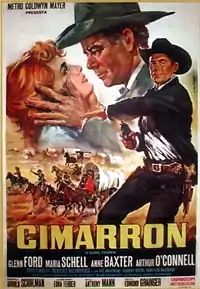 Theatrical release poster | |
| Directed by | Anthony Mann Uncredited: Charles Walters |
| Screenplay by | Arnold Schulman |
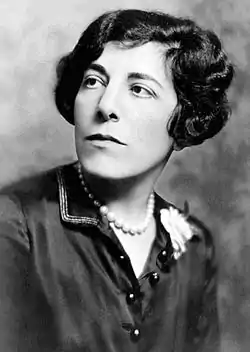
| Based on | Cimarron 1929 novel by Edna Ferber |
| Produced by | Edmund Grainger |
| Starring | Glenn Ford Maria Schell Anne Baxter Harry Morgan |
| Cinematography | Robert Surtees |
| Edited by | John D. Dunning |
| Music by | Franz Waxman |
| Distributed by | Metro-Goldwyn-Mayer |
Release date | December 1, 1960, Oklahoma City (premiere) |
Running time | 147 minutes |
| Country | United States |
| Language | English |
| Budget | $5,421,000[1] |
| Box office | $4,825,000[1] |
Cimarron was the first of three epics (along with El Cid and The Fall of the Roman Empire) that Mann directed. Despite high production costs and an experienced cast of western veterans, stage actors and future stars, the film was released with little fanfare.
Plot
Sabra Cravat joins her new husband, lawyer Yancey "Cimarron" Cravat, during the Oklahoma land rush of 1889. They encounter Yancey's old friend William "The Kid" Hardy and his buddies Wes Jennings and Hoss Barry. On the trail, Yancey helps Tom and Sarah Wyatt and their eight children, taking them aboard their wagons.
It seems to Sabra that her husband knows everyone in Oklahoma. A small crowd cheers Bob Yountis and his henchman Millis when they attack an Indian family. Yancey joins his friend Sam Pegler, editor of the Oklahoma Wigwam newspaper, in resisting Yountis.
Yountis warns Pegler using the paper for his crusading as he had done in Texas. Sabra is angry that Yancey risked his life for an Indian but she helps the others, including peddler Sol Levy and printer Jesse Rickey, in righting the Indians' overturned wagon. Sam and his wife Mavis reveal more about Yancey's past as a cowboy, gambler, gunman and lawyer.
When 50,000 settlers race across the prairie to claim land, Tom falls and Sarah claims a dry, worthless patch. Pegler is trampled to death, and Dixie beats Yancey to the land that he wanted, so he asks Jesse to stay to help him run the paper.
In the new town of Osage, which consists of tents and half-built storefronts, Yountis and The Kid terrorize Levy in the street. Yancey tries but fails to persuade the Kid to change. One night, Yountis leads a lynch mob. Yancey arrives too late to stop it, but he kills Yountis and brings Arita and her baby Ruby home. Meanwhile, Sabra has given birth to a boy whom they name Cimarron, Cim for short.
Four years later, Osage is thriving. Tom has built an oil-drilling apparatus but he is a laughingstock. Wes, Hoss and The Kid, wanted outlaws, try to rob a train but are all killed soon after. When Yancey destroys the $1,000 reward check, Sabra is furious because he does not consider their son's security. Yancey leaves to be part of the Cherokee Strip, but Sabra refuses to join him. Years later, he returns and Sabra and Cim forgive him.
Tom finally strikes oil, and Yancy is disgusted to learn that Tom bought the rights to oil found on Indian land. However, Yancey's campaign to win the Indians justice is a huge success, and he becomes governor of the Oklahoma Territory. Sabra discovers that Cim and Ruby have grown close, and she is desperate to separate them.
In Washington, D.C., Yancey finds Tom with a group of influential men and learns that the price of his appointment is his integrity. When Yancy tells Sabra that he can't be governor, she sends him away forever.
Cim and Ruby marry without warning and set off for Oregon, though Sabra tells him that he is throwing his life away.
Ten years later, on the occasion of the Oklahoma Wigwam's 25th anniversary, war is declared. Later, Sabra hears that Yancey has been killed in the war.
Cast
Main
- Glenn Ford as Yancey Cravat
- Maria Schell as Sabra Cravat
- Anne Baxter as Dixie Lee
- Arthur O'Connell as Tom Wyatt
- Russ Tamblyn as William Hardy (The Cherokee Kid)
- Mercedes McCambridge as Sarah Wyatt
- Vic Morrow as Wes Jennings
- Robert Keith as Sam Pegler
- Charles McGraw as Bob Yountis
- Aline MacMahon as Mavis Pegler
- Harry Morgan as Jesse Rickey (Credited as Henry {Harry} Morgan)
- David Opatoshu as Sol Levy
- Edgar Buchanan as Judge Neal Hefner
Supporting
- Lili Darvas as Felicia Venable
- Mary Wickes as Mrs. Neal Hefner
- Royal Dano as Ike Howes
- L. Q. Jones as Millis
- George Brenlin as Hoss Barry
- Vladimir Sokoloff as Jacob Krubeckoff
- Eugene Jackson as Isaiah
Cameo/Uncredited
- Andy Albin as Water Man
- Rayford Barnes as Cavalry Sergeant Who Breaks Up Fight
- Herman Belmonte as Dancer at Ball
- Mary Benoit as Mrs. Lancey
- Barry Bernard as Butler
- Jimmie Booth as Wagon Driver
- Danny Borzage as Townsman
- Chet Brandenburg as Townsman
- Janet Brandt as Madam Rhoda
- Paul Bryar as Mr. Self – Politician
- Robert Carson as Senator Rollins
- John L. Cason as Suggs
- William Challee as Barber
- Mickie Chouteau as Ruby Red Feather
- Fred Coby as Oil Worker
- Gene Coogan as Butler / Townsman
- Jack Daly as Wyatt's Man
- John Damler as Foreman
- Richard Davies as Mr. Hodges
- George DeNormand as Townsman at Celebration
- James Dime as Townsman
- Phyllis Douglas as Sadie
- Ted Eccles as Cimarron Cravat – Age 2
- LaRue Farlow as Dancer
- Franklyn Farnum as Townsman at Schoolhouse
- George Ford as Townsman at Celebration
- Coleman Francis as Mr. Geer
- Ben Gary as Reporter
- James Halferty as Cimarron Cravat – Age 10
- Sam Harris as Ball Guest
- Lars Hensen as Dancer at Ball
- Clegg Hoyt as Great Gotch
- Irene James as Townswoman
- Colin Kenny as Townsman at Schoolhouse
- Paul Kruger as Party Guest
- Jimmy Lewis as Hefner Boy
- Dawn Little Sky as Arita Red Feather
- Eddie Little Sky as Ben Red Feather
- Buzz Martin as Cimarron Cravat as a Young Man
- Kermit Maynard as Setter
- Mathew McCue as Townsman
- J. Edward McKinley as Beck
- Walter Merrill as Reporter
- Jack Perry as Townsman
- John Pickard as Ned – Cavalry Captain
- Ralph Reed as Bellboy
- William Remick as Reporter
- Gene Roth as Connors
- Jack Scroggy as Walter
- Charles Seel as Charles
- Bernard Sell as Townsman at Celebration
- Jack Stoney as Man at Lynching
- Harry Tenbrook as Sooner at Camp Fight
- Arthur Tovey as Dancer at Ball
- Ivan Triesault as Lewis Venable – Sabra's Father
- Charles Watts as Lou Brothers – Politician
- Helen Westcott as Miss Kuye – Schoolteacher
- Robert Williams as Oil Worker
- Jeane Wood as Clubwoman
- Wilson Wood as Reporter
- Jorie Wyler as Theresa Jump
Production
MGM bought the remake rights to Cimarron from RKO in 1941 for $100,000.[3] In 1947, MGM announced an operetta version starring Kathryn Grayson and produced by Arthur Freed,[4] but this did not happen.
MGM announced its plans to produce Cimarron in February 1958 as the studio's second film in MGM Camera 65 following Raintree Country.[5][6] Glenn Ford, with experience in the Westerns 3:10 to Yuma (1957) and The Sheepman (1958), soon became attached as star.[7]
Arnold Schulman was signed to write the screenplay.[8] King Vidor declined an invitation to direct,[9] and Anthony Mann was eventually named as director. Known primarily for the critically acclaimed hits The Glenn Miller Story (1954) and Men in War (1957), Mann had previously directed eight Westerns.[10] However, disagreements with producer Edmund Grainger caused Mann to leave the project halfway through filming. Director Charles Walters finished the film but received no screen credit.[11]
The climactic scene portraying the Oklahoma Land Rush was shot in Arizona[12] and featured over 1,000 extras, 700 horses and 500 wagons and buggies.[13]
Anne Baxter, who plays Dixie Lee, revealed in her autobiography Intermission that Ford and Maria Schell developed an offscreen romance: "During shooting, they'd scrambled together like eggs. I understood she'd even begun divorce proceedings in Germany. It was obviously premature of her." However, by the end of filming, "... he scarcely glanced or spoke in her direction, and she looked as if she were in shock."[14]
Reception
According to MGM records, Cimarron earned $2,325,000 in the U.S. and Canada and $2,500,000 overseas, resulting in an overall loss of $3,618,000.[1]
In 1961, the film was nominated for Best Art Direction (George W. Davis, Addison Hehr, Henry Grace, Hugh Hunt and Otto Siegel) and Best Sound (Franklin Milton),[15][16] but failed to win either.
The 1960 remake is considered a Revisionist Western for its sympathetic portrayal of indigenous Americans and their mistreatment[17][18] In the 1931 film, Yancey, a character based on Temple Lea Houston,[18] is an advocate for the Indians but he incurs the scorn of Sabra's family and the community because of it. However, he does not stop his work as a lawyer as he does in the 1960 film.[19]
The 1960 adaptation deviates from the Ferber book in many ways, including its focal point. TCM's James Tartara observes: "It makes sense that, rather than focusing on the more refined Sabra, who guided both Ferber's novel and the earlier filmic adaptation, [Director] Mann chose to focus more on Ford's gutsy adventurer. He also hoped to capture the drama of the changing Western landscape as it fills with settlers, a task that perfectly suited CinemaScope. ... The resulting picture is a striking example of the CinemaScope process while still being something of a creative mishmash. The critics were bored, audiences stayed away in droves, and MGM never earned a penny from it."[20]
Screenwriter Arnold Schulman introduced several characters, including those of journalist Sam Pegler (Robert Keith) and Wes Jennings (Vic Morrow),[18] while removing the Cravats' daughter, Donna and a boy named Isaiah.[20]
Glenn Ford's performance earned a nomination for a Laurel Award for Top Action Performance, though he did not win.[21]
See also
References
- The Eddie Mannix Ledger, Los Angeles: Margaret Herrick Library, Center for Motion Picture Study.
- "Cimarron (1960)". Turner Classic Movies. Retrieved December 15, 2019.
- "Metro Buys 'Cimarron' Rights From RKO for $100,000 – Purchases 'Rio Rita': BRITISH FILM HERE TODAY "It Happened to One Man' Opens at Carnegie – 'Tobacco Road' Sets First Day Record". New York Times. February 22, 1941. p. 11.
- THOMAS F. BRADY (November 24, 1947). "CIMARRON' REMAKE LISTED BY METRO: Arthur Freed to Produce New Film of Edna Ferber Novel, Starring Kathryn Grayson". New York Times. p. 30.
- "Metro Remakes 'Cimarron'". Variety. February 26, 1958. p. 20. Retrieved September 28, 2021 – via Archive.org.
- Pryor, Thomas M. (February 20, 1958). "U. S. VS. AL CAPONE TO BE FILM THEME: Story of Treasury Agents' War on Breweries Slated -Holden-Paramount Rift". The New York Times. p. 29.
- Scheuer, Philip K. (February 17, 1959). "Glenn Ford Value Seen as 'Built' Star: Ava Gardner His Likely Lead; Producer Cites Other Examples". Los Angeles Times. p. C7.
- "SCHULMAN FORMS PRODUCTION UNIT: Author of 'A Hole in the Head' Plans Second Play for Stage and Films". New York Times. October 8, 1959. p. 49.
- "Entertainment Films Stage Music: Viertel Film Will Not Star Deborah". Los Angeles Times. September 11, 1959. p. B6.
- "Anthony Mann". IMDb. Retrieved February 15, 2019.
- "Cimarron (1960)". Turner Classic Movies. Retrieved February 15, 2019.
- JOHN H. ROTHWELL (January 10, 1960). "SHOT ON THE OLD 'CIMARRON' TRAIL". New York Times. p. X7.
- Cimarron (1960), retrieved February 15, 2019
- "Cimarron (1960)". Turner Classic Movies. Retrieved February 15, 2019.
- "The 33rd Academy Awards (1961) Nominees and Winners". oscars.org. Retrieved August 22, 2011.
- "Cimarron". Movies & TV Dept. The New York Times. 2009. Archived from the original on August 13, 2009. Retrieved December 24, 2008.
- Peter Rollins. Hollywood's Indian: The Portrayal of the Native American in Film.
- Cimarron (novel) – Wikipedia
- "AFI|Catalog". catalog.afi.com. Retrieved December 15, 2019.
- "Cimarron (1960)". Turner Classic Movies. Retrieved February 15, 2019.
- "Glenn Ford". IMDb. Retrieved February 15, 2019.
External links
- Cimarron at IMDb
- Cimarron at AllMovie
- Cimarron at the TCM Movie Database
- Cimarron at the American Film Institute Catalog
| Plays |
|  | |||||||||||||
|---|---|---|---|---|---|---|---|---|---|---|---|---|---|---|---|
| Novels |
| ||||||||||||||
| Other works |
| ||||||||||||||
| Adaptations |
| ||||||||||||||
| Family | |||||||||||||||
Authority control  | |
|---|---|
| General | |
| National libraries | |