Cladonia squamosa
Cladonia squamosa or the dragon cup lichen[1] is a species of cup lichen in the family Cladoniaceae.[2]
| Cladonia squamosa | |
|---|---|
 | |
Scientific classification  | |
| Kingdom: | Fungi |
| Division: | Ascomycota |
| Class: | Lecanoromycetes |
| Order: | Lecanorales |
| Family: | Cladoniaceae |
| Genus: | Cladonia |
| Species: | C. squamosa |
| Binomial name | |
| Cladonia squamosa | |
| Synonyms | |
| |
Description
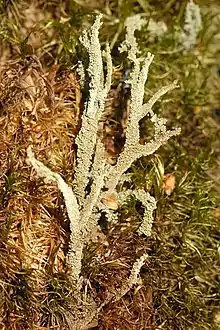
The primary thallus is composed of medium-sized, crenate squamules, approximately 1.5-7mm. long, and 1-5mm. wide. The upper surface is fawn or tan to cinnamon-colored varying toward greenish grey. The apothecia are small, ranging from .5-3 mm. in diameter, and are located on the margin of the cups or at the ends of branches or proliferations. They are fawn to cinnamon-colored. The paraphyses are usually simple, sometimes thickened, and are brownish towards the apex. The hymenium is pale or pale-brownish below and brownish above. The asci are lecanoralean, with a thickened tholus. There are a usually 8 ascospores, which are oblong or oblong-obtuse to fusiform in shape, between 5-17 µm. long and 2.5-3.5 µm. wide. Conidia are falcate and 3-8 µm. long. [3][4]
Range
This species is widespread in North America and occasional in the Pacific Northwest. [5]
Habitat
"Cladonia squamosa is widespread on soil, mosses and humus covered rocks in mature and open woods in most of eastern United States and Canada" [6]
Biochemistry
Secondary metabolites of Cladonia squamosa include barbatic acid, decarboxythamnolic acid, thamnolic acid, squamatic acid as well as various unknown or unidentified terpenes and/or terpenoids. [4][7]
References
- "Standardized Common Names for Wild Species in Canada". National General Status Working Group. 2020.
- "Dragon Horn (Cladonia squamosa)". iNaturalist. Retrieved 2021-03-27.
- Fink, Bruce (1907). Further Notes on Cladonias. IX. Cladonia squamosa and Cladonia subsquamosa. The Bryologist , Mar., 1907, Vol. 10, No. 2 (Mar., 1907), pp. 21-23. American Bryological and Lichenological Society.
- "LIAS light - Item Descriptions". Archived from the original on 2016-03-04.
- McClune, B.; Geiser, L. (1997). Macrolichens of the Pacific Northwest. Oregon State University Press. p. 386. ISBN 0-87071-394-9.
- Flenniken, D. G. The Macrolichens in West Virginia. Carlisle Printing.
- Culberson, Chicita F. (1970), Supplement to "Chemical and Botanical Guide to Lichen Products" The Bryologist , Summer, 1970, Vol. 73, No. 2 (Summer, 1970) p. 257, American Bryological and Lichenological Society
}