Claude Du Bosc
Claude Du Bosc (also spelled Dubosc and DuBosc; c. 1682–c. or after 1746)[1] was a French engraver and printseller who spent much of his career in London. Associated with the pioneering French Rococo artist Antoine Watteau,[2] Du Bosc notably contributed to English printmaking and publishing during the early 18th century, alongside with a younger contemporary Hubert-François Gravelot and other French engravers who worked in England.[3]
Claude Du Bosc | |
|---|---|
| Born | c. 1682 |
| Died | c. or after 1746 |
| Nationality | |
| Education | Bernard Picart |
| Known for |
|
Life
Nothing known of Du Bosc's early life and work; it has been usually thought that Du Bosc was born in France c. 1682,[1] and was likely a pupil of Bernard Picart.[4] The earliest secure mentions of Du Bosc date to c. 1712–1713, when he produced engravings for Gaspard Duchange's 1714 publication of Recueil de cent estampes représentant différentes nations du Levant;[5] at the same time, Du Bosc was also an assistant of Picart in engraving a set of The Labours of Hercules after Louis Chéron.[6] Later c. 1712,[7] he moved to England with Charles Dupuis[lower-alpha 1] to assist Nicholas Dorigny in engraving the Raphael Cartoons at Hampton Court, where he lived for some time.[10] Before the work was half complete, Du Bosc and Dupuis fell out with Dorigny; Dupuis returned to Paris, and Du Bosc set up as an engraver on his own account. He prepared a set of engravings done by himself from the cartoons, but Dorigny's engravings, being superior, held the day.[11]
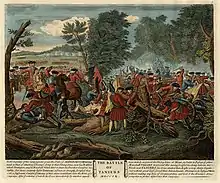
In February 1714, Du Bosc undertook with Louis Du Guernier to engrave a series of plates illustrative of the battles of the Duke of Marlborough and Prince Eugene.[12] He sent to Paris for two more engravers, Bernard Baron and Beauvais, to assist him on the work, which was completed in 1717.[13]
George Vertue states that towards the end of 1729 Baron and Du Bosc went over to Paris, Du Bosc wishing to arrange matters relating to the trade of print-selling, as he had now set up a shop, and that Vanloo then painted both their portraits, which they brought back to England.[14] From Vertue's notebooks, it is known that in c. 1726, Du Bosc also sat for another portrait, painted by John Smibert.[15]
In 1733, Dubosc published an English edition of Bernard Picart's Religious Ceremonies of All Nations, some of the plates being engraved by himself; he also invited a younger artist Hubert-François Gravelot for assistance.[16][17]: 324 His other prints included Apollo and Thetis and The Vengeance of Latona, after Jouvenet; some of the Labours of Hercules and The Sacrifice of Iphigenia, after Louis Cheron; The Head of Pompey brought to Cæsar, after Bernard Picart; The Continence of Scipio,[18][19] after Poussin; The Temple of Solomon, after Parmentière; a portrait of Bonaventura Giffard,[20] and numerous book illustrations, including numerous plates for Rapin's History of England (1743).[14] By 1743, Du Bosc was said by Vertue to be an associate of the Rose and Crown Club;[21] according to Timothy Clayton's 2004 entry published in the Oxford Dictionary of National Biography, Du Bosc was last mentioned in the May 1746 issue of the British Magazine, as a publisher for a plan of the Battle of Culloden.[22]: 126
Later in the 18th century, Joseph Strutt described him as "an engraver of no great merit", adding that "his style of engraving is coarse and heavy; and the drawing of the naked parts of the figure in his plates is exceedingly defective";[23] Strutt's point has been long reiterated.[24]
Gallery
_the_magician_is_rendered_bl_Wellcome_V0034985.jpg.webp)

 The Trial of the King, plate from The Reign of Charles I, after Peter Angelis, British Museum, London
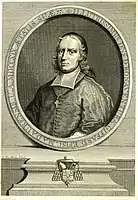 Bonaventure Giffard, British Museum, London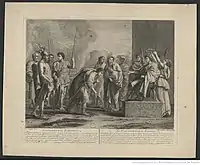
 La Tourilere comédien, after Antoine Watteau, British Museum, London
Notes
- According to some sources, François-Bernard Lépicié and Nicolas-Dauphin de Beauvais were also assistants of Dorigny in engraving the Raphael Cartoons, along with Du Bosc and Dupuis.[8][9]
References
- In a widely represented point, Cust 1888, p. 80, cited in Treydel 2001, p. 79, establishes c. 1682 and c. 1745 as respective datings of Du Bosc's birth and death. In a different point, Herold & Vuaflart 1929, p. 93, states that there are no actual datings for that. In recent sources such as Clayton 1746, p. 17 and Gatrell 2013, Du Bosc's death is dated c. or after 1746.
- Roux & Pognon 1951, p. 360: "Dubosc (Claude) […] C'est une des graveurs de Watteau."
- Antal 1962, pp. 151, 240; Paulson 1974, p. 56; Godfrey 1978, p. 32; Waterhouse 1978, p. 165.
- Portalis & Béraldi 1882, p. 26; Thieme 1914, p. 2; Herold & Vuaflart 1929, p. 93; Treydel 2001, p. 79.
- Clayton 2004, p. 17.
- Portalis & Béraldi 1882, p. 26; Thieme 1914, p. 2; Treydel 2001, p. 79.
- According to Uglow 1997, p. 52, cited in Grigson 2015, p. 78 n. 29, it was c. 1711 when Du Bosc set up a print shop in Covent Garden.
- Dussieux 1876, p. 315; Portalis & Béraldi 1882, p. 26; Herold & Vuaflart 1929, p. 93.
- McClellan, Andrew; Michel, Christian (1996). "(François)-Bernard Lépicié". In Turner, Jane (ed.). The Dictionary of Art. 19. New York: Grove's Dictionaries. p. 216. ISBN 1-884446-00-0. OCLC 1033643331 – via the Internet Archive.
- Vertue 1932, p. 11: "At Hampton Court(:) N. Dorigny.(,) Du Puis Sen.(,) C. Dubosch." See also Vertue 1934, p. 8; Wescher 1951, p. 182; Burke 1977, p. 177; Godfrey 1978, p. 32; Clayton 1997, pp. 19, 52; Clayton 2004, p. 17.
- Cust 1888, p. 80; Clayton 1997, p. 52.
- Guilmard-Geddes, Laurence (1996). "Du Guernier". In Turner, Jane (ed.). The Dictionary of Art. 9. New York: Grove's Dictionaries. p. 259. ISBN 1-884446-00-0. OCLC 1033638391 – via the Internet Archive.
- Cust 1888, p. 80; Clayton 1997, p. 56
- Cust 1888, p. 80.
- Foote 1950, pp. 24, 90, 204–205; Smibert 1969, p. 82; Saunders 1995, pp. 54–55, 223; cat. no. 259.
- Wescher 1951, p. 182; Godfrey 1978, p. 37.
- Rorshach, Kimerly (1996). "Gravelot, Hubert-François". In Turner, Jane (ed.). The Dictionary of Art. 13. New York: Grove's Dictionaries. pp. 324–325. ISBN 1-884446-00-0. OCLC 1033667059 – via the Internet Archive.
- Blunt, Anthony (1966). The Paintings of Nicolas Poussin. A Critical Catalogue. London: Phaidon. p. 129, cat. no. 181. OCLC 1153562776 – via the Internet Archive.
- Rosenberg, Pierre (1994). Nicolas Poussin, 1594–1665 (exhibition catalogue). Paris: Reunion des musees nationaux. pp. 290–291, under cat. no. 96. ISBN 2-7118-3027-6 – via the Internet Archive.
- O'Donoghue, Freeman Marius (1908). Catalogue of engraved British portraits preserved in the Department of Prints and Drawings in the British Museum. London: Trustees of the British Museum. p. 329. OCLC 1041770924 – via the Internet Archive.
- Vertue 1952, p. 35, cited in Bignamini 1988, pp. 53, 57 n. 25; Clayton 2004, p. 17.
- "List of Books, &c. published May 1746". The British Magazine. May 1746. pp. 124–126 – via the Internet Archive, cited in Clayton 2004, p. 17: "…A Plan of the Dispofitions of both Armies in that ever memorable Battle and Defeat of the Rebels at Culloden. Du Bosc, 6 d."CS1 maint: postscript (link)
- Strutt 1785, p. 128.
- Redgrave 1878, p. 131, cited in Treydel 2001, p. 79; Cust 1888, p. 80; Bryan 1903, p. 92.
- Clayton 2014, p. 141.
- Clayton 1997, p. 70.
Further reading
- Antal, Frederick (1962). Hogarth and His Place in European Art. New York: Basic Books. pp. 35, 62, 151, 240. OCLC 1035595582 – via the Internet Archive.
- Atherton, Herbert M. (1974). Political Prints in the Age of Hogarth: A Study of the Ideographic Representation of Politics. Oxford: Clarendon Press. pp. 17, 44, 46. ISBN 0-19-827188-3. OCLC 1034667797 – via the Internet Archive.
- Bignamini, Ilaria (1988). "George Vertue, Art Historian and Art Institutions in London, 1689–1768: A Study of Clubs and Academies". The Walpole Society. 54: 1–148. JSTOR 41829562.
- Bryan, Michael (1903). Bryan's Dictionary of Painters and Engravers. 2. New York: Macmillan. p. 92. OCLC 1041634111 – via the Internet Archive.
- Burke, Joseph (1976). English Art, 1714–1800. Oxford History of English Art. 9. Oxford: Clarendon Press. pp. 177–178. ISBN 0-19-817209-5. OCLC 1150946106 – via the Internet Archive.
- Clayton, Timothy (1997). The English Print, 1688–1802. London, New Haven: Yale University Press. ISBN 0-300-06650-3.
- Clayton, Timothy (2004). "Du Bosc, Claude". In Matthew, H. C. G. & Harrison, Brian (eds.). Oxford Dictionary of National Biography. 17. Oxford, New York: Oxford University Press. pp. 17–18. ISBN 0-19-861367-9. OCLC 1035755389 – via the Internet Archive.
- Clayton, Timothy (2014). "The London Printsellers and the Export of English Graphic Prints". In Kremers, Anorthe; Reich, Elisabeth (eds.). Loyal Subversion? Caricatures from the Personal Union Between England and Hanover (1714–1837). Göttingen, Bristol: Vandenhoeck & Ruprecht. pp. 140–161. ISBN 978-3-525-30167-8. OCLC 882905477 – via Google Books.
- Cust, Lionel Henry (1888). . In Stephen, Leslie (ed.). Dictionary of National Biography. 16. London: Smith, Elder & Co. p. 80.
- Dacier, Émile; Vuaflart, Albert (1922). Jean de Julienne et les graveurs de Watteau au XVIII-e siècle. III. Catalogue (in French). Paris: M. Rousseau. pp. 20, 34–35, 62, 72–73, 98, 103, 133, 136, 141, 144. OCLC 1039156495.
- Dussieux, Louis (1876). Les artistes français à l'étranger (in French) (3rd ed.). Paris, Lyon: Lecoffre. pp. 315–316. OCLC 986071909 – via the Internet Archive.
- Foote, Henry Wilder (1950). John Smibert, Painter With a Descriptive Catalogue of Portraits, and Notes on the Work of Nathaniel Smibert. Cambridge: Harvard University Press. pp. 24 n. 13, 90, 204–205, 230. OCLC 900850057 – via the Internet Archive.
- Fuhring, Peter (September 1985). "The Print Privilege in Eighteenth-Century France–I". Print Quarterly. 2 (3): 175–193. JSTOR 41823682.
- Gatrell, Vic. The First Bohemians: Life and Art in London's Golden Age. London: Allen Lane. ISBN 0718195833. OCLC 892832012.
- Godfrey, Richard T. (1978). Printmaking in Britain: A General History from Its Beginnings to the Present Day. New York: New York University Press. p. 32, 37. ISBN 0-8147-2973-8. OCLC 1151065422 – via the Internet Archive.
- Goulden, R. J. (April 1982). "William Darres, Claude du Bosc and the European Market". Factotum. London: British Library (14): 17–20. ISSN 0141-3635.
- Grigson, Caroline (2015). "'An Universal language': William Hunter and the Production of The Anatomy of the Human Gravid Uterus". In Hancock, E. Geoffrey; Pearce, Nick & Campbell, Mungo (eds.). William Hunter's World: The Art and Science of Eighteenth-Century Collecting. Farnham: Ashgate. pp. 59–80. ISBN 978-1-4094-4774-0.
- Harris, Michael (1997). "Scratching the surface: engravers, printsellers and the London book trade in the mid-18th century". In Hunt, Arnold; Mandelbrote, Giles & Shell, Allison (eds.). The Book Trade & Its Customers, 1450-1900: Historical Essays for Robin Myers. Winchester, New Castle Del.: Oak Knoll Press. pp. 95–114. ISBN 1-884718-34-5.
- Herold, Jacques; Vuaflart, Albert (1929). Jean de Julienne et les graveurs de Watteau au XVIII-e siècle. I. Notices et documents biographiques (in French). Paris: M. Rousseau. pp. 90, 93–94, 114, 117 132, 267. OCLC 1039157338.
- Le Blanc, Charles (1854–1890). Manuel de l'amateur d'estampes (in French). 2. Paris: E. Bouillon. p. 148. OCLC 1048783339 – via the Internet Archive.
- Lippincott, Louise (1983). Selling Art in Georgian London: The Rise of Arthur Pond. Studies in British Art. London, New Haven: Yale University Press. pp. 14, 169 n. 21. ISBN 0-300-03070-3.
- Lippincott, Louise (1988). "Arthur Pond's Journal of Receipts and Expenses, 1734-1750". The Walpole Society. 54: 220–333. JSTOR 41829564.
- Paulson, Ronald (1974) [1971]. Wilde, Anne (ed.). Hogarth: His Life, Art, and Times (abridged ed.). New Haven, London: Yale University Press. pp. 21–23, 56, 156. ISBN 0-300-01766-9. OCLC 1193948705 – via the Internet Archive.
- Portalis, Roger; Béraldi, Henri (1882). "Dubosc (Claude)". Les graveurs du dix-huitième siècle [Engravers of the Eighteenth Century] (in French). 2 (pt. 1). Paris: D. Morgand et C. Fatout. p. 26 – via the Internet Archive.
- Redgrave, Samuel (1878). A Dictionary of Artists of the English School (2nd ed.). London: George Bell. p. 131. OCLC 1043009709 – via the Internet Archive.
- Roland Michel, Marianne (1986). "Watteau and England". In Hind, Charles (ed.). The Rococo in England. London: Victoria and Albert Museum. pp. 46–59. ISBN 0-948107-37-5. OCLC 18588917.
- Roux, Marcel; Pognon, Edmond (1951). Inventaire du fonds français, graveurs du XVIIIe siècle (in French). 7. Paris: Bibliothèque nationale de France. pp. 360–374 – via Gallica.
- Saunders, Richard H. (1995). John Smibert: Colonial America's First Portrait Painter. New Haven, London: Yale University Press. pp. 54–55, 102, 223. ISBN 0-300-04258-2. OCLC 31607421.
- Smibert, John (1969). The Notebook of John Smibert. Boston: Massachusetts Historical Society. OCLC 6380 – via the Internet Archive.
- Strong, Roy C. (2000). The Artist and the Garden. New Haven, London: Yale University Press. p. 210. ISBN 0-300-08520-6. OCLC 1244217591 – via the Internet Archive.
- Strutt, Joseph (1785). "Claude Du Bosc". A Biographical Dictionary Containing All the Engravers, From the Earliest Period of the Art of Engraving to the Present Day. 1. London: Robert Faulder. pp. 127–128. OCLC 1045376483 – via the Internet Archive.
- Thieme, Ulrich, ed. (1914). "Dubosc (Du Bosc), Claude". Allgemeines Lexikon der bildenden Künstler (in German). 10. Leipzig: E. A. Seemann. p. 2. OCLC 1039510711 – via the Internet Archive.
- Treydel, Renate (2001). "Dubosc (Du Bosc), Claude". In Kasten, Eberhard; et al. (eds.). Allgemeines Künstlerlexikon (in German). 30. München, Leipzig: Saur. p. 79. ISBN 3-598-22770-1.
- Uglow, Jennifer S. (1997). Hogarth: A Life and a World. London: Faber and Faber. p. 52. ISBN 0-571-16996-1. OCLC 1256244974 – via the Internet Archive.
- Vertue, George (1765). Walpole, Horace (ed.). A Catalogue of Engravers. Strawberry Hill: Thomas Kirgate. p. 122. OCLC 1039533429 – via the Internet Archive.
- Vertue, George (1932). "The Note-Books of George Vertue Relating to Artists and Collections in England (II)". The Walpole Society. 20. whole issue. JSTOR i40086519.
- Vertue, George (1934). "The Note-Books of George Vertue Relating to Artists and Collections in England (III)". The Walpole Society. 22. whole issue. JSTOR i40086509.
- Vertue, George (1952). "The Note-Books of George Vertue Relating to Artists and Collections in England (VI)". The Walpole Society. 30. whole issue. JSTOR i40086545.
- Walpole, Horace (1879). Anecdotes Of Painting In England. London: Ward, Lock, and Co. p. 457. OCLC 1039484687 – via the Internet Archive.
- Waterhouse, Ellis K. (1978) [1953]. Painting in Britain, 1530 to 1790. The Pelican History of Art (4th ed.). Harmondsworth, England; New York: Penguin Books. p. 165. ISBN 0-14-056101-3. OCLC 1245624144 – via the Internet Archive.
- Wescher, Paul (Autumn 1951). "Philippe Mercier and the French Artists in London". Art Quarterly. 14: 179–194 – via the Internet Archive.
Authority control  | |
|---|---|
| General | |
| National libraries | |
| Art research institutes | |
| Other | |