Clavogaster virescens
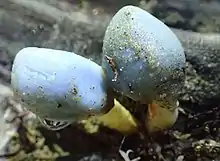
Clavogaster virescens is a species of secotioid or pouch-like fungus in the family Agaricaceae.[2] It is endemic and indigenous to New Zealand,[3] where it grows on rotting wood in native bush and mixed native and introduced forests. It has a stout yellowish stem, and a powder blue, purpleish or greenish blue cap that forms a pouch, often referred to as a peridium, enclosing reddish brown or orange chambered gleba.[4][5] The species is sometimes knows as the "Spindle Pouch".[6]
| Clavogaster virescens | |
|---|---|
 | |
Scientific classification  | |
| Kingdom: | Fungi |
| Division: | Basidiomycota |
| Class: | Agaricomycetes |
| Order: | Agaricales |
| Family: | Agaricaceae |
| Genus: | Clavogaster |
| Species: | C. virescens |
| Binomial name | |
| Clavogaster virescens (Massee) J.A. Cooper (2015) | |
| Synonyms[1] | |
Taxonomy
Clavogaster virescens was described in 1890 as Secotium virescens, placed in the genus Secotium alongside other unrelated secotioid fungi due to its pouch-like form.[5]
In 1958 it was transferred to the newly created genus Weraroa and became known as Weraroa virescens, sharing the genus with the bright red Weraroa erythrocephala and the bluing Weraroa novae-zelandiae, which was the type species of the genus.[7] Advances in phylogenetics and DNA barcoding lead to many taxonomic changes between 1958 and 2015. Weraroa novae-zelandiae became Psilocybe weraroa, a blueing member of the genus Psilocybe.[8] Weraroa erythrocephala belonged in Leratiomyces and is now known as Leratiomyces erythrocephalus, a bright red pouch-like fungus also endemic to New Zealand.[9]
Weraroa virescens had no relationship to the type species of Weraroa and no known relatives, but it had a potential synonym, Clavogaster novozelandicus, the type species of the genus Clavogaster created in 1896.[10] In 2015 Weraroa virescens and Clavogaster novozelandicus were combined and the name Clavogaster virescens was published, in a genus that had in a way been created for it over 100 years earlier.[2]
In the botanical name, virescens refers to the greenish colour of the pouch.
Additional synonyms of Clavogaster virescens are Secotium superbum,[5] described in 1924 as a large and magnificent blue-green secotioid species with a bright yellow stem, and Cauloglossum novozelandicum described in 1905.[1]
Description
Clavogaster virescens | |
|---|---|
 | glebal hymenium |

 | cap is conical or ovate |
 | hymenium attachment is not applicable |
 | spore print is reddish-brown |
 | ecology is saprotrophic |
 | edibility: inedible |
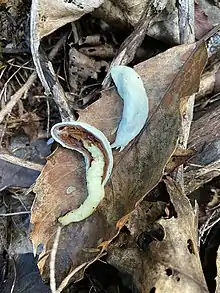
The cap or pileus forms an elongated pouch approximately 20x60 mm, it is powder blue, purplish blue or greenish, smooth and glabrous or pitted and furrowed, sometimes long and quite narrow, and usually tapered to the apex. The base can be attached to the stem then become free as it lifts slightly away, or remain attached and smoothly transition into the stem. The feeling of the pouch is somewhat rubbery and cartilaginous; The stem is whitish to yellowish, often a more vibrant yellow towards the base, solid, smooth and stout, widening towards the pouch, often short, sometimes a little shiny or reflective, with a smooth or slightly slippery feel; Inside the pouch the gleba are enclosed inside a purple-brown sack-like layer within the pouch wall, in a regular, chambered cell-like structure, laterally compressed, reddish brown or lighter red, sometimes rust-coloured or orange. The fruitbodies grow in forests on rotting wood, sometimes solitary or in small scattered groups and other times in larger groups, on or near the forest floor.[5][4]
Original descriptions
The following original texts are reproduced and available to read in full on the website of Manaaki Whenua - Landcare Research, New Zealand's online fungarium.
Secotium virescens Massee (1890) described in "Fungi of New Zealand" in 1890: Description, Typification and Notes
Secotium virescens Massee (1890) published again in 1924 with Description, Habitat, Collections Examined and Notes;
Secotium superbum sp. nov G. Cunn. (1924) (synonym) described as new to science in 1924, full description including the Latin, Typification, Collections Examined, Description, Habitat and Notes.
Similar species
_Beever_%2526_D.C._Park_918226.jpg.webp)
Leratiomyces erythrocephalus has a very similar appearance but is bright red, and the pouch tends to be round rather than elongated.
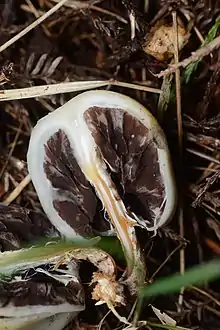
Psilocybe weraroa is a close lookalike, and Clavogaster virescens is often mistaken for that species by foragers. It can be a similar shade of blue and shares the same habitat. Psilocybe weraroa is psychoactive and demonstrates an additional blueing reaction with damage. It has an equal, moderately thin white stem that is fibrous and often hollow, and the gills or gleba are contorted, twisted chambers, sepia or chocolate-brown to purple-brown. In contrast Clavogaster virescens has reddish-brown to orange gleba arranged in a regular chambered cell-like structure, a solid yellow stem that widens towards the pouch, and no blueing reaction or psychoactive properties.[5][4]
'Clavogaster "Whakapapa" is an undescribed and related secotioid species. Unlike Clavogaster virescens it may also have an agaricoid form.[11]
Similar pouch-like morphology exists in other genera, especially in New Zealand, with many in the genus Cortinarius. Some are C. beeverorum, C. cartilagineus, C. epiphaeus, C. minorisporus, C. porphyroideus, C. purpureocapitatus, and C. violaceovolvatus.
Distribution and habitat
New Zealand, more common in the North Island, especially the Wellington and Auckland regions. Scattered to gregarious in forests, from rotting wood, near or on the ground.[5]
See also
- Gasteroid fungi
- Secotioid fungi
- The genus Clavogaster
- The genus Secotium
- The genus Weraroa
References
- "Synonyms of Clavogaster virescens (Massee) J.A. Cooper (2015)". New Zealand Fungi Database - Landcare Research. Retrieved 8 October 2021.
- Clavogaster virescens in Index Fungorum
- Clavogaster virescens (Massee) J.A. Cooper (2016) Retrieved 08 October 2021. New Zealand Organisms Register (NZOR).
- Cooke, M.C. (1890). "Fungi of New Zealand". Grevillea. 19 (90): 47–49.
- Cunningham, G.H. (1924). "A critical revision of the Australian and New Zealand species of the genus Secotium". Proceedings of the Linnean Society of New South Wales. 49 (2): 97–119.
- "Clavogaster virescens (Massee) J.A. Cooper (2015)". Manaaki Whenua - Landcare Research: New Zealand Fungi. Retrieved 22 October 2021.
- Singer, R.; Smith, A.H. (1958). "Studies on secotiaceous fungi. III. The genus Weraroa". Bulletin of the Torrey Botanical Club. 85: 324–334.
- Psilocybe weraroa Borovička, Oborník & Noordel. in New Zealand Organisms Register (NZOR)
- Leratiomyces erythrocephalus (Tul. & C. Tul.) Beever & D.-C. Park in New Zealand Organisms Register (NZOR)
- Hennings, P. (1896). "Clavogaster, eine neue Gasteromycetengattung, sowie mehrere neue Agaricineen aus Neu-Seeland". Hedwigia (in German). 35 (5–6): 303–5.
- "Specimen Details". Landcare Research Systematics Collections Data. 2019. Retrieved 2 October 2021.
External links
- Observations of Clavogaster virescens on iNaturalist.
- Observations and information about Clavogaster virescens on Mushroom Observer
- Records, history, photos and information at New Zealand's online fungarium with Manaaki Whenua - Landcare Research
- Further notes and descriptions at Manaaki Whenua - Landcare Research
- Species in the 1924 literature revising the genus Secotium.