Club de l'Entresol
The Club de l'Entresol (French pronunciation: [klœb də lɑ̃tʁəsɔl], "Mezzanine Club") was a discussion group and early think tank in Paris, active from 1723[1] to 1731, created and primarily led by Abbot Pierre-Joseph Alary.[2]
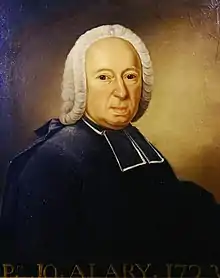
Name and background
The club's name came from the fact that at its inception, Alary lived in the mezzanine (French: entresol) of the hôtel particulier of Charles-Jean-François Hénault at 7 place Vendôme, also known as Hôtel Le Bas de Montargis for its original builder in 1708.[3] The club kept its name even as Alary moved to other apartments where the meetings were subsequently held, including when he lived at the Royal Library. The adoption of the word club was suggested by Henry St John, 1st Viscount Bolingbroke, who was in Paris and close to Alary in the early 1720s.[4] It ostensibly echoed the English model of clubs for free discussion of political and economic questions, at a time of widespread Anglophilia in Paris under the Régence.
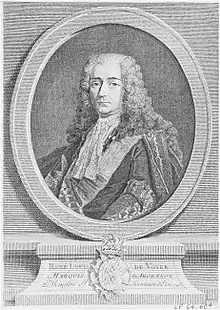
In spite of its English-sounding name, the inspiration for the club was homegrown. Its roots went back to the académie du Luxembourg, a short-lived discussion group led in 1691-1692 by François-Timoléon de Choisy whose members included such luminaries as François Lefebvre de Caumartin, Louis de Courcillon, Louis Cousin, Bernard Le Bovier de Fontenelle, Barthélemy d'Herbelot, Charles Perrault, and Eusèbe Renaudot. The Académie du Luxembourg was well known to Alary from the memories of the brothers Philippe and Louis de Courcillon and of two of Choisy's relatives, the marquis de Balleroy and the marquis d'Argenson.[1] A more recent experience had been the académie politique established at the Louvre by Jean-Baptiste Colbert, Marquess of Torcy, which operated from 1712 to 1715 and again from 1717 to 1720 and from which the club's members drew lessons about how best to organize their activities.[5]: 101
The main source of information about the club's activity is the memoirs written by d'Argenson, who was a leading member of the club together with Alary and the Abbé de Saint-Pierre.[1][5]
Activity
The club met every Saturday, between 5pm and 8pm, at Alary's apartment.[5]: 96 It was frequented by about twenty scholars who can be viewed as forerunners of the Age of Enlightenment. Its membership was exclusively male and French, though attendees also included women and foreigners, e.g. Madame du Deffand and the future Madame de Pompadour as well as Bolingbroke.[6] The club's activities included readings on current affairs, with emphasis on foreign sources such as Dutch periodicals in French language.[1]
It was more than a mere literary salon given its structured program, and differed from most learned societies by its emphasis on current affairs and public policy, primarily foreign affairs and economics. Members specialized in specific policy areas and prepared their contributions in advance, whose manuscripts were kept by Alary.[5] These features made the club de l'entresol a precursor of more recent think tanks.
France's chief minister Cardinal Fleury acknowledged the club's value, but eventually decided on its closure in 1731 after it became an object of controversy at the royal court in Versailles.[5]: 102-109
Members
In his memoirs, d'Argenson lists the members of the club, aside from Alary and himself, in the following order:[5]: 88-91
- Jacques-Claude-Augustin de la Cour, marquis de Balleroy
- François de Franquetot de Coigny
- Thomas Goyon de Matignon
- Gérard Lévesque de Champeaux
- Thibaut de La Brousse de Verteillac
- Louis-Joseph de Goujon de Thuisy, comte d'Autry
- Louis de Bréhan de Plélo
- Bertrand René Pallu du Ruau
- François de Riquet, comte de Caraman
- Andrew Michael Ramsay
- Dominique-Claude Barberie de Saint-Contest
- François Dominique de Barberie de Saint-Contest, son of the former
- Christophe-Bernard de Bragelongne
- Armand de Madaillan de Lesparre, marquis de Lassay
- Antoine François de La Trémoille, duc de Noirmoutier
- Louis Davy de la Fautrière
- Pierre Blouet de Camilly
- Antoine-Robert Pérelle[7]
- Henri Charles Arnauld de Pomponne
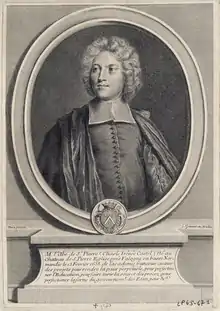
- Charles-Irénée Castel de Saint-Pierre
- Pierre François Delatre d'Oby
D'Argenson also mentions that Abbot Franchini, ambassador of Tuscany, and Nicolas Prosper Bauyn d'Angervilliers sought to become members but were not included, the former for being a foreigner, and the latter because of his appointment to public office; and that Horatio Walpole made a presentation to the club in 1726, at his own request. Montesquieu participated in the club's activities and gave there a reading of his dialogue between Sulla and Eucrates.[1] Jean-Baptiste Colbert, Marquess of Torcy was another occasional participant.[6] The mention in some online sources[3][8] of Claude Adrien Helvétius as a member is implausible, given his young age at the time of the club's activity and the fact that he spent much of his youth in Caen.
Notes
- Pierre-Yves Beaurepaire (2011), La France des Lumières 1715-1789, Paris: Belin, p. 112-115
- Nick Childs (2000), "A Political Academy in Paris 1724–1731: The Entresol and Its Members", Studies on Voltaire and the Eighteenth Century, Oxford: Voltaire Foundation, 2000:10
- "L'Hôtel de Créqui ou Le Bas de Montargis". Paristoric.
- Jean-Pierre Bois (2017), L'abbé de Saint-Pierre: Entre classicisme et Lumières, Ceyzérieu: Champ Vallon
- René Louis d'Argenson (1857), Mémoires et journal inédit, Paris: Pierre Jannet
- Henry Saint-John Bolingbroke (1808), Lettres historiques, politiques, philosophiques et particulières, depuis 1710 jusqu'en 1736, contenant le secret des négociations de la paix d'Utrecht, beaucoup de détails relatifs à l'histoire, à la philosophie, à la littérature, Volume 3, Paris: Dentu
- E. R. Briggs (1934), "L'Incrédulité et la pensée anglaise en France au début du dix-huitième siècle", Revue d'Histoire littéraire de la France, Paris: Presses Universitaires de France, 41:4 (4): 497–538, JSTOR 40520052
- "Helvétius Claude-Adrien Schweitzer". Paris révolutionnaire. 3 December 2010.