Coffee in South Korea
Coffee in South Korea has been a strong element in South Korean culture. Originating in the 19th century, it has become a prominent commodity in South Korean marketplaces. It is one of the most popular beverages in the area.[1]

History
According to Junman Kang's King Gojong goes to Starbucks (한국어: 고종 스타벅스에 가다) states that King Gojong was the first person to taste coffee in Korea.[2][3] Antoinette Sontag, the sister-in-law of a Russian ambassador, treated the king to a cup of coffee in 1896. Koreans were curious about foreign cultures and the new beverage.[2] Because it came from the West and resembled Asian herbal medicine that only the rich could afford, it was consumed as a symbol of westernization and modernization. In the early days, people called coffee shop or café "dabang". The very first dabang in Korea was built by Sontag as named Sontag Hotel at Junggu Jeongdong in Seoul in 1902.
The modern type of dabangs dates from 1927 in Myeongdong and were spread to Jongno and Chungmuro. At first dabangs were open to the royal family and people in high positions and later were used as politicians’ hall, artists’ headquarters, and businessmen's meeting place. Koreans were fascinated by dabang because they enjoyed the practice of drinking coffee in dabang atmosphere; it was a great pleasure to experience using forks to have cake and drinking coffee in a teacup instead of using chopsticks and drinking Korean traditional soup out of a bowl.[2]
In mid-1900, dabangs continued to exist as a meeting place rather than as a place where people could drink coffee; however, it was not the time for ordinary citizens to consume coffee yet due to the high price. Before the introduction of coffee shops, people in high positions often held meetings at kisaeng houses while commoners hung out at jumaks to talk about their lives and politics. Since dabangs were the center of debates about politics, economy, culture, education, art, and religion by people of different professions, the Korean government strictly restricted individuals’ visit to dabangs.[2] In that sense, Korean cafés in 1950s were very similar to Parisian cafés in the late seventeenth century when the “police [had] closely watched cafés” due to the cafés’ function as social institutions (Haine 1992, 608).
Coffee would remain a good consumed by the upper classes until the introduction of instant coffee in Korea during the Korean War (1950 – 1953) by the U.S. military.[4] Instant coffee became widely available before and after the Korean War and many Koreans began to enjoy coffee and later became regular drinkers.[4]
In the 1960s, the value of coffee skyrocketed because coffee was prohibited from dabangs due to the movement of using domestic products after dictator Park Chung-hee’s 5.16 military coup d'état in 1961. However, dabangs in general became more open to middle class citizens in 1960s. Although dabangs were still for adults only, it became a popular dating place for young men and women.[2] The first Korean theme café was probably a music dabang in the 1970s. This type of dabang had disk jockeys who received song requests from customers and played record music for them. It provided a feeling of freedom to college students who could not express their political opinions openly in 1970s.
As the competition amongst dabangs increased in the 1980s, they decorated themselves with distinctive items, such as pink lights and indoor waterfalls, to survive in the increasingly crowded marketplace. At that time, dabangs underwent huge changes in their atmosphere and menu. For example, dark dabangs with dividers to block others' views changed into the ones with bright and cozier atmospheres.[2] This new type of coffee shop, which called themselves cafés to distinguish themselves from old style dabangs, began to focus on different kinds of coffee instead of selling traditional teas and sodas.
In the 1990s, people thought that consumption had a style and preferred cafés with a neater interior design and professionalism in coffee. There was a huge shift in Korean café culture's history in 1999 when Starbucks, the first foreign franchise coffee shop in Korea, was established in Sinchon, Seoul. Starbucks introduced Korea to a new café culture, such as take-out and self-service system without good-looking waitresses and staying at a café alone reading a book or doing homework. Since then, more foreign franchise coffee shops entered the market with a greater variety of coffee and atmosphere, and more local franchise cafés and small private-owned cafés appeared with their unique features.[2]
Coffee Consumption
As of 2015, there were an estimated 49,600 coffee shops in South Korea, and 17,000 coffee shops in Seoul, making Seoul's coffee-per-capita greater than that of Seattle or San Francisco. In 2013, it was estimated that around 657,000 tons of coffee were sold in South Korea, with a per capita coffee consumption of about 2.3 kg per person.[1][5][6]
The instant coffee market makes up a large percentage of the total coffee consumption in Korea where many well-known brands compete for market share. Instant coffee technology like freeze-drying, which was the best method of preserving the flavor of coffee, was improved upon in Korea.[4] Where freeze-drying was stabilized for mass production.[4] As of 2003, instant coffee made up 90 percent of all the coffee consumed.[4]
With the introduction of big coffee chains like Starbucks, in the late 1990s, the consumption of freshly brewed coffee increased.[4] Going to Starbucks to enjoy coffee became a way to engage with American and Western culture, hence many young and/or middle and upper-middle class Koreans began to frequent Starbucks.[4]
Buddhism and Coffee Consumption
Another group of Koreans who have increased their consumption of coffee are Korean Buddhist. In Korea today some major monasteries say that over half of the meditation monks have switched to coffee.[7] Making coffee and sharing it with visitors is also rationalized as a way for Buddhism to remain relevant in contemporary society.[7] The type of coffee normally associated with the Korean monastic community is hand-drip coffee.[7] That is because monks may want to be associated with Korean high-culture which is associated with hand-drip coffee.[7] Additionally, there are many tools and steps involved with hand-drip coffee which mirror the ceremony of making tea.[7] As an example of how the Korean Buddhist community has embraced coffee one can turn to the Puramsa, Torisa, and other monastic grounds where cafes were established.[7]
Roasters
The sudden influx of coffee shops have replaced the once traditional "dabang" which were common meetings places serving a selection of customary teas. In addition to large US chains that have profited from the surge in demand for coffee, local businesses and entrepreneurs have also seized the opportunities. As of 2014 South Korean boasted 17,000 coffee shops and the capital, Seoul, had more outlets of Starbucks than any other city in the world, even New York.[8][5]
Starbucks
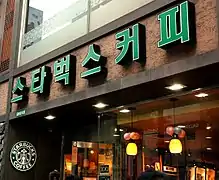
Starbucks opened its first store in 1999 and since 2011 has been opening about 80 new premises a year. The strong association with the South Korean public and the US has helped make coffee desirable and with many Koreans associating coffee and Starbucks as a lifestyle choice, it has become a status symbol throughout Seoul. Landlords are eager to have the brand open up a store in their buildings to enhance their value, reputation and image.
However, not all new Starbucks locations were welcomed warmly. In 2001, Starbucks opened a store in Insa-dong overcoming fierce resistance from the neighborhood’s shop owners.[4] The locals opposed the plane to open Starbucks because it would taint the Insa-dong’s identity as the cradle of all Korean culture.[4] Shop owners also had practical concerns as they believed that Starbucks would lure away customers who visited the traditional teahouses in the area.[4] After numerous negotiations and compromises Starbucks opened their Insa-dong shop.[4] This shop is unique in that it is the only Starbucks with a Korean sign board and its windows have traditional wooden lattice patterns.[4] Inside the shop there are also several markers of traditional culture like wooden masks.[4] However, some Koreans remain cynical of the Insa-dong shop as they view Starbuck’s attempts as superficial and merely cosmetic with no real tribute to Korean culture.[4]
Caffé Bene
Caffe Bene is a coffeehouse chain based in Seoul. It was founded in May 2008 by Sun-Kwon Kim, its chief executive officer. Caffè Bene is the largest coffeehouse in South Korea measured by number of stores. As of April 24, 2012, it had 760 outlets.[9]
Initially Caffe Bene struggled to gain any traction in an oversaturated American market. Failing to gain brand recognition, Sun-Kwon Kim agreed a deal with a number of entertainment shows to use his coffee locations in a selection of TV shows for a 3% share in the companies profit.[8]
Ediya
Ediya is a mid-priced coffee chain, containing around 1,800 stores in South Korea since 2016. Founded in 2001,[10] it is run by CEO Moon Chang-ki.[5]
Pascucci
Caffe pascucci is an Italian coffeehouse chain with over 480 stores[11] in South Korea.
Hollys Coffee
Hollys Coffee is a South Korean coffeehouse chain established in 1998.
Paik's Coffee
Inexpensive coffee chain founded by Korean celebrity chef turned CEO Baek Jong Won.
A Twosome Place
A Twosome Place is a coffeehouse chain owned by CJ Group in South Korea.
References
- "The History of Coffee in Korea". Daniel Gray.
- Jang, JungHee. "Korean Café Culture: What Korean Cafés Mean to Koreans" (PDF). Global Studies Advanced Seminar. Archived from the original (PDF) on 2017-06-08.
- 강 (Kang), 준만 (Junman); 오 (Oh), 두진 (Dujin) (2005-08-23). 고종 스타벅스에 가다 (King Gojong goes to Starbucks). Seoul: 인물과사상사.
- "한국학중앙연구원 > 출판·자료 > 정기간행물 > Korea Journal > Articles". www.aks.ac.kr. Retrieved 2021-05-05.
- "Coffee wars: South Korea's cafe boom nears saturation point". Reuters. 2017-04-05. Retrieved 2017-03-10.
- (KOCIS), Korean Culture and Information Service. "Korea's coffee culture :: Korea.net : The official website of the Republic of Korea". Retrieved 2017-03-10.
- Kaplan, Uri (2017-01-02). "From the Tea to the Coffee Ceremony: Modernizing Buddhist Material Culture in Contemporary Korea". Material Religion. 13 (1): 1–22. doi:10.1080/17432200.2016.1271969. ISSN 1743-2200.
- "The Growing Coffee Market In South Korea". 2014-10-17.
- (April 24, 2012)"승승장구 카페베네…주식시장에서도 통할까?" ("Caffè Bene...Doing Just Fine in the Stock Market?"), 매일경제 (Economic Daily)
- Hyo-sik, Lee (November 17, 2013). "Ediya goes after Asian coffee drinkers". The Korea Times. Archived from the original on 14 December 2014. Retrieved 13 December 2014.
- 기자, 유은정 (2018-12-04). "파스쿠찌, 론칭 16주년 기념 '정통 이탈리안 에스프레소' 캠페인 진행". 파스쿠찌, 론칭 16주년 기념 '정통 이탈리안 에스프레소' 캠페인 진행. Retrieved 2019-08-13.
External links
- Bak Sangmee, From Strange Bitter Concoction to Romantic Necessity: The Social History of Coffee Drinking in South Korea. (Korea Journal Vol.45. No.2 Summer, 2005 pp. 37~59)
- Korea Coffee Market, Terarosa Coffee, Yunson, Lee
- Korea's coffee culture, korea.net
- Episode #33: The History of Coffee in Korea, KBS World
- The History of Coffee in Korea, Daniel Gray
- Korean Coffee Culture 101 – History & Timeline
- Café Culture in Seoul, Korea
- JungHee Jang, Korean Café Culture: What Korean Cafés Mean to Koreans
- Cultural Meaning and Power of Starbucks in South Korea