Colour banding
Colour banding is a problem of inaccurate colour presentation in computer graphics. In 24-bit colour modes, 8 bits per channel is usually considered sufficient to render images in Rec. 709 or sRGB. However, in some cases there is a risk of producing visible changes between shades of the same colour. For instance, displaying natural gradients (like sunsets, dawns or clear blue skies) can show minor banding.

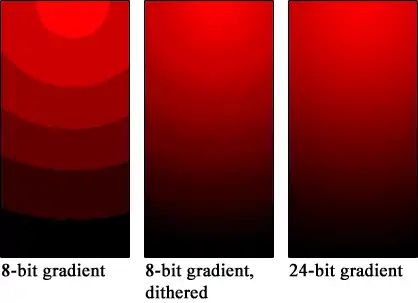
Colour banding is more noticeable with fewer bits per pixel (BPP) at 16–256 colours (4–8 BPP), where there are fewer shades with a larger difference between them.
Possible solutions include the introduction of dithering and increasing the number of bits per colour channel.
Because the banding comes from limitations in the presentation of the image, blurring the image does not fix this.
External links
Color topics | ||||||||
|---|---|---|---|---|---|---|---|---|
| Color science |
|  | ||||||
| Color philosophy |
| |||||||
| Color terms |
| |||||||
| Color organizations | ||||||||
| Lists | ||||||||
| Related | ||||||||
| ||||||||

