Colt Officer's Model (revolver)
The Colt Officer's Model is a medium frame, double action revolver produced between 1904 and 1972 and which was mainly focused on sport shooting and was available in four variants: Officer's Model Target, Officer's Model Target Rimfire, Officer's Model Special and Officer's Model Match.[1]
| Colt Officer's Model | |
|---|---|
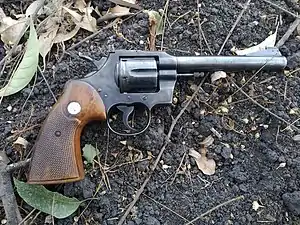 Colt Officer's Model Match .22 L.R. | |
| Type | Revolver |
| Place of origin | United States |
| Production history | |
| Manufacturer | Colt's Manufacturing Company |
| Produced | 1904–1972 |
| Specifications | |
| Mass | 1,075g - 1,220g |
| Length | 286 mm |
| Barrel length | 152 mm |
| Cartridge | |
| Action | double-action |
| Feed system | six round cylinder |
| Sights | rear: adjustable |
History and design
The first variant, the Officer's Model Target appeared in 1904 as a Premium model more focused on sports shooting than to give it common use, it was produced in calibers .32 and .38 and with barrels from 4 to 7.5 inches, being the most common is the 6-inch. The earliest guns were produced with a cylinder that rotated counterclockwise, however, following the introduction of the Colt Army Special in 1908, the sense of the cylinder was reversed.[1]
In 1930, Officer's Model Target Rimfire appeared, which was a .22 LR caliber version of the Model Target and was only produced with a 6-inch barrel. Both versions of Model Target were discontinued in 1972.[1]
In 1949, Officer's Model Special was announced, which was produced only in .22 LR and .38 Special calibers, featuring a Coltmaster adjustable sight. It was replaced in 1953 by the Officer's Model Match, which was produced in the same calibers until 1972 and the only difference being that the Special was mounted on the Colt "E" frame, while the Match featured the "J" frame, also featured an Accro adjustable sight.[1]
The first versions of the Officer's Model were built on Colt's "E" frame like its contemporary the Colt Official Police. Units manufactured before the Second World War, being "Premium" weapons, received a heat treatment (not chemical) that left them with an intense blue finish.
Pre-war guns used a flanged screw and bolt to hold the cylinder in place. When the screw is removed, the screw flange pushes up the cylinder retaining bolt. Postwar guns used a head screw, spring and bolt arrangement. The screw is actually a cap that retains the cylinder retaining bolt and spring.
References
- Hogg, Ian; Weks, John (1992). Pistols of the world: The definitive ilustrated guide to the world's pistols and revolvers (3 ed.). Northbrook, IL: DBI Books Inc. pp. 66, 255. ISBN 0-87349-128-9.