Commercial astronaut
A commercial astronaut is a person who has commanded, piloted, or served as an active crew member of a privately funded spacecraft. This is distinct from an otherwise non-government astronaut, for example Charlie Walker, who flies while representing a non-government corporation but with funding or training or both coming from government sources.
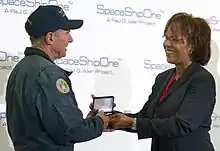 Patti Grace Smith, presents SpaceShipOne pilot Mike Melvill the department's first commercial astronaut wings. | |
| Occupation | |
|---|---|
Occupation type | Profession |
| Description | |
| Competencies | See astronaut training |
Fields of employment | Space exploration |
Related jobs | Astronaut |
Criteria
The definition of "astronaut" and the criteria for determining who has achieved human spaceflight vary. The Fédération Aéronautique Internationale defines spaceflight as any flight over 100 kilometers (62 mi) of altitude. In the United States, professional, military, and commercial astronauts who travel above an altitude of 50 miles (80 km) are eligible to be awarded astronaut wings. Until 2003, professional space travelers were sponsored and trained exclusively by governments, whether by the military or by civilian space agencies. However, with the first sub-orbital flight by the privately funded Scaled Composites Tier One program in 2004, the commercial astronaut category was created.[1] The next commercial program to achieve sub-orbital flight was Virgin Galactic's SpaceShipTwo program in 2018.[2] Criteria for commercial astronaut status in other countries have yet to be made public.
By 2021, with the substantial increase in commercial spaceflight—with the first suborbital passenger flight by both Virgin Galactic's SpaceShipTwo and Blue Origin's New Shepard in July, and with SpaceX's first orbital private spaceflight completed on September 18th 2021—the roles and functions of people going to space are expanding. Criteria for the broader designation "astronaut" has become open to interpretation. Even in the US alone, the "FAA, U.S. military and NASA all have different definitions of what it means to be designated as an 'astronaut' and none of them fit perfectly with the way Blue Origin or Virgin Galactic are doing business."[3] It is even possible that by the FAA commercial astronaut definition, one company's July flight participants may receive FAA commercial astronaut wings while the other will not.[3] SpaceNews reported that "Blue Origin awarded their version of astronaut wings" to the four participants of the first Blue Origin passenger flight but was unclear on whether these included the FAA astronaut designation.[4]
FAA Commercial Astronaut rating
With the advent of private commercial space flight ventures in the U.S., the FAA has been faced with the task of developing a certification process for the pilots of commercial spacecraft. The Commercial Space Launch Act of 1984 established the FAA's Office of Commercial Space Transportation and required companies to obtain a launch license for vehicles, but at the time manned commercial flight – and the licensing of crewmembers – was not considered. The Commercial Space Launch Amendments Act has led to the issuance of draft guidelines by the FAA in February 2005 for the administration of vehicle and crew certifications.[5][6] Currently, the FAA has not issued formal regulatory guidance for the issuance of a Commercial Astronaut Certificate, but as an interim measure, has established the practice of awarding "Commercial Astronaut Wings" to commercial pilots who have demonstrated the requisite proficiency. The content of 14 CFR Part 460 implies that an instrument rating and second-class medical certificate issued within the 12 months prior to the proposed qualifying flight will be included as a minimum standard.
The FAA's Commercial Astronaut Wings Program is designed to recognize flight crewmembers who further the FAA's mission to promote the safety of vehicles designed to carry humans. Astronaut Wings are given to flight crew who have demonstrated a safe flight to and return from space on an FAA/AST licensed mission. To be eligible for FAA Commercial Space Astronaut Wings, commercial launch crewmembers must meet the following criteria:
- Meet the requirements for flight crew qualifications and training under Title 14 of the Code of Federal Regulations (14 CFR) part 460.
- Demonstrated flight beyond 50 statute miles above the surface of the Earth as flight crew on an FAA/AST licensed or permitted launch or reentry vehicle.
- Demonstrated activities during flight that were essential to public safety, or contributed to human spaceflight safety.[7]
Astronaut Wings
The emblem for the first set of FAA Commercial Astronaut Wings issued in 2004 has in its center a green globe on a blue background, with the three-prong astronaut symbol superimposed on top. In yellow block text around the globe are the words "Commercial Space Transportation" in all capital letters. In a gold ring outside the blue are the words "Department of Transportation Federal Aviation Administration" in black. Beginning with the wings awarded for flights in 2018, the design has been simplified to be the astronaut symbol, surrounded by the words "Commercial Space Transportation", all in gold on a black background. In December 2021, the FAA decided to end the Commercial Astronaut Wings program on January 1.[8]
| Years awarded | Country | Commercial Astronaut Wings |
|---|---|---|
| 2004 | US | 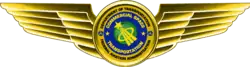 |
| 2018 – 2021 | US | 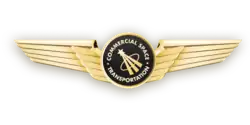 |
List of commercial astronauts
| # | Name | Vehicle | Company | Awarding Body | Qualification Date | Max Altitude | Notes |
|---|---|---|---|---|---|---|---|
| 1 | Mike Melvill[9] | SpaceShipOne | Scaled Composites | FAA | 21 June 2004 | 100 kilometers (62 mi) | First set of Commercial Astronaut wings; flight 15P |
| 2 | Brian Binnie[9] | SpaceShipOne | Scaled Composites | FAA | 4 October 2004 | 112 kilometers (70 mi) | flight 17P |
| 3 | Mark Stucky[9] | SpaceShipTwo Unity | Virgin Galactic | FAA | 13 December 2018 | 83 kilometers (52 mi) | flight VP-03 |
| 4 | CJ Sturckow[9] | SpaceShipTwo Unity | Virgin Galactic | FAA | 13 December 2018 | 83 kilometers (52 mi) | First to hold both NASA (STS-88) and Commercial Astronaut (flight VP-03) wings |
| 5 | David Mackay[10] | SpaceShipTwo Unity | Virgin Galactic | FAA | 22 February 2019 | 90 kilometers (56 mi) | First person born in Scotland to enter space; flight VF-01 |
| 6 | Michael Masucci[10] | SpaceShipTwo Unity | Virgin Galactic | FAA | 22 February 2019 | 90 kilometers (56 mi) | flight VF-01 |
| 7 | Beth Moses[10] | SpaceShipTwo Unity | Virgin Galactic | FAA | 22 February 2019 | 90 kilometers (56 mi) | First passenger, first woman (Chief Astronaut Instructor and Interiors Program Manager); flight VF-01 |
| 8 | Richard Branson[11] | SpaceShipTwo Unity | Virgin Galactic | FAA | 11 July 2021 | 86 kilometers (53 mi) | founder of Virgin Galactic; Unity 22 |
| 9 | Colin Bennett | SpaceShipTwo Unity | Virgin Galactic | FAA | 11 July 2021 | 86 kilometers (53 mi) | Unity 22 |
| 10 | Sirisha Bandla | SpaceShipTwo Unity | Virgin Galactic | FAA | 11 July 2021 | 86 kilometers (53 mi) | Unity 22 |
| 11 | Jeff Bezos[11] | New Shepard | Blue Origin | FAA | 20 July 2021 | 107 kilometers (66 mi) | founder of Blue Origin; NS-16 |
| 12 | Mark Bezos | New Shepard | Blue Origin | FAA | 20 July 2021 | 107 kilometers (66 mi) | NS-16 |
| 13 | Wally Funk | New Shepard | Blue Origin | FAA | 20 July 2021 | 107 kilometers (66 mi) | Member of the Mercury 13; NS-16 |
| 14 | Oliver Daemen | New Shepard | Blue Origin | FAA | 20 July 2021 | 107 kilometers (66 mi) | NS-16 |
| 15 | Jared Isaccman[11] | Crew Dragon | SpaceX | FAA | 16 September 2021 | 585 kilometers (364 mi) | Shift4 Payments CEO; Inspiration4 |
| 16 | Sian Proctor | Crew Dragon | SpaceX | FAA | 16 September 2021 | 585 kilometers (364 mi) | Inspiration4 |
| 17 | Hayley Arceneaux | Crew Dragon | SpaceX | FAA | 16 September 2021 | 585 kilometers (364 mi) | Currently the youngest American to have flown in space; Inspiration4 |
| 18 | Christopher Sembroski | Crew Dragon | SpaceX | FAA | 16 September 2021 | 585 kilometers (364 mi) | Inspiration4 |
| 19 | Audrey Powers[11] | New Shepard | Blue Origin | FAA | 13 October 2021 | 107 kilometers (66 mi) | NS-18 |
| 20 | Chris Boshuizen | New Shepard | Blue Origin | FAA | 13 October 2021 | 107 kilometers (66 mi) | NS-18 |
| 21 | Glen de Vries | New Shepard | Blue Origin | FAA | 13 October 2021 | 107 kilometers (66 mi) | NS-18 |
| 22 | William Shatner | New Shepard | Blue Origin | FAA | 13 October 2021 | 107 kilometers (66 mi) | Actor, currently the oldest person to have flown in space; NS-18 |
See also
 Spaceflight portal
 Space portal
 Solar System portal
 Astronomy portal
References
- "SpaceShipOne". National Air and Space Museum. 2016-03-20. Retrieved 2019-06-12.
- Virgin Galactic flies its first astronauts ...
- Kramer, Miriam (20 July 2021). "New wrinkle for space tourism: Deciding who counts as an astronaut". Axios. Retrieved 21 July 2021.
- Foust, Jeff (20 July 2021). "New Shepard astronauts rave about suborbital spaceflight experience as Bezos faces backlash". SpaceNews. Retrieved 21 July 2021.
- Commercial Space Flight - New Legislation and the Industry and Developments which Impact Commercial Airports, FAA NW Mountain Region 2005-04-05, accessed 2007-02-20
- "IAC-13-E6.4.5 – Industry Standards for Commercial Space Transportation" (PDF).
- "FAA Commercial Space Astronaut Wings Program" (PDF). FAA. Retrieved 2021-07-22.
- "First on CNN: The US gives Bezos, Branson and Shatner their astronaut wings". CNN. 10 December 2021. Retrieved 11 December 2021.
- "Press Release – Statement of FAA Assistant Administrator Bailey Edwards on the Successful Virgin Galactic Flight". www.faa.gov. Retrieved 2021-07-25.
- "Three Virgin Galactic Crew Presented with Commercial Astronaut Wings at 35th National Space Symposium".
- "FAA Commercial Human Spaceflight Recognition". Retrieved 10 December 2021.
| General |  | ||||||
|---|---|---|---|---|---|---|---|
| Applications | |||||||
| Human spaceflight |
| ||||||
| Spacecraft | |||||||
| Destinations | |||||||
| Space launch | |||||||
| Ground segment | |||||||
| |||||||


