Commodore PC compatible systems
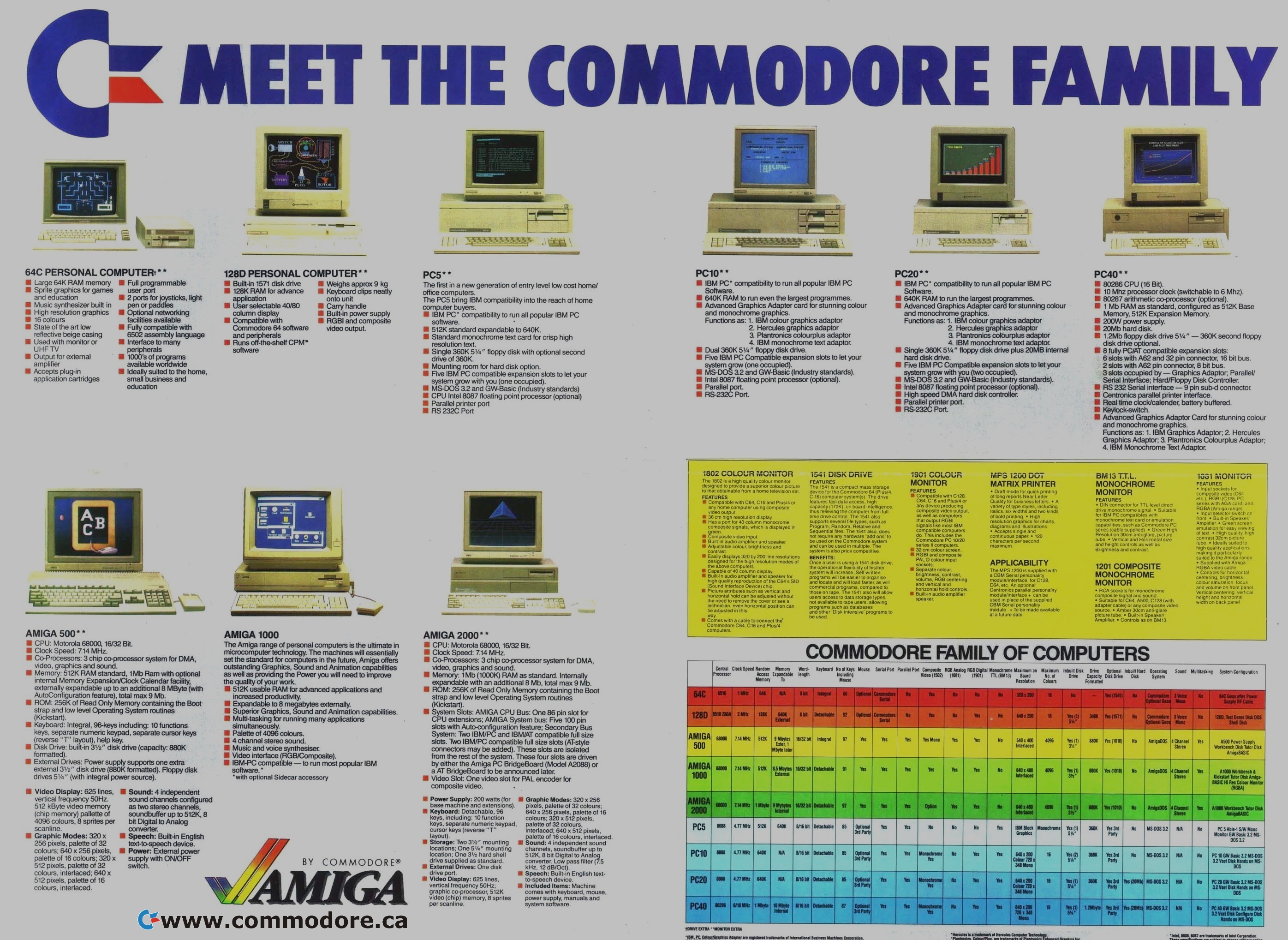
The Commodore PC compatible systems are a range of IBM PC compatible personal computers introduced in 1984 by home computer manufacturer Commodore Business Machines.
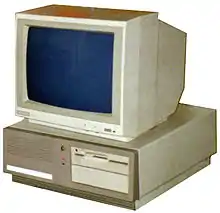
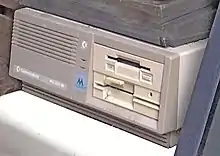
Incompatible with Commodore's prior Commodore 64 and Amiga architectures, they were generally regarded as good, serviceable workhorse PCs with nothing spectacular about them, but the well-established Commodore name was seen as a competitive asset.[1]
History
In 1984 Commodore signed a deal with Intel to second source manufacture the Intel 8088 CPU used in the IBM PC, along with a license to manufacture a computer based on the Dynalogic Hyperion. It is unknown whether any of these systems were produced or sold.
In 1987 the first model released, the PC-10, sold for $559 without monitor ($1273 in 2020).[2] They were sold alongside Commodore's Amiga and Commodore 64c/128 lines of home and graphics computers. The PC10 was comparable in the market to the Blue Chip PC, Leading Edge Model D and Tandy 1000 line of PC compatibles.[3][4]
Models
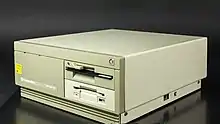
The line, not including later laptops, consists of the following models:
- PC-I (also called PC-1): A small-form-factor low-end non-expandable system. It has a 4.77 MHz 8088 processor, combined Hercules/CGA graphics, and one 5.25-inch floppy disk drive. It came standard with 512 kB of RAM.
- PC-5: A full-size PC/XT-clone with a standard monochrome text card and 512k of memory on the motherboard. It is expandable with up to five 8-bit ISA cards.[5]
- PC-10: A full AT-sized model with an 8088 and combined Hercules/CGA/Plantronics Colorplus graphics provided by an ATI Graphics Solution card. Two variations were produced: the PC10-I with one (sometimes two) floppy drive and 512 kB RAM and the PC10-II with two floppy drives and 640 kB RAM. These systems can be upgraded with the 8087 FPU.[6]
- PC-20: A PC-10 with a 20 MB hard disk
- Colt: A rebranded PC-10-III
- PC-30: A PC-AT compatible with a 12 MHz 286 CPU and a 20MB hard disk, only sold in Europe
- PC-35: Identical to PC-30
- PC-40: A 12 MHz PC-AT system with 1 MB of RAM, on-board VGA/EGA/CGA and Hercules video, and hard disk options from 20–80 MB.[7]
- PC-45: Based on the 286 CPU running at 12 MHz with 2 MB of RAM with a VGA card
- PC-50: Based on the 386SX running at 16 MHz. It includes a 40MB to 100MB hard disk.
- PC-60: 25 MHz 386 system with FPU. It came in a tower case with a 60 MB to 200 MB hard disk.
References
- "RUN Magazine issue 42".
- "TCP ad, Run magazine Sep. 1987".
- "The PC10 has Landed".
Two of the PC10-2's most visible competitors for the home and school markets are the Leading Edge Model D and the Tandy 1000SX.
- "Run Magazine Issue 42 : Free Download & Streaming : Internet Archive". Internet Archive. Retrieved 22 December 2014.
- "Impressions of the Commodore PC-5". Retrieved 22 December 2014.
- "RUN Magazine Issue 42".
- "Original Commodore PC-40 Brochure". Classic Computer Brochures. Retrieved 21 December 2014.
External links
 |
Wikimedia Commons has media related to Commodore PCs. |
- Richard Lagendijk: CIP - Commodore Info Page
- Bo Zimmerman: Commodore turns blue
- Bo Zimmerman's Commodore gallery
- OLD-COMPUTERS.COM
- Brochure comparing a number of Commodore Models
- Commodore History Part 6 - The PC Compatibles By The 8-Bit Guy
- Brochure for the Commodore PC10-1 and PC10-2 at classic.technology