New York City Council
The New York City Council is the lawmaking body of New York City. It has 51 members from 51 council districts throughout the five boroughs.
New York City Council | |
|---|---|
 | |
 | |
| Type | |
| Type | |
| Leadership | |
Speaker | |
Majority Leader | |
Minority Leader | |
| Structure | |
| Seats | 51 |
.png.webp) | |
Political groups |
|
| Committees | See Standing Committees |
| Elections | |
| First-past-the-post; Ranked-choice voting (primaries and special elections beginning 2021) | |
Last election | November 2, 2021 |
Next election | November 7, 2023 |
| Meeting place | |
| New York City Hall, Manhattan | |
| Website | |
| www | |
The council serves as a check against the mayor in a mayor-council government model, the performance of city agencies land use decisions, and legislating on a variety of other issues. It also has sole responsibility for approving the city budget. Members elected in or after 2010 are limited to two consecutive four-year terms in office but may run again after a four-year respite; however, members elected before 2010 may seek third successive terms.
The head of the city council is called the Speaker. The current Speaker is Corey Johnson, a Democrat. The Speaker sets the agenda and presides at city council meetings, and all proposed legislation is submitted through the Speaker's Office. Majority Leader Laurie Cumbo leads 48 Democratic council members. Minority Leader Joe Borelli leads the four Republican council members.
The council has 35 committees with oversight of various functions of the city government. Each council member sits on at least three standing, select or subcommittees (listed below). The standing committees meet at least once per month. The Speaker of the council, the majority leader, and the minority leader are all ex officio members of every committee.
Council members are elected every four years. The exception is two consecutive two-year terms every twenty years to allow for redistricting after each national census (starting in 2001 and 2003 for the 2000 Census and again in 2021 and 2023 for the 2020 Census).[1]
Composition
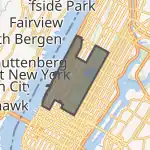
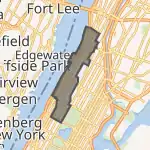
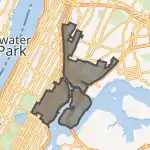
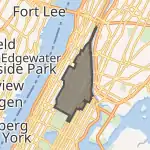






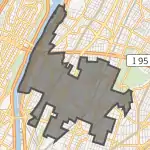
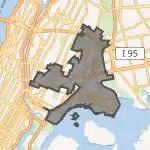







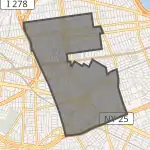
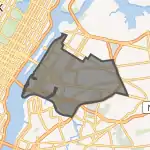
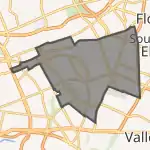


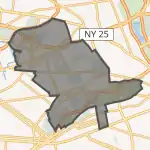
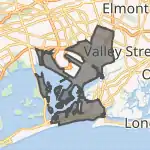

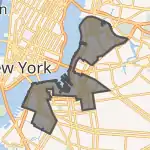


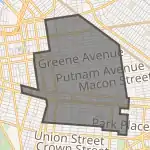
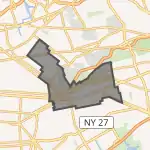
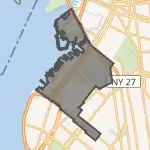
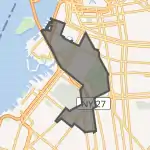




- Councilman Holden was elected in 2017 on the Republican Party line, but is a registered Democrat.
(An asterisk (*) next to the election year denotes a special election. A double asterisk (**) next to the election year means the member took office after certification to fill the remainder of an unexpired term.)
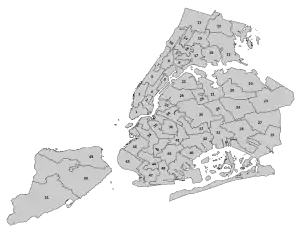
| Borough |
Population (2017 est)[2] |
Total |
Democratic |
Republican |
|---|---|---|---|---|
| Brooklyn | 2,648,771 | 15 | 14 | 1 |
| Queens | 2,358,582 | 14 | 13 | 1 |
| Manhattan | 1,664,727 | 10 | 10 | 0 |
| The Bronx | 1,471,160 | 7 | 7 | 0 |
| Staten Island | 479,458 | 3 | 1 | 2 |
| Total | 8,008,278 | 51 | 47 | 4 |
| Position | Name | Party | Borough |
|---|---|---|---|
| Speaker | Corey Johnson | Democratic | Manhattan |
| Majority Leader | Laurie Cumbo | Democratic | Brooklyn |
| Minority Leader | Joe Borelli | Republican | Staten Island |
Salary
Council Members currently receive $148,500 a year in base salary, which the council increased from $112,500 in early 2016.[3] Members receive no additional compensation for serving as a committee chairperson or other officer under the new salary raise.
Law
The New York City Charter is the fundamental law of the government of New York City including the council. The New York City Administrative Code is the codification of the laws promulgated by the council and is composed of 29 titles.[4][5] The regulations promulgated by city agencies pursuant to law are contained in the Rules of the City of New York in 71 titles.[6]
A local law has a status equivalent with a law enacted by the legislature (subject to certain exceptions and restrictions), and is superior to the older forms of municipal legislation such as ordinances, resolutions, rules and regulations.[7] Each local government must designate a newspaper of notice to publish or describe its laws.[8] The secretary of state is responsible for publishing local laws as a supplement to the Laws of New York (the "session laws" of the state), but they have not done so in recent years.[8] The New York City Charter, the New York City Administrative Code, and the Rules of the City of New York are published online by the New York Legal Publishing Corp. under contract with the New York City Law Department.[9]
History
The history of the New York City Council can be traced to Dutch Colonial times when New York City was known as New Amsterdam. On February 2, 1653, the town of New Amsterdam, founded on the southern tip of Manhattan Island in 1625, was incorporated as a city under a charter issued by the Dutch West India Company. A Council of Legislators sat as the local lawmaking body and as a court of inferior jurisdiction. During the 18th and 19th centuries the local legislature was called the Common Council and then the Board of Aldermen. In 1898 the amalgamation charter of the City of Greater New York renamed and revamped the council and added a New York City Board of Estimate with certain administrative and financial powers. After a number of changes through the ensuing years, the present Council was born in 1938 under a new charter which instituted the council as the sole legislative body and the New York City Board of Estimate as the chief administrative body. Certain functions of the council, however, remained subject to the approval of the board.
A system of proportional representation known as Single Transferable Vote seated a 26-member Council in 1938 to serve two-year terms. The term was extended to four years in 1945 to coincide with the term of the mayor. Proportional representation was abolished in 1947, largely from pressure from Democrats, who played on fears of Communist council members being elected (two already had).[10] It was replaced by a system of electing one Council Member from each New York State Senate district within the city. The Charter also provided for the election of two Council Members-at-large from each of the five boroughs. In June 1983, however, a federal court ruled that the 10 at-large seats violated the United States Constitution's one-person, one-vote mandate.[11]
In 1989, the Supreme Court ruled that the Board of Estimate also violated the one-person, one-vote mandate. In response, the new Charter abolished the Board of Estimate and provided for the redrawing of the council district lines to increase minority representation on the council. It also increased the number of Council Members from 35 to 51. The council was then granted full power over the municipal budget, as well as authority over zoning, land use and franchises. In 1993 the New York City Council voted to rename the position of president of the city council to the Public Advocate. As the presiding officer, the Public Advocate was an ex officio member of all committees in the council, and in that capacity had the right to introduce and co-sponsor legislation.[12] However the city charter revision of 2002 transferred the duties of presiding officer from the Public Advocate to the Council Speaker; the Public Advocate remains a non-voting member of the council.[13]
Term limits
A two-term limit was imposed on city council members and citywide elected officials in a 1993 referendum. The movement to introduce term limits was led by Ronald Lauder, a cosmetics heir. In 1996, voters turned down a council proposal to extend term limits. Lauder spent $4 million on the two referenda.
However, in 2008, under pressure from Mayor Michael Bloomberg (who, like many Council members, was facing the end of his two-term limit at that time), the council voted 29–22 to extend the limit to three terms; the council also defeated (by a vote of 22–28, with one abstention) a proposal to submit the issue to public referendum.[14]
Legal challenges to the extension of term limits failed in federal court. The original decision by Judge Charles Sifton of the United States District Court for the Eastern District of New York (Long Island, Brooklyn, Queens and Staten Island) was upheld by a three-judge panel of the United States Court of Appeals for the Second Circuit (Vermont, Connecticut and New York), and a proposal in the New York State Legislature to override the extension was not passed.[15][16][17]
Voters voted to reinstate the two-term limit law in another referendum in 2010.[18] However, according to The New York Times, incumbent members of the city council who were elected prior to the 2010 referendum “will still be allowed to run for a third term. People in office before 2010 were eligible for three terms.”[19]
Membership milestones
- First female member: Genevieve B. Earle (elected 1937 via proportional representation)
- First African-American male member: Adam Clayton Powell Jr. (elected 1939 via proportional representation)
- First African-American female member: Mary Pinkett (elected 1974)
- First Puerto Rican female member: Nydia Velázquez (elected 1984)
- First Dominican Elected to the NYC Council: Guillermo Linares (elected in 1991)
- First openly gay male members: Thomas Duane and Antonio Pagán (both elected 1991)
- First Asian-American member: John Liu (elected 2001)
- First Muslim elected member: Robert Jackson (elected 2002)
- First female speaker: Christine Quinn (elected Speaker 2005)
- First openly gay speaker: Christine Quinn (elected Speaker 2005)
- First Asian-American Republican elected member: Peter Koo (elected 2009; switched party affiliation to Democratic in 2012)
- Youngest elected member: Ritchie Torres, age 25 (elected 2013)
- First Mexican-American elected member: Carlos Menchaca (elected 2013)
- First Latina speaker: Melissa Mark-Viverito (elected Speaker 2014)
- First openly gay male speaker: Corey Johnson (elected Speaker 2017)
- First Bangladeshi-American member: Shahana Hanif (elected 2021)
- First Korean-American member: Julie Won (elected 2021)
Presiding officers since 1898
Through several changes in title and duties, this person has been, together with the Mayor and City Comptroller, one of the three municipal officers directly elected by all of the city's voters, and also the person who—when the elected mayor resigns, dies, or otherwise loses the ability to serve—becomes acting mayor until the next special or regular election.[20]
Until 1989, these three officers, together with the five borough presidents, constituted the New York City Board of Estimate. Political campaigns have traditionally tried to balance their candidates for these three offices to appeal as wide a range of the city's political, geographical, social, ethnic and religious constituencies as possible (and, when possible, to both genders).