Coracora
Coracora or Qura Qura is a town in central Peru, and it is the capital of the Parinacochas Province in the Ayacucho Region.[1] It has a population of approximately 13,000.[2]
Coracora
Qura Qura | |
|---|---|
Town | |
| Nickname(s): Coracora Tierra de Tradiciónes | |
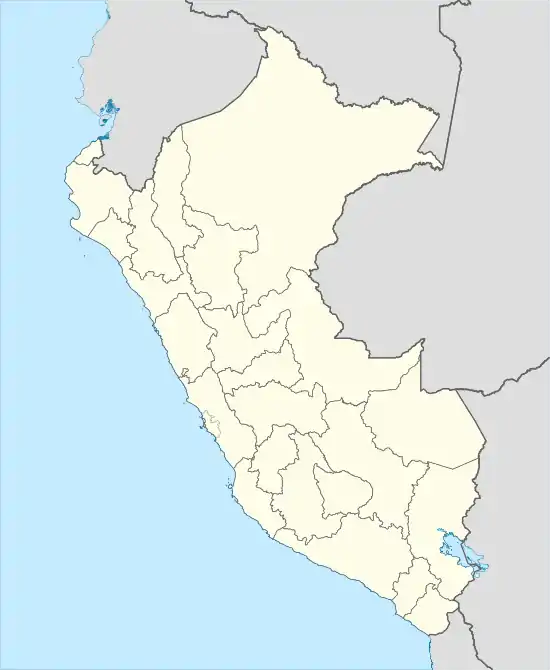  Coracora | |
| Coordinates: 15°01′01.18″S 73°46′49.51″W | |
| Country |  Peru Peru |
| Region | Ayacucho |
| Province | Parinacochas |
| District | Coracora |
| Government | |
| • Mayor | Alfredo Lopez Gutierrez |
| Elevation | 3,175 m (10,417 ft) |
| Time zone | UTC-5 (PET) |
Etymology
Coracora or Qura Qura comes from the Quechuan qura meaning Herbaceous plant,[3] the reduplication indicates that there is a group or a complex of something, "a complex of herbaceous plants".
Location
Coracora is located 800 km from Lima, Peru at an altitude between 3,150 and 3,350 meters above sea level, known as the Quechua ecological region.[4] The city of Coracora is the capital of the Parinacochas Province. It forms part of the department of Ayacucho and is located in the southwestern region of Peru. The districts that form the Parinacochas Province are: Coracora, Upahuacho, Pacapauza, Rivacayco, Chumpi, Incuyo, Pullo and Anizo.
Climate
Dry and sometimes cold, the days resemble a mild summer day, but the nights resemble a freezing cold winter. The days are usually something mild between +12 and +18 °C and at nights between -5 and 5 °C.[5] The winter season is manifested between June and September with frequent frosts, and the temperate and very rainy summer between December and March.
History
Founded by Spanish conquerors in the 17th century, Coracora was developed in what was then the road between Lima and Cuzco. Old colonial buildings were constructed from white ashlars, such as the beautiful local church, which was built in the Baroque and Renaissance styles.
Nevertheless, it was during the 19th and 20th centuries when Coracora became one of the flourishing cities from the Peruvian south mountain, thanks to the cattle raising that could gather an important number of local managers and European immigrants.
Toward the 1940s, Coracora reached an uncommon cultural and economic peak for a small city on mountain Peruvian. This prosperity began to fluctuate during the 1980s due to the social violence of those years throughout Peru.
As of modern times, it has recovered their character of center cattleman, commercial and tourist with significant improvements in access roads, infrastructure, and services.
Festivities
From August 1 to August 8, Coracora celebrates the devotion of La Virgen de Las Nieves, or known as "Virgin of the Snow".
August 1: People prepare for the festivities and cook food for the entire family.
August 2: People walk to Pumahuiri (the mountain that the Virgin of the Snow was found). People sing and dance as they walk to Pumahuiri. These songs are usually prayers.
August 3: It is the "Entrada de Negritos" (Entrance of the Blacks). The kids, as they were mentioned before, walk into town and keep singing and dancing as people follow them just as they did on their way to Pumahuiri.
August 4: It is the "Entrada de Chamiza" (Entrance of Retama). They are brought on donkeys' and llamas' backs. At night, people burn a dry plant. People dance around it with the rhythm of the band that plays all night. On that same night, they have Los Castillos, or fireworks on wood, in the Main Plaza, Plaza de Armas. They also have serenades with people dancing and singing.
August 5: It is the main day of the festivities. The townspeople walk around the main plaza where the church is located.
August 6 to August 8: On this day, the city goes to the bullring. Each family pays for their own place. Every square foot is worth $200.00. People buy the bulls in honor of Our Lady of the Snows and the ofresen estimates the person (compadres). It is somewhat like a donation. If the bull does not die, the person who bought it and the person receiving it enters the bullring. People dressed in red lead a team of bulls.
Each year, a person must sign up to be in charge of the town festival on August 5.
Virgen de Las Nieves
Spaniards had a specific job to bring the statue of the Virgin. Their destination was Cuzco, but along the way, they had stopped in Pumahuiri.[6] Their route was really from Lima to Cuzco, but Pumahuiri was a long and very tiring mountain, so they stopped and rested. But one man had a dream about the Virgin of the Snow, telling him how she wanted to stay in that town, not Cuzco.[7] That town was Coracora. When the man awakened, he told his fellow mates about his dream. They believed about what he had dreamed, so they climbed down the mountain and took the Virgin to Coracora. Since the men that carried the Virgin Mary down the mountain with hope and honour, the small "negritos" are supposed to represent the enslaved black men that carried the Virgen Mary.[7][6]
Notable people
References
- (in Spanish) Instituto Nacional de Estadística e Informática. Banco de Información Digital Archived April 23, 2008, at the Wayback Machine, Retrieved June 10, 2008
- "INSTITUTO NACIONAL DE ESTADÍSTICA E INFORMÁTICA: AYACUCHO" (PDF). Instituto Nacional de Estadistica e Informatica de Peru. October 2018. Retrieved 23 November 2021.
- Teofilo Laime Ajacopa, Diccionario Bilingüe Iskay simipi yuyayk'ancha, La Paz, 2007 (Quechua-Spanish dictionary)
- "Coracora en la region de Ayacucho - Municipio y municipalidad de Perú". www.distrito.pe. Retrieved 2021-11-24.
- "Clima Cora Cora: Temperatura, Climograma y Tabla climática para Cora Cora - Climate-Data.org". es.climate-data.org. Retrieved 2021-11-24.
- Garcia Rivas, Alida Jesus (2019). "Impacto del turismo en el patrimonio inmaterial religioso. Caso "Festividad de las Virgen de las Nieves de Coracora - Ayacucho - 2017"". Universidad de San Martín de Porres - USMP.
- Martínez Parra, Reynaldo (1999). Tradición y leyenda de la Virgen de las Nieves: (patrona de Coracora). Texas: University of Texas.
External links
 |
Wikinews has related news: |
Authority control  | |
|---|---|
| General | |
| National libraries | |