Cordyceps militaris
Cordyceps militaris is a species of fungus in the family Cordycipitaceae, and the type species of the genus Cordyceps. It was originally described by Carl Linnaeus in 1753 as Clavaria militaris.[1]
| Cordyceps militaris | |
|---|---|
 | |
| Scientific classification | |
| Kingdom: | |
| Division: | |
| Class: | |
| Order: | |
| Family: | |
| Genus: | |
| Species: | C. militaris |
| Binomial name | |
| Cordyceps militaris | |
Description
Macroscopic characteristics
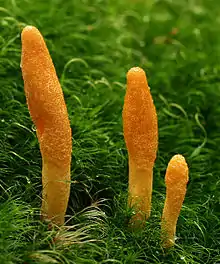
The fungus forms 1–8 cm high, club-shaped[2] and orange/red fruiting bodies, which grow out of dead underground pupae. The club is covered with the stroma, into which the actual fruit bodies, the perithecia, are inserted. The surface appears roughly punctured. The inner fungal tissue is whitish to pale orange.
Microscopic features
The spores are smooth, hyaline, long-filiform, and often septate. They decompose to maturity in 3–7 μm × 1–1.2 μm subpores. The asci are long and cylindrical. Sometimes an anamorphic state, which is Isaria, is found. Masses of white mycelia form around the parasitised insect; however, these may not be of the same species.
Ecology and dispersal
Cordyceps militaris is a entomopathogenic fungus, meaning it parasitizes insects. Many authors consider it quite common, spread throughout the northern hemisphere,[3] and fruiting bodies appear in Europe from August to November.
Cultivation and use
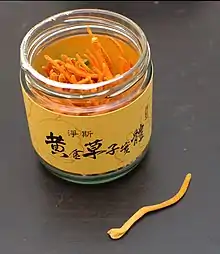
C. militaris can be cultivated in a variety of media including silkworm pupae, rice, or liquid nutrition.[4][5] It is considered inedible or "probably edible" by North American field guides.[6][2] In Asia the fruiting body is cooked as a mushroom in dishes like chicken soup[7] and hot pot.
C. militaris is a potential harbour of bio-metabolites for herbal drugs and evidences are available about its applications for revitalization of various systems of the body from ancient times.[8] In traditional Chinese medicine, this fungi can serve as a cheap substitute of Ophiocordyceps sinensis. Both contain cordycepin.[4]
C. militaris contains a protein CMP18 that induces apoptosis in vitro via a mitochondrion-dependent pathway. It is thought that it might be toxic when eaten. Cooking destroys this protein.[9]
Distribution area
In June 2019, researchers discovered Cordyceps militaris at an altitude of 2500m in Hoàng Liên National Park Sa Pa- Lao Cai, Vietnam.[10]
Similar species
Cordyceps in the wild has more than 400 different species. Similar species include Cordyceps sobolifera, Elaphocordyceps capitata, and Elaphocordyceps ophioglossoides.[2]
References
- "GSD Species Synonymy: Cordyceps militaris (L.) Fr". Species Fungorum. CAB International. Retrieved 2014-05-20.
- Davis, R. Michael; Sommer, Robert; Menge, John A. (2012). Field Guide to Mushrooms of Western North America. Berkeley: University of California Press. pp. 381–382. ISBN 978-0-520-95360-4. OCLC 797915861.
- Pilz des Jahres 2007: Cordyceps militaris (L.) Link, Puppenkernkeule
- Lu, Yi; Zhi, Yuee; Miyakawa, Takuya; Tanokura, Masaru (2019-05-22). "Metabolic profiling of natural and cultured Cordyceps by NMR spectroscopy". Scientific Reports. 9 (1). doi:10.1038/s41598-019-44154-x.
- "CN102626036A 一种蛹虫草子实体的规模化栽培方法和质量检测方法" [A method for large-scale cultivation of C. militaris fruiting bodies and quality testing thereof]. Google Patents (in Chinese). 2012-04-24.
- Phillips, Roger (2010). Mushrooms and Other Fungi of North America. Buffalo, NY: Firefly Books. p. 379. ISBN 978-1-55407-651-2.
- "虫草花淮山杞子鸡汤". 心食谱.
- Das, Shonkor Kumar; Masuda, Mina; Sakurai, Akihiko; Sakakibara, Mikio (2010). "Medicinal uses of the mushroom Cordyceps militaris: Current state and prospects". Fitoterapia. 81 (8): 961–968. doi:10.1016/j.fitote.2010.07.010. PMID 20650308.
- Bai, Ke-Chun; Sheu, Fuu (January 2018). "A novel protein from edible fungi Cordyceps militaris that induces apoptosis". Journal of Food and Drug Analysis. 26 (1): 21–30. doi:10.1016/j.jfda.2016.10.013.
- Phung Thi, Ly. "Cordyceps militaris". Chuyên trang nghiên cứu về đông trùng hạ thảo tự nhiên Việt Nam.
External links
- Cordyceps militaris in Index Fungorum
 Media related to Cordyceps militaris at Wikimedia Commons
 Data related to Cordyceps at Wikispecies