Corey-Nicolaou macrolactonization
Corey-Nicolaou macrolactonization is a named reaction of organic chemistry, for the synthesis of lactones from hydroxy acids, found in 1974.[1] The reaction should take place in a polar aprotic solvent with mild conditions,[2] with the use of 2,2'-Dipyridyldisulfide and triphenylphosphine.

| Corey-Nicolaou macrolactonization | |
|---|---|
| Named after | Elias James Corey K. C. Nicolaou |
| Reaction type | Name reaction |
Mechanism
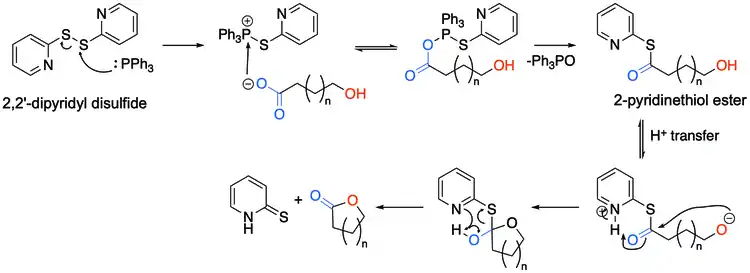
The hydroxy acid first reacts with the 2,2'-Dipyridyldisulfide to form the corresponding 2-pyridinethiol ester, and after a proton transfer, the alkoxide attacks the carbonyl carbon, forming a tetrahedral transition state, before resolving back to the desired lactone and 2-pyridinethione.
See also
References
- Corey, Elias James; Nicolaou, Kyriacos Costa (1974-08-01). "Efficient and mild lactonization method for the synthesis of macrolides". Journal of the American Chemical Society. 96 (17): 5614–5616. doi:10.1021/ja00824a073.
- Meng, Qingchang; Hesse, Manfred (1992). "Ring-closure methods in the synthesis of macrocyclic natural products". Topics in Current Chemistry. 161: 107–176. doi:10.1007/3-540-54348-1_9.
This article is issued from Wikipedia. The text is licensed under Creative Commons - Attribution - Sharealike. Additional terms may apply for the media files.