Cotton bale
A Cotton bale is a standard-sized and weighted pack of compressed cotton lint after ginning. The dimensions and weight may vary with different cotton-producing countries.[1]

Significance
A bale has an essential role from the farm to the factory. The cotton yield is calculated in terms of the number of bales.[2] Bale is a standard packaging method for cotton to avoid various hassles in handling, packing, and transportation. The bales also protect the lint from foreign contamination and make them readily identifiable.[3]
Standards
Bale
A "bale of cotton" is also the standard trading unit for cotton on the wholesale national and international markets. Although different cotton-growing countries have their bale standards, for example, In the United States, cotton is usually measured at approximately 0.48 cubic meters (17 cubic feet) and weighs 226.8 kilograms (500 pounds).[4] In India, the standard bale size is 170 kg.[5][6][7][8]
Parameters
The most important parameters of a cotton bale are:
- Density (448 kg/m3)[7]
- Measurements of the bales (nominally 1.40 X 0.53 X 0.69 m)[9][7]
- Weight (Varies, but ‘statistical’ bale weighs 480 lbs.)[7]
| Sr.No. | Country | Bale in Kgs |
|---|---|---|
| 1 | Australia | 227 |
| 2 | Colombia | 233 |
| 3 | Egypt | 327 |
| 4 | India | 170[10] |
| 5 | Pakistan | 170 |
| 6 | Mexico | 230 |
| 7 | Nigeria | 185 |
| 8 | South Africa | 200 |
| 9 | Sudan | 191 |
| 10 | Tanzania | 181 |
| 11 | Uganda | 181 |
| 12 | United States of America | 225 |
Advances in standardization are reducing the variation in weights, sizes, dimensions, and densities of cotton bales.[5][11]
Trash
When cotton is harvested and exposed to ginning, it carries more than 64% cottonseed, 2% waste and 34% fibrous matter (also known as lint).[15] Lower trash percentage in cotton increases the recovery.[16] Cotton bales are not pure cotton; they contain foreign contaminants, residual trash and leaf (and other non lint material) that have a direct impact on the recovery in yarn spinning.[17][18]
Gallery
Cotton cultivation
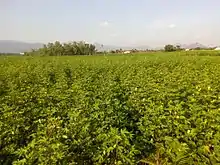 Cotton Field at Singalandapuram, Rasipuram, India (2017)
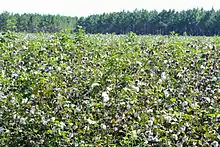 Cotton field
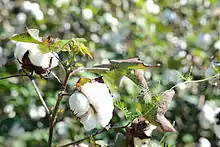 Cotton plant
Harvesting
_READY_FOR_HARVEST.jpg.webp)
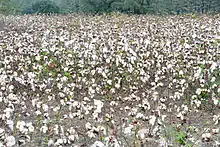 A cotton field, late in the season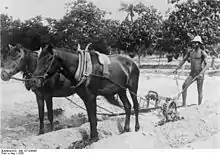
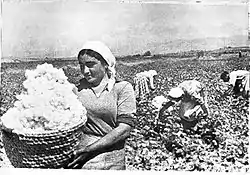 Picking cotton in Armenia in the 1930s. No cotton is grown there today.
 A group of Egyptian fellahs picking cotton by hand
-06.jpg.webp) Hand picking cotton (Tashkent, Uzbekistan)
Hand picking cotton (Tashkent, Uzbekistan)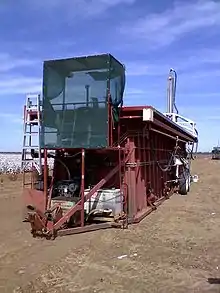 A module builder
%252CUS_wed01jan2014-1557h.jpg.webp) Cotton modules in a harvested cotton field (Clinch County, Georgia, USA, January 2014).
Cotton modules in a harvested cotton field (Clinch County, Georgia, USA, January 2014).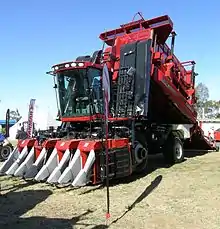 Case IH Module Express 625 picks cotton and simultaneously builds cotton modules
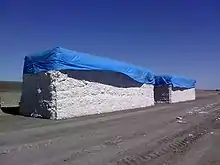 Cotton modules in Australia (2007)
Ginning and bale making
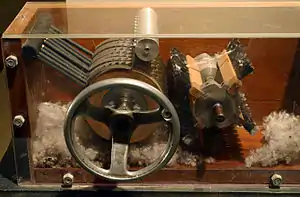 A model of a 19th-century cotton gin on display at the Eli Whitney Museum in Hamden, Connecticut
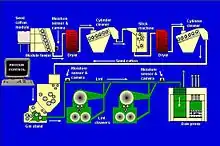 Diagram of a modern cotton gin plant, displaying numerous stages of production
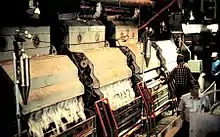 Modern ginning machines in working
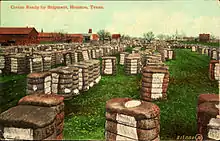 Cotton ready for shipment, Houston, Texas (postcard, circa 1911)
See also
References
- Turner, Joseph Addison (1865). The Cotton Planter's Manual: Being a Compilation of Facts from the Best Authorities on the Culture of Cotton; Its Natural History, Chemical Analysis, Trade, and Consumption; and Embracing a History of Cotton and the Cotton Gin. Judd. p. 273.
- "Cotton Corporation of India". cotcorp.org.in. Retrieved 2021-02-24.
- Forestry, United States Congress Senate Committee on Agriculture and (1928). Standardized Bales of Cotton: Hearing, Seventieth Congress, First Session, on S. 872, a Bill to Standardize Bales of Cotton and Requiring Sale of Cotton by the True Net Weight of Bale. May 16, 1928. U.S. Government Printing Office. p. 100.
- National Cotton Council of America, "U.S. Cotton Bale Dimensions Archived 6 October 2013 at the Wayback Machine" (accessed 5 October 2013).
- "Cotton imports may rise four fold as record exports deplete stocks". The Financial Express. 2012-09-21. Retrieved 2021-02-24.
- "Cotton - International Year of Natural Fibres". 2011-09-03. Archived from the original on 2011-09-03. Retrieved 2021-02-24.
- "Measurements - The Farm Hub - Textile Exchange". farmhub.textileexchange.org. Retrieved 2021-02-25.
- "Conversion factors". www.cottonguide.org. Retrieved 2021-02-25.
- "U.S. Cotton Fiber Chart - Bale Sizes". Cotton Incorporated. Retrieved 2021-02-25.
- COTTON SECTOR
- 14:00-17:00. "ISO 8115:1986". ISO. Retrieved 2021-02-25.CS1 maint: numeric names: authors list (link)
- "MCX traders can see cotton prices in candy too". Business Standard India. Press Trust of India. 2017-04-09. Retrieved 2021-11-01.
- Vora, Rutam. "Cotton trade may soon have uniform unit of measurement". @businessline. Retrieved 2021-02-24.
- "Cotton Rate, Today's Cotton Price in India: Cotton News on Economic Times". The Economic Times. Retrieved 2021-02-25.
- Akroyd, H. David (2017-10-24). Agriculture and Rural Development Planning: A Process in Transition. Routledge. p. 260. ISBN 978-1-351-96010-6.
- Kolanjikombil, Mathews (2018). The Substrates: Fibres, Yarn and Fabrics. Woodhead Publishing India Pvt Limited. p. 21. ISBN 978-93-85059-90-2.
- Division, United States Agricultural Marketing Service Cotton (1965). The Classification of Cotton. U.S. Department of Agriculture. p. 9.
- Morris, John; Wilkinson, F. W. (1897). The Elements of Cotton Spinning. Longmans.