Crazy (Willie Nelson song)
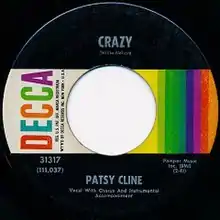
"Crazy" is a song written by Willie Nelson and popularized by country singer Patsy Cline in 1961. Cline's version is considered a country music standard, and it became the all-time most played song in jukeboxes in the United States by 1996.
| "Crazy" | ||||
|---|---|---|---|---|
 | ||||
| Single by Patsy Cline | ||||
| from the album Showcase | ||||
| B-side | "Who Can I Count On?" | |||
| Released | October 16, 1961 | |||
| Recorded | August 21– September 15, 1961 | |||
| Studio | Quonset Hut Studio | |||
| Genre | Country, traditional pop | |||
| Length | 2:41 | |||
| Label | Decca | |||
| Songwriter(s) | Willie Nelson | |||
| Producer(s) | Owen Bradley | |||
| Patsy Cline singles chronology | ||||
| ||||
The song was written by Nelson while he lived in Houston, Texas. He worked for Pappy Daily's label D Records while he was also a DJ in radio and performed in clubs. Nelson then moved to Nashville, Tennessee, where he was hired as a writer by Pamper Music. Through Hank Cochran, Nelson's "Crazy" reached Patsy Cline. Upon its original release, Cline's version reached number 2 on Billboard's Hot Country Singles and it crossed over to the pop chart as a top ten single.
"Crazy" was recorded by multiple artists and different versions of it appeared on diverse charts. It was featured in films and listed among the best country songs of all time by diverse publications. Cline's version was inducted to the National Recording Registry by the Library of Congress.
Background and writing
In 1958, as he was performing around Fort Worth, Texas and working as a DJ hosting The Western Express, Willie Nelson attracted the attention of Pappy Daily.[1] Daily, a record producer from Houston, offered Nelson a contract as a recording artist for D Records and as a writer for Glad Music.[2] Nelson moved to Houston, and he started to look for ballrooms to find work. He went to the Esquire Ballroom, where he talked to band leader Larry Butler. Butler clarified that he did not need any players, but Nelson offered to sell him some songs that he played on a reel-to-reel tape recorder.[3] Butler liked the songs, but he refused to buy them and he offered Nelson a job working six nights a week with his band instead.[4] Nelson settled with his family in Pasadena,[3] where he took an additional job as a DJ on radio station KRCT.[4][2] Soon later, he also taught guitar lessons.[5]
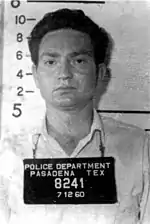
Nelson used his commute driving from Pasadena to the Esquire Ballroom as his writing time, as he needed an hour for the 30 mi (48.28 km) ride. He wrote the new lyrics that occurred to him as he reached his destination.[5][4] During one week, Nelson wrote "Crazy", "Nightlife" and "Funny How Time Slips Away".[6][7] Nelson's mood was at the time negatively affected by the lack of an stable employment while he supported his wife and three children, as neither of his two jobs provided him with enough income.[8] As he compared his night commutes to clubs with the lives of others, Nelson felt while he was driving that "the world was asleep".[9] According to his autobiography It's A Long Story: My Life, Nelson wondered if he was "Crazy" and he completed the song as if he was a man whose relationship recently ended.[9] Musician Sleepy LaBeef, who accompanied Nelson with an upright bass on the demo recordings of the song, asserted that the songwriter arrived in Houston with "Crazy" already written.[2] Meanwhile, biographer Joe Nick Patoski noted that Nelson played "Crazy" for Butler along with the songs he planned to sell him as he just arrived in the city.[10] Nelson wrote "Crazy" in less than an hour,[11] and he originally entitled it "Stupid".[6] He was inspired for the intonation of the opening by Floyd Tillman's "I Gotta Have My Baby Back".[12]
Nelson sold his original, "Family Bible", which was recorded by Claude Gray. Gray's recording enjoyed success, but Nelson's employment situation continued to be unstable.[13] Nelson accumulated debts, while he often attended parties and drank in excess. In July 1960, he was arrested for speeding and driving without a license.[2] He was then fired by KRCT after he arrived late several times, and later he was also from a club he performed in Pasadena. Nelson then decided to move his wife and children to Waco, Texas, while he moved to Nashville following the success of "Family Bible".[12]
Nelson lived at first with Billy Walker, who found him a job selling encyclopedias.[14] While taking him to different music publishers in town, Walker introduced Nelson to the artists and songwriters that frequented Tootsie's Orchid Lounge as the writer of "Family Bible". Through steel guitarist Buddy Emmons, Nelson became acquainted with Grand Ole Opry performers.[15] He was hired by the publishing house Pamper Music after the recordings of "Hello Walls" and "Funny How Time Slips Away" became successful for Faron Young and Billy Walker respectively.[16]
Patsy Cline's recording
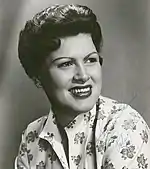
In his book, Wilie: An Autobiography, Nelson recalled that it was hard to find artists interested in recording "Crazy" due to its use of several chords, instead of the standard three used for Country music compositions at the time.[17] Walker intended to record the song, and he made a demo at Starday Records. Ultimately, the label decided to reject Walker's proposition since they felt that "Crazy" would not have commercial success.[18]
Nelson's fellow Pamper Music song plugger and writer Hank Cochran played "Crazy" for Patsy Cline's producer, Owen Bradley. Bradley felt that the composition was good for Cline to record.[19] Cochran then told Walker of Bradley's interest to record the song with Cline and he asked him not to record the song. In exchange, Cochran gave Walker "Charlie's Shoes".[18]
Cline's husband, Charlie Dick, had previously taken her a demo of Nelson's "Night Life". Cline disliked the song, and she requested her husband not take her any more songs written by Nelson, as she did not desire to record compositions that entailed loss of love, nor vulnerability. Cochran then drove Nelson to Cline's house with the demo of "Crazy". While Nelson waited in the car, Cochran played the song for Cline. Cline told Cochran to bring Nelson into the house, where he taught her to sing the song. Cline had difficulty following Nelson's phrasing, who sang behind the beat.[20][21] An alternative account by Nelson was then published on his 2015 book It's A Long Story: My Life: While drinking with Dick at Tootsie's Orchid Lounge, Nelson put his demo of "Crazy" on the jukebox of the bar. Dick considered that the song was good and that his wife should record it. Dick proposed Nelson to take him to his home to play the single for Cline. As it was after midnight, Nelson decided to wait on the car as Dick played the song for the singer and Cline later invited him in.[22][23]
Cline's producer, Owen Bradley, planned to record "Crazy" with the jazz chords utilized by Nelson composed of minor and major sevenths.[21] For most of the song, the composition uses a B-flat key, with an ending on B major.[24] Bradley decided to add The Jordanaires on background vocals, pianist Floyd Cramer and a bass guitarist Bob Moore.[21] Floyd opened with a four-bar introduction, followed by brushing from drummer Buddy Harman. Moore was complemented by Harold Bradley's electric guitar to create a tic-tac effect.[24] The first four-hour recording session took place on August 21, 1961 at Quonset Hut Studio.[25] Following a recent car accident that bruised Cline's ribs, Bradley had to end her participation because she could not reach the notes needed to match Nelson's phrasing. Bradley worked the arrangements with the musicians and he recorded the music track for the song.[23]
Bradley asked Cline to not follow Nelson's singing style, but to instead use her own.[26] After recovering, Cline returned two weeks later to record her vocal track and accomplished it on the first take.[23] On the result of the September 15 session,[25] Cline's vocal featured ascending and descending intervals and the use of broken chords. Cline learned to sing the type of notes required for "Crazy" early in her life, as she listened and imitated big band and jazz performers that she heard on the radio.[27] Cline sang slightly behind the beat following Nelson's singing style, but she modified it to fit her own.[28]
Release and reception
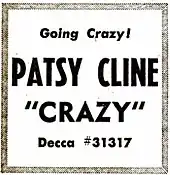
"Crazy" was released in October 1961 by Decca Records under the catalog number 31317 with "Who Can I Count On" on the flipside.[29] In November, "Crazy" was included on Cline's album release Showcase.[30] After 11 weeks, the single peaked at number 2 on Billboard's Hot Country Singles,[31] while it crossed over to the pop charts and it reached number 9 on the Billboard Hot 100.[16] Additionally, it reached number 2 on Billboard's Easy Listening chart.[32] With the success of "Crazy" and her previous single, "I Fall to Pieces", Cline was named Billboard's Favorite Female Country Artist of 1961.[33] In November 1961, Cline sand "Crazy" during a performance with the Grand Ole Opry cast at Carnegie Hall.[34]
"Crazy" became Cline's most successful pop single and her signature song, while the track became one of the country songs that generated the most royalties.[35][36] Nelson dubbed Cline's his favorite version of his original composition, as he opined that her interpretation was done with "delicacy, soul, and perfect diction".[23] Media including National Public Radio , New Musical Express and American Songwriter defined "Crazy" as a country music standard.[21][37][25]
The recording was featured in the 1985 Cline biopic Sweet Dreams.[38] In 1989, "Crazy" was ranked at number 2 on the all-time Top 40 Jukebox Singles in the United States by the Amusement and Music Operators Association.[39][40] By 1996, the updated list placed the song as the most played in jukeboxes.[41] "Crazy" appeared on the UK Singles Chart in 1987 at number 79, and then at number 14 in 1990.[42] The next year, it peaked at number 14 on the Irish Singles Chart.[43] In 2003, Cline's recording was inducted to the National Recording Registry by the Library of Congress.[44] The next year, it was ranked number 85 on Rolling Stone's list of The 500 Greatest Songs of All Time.[45] In the 2021 version of the list, the magazine placed it at number 195.[46] In 2018 it was included by New Musical Express on their "25 best country songs of all time" list,[37] while the following year The Tennessean listed it on their "100 best country songs of all time.[47]
Personnel
All credits are adapted from the original liner notes of Showcase.[48]
- Harold Bradley – 6-string electric bass
- Owen Bradley – organ
- Floyd Cramer – piano
- Buddy Harman – drums
- Walter Haynes – steel guitar
- Randy Hughes – acoustic guitar
- The Jordanaires – backing vocals
- Grady Martin – electric guitar
- Bob Moore – acoustic bass
Other versions
Nelson recorded his own version of "Crazy" for his 1962 debut album, ...And Then I Wrote.[49] Nelson's original demo of "Crazy" was released in 2003's Crazy: The Demo Sessions.[25] In 1977, Linda Ronstadt released a version as a single to her album Hasten Down the Wind.[50] Ronstadt's release reached number 6 on Billboard's Hot Country Songs chart.[51] A version by Beverly D'Angelo was featured on the 1980 film Coal Miner's Daughter.[52]
In 1993 Canadian country music singer Colleen Peterson charted at number 29 on the RPM country music chart.[53] Julio Iglesias' single release of the song appeared at number 43 on the UK Singles Chart in 1994.[54] In 1998, a cover of "Crazy" by Kidneythieves was featured on the soundtrack of Bride of Chucky.[55] Singer LeAnn Rimes included "Crazy" on her 1999 album LeAnn Rimes.[56] In the United Kingdom, it reached number 36 on the Singles chart.[57]
"Crazy" was twice featured in Nashville: sung by Juliette Barnes on the 2014 episode "That's Me Without You",[58] and by Barnes and Steven Tyler on a duet on the 2015 episode "Can't Let Go".[59] Nelson recorded duets of the song with Mary Sarah (2014) and then with Carla Bruni (2017).[60][61]
Chart performance
Patsy Cline
| Year | Chart | Peak position |
|---|---|---|
| 1961 | ||
| Australian Top 100 Singles (Kent Music Report)[62] | 56 | |
| US Hot Country Songs (Billboard)[63] | 2 | |
| US Billboard Hot 100[64] | 9 | |
| US Adult Contemporary (Billboard)[65] | 2 | |
| 1987 | UK Singles (OCC)[66] | 79 |
| 1990 | UK Singles (OCC)[66] | 14 |
| 1991 | Ireland (IRMA)[67] | 14 |
| Region | Certification | Certified units/sales |
|---|---|---|
| United Kingdom (BPI)[68] | Silver | 200,000 |
|
| ||
Other artists
| Year | Artist | Chart | Peak position |
|---|---|---|---|
| 1977 | Linda Ronstadt | US Billboard Hot 100[69] | 6 |
| 1993 | Colleen Peterson | Canada Country Tracks (RPM)[70] | 29 |
| 1994 | Julio Iglesias | UK Singles (OCC)[71] | 43 |
| 1999 | LeAnn Rimes | UK Singles (OCC)[72] | 36 |
References
- Nelson, Willie & Shrake, Bud 2000, pp. 103–105.
- Smith, William Michael 2013.
- Nelson, Willie & Shrake, Bud 2000, p. 116.
- Nelson, Willie & Shrake, Bud 2000, p. 117.
- Patoski, Joe Nick 2008, p. 98.
- Duncan, Dayton & Burns, Ken 2019, p. 239.
- Nelson, Willie & Cash, Johnny 1998.
- Nelson, Willie & Ritz, David 2015, pp. 119–120.
- Nelson, Willie & Ritz, David 2015, p. 122.
- Patoski, Joe Nick 2008, p. 96.
- Richmond, Clint 2000, p. 37.
- Patoski, Joe Nick 2008, p. 103.
- Patoski, Joe Nick 2008, p. 102.
- Patoski, Joe Nick 2008, p. 108.
- Patoski, Joe Nick 2008, p. 109.
- Ott, Tim 2020.
- Nelson, Willie & Shrake, Bud 2000, p. 140.
- Oermann, Robert K. 2008, p. 226.
- Patoski, Joe Nick 2008, p. 115.
- Patoski, Joe Nick 2008, p. 116.
- Wertheimer, Linda 2000.
- Nelson, Willie & Ritz, David 2015, pp. 144–145.
- Duncan, Dayton & Burns, Ken 2019, p. 240.
- Johnson, Chad 2018, p. 35.
- Kingsbury, Paul 2019.
- Nelson, Willie, Nelson, Bobbie & Ritz, David 2020, p. 142.
- Hofstra, Warren 2013, p. 76.
- Sullivan, Steve 2013, p. 96.
- Neely, Tim 2006, p. 241.
- Billboard staff 1961, p. 6.
- Billboard staff 1962, p. 35.
- Billboard staff 2 1961, p. 14.
- Oermann, Robert K. 2008, p. 97.
- Duncan, Dayton & Burns, Ken 2019, p. 241.
- Kosser, Michael 2006, p. T4.
- Duncan, Dayton & Burns, Ken 2019, p. 257.
- Cooper, Leonie 2018.
- Sharpe, Jerry 1985, p. F6.
- Murrieta, Ed 1989, p. S3.
- Newsweek 1990, p. F-2.
- Associated Press staff 1996, p. 2B.
- Official Charts staff 2021.
- Gogan, Larry 2021.
- National Recording Registry 2021.
- Rolling Stone staff 2003.
- Rolling Stone staff 2021.
- Leimkuehler, Matthew, Paulson, Dave & Watts, Cindy 2019.
- Cline, Patsy (November 27, 1961). "Showcase (LP Liner Notes and Album Information)". Decca Records. DL 4202.
- Milward, John 2021, p. 61.
- Ronstadt, Linda 2014, p. 207.
- Billboard staff 2021.
- Hilburn, Robert 1980, p. C-77.
- RPM staff 1993.
- Official Charts staff 2 2021.
- A.V. Club 2009, p. RA1.
- Harrison, Thomas 2011, p. 136.
- Official Charts staff 3 2021.
- Weiss, Max 2014.
- Weiss, Max 2015.
- Fekadu, Mesfin 2014.
- Barsamian, Edward 2017.
- David Kent (1993). Australian Charts Book 1970—1992. Australian Chart Book Pty Ltd, Turramurra, N.S.W. ISBN 978-0-646-11917-5.
- "Patsy Cline Chart History (Hot Country Songs)". Billboard.
- "Patsy Cline Chart History (Hot 100)". Billboard.
- "Patsy Cline Chart History (Adult Contemporary)". Billboard.
- "Patsy Cline: Artist Chart History". Official Charts Company.
- "The Irish Charts – Search Results – Crazy". Irish Singles Chart.
- "British single certifications – Patsy Cline – Crazy". British Phonographic Industry. Retrieved November 19, 2021.
- "Linda Ronstadt Chart History (Hot 100)". Billboard.
- "Top RPM Country Tracks: Issue 1471." RPM. Library and Archives Canada.
- "Julio Iglesias: Artist Chart History". Official Charts Company.
- "LeeAnn Rimes: Artist Chart History". Official Charts Company.
- Sources
- Associated Press staff (October 26, 1996). "Flash". 113 (94). Tampa Bay Times. Associated Press. Retrieved November 24, 2021 – via Newspapers.com.

- A.V. Club (2009). Inventory: 16 Films Featuring Manic Pixie Dream Girls, 10 Great Songs Nearly Ruined by Saxophone, and 100 More Obsessively Specific Pop-Culture Lists. Simon & Schuster. ISBN 978-1-439-10989-2.
- Barsamian, Edward (June 17, 2017). "El 'French Touch' de Carla Bruni-Sarkozy". Vogue. Retrieved November 15, 2021.
- Billboard staff (November 20, 1961). "Album Reviews". Billboard. Retrieved November 2, 2021 – via Google Books.
- Billboard staff 2 (December 4, 1961). "Easy Listening". Billboard. Retrieved November 2, 2021 – via Google Books.
- Billboard staff (January 27, 1962). "Hot C&W Sides". Billboard. Vol. 74 no. 4. Retrieved November 2, 2021 – via Google Books.
- Billboard staff (2021). "Chart History - Linda Ronstadt". Billboard. Retrieved November 9, 2021.
- Cooper, Leonie (April 15, 2018). "The 25 best country music songs of all time". NME. Retrieved November 24, 2021.
- Duncan, Dayton; Burns, Ken (2019). Country Music: An Illustrated History. Knopf Doubleday Publishing Group. ISBN 978-0-525-52055-9.
- Gogan, Larry (2021). "Crazy". The Irish Charts. Retrieved November 10, 2021.
- Harrison, Thomas (2011). Music of the 1990s. ABC-CLIO. ISBN 978-0-313-37943-7.
- Hilburn, Robert (March 30, 1980). "'Daughter soundtrack vs. legend-a timely reminder". Los Angeles Times. Retrieved November 8, 2021 – via Newspapers.com.
- Hofstra, Warren (2013). Sweet Dreams: The World of Patsy Cline. University of Illinois Press. ISBN 978-0-252-09498-9.
- Johnson, Chad (2018). Hal Leonard Baritone Guitar Method. Hal Leonard Corporation. ISBN 978-1-540-04297-2.
- Kingsbury, Paul (2019). "Behind the Song: Willie Nelson, "Crazy"". American Songwriter. Retrieved November 1, 2021.
- Kosser, Michael (2006). How Nashville Became Music City, U.S.A.: 50 Years of Music Row. Hal Leonard Corporation. ISBN 978-0-634-09806-2.
- Fekadu, Mesfin (November 7, 2014). "Mary Sarah duets with Willie Nelson, Dolly Parton, more". The Tennesseean. Retrieved November 15, 2021.
- Leimkuehler, Matthew; Paulson, Dave; Watts, Cindy (August 25, 2019). "100 all-time greatest country songs". The Tennesean. Retrieved November 24, 2021.
- Milward, John (2021). Americanaland: Where Country & Western Met Rock 'n' Roll. University of Illinois Press. ISBN 978-0-252-05281-1.
- Murrieta, Ed (October 20, 1989). "Take your pick: Here's a look at the all-time, Top 40 jukebox singles". The Sacramento Bee. 266. Retrieved November 3, 2021 – via Newspapers.com.
- National Recording Registry (2021). "Complete National Recording Registry Listing". Library of Congress. Retrieved November 9, 2021.
- Neely, Tim (2006). Goldmine Standard Catalog of American Records: 1950-1975. Krause Publications. ISBN 978-0-896-89307-8.
- Nelson, Willie; Cash, Johnny (1998). Johnny Cash / Willie Nelson – VH1 Storytellers (CD). American Recordings. CT 69416.
- Nelson, Willie; Shrake, Bud (2000). Willie: An Autobiography. Cooper Square Press. ISBN 978-1-461-66131-3.
- Nelson, Willie; Ritz, David (2015). It's a Long Story: My Life. Hachette UK. ISBN 978-0-316-40356-6.
- Nelson, Willie; Nelson, Bobbie; Ritz, David (2020). Me and Sister Bobbie: True Tales of the Family Band. Random House Publishing Group. ISBN 978-1-984-85414-8.
- Newsweek (March 12, 1990). "By The Numbers". The Los Angeles Times. Retrieved November 3, 2021 – via Newspapers.com.
- Oermann, Robert K. (2008). Behind the Grand Ole Opry Curtain: Tales of Romance and Tragedy. Hachette UK. ISBN 978-1-599-95184-3.
- Official Charts staff (2021). "Patsy Cline". Official Charts. Retrieved November 10, 2021.
- Official Charts staff 2 (2021). "Crazy". OfficialCharts.com. Retrieved November 10, 2021.
- Official Charts staff 3 (2021). "Leann Rimes". OfficialCharts.com. Retrieved November 15, 2021.
- Ott, Tim (December 15, 2020). "How Patsy Cline and Willie Nelson Teamed up for Her Hit Song "Crazy"". Biography. Retrieved October 21, 2021.
- Patoski, Joe Nick (2008). Willie Nelson: An Epic Life. Hachette Digital. ISBN 978-0-316-01778-7.
- Richmond, Clint (2000). Willie Nelson. Simon and Schuster. ISBN 978-0-671-03960-8.
- Rolling Stone staff (December 11, 2003). "500 Greatest Songs of All Time (2004)". Rolling Stone. Retrieved November 9, 2021.
- Rolling Stone staff (September 15, 2021). "The 500 Greatest Songs of All Time". Rolling Stone. Retrieved November 9, 2021.
- Ronstadt, Linda (2014). Simple Dreams: A Musical Memoir. Simon & Schuster. ISBN 978-1-451-66873-5.
- RPM staff (October 2, 1993). "RPM 100 Country Tracks". 58 (13). 1471. Retrieved November 11, 2021. Cite journal requires
|journal=(help) - Sharpe, Jerry (December 15, 1985). "'Sweet Dreams' sound track recaptures Patsy Cline flair". The Pittsburgh Press. 102 (173). Retrieved November 8, 2021 – via Newspapers.com.
- Smith, William Michael (April 24, 2013). "Mr. Record Man: Willie Nelson". Houston Press. Retrieved October 13, 2021.
- Sullivan, Steve (2013). Encyclopedia of Great Popular Song Recordings. 1. ISBN 978-0-810-88296-6.
- Weiss, Max (September 25, 2014). "Nashville Season 3 Premiere Recap: Put a Ring on It". Vulture. Retrieved November 15, 2021.
- Weiss, Max (September 24, 2015). "Nashville Recap: It's Aliiiiive!". Vulture. Retrieved November 15, 2021.
- Wertheimer, Linda (September 4, 2000). "Patsy Cline's 'Crazy' Changed The Sound Of Country Music". NPR. Retrieved October 25, 2021.
External links
- SecondHandSongs listing of known covers of "Crazy"
- Library of Congress essay on Patsy Cline's version and its inclusion in the National Recording Registry.
- Patsy Cline - Crazy on YouTube


Authority control  |
|---|