Criminal sentencing in the United States
In the United States, sentencing law varies by jurisdiction. Since the Constitution of the United States is the supreme law of the nation, all sentences in the country must conform to the requirements of the Constitution, which sets basic mandates while leaving the bulk of policy-making up to the fifty states and territories.
Despite the continued growth of federal criminal law, the vast majority of criminal sentencing takes place in state and local courts. Except for death penalty cases (which are exceptionally rare), juries generally have little involvement in sentencing, which is typically left to the discretion of the presiding judge. Sentence can be pronounced by the judge on the day of trial or in a separate hearing, after the jury (or other finder of fact) has issued findings of fact and a guilty verdict, and in some cases after the probation department has carried out a presentence investigation report. The structure and jurisdiction of courts within a U.S. state are governed by state law, as are sentences and the advisory sentencing guidelines.[1] There is enormous substantive and procedural difference between the criminal laws of the fifty states and the various federal territories and enclaves.
Each state is different in terms of sentencing, and even what acts under its law are crimes:
- Actions which might constitute a crime in one state would not necessarily constitute a crime in another state, or they might constitute a crime of a different severity. A 15-year-old and a 17-year-old having consensual sexual intercourse might constitute a crime in one state but not another. The possession of cannabis, certain types of firearms, or exotic animals might be serious crimes in some states but be perfectly legal in other states. A burglary might be completed only upon entry into a locked house in one state, but upon entry into an attached carport in another.
- States have different schemes for dividing up crimes by severity and these categories might have similar names across states, but different practical effects. For example, a "2nd degree felony" in Florida is a category of crime punishable by up to 15 years in prison with no minimum while a "2nd degree felony" in Texas is a category of crime punishable by up to 20 years in prison, with a mandatory minimum of 2 years incarceration.
- Many states have adopted sentencing guidelines which incorporate various factors into a single formula that may or may not constrain the judge's sentencing discretion. The general purpose of these schemes is to produce uniform and fair sentencing within a jurisdiction. However, since views about the correct approach to criminal justice vary from state to state, these statutory schemes vary enormously.
- Many states have mandatory sentencing statutes which remove the judge's discretion under certain circumstances. Mandatory sentencing schemes typically require minimum periods of incarceration for certain serious crimes and for individuals who have serious criminal records. The state typically has discretion to pursue or waive mandatory sentencing. The content of these mandatory sentencing statutes and the procedures required to bring them into play are different in each state.
- Most states have programs such as probation, parole, early release from incarceration, halfway house, community service, or house arrest with electronic monitoring, etc., while some do not.
Some defendants are given life sentences. In some states, a life sentence means life, without the possibility of parole. In other states, people with life sentences are eligible for parole. In some cases, the death penalty may be applicable; however, since the 2002 decision in Ring v. Arizona, a recommendation of the trial jury is required to impose a sentence of death. However, as one can be sentenced to life without parole, another way to be sentenced for life is a minimum number of years spent in prison depending on the life expectancy of the defendant. Thus, the defendant will then spend the rest of his or her life in prison.[2]
The Federal Sentencing Guidelines prescribe a reduction of sentence time for most defendants who accept responsibility and plead guilty; further discounts are available to some defendants through fact bargaining, substantial assistance, and so on. Federal court statistics from 2003 show that the average sentence given for offenses resolved by guilty plea was 54.7 months, while the average sentence for offenses resolved by trial was 153.7 months.[3] The practice of giving much harsher sentences when a defendant chooses to exercise the right to a trial by jury of his peers has been controversial, as is seen as a personal act of anger by the judge over "wasting court time."
Determinate and indeterminate sentencing
Because an indeterminate sentence is construed by some as indefinite imprisonment, it has become a thing of the past.[4] One reason for this is that such sentences have been vaguely interpreted,[5] including by the courts of appeals and the Board of Immigration Appeals (BIA).[6] In response to this problem, the Sentencing Reform Act of 1984 abolished indeterminate sentencing in favor of a sentence with probation and/or supervised release.[7][8] Later, in the Illegal Immigration Reform and Immigrant Responsibility Act of 1996 (IIRIRA), Congress added the following:
(A) The term 'conviction' means, with respect to an alien, a formal judgment of guilt of the alien entered by a court or, if adjudication of guilt has been withheld, where—(i) a judge or jury has found the alien guilty or the alien has entered a plea of guilty or nolo contendere or has admitted sufficient facts to warrant a finding of guilt, and (ii) the judge has ordered some form of punishment, penalty, or restraint on the alien's liberty to be imposed. (B) Any reference to a term of imprisonment or a sentence with respect to an offense is deemed to include the period of incarceration or confinement ordered by a court of law regardless of any suspension of the imposition or execution of that imprisonment or sentence in whole or in part.[9]
The above quoted text applies to convictions and sentences entered at any time in the past,[10][11] whether inside or outside the United States.[12] The Third Circuit believes that home confinement is imprisonment for purposes of the INA.[13] The problem with this belief is that it is based on pre-IIRIRA dicta, "statement[s] of law in the opinion which could not logically be a major premise of the selected facts of the decision[,]"[14] and it not only conflicts with prior holdings but also with the highest courts of several states.[15] Accepting the Third Circuit's extreme view would make those inside the International Space Station or those living on islands as being confined prisoners. In fact, everyone on Earth could be labelled a confined to Earth prisoner. Then there are also issues relating to pregnant women in home confinement, e.g., pregnancy, fetus, child, etc.[16]
The non-binding advisory sentencing guidelines set the maximum and minimum term of imprisonment that may be handed down to a defendant,[1] which is then left to the discretion of the trial court to choose the exact number of days, months or years the defendant must spend in prison, including the length of parole or supervised release.[17] The advisory sentencing guidelines are widely used in the United States. A court is not permitted to impose any greater sentence than the base range as written in the sentencing guidelines sentence form, "unless certain enumerated circumstances were found to be present."[18] When a court orders an individual to serve "four months" in an institutional setting such as a prison then the entire sentence is "four months",[19] regardless if the maximum sentence is higher in the advisory sentencing guidelines.[19][1] The remaining period automatically becomes supervision, which is not punishment or penalty. Courts are statutorily permitted to reduce an already imposed sentence in a particular case.[20]
During a long sentence, an offender can take full advantage of the programs that the prison has, including rehab for drug abuse or alcohol abuse, anger management, mental health, and so on, so when the offender completes the rehab or program he may be released upon request from authorities with a lower risk of recidivism. This process tries to combat the tendency of prisoners leaving incarceration after a long sentence to go back to offending in short order, without any attempt at correcting their ways.
Those given short sentences usually serve the full-time (do "day-for-day") as imposed by the judge, or might receive time off for good behavior, based on state or local rules and regulations. In the mid-1970s, most state and federal prisons moved from long term to short term sentencing. Over time, though, state and federal authorities have gradually migrated their philosophies back toward long-term sentences. Many states use a mixture of the two; e.g., some offenders may receive sentences reduced by several months due to rehabilitation, counseling, and other programs, as well as good time.
Trends in sentencing law
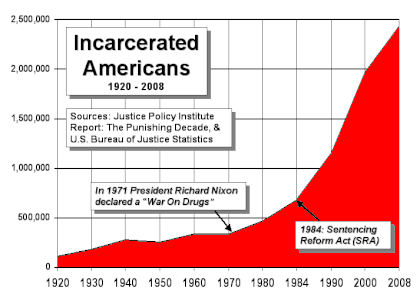
Since the 1840s, many jurisdictions, including the federal courts, have adopted a practice of having a probation officer prepare a presentence investigation report to inform the court as to the defendant's characteristics, including his criminal record, if any. In the 1970s, the length of incarceration had increased in response to the rising of crime rates in the United States. By the 1980s, state legislatures began to reduce judicial discretion in sentencing terms and conditions. This was especially true in cases of life imprisonment, which between 1992 and 2003 increased by 83% due to the implementation of three strikes laws. Short term sentencing, mandatory minimums, and guideline-based sentencing began to remove the human element from sentencing. They also required the judge to consider the severity of a crime in determining the length of an offender's sentence.
Sentencing murderers
The United States does not have a specific guideline to sentencing murderers, including serial killers. When a killer is apprehended, he will be charged with murder, and if convicted can get life in prison or receive the death penalty, depending on in which state the murders took place. Generally speaking, each victim of a murder will merit a separate charge of murder against the offender, and as such, the killer could get a life sentence, a death sentence, or some other determinate or indeterminate sentence based upon the number of murders, the evidence presented, and any aggravating or mitigating circumstances present. Such a compounded sentence may be tailored to run consecutively, with one sentence beginning after completion of another, or concurrently, where all or most of several sentences are served together.
Below are several examples of how a murderer may be sentenced, by state:
Arizona
In Arizona, a person is guilty of murder if an offender knowingly and intentionally causes the death of a person. The murder must be premeditated. If an individual is found guilty of murder, there are three possible sentences: 35 years to life, life without parole, or the death penalty.[21]
Florida
In Florida, a person is guilty of first degree murder when it is perpetrated from a premeditated design to result in the death of a human being. Murder is categorized as a capital offense; if convicted, the offender will receive either the death penalty or life in prison without parole. A unanimous vote of a twelve-person jury, is required to sentence a person to death if they are convicted of capital murder.[22][23]
Hawaii
In Hawaii, a person is found guilty of second degree murder when they intentionally and knowingly cause the death of another person. If the person intentionally or knowingly kills more than one person, or kills a law enforcement officer, a judge, or a prosecutor in the line of, or as a result of, their duties, a witness to a crime, or a defendant to a corroborated crime, or if he hires another party to kill a certain individual, the person has met the criteria to be charged with first degree murder. The State of Hawaii has no death penalty. If they are found guilty, the maximum penalty is life imprisonment without parole.[24]
Louisiana
Louisiana states that homicide in the first degree is killing of a human being with intent. There are other specific circumstances that may contribute, such as killing a police officer or a firefighter. Either of these offenses, or the killing of more than one person, is an automatic first degree charge. Louisiana provides for life imprisonment without parole or the death penalty for murder.[25]
Massachusetts
In Massachusetts, first degree murder is defined as killing a person with premeditated intent to kill. The only possible sentence for first degree murder is life in prison without parole as Massachusetts does not have the death penalty. Second-degree murder carries a mandatory life sentence in prison, but with the possibility of parole after 15 years, which is the standard minimum non-parole period in the state for second-degree murder and most other offenses.
Michigan
In Michigan, a person is found guilty of first degree murder when murder is perpetrated by means of poison, lying in wait, or any other willful, deliberate, and premeditated killing. In Michigan, first degree murder carries an automatic life sentence without parole.[26]
Nevada
In Nevada, first degree murder is the unlawful killing of a human being with malice aforethought, either expressed or implied. If a killer is found guilty with aggravating circumstances, such as killing someone via torture or killing a stranger with no apparent motive, they may receive either the death penalty or life without parole.[27]
Washington
In the state of Washington, a person is found guilty of first degree murder when there is a premeditated intent to cause the death of another person. Murder in the first degree is a class A felony.[28] If a person is convicted of first degree murder, he or she will receive a life sentence.[29] If an aggravating circumstance exists in addition to first degree murder, the defendant can be charged with aggravated first-degree murder, which carries only one possible sentence life without parole. Aggravating factors include the killing of a law enforcement officer, murder for hire, or murder committed during the course of kidnapping, rape, robbery, burglary, or arson, or for multiple murders.[30]
Criminal sentencing of women
Throughout the history of the Criminal Justice System in the United States, women have been held responsible for only 20 percent of total crime.[31] Despite only committing a small portion of crime, women in the United States remain overrepresented in the Criminal Justice System. The United States generates 30 percent of all incarcerated women in the world, despite only comprising five percent of the female population.[31] As such, multiple studies have been conducted to analyze the differences in the crimes committed by men and women, as well as the sentencing of such offenders. Typically, women have been found to hold an advantage over men in sentencing; however, the degree of preferential treatment varies by the type of offense committed.[31][32][33][34] In regard to property and drug offenses specifically, women are less likely than male offenders to receive a prison sentence. When female offenders do receive a prison sentence, research has found women receive shorter sentences than male offenders for the same offense.[32][35] The level of preferential treatment shown to female offenders was lower when the offense was in violation of gender norms. Women who committed more "masculine crimes," such as violent offenses or crimes against children, were not treated preferentially during sentencing.[32] During his concurring opinion in Furman v. Georgia, Justice Thurgood Marshall stated, "There is also overwhelming evidence that the death penalty is employed against men and not women."[35]:76 Within the scope of capital punishment, women are far less likely to receive a death sentence and even less likely to actually face execution. Between 1973 to 2012, women comprised only 2.1% of death sentences imposed at trial and merely 0.9% of persons executed.[36] Women who are sentenced to death at trial are more likely to receive executive clemency than their male counterparts, despite their crime having more aggravating factors that may increase sentencing outcomes.[37]
In an attempt to explain the preferential treatment that is shown to female offenders in criminal sentencing, researchers have developed theories that concentrate on the differences between the treatment of each gender by society. A possible explanation for disproportionate sentencing is the chivalry thesis which states that gendered stereotypes influence sentencing outcomes as women are considered childlike, less threatening, less dangerous, and not responsible for their behaviors.[32][33] This theory also maintains that men are traditionally inclined to minimize the suffering of women as a result of their paternalistic desire and this behavior has been incorporated into the justice system as it is a male-dominated field.[32][33] Judges primarily explained sentencing differentials as a result of childcare responsibilities that would create a larger social cost if mothers were incarcerated, illustrating direct applications of the chivalry thesis.[33] Others argue the disparity in sentencing is merely the result of human error as a result of the dynamics of judicial decision-making.[32] The focal concerns theory reaffirms this belief as this theory states that the sentencing disparity is the result of a judge's inability to spend a large amount of time on a single case and the incomplete information given to them minimizes their ability to make an fully informed decision.[32][33] As a result, judges may unknowingly rely on generalizations of personal biases to guide sentencing decisions.[32] In an attempt to prevent preferential treatment to particular genders, races, ethnicities, or socio-economic classes, the Federal Sentencing Guidelines were enacted to create sentencing uniformity and equality.[35] The enactment of these guidelines has since increased sentences given to women at trial; however, the disparity between male and female offenders persists as the internal biases influencing preferential sentencing have not been addressed.[35]
See also
Notes and references
This article in most part is based on law of the United States, including statutory and latest published case law.
- "Rosales-Mireles v. United States, 138 S. Ct. 1897 (2018)". U.S. Supreme Court. Harvard Law School. June 18, 2018. p. 1904.
Courts are not bound by the Guidelines, but even in an advisory capacity the Guidelines serve as 'a meaningful benchmark' in the initial determination of a sentence and 'through the process of appellate review.'
- "Commonwealth v. Yuhasz, 592 Pa. 120, 923 A.2d 1111 (2007)". Supreme Court of Pennsylvania. Harvard Law School. May 31, 2007. p. 132.
It is well established that the Sentencing Guidelines are purely advisory in nature.
- "Commonwealth v. Mouzon, 571 Pa. 419, 812 A.2d 617 (2002)". Supreme Court of Pennsylvania. Harvard Law School. December 19, 2002. p. 424.
The Sentencing Guidelines enumerate aggravating and mitigating circumstances, assign scores based on a defendant's criminal record and based on the seriousness of the crime, and specify a range of punishments for each crime.
- "Commonwealth v. Yuhasz, 592 Pa. 120, 923 A.2d 1111 (2007)". Supreme Court of Pennsylvania. Harvard Law School. May 31, 2007. p. 132.
- Van Zyl Smit, Dir (2002). Taking Life Imprisonment Seriously in National and International Law. The Hague: Brill.
- Bureau of Justice Statistics, Compendium of Federal Justice Statistics 70, 75 tbl. 5.3 (2003).
- "Parole Boards within Indeterminate and Determinate Sentencing Structures". Edward E. Rhine; Alexis Watts; Kevin R. Reitz. University of Minnesota. April 3, 2018. Retrieved 2021-12-09.
In terms of sentencing structures, a review at the state level shows there is no such thing as a purely indeterminate sentencing system....
- "United States v. Davis, 139 S. Ct. 2319 (2019)". U.S. Supreme Court. Harvard Law School. June 24, 2019. p. 2323.
In our constitutional order, a vague law is no law at all.
- "Commonwealth v. Wolfe, 140 A.3d 651 (2016)". Supreme Court of Pennsylvania. Harvard Law School. June 20, 2016. p. 661.
We also agree with Appellee and his amicus that a sentence based on an unconstitutional statute that is incapable of severance is void.
- "Commonwealth v. Michuck, 454 Pa. Super. 594, 686 A.2d 403". Superior Court of Pennsylvania. Harvard Law School. November 19, 1996. p. 602.
An unconstitutional statute 'is ineffective for any purpose since its unconstitutionality dates from the time of its enactment and not merely from the date of the decision holding it so.'
- "Commonwealth v. Michuck, 454 Pa. Super. 594, 686 A.2d 403". Superior Court of Pennsylvania. Harvard Law School. November 19, 1996. p. 602.
- "Commonwealth v. Wolfe, 140 A.3d 651 (2016)". Supreme Court of Pennsylvania. Harvard Law School. June 20, 2016. p. 661.
- See, e.g.,
- "United States ex rel. Robinson v. Day, 51 F.2d 1022". U.S. Court of Appeals for the Second Circuit. Harvard Law School. July 7, 1931. p. 1023.
- "Holzapfel v. Wyrsch, 259 F.2d 890". U.S. Court of Appeals for the Third Circuit. Harvard Law School. October 9, 1958. p. 891 n.3.
- "Wilson v. Carr, 41 F.2d 704". U.S. Court of Appeals for the Ninth Circuit. Harvard Law School. June 2, 1930. p. 706.
By the original order granting probation, the appellant was committed to the county jail for the period of sixty days, and the statute confers no express authority upon the court to again commit him for a period of one year, or any other period.
- "Matter of Calvillo Garcia, 26 I&N Dec. 697" (PDF). Board of Immigration Appeals. U.S. Dept. of Justice. December 9, 2015. p. 699.
The Immigration Judge recognized that 'an indeterminate sentence is to be considered a sentence for the maximum term imposed,' which in this case is 1 year.
- "Matter of Chen, 10 I&N Dec. 671" (PDF). Board of Immigration Appeals. U.S. Dept. of Justice. April 10, 1964. pp. 672–73.
The crux of this case, therefore, is whether under California law, the minimum or maximum limit of an 'indeterminate sentence' of from six months to ten years is determinative. In the light of the following authorities, we hold that it is a sentence for the maximum term.
(emphasis added)
- "Matter of Calvillo Garcia, 26 I&N Dec. 697" (PDF). Board of Immigration Appeals. U.S. Dept. of Justice. December 9, 2015. p. 699.
- Doherty, Fiona (June 2013). "Indeterminate Sentencing Returns: The Invention of Supervised Release". New York University Law Review. 88 (3).
- "United States v. Pettus, 303 F.3d 480". U.S. Court of Appeals for the Second Circuit. Harvard Law School. September 9, 2002. p. 483.
- "Romano v. Luther, 816 F.2d 832". U.S. Court of Appeals for the Second Circuit. Harvard Law School. April 3, 1987. p. 837.
The Sentencing Reform Act makes a major change in federal sentencing and parole practices by replacing indeterminate sentences and parole with determinate sentences and no parole.
- "Walden v. United States Parole Commission, 114 F.3d 1136". U.S. Court of Appeals for the Eleventh Circuit. Harvard Law School. June 12, 1997. p. 1138.
The SRA provides for the total revamping of the sentencing procedures in the federal judicial system.
- "Romano v. Luther, 816 F.2d 832". U.S. Court of Appeals for the Second Circuit. Harvard Law School. April 3, 1987. p. 837.
- (emphases added)
- "Sec. 302(b). Definitions" (PDF). New Way Forward Act. U.S. Congress. pp. 18–19.
CONVICTION.—Section 101(a)(48) of the [INA] (8 U.S.C. 1101(a)(48)) is amended....
(proposed bill)
- "Sec. 302(b). Definitions" (PDF). New Way Forward Act. U.S. Congress. pp. 18–19.
- "Subtitle B—Criminal Alien Provisions: Sec. 322. Definition of Conviction and Term of Imprisonment" (PDF). Illegal Immigration Reform and Immigrant Responsibility Act of 1996. U.S. Congress. p. 630.
(c) EFFECTIVE DATE.—The amendments made by subsection (a) shall apply to convictions and sentences entered before, on, or after the date of the enactment of this Act.
(emphases added) - "Alabama v. Bozeman, 533 U.S. 146 (2001)". U.S. Supreme Court. Harvard Law School. June 11, 2001. p. 153.
The word 'shall' is ordinarily the language of command.
(internal quotation marks omitted)- "Anderson v. Yungkau, 329 U.S. 482 (1947)". U.S. Supreme Court. Harvard Law School. January 13, 1947. p. 485.
And when the same Rule uses both 'may' and 'shall,' the normal inference is that each is used in its usual sense—the one act being permissive, the other mandatory.
- "Dessouki v. Attorney General, 915 F.3d 964". U.S. Court of Appeals for the Third Circuit. Harvard Law School. February 14, 2019. p. 966.
[T]he word 'shall' imposes a mandatory requirement.
- "Orozco-Velasquez v. Attorney General, 817 F.3d 78". U.S. Court of Appeals for the Third Circuit. Harvard Law School. March 11, 2016. p. 83. (same)
- "Dessouki v. Attorney General, 915 F.3d 964". U.S. Court of Appeals for the Third Circuit. Harvard Law School. February 14, 2019. p. 966.
- "Anderson v. Yungkau, 329 U.S. 482 (1947)". U.S. Supreme Court. Harvard Law School. January 13, 1947. p. 485.
- "Torres v. Lynch, 136 S. Ct. 1619 (2016)". U.S. Supreme Court. Harvard Law School. May 19, 2016. p. 1627.
The whole point of § 1101(a)(43)'s penultimate sentence is to make clear that a listed offense should lead to swift removal, no matter whether it violates federal, state, or foreign law.
- "Ilchuk v. Attorney General, 434 F.3d 618". U.S. Court of Appeals for the Third Circuit. Harvard Law School. January 17, 2006. p. 623.
Our sister circuit has opined that home confinement may constitute custody.
- "United States v. Warren, 338 F.3d 258". U.S. Court of Appeals for the Third Circuit. Harvard Law School. August 7, 2003. p. 265. (internal quotation marks omitted)
- See, e.g.,
"United States v. Pray, 373 F.3d 358". U.S. Court of Appeals for the Third Circuit. Harvard Law School. July 2, 2004. p. 361.
- "United States v. Gordon, 346 F.3d 135". U.S. Court of Appeals for the Fifth Circuit. Harvard Law School. September 11, 2003. p. 137.
Gordon cites decisions from the Sixth, Seventh, and Ninth Circuits in support of his proposition that home detention differs from 'imprisonment'....
- "State v. Reed, 162 Ohio St. 3d 554 (2020)". Supreme Court of Ohio. Harvard Law School. September 1, 2020. p. 7-8.
Confinement in a personal residence, therefore, does not qualify under the statute.
- "Commonwealth v. Kriston, 527 Pa. 90, 588 A.2d 898 (1991)". Supreme Court of Pennsylvania. Harvard Law School. March 20, 1991. p. 97.
Appellant argues that even if, as we have held, electronic home monitoring does not constitute imprisonment, he should nevertheless be granted credit for the time he served in the electronic home monitoring program.
- "State v. Reed, 162 Ohio St. 3d 554 (2020)". Supreme Court of Ohio. Harvard Law School. September 1, 2020. p. 7-8.
- "United States v. Gordon, 346 F.3d 135". U.S. Court of Appeals for the Fifth Circuit. Harvard Law School. September 11, 2003. p. 137.
- "Lamie v. United States Trustee, 540 U.S. 526 (2004)". U.S. Supreme Court. Harvard Law School. January 26, 2004. p. 534.
It is well established that when the statute's language is plain, the sole function of the courts—at least where the disposition required by the text is not absurd—is to enforce it according to its terms.
(quotation marks omitted)- "NLRB v. Jones & Laughlin Steel Corp., 301 U.S. 1 (1937)". U.S. Supreme Court. Harvard Law School. April 12, 1937. p. 30.
The cardinal principle of statutory construction is to save and not to destroy. We have repeatedly held that as between two possible interpretations of a statute, by one of which it would be unconstitutional and by the other valid, our plain duty is to adopt that which will save the act. Even to avoid a serious doubt the rule is the same.
- "In re Kaiser Aluminum Corp., 456 F.3d 328". U.S. Court of Appeals for the Third Circuit. Harvard Law School. July 26, 2006. p. 338.
A basic tenet of statutory construction is that courts should interpret a law to avoid absurd or bizarre results.
- "In re Kaiser Aluminum Corp., 456 F.3d 328". U.S. Court of Appeals for the Third Circuit. Harvard Law School. July 26, 2006. p. 338.
- "NLRB v. Jones & Laughlin Steel Corp., 301 U.S. 1 (1937)". U.S. Supreme Court. Harvard Law School. April 12, 1937. p. 30.
- See, e.g.,
- "42 Pa. Cons. Stat. Ann. § 9756". Pennsylvania General Assembly.
- "Commonwealth v. Martin, 466 Pa. 118, 351 A.2d 650 (1976)". Supreme Court of Pennsylvania. Harvard Law School. January 29, 1976. p. 133.
The sentence must be imposed for the minimum amount of confinement that is consistent with the protection of the public, the gravity of the offense, and the rehabilitative needs of the defendant.
- "Commonwealth v. Stein, 39 A.3d 365". Superior Court of Pennsylvania. Harvard Law School. February 7, 2012. p. 367 n.1.
The usual practice in this Commonwealth is that the minimum sentence cannot exceed one-half of the maximum sentence, and a flat sentence is an illegal sentence.
- "Commonwealth v. Hamilton, 339 Pa. Super. 1, 488 A.2d 277". Superior Court of Pennsylvania. Harvard Law School. February 8, 1985. p. 284.
Since a suspended sentence is not provided for in the Sentencing Code, 42 Pa.C.S. § 9721(a), it is an illegal sentence.
- "Guidelines & Statutes - Sentencing". Pennsylvania Commission on Sentencing. Pennsylvania State University.
- "Commonwealth v. Stein, 39 A.3d 365". Superior Court of Pennsylvania. Harvard Law School. February 7, 2012. p. 367 n.1.
- "Commonwealth v. Martin, 466 Pa. 118, 351 A.2d 650 (1976)". Supreme Court of Pennsylvania. Harvard Law School. January 29, 1976. p. 133.
- "42 Pa. Cons. Stat. Ann. § 9756". Pennsylvania General Assembly.
- "United States v. Grier, 475 F.3d 556". Third Circuit. Harvard Law School. February 5, 2007. p. 563.
- "United States v. Ausburn, 502 F.3d 313". U.S. Court of Appeals for the Third Circuit. Harvard Law School. September 10, 2007. p. 316.
- See, e.g., "Vartelas v. Holder, 566 U.S. 257 (2012)". U.S. Supreme Court. Harvard Law School. p. 260.
- "Vartelas v. Holder, 620 F.3d 108". U.S. Court of Appeals for the Second Circuit. Harvard Law School. September 9, 2010. p. 110.
That offense carried a maximum term of imprisonment of five years. The range of imprisonment recommended by the Sentencing Guidelines ('Guidelines') was 4-10 months; the prison term imposed on Vartelas was four months.
- "Hanif v. Attorney General, 694 F.3d 479". U.S. Court of Appeals for the Third Circuit. Harvard Law School. September 14, 2012. p. 482.
- "Bobb v. Attorney General, 458 F.3d 213". U.S. Court of Appeals for the Third Circuit. Harvard Law School. August 3, 2006. pp. 215, 221.
- "Vartelas v. Holder, 620 F.3d 108". U.S. Court of Appeals for the Second Circuit. Harvard Law School. September 9, 2010. p. 110.
- "United States v. Benz, 282 U.S. 304 (1931)". U.S. Supreme Court. Harvard Law School. January 5, 1931. p. 306-07.
The general rule is that judgments, decrees and orders are within the control of the court during the term at which they were made. They are then deemed to be 'in the breast of the court' making them, and subject to be amended, modified, or vacated by that court.
- "Matter of Abdelghany, 26 I&N Dec. 254" (PDF). Board of Immigration Appeals. U.S. Dept. of Justice. February 28, 2014. p. 256 n.4.
The respondent's 24-month sentence was subsequently reduced to a term of 6 months pursuant to Rule 35 of the Federal Rules of Criminal Procedure.
- "Matter of Abdelghany, 26 I&N Dec. 254" (PDF). Board of Immigration Appeals. U.S. Dept. of Justice. February 28, 2014. p. 256 n.4.
- "13-1105 - First degree murder; classification". Azleg.state.az.us. Archived from the original on April 11, 2001. Retrieved 2010-07-01.
- "The 2010 Florida Statutes". The Florida Senate. Retrieved 13 September 2010.
- "Statutes & Constitution :View Statutes". flsenate.gov. Archived from the original on January 17, 2003. Retrieved 2010-07-01.
- "House Bill". Capitol.hawaii.gov. 1987-01-01. Retrieved 2010-07-01.
- "PART II. OFFENSES AGAINST THE PERSON". Louisiana Legislature. Archived from the original on April 12, 2010. Retrieved 2010-07-01. Cite journal requires
|journal=(help) - "Michigan Legislature - Section 750.316". Legislature.mi.gov. Retrieved 2010-07-01.
- "NRS: CHAPTER 200 - CRIMES AGAINST THE PERSON". Leg.state.nv.us. Retrieved 2010-07-01.
- "RCW 9A.32.030: Murder in the first degree". Apps.leg.wa.gov. Retrieved 2010-07-01.
- "RCW 9A.32.040: Murder in the first degree — Sentence". Apps.leg.wa.gov. Retrieved 2010-07-01.
- "RCW 10.95.020: Definition". Apps.leg.wa.gov. Retrieved 2010-07-01.
- Bagaric, Mirko; Bargaric, Brienna (2016). "Mitigating the Crime that is the Over-Imprisonment of Women: Why Orange should not be the New Black". Vermont Law Review. 41 (537).
- Curry, Theodore; Lee, Gang; Fernando Rodriguez, S (June 2006). "Gender Differences in Criminal Sentencing: Do Effects Vary Across Violent, Property, and Drug Offenses?". Social Science Quarterly. 87 (2): 318–339. doi:10.1111/j.1540-6237.2006.00383.x.
- Barrick, Kelle; Bontrager, Stephanie; Stupi, Elizabeth (Spring 2013). "Gender and Sentencing: A Meta-Analysis of Contemporary Research". The Journal of Gender, Race, and Justice. 16 (2): 349–372.
- Nagel, Ilene H.; Johnson, Barry L. (Summer 1994). "The role of gender in a structural sentencing system: Equal treatment, policy choices, and the sentencing of female offenders under the United States sentencing guidelines". Journal of Criminal Law & Criminology. 85 (1).
- Etienne, Margareth (Fall 2010). "Sentencing Women: Reassessing the Claims of Disparity". The Journal of Gender, Race, and Justice. 14 (1): 73–84.
- Streib, Victor L. (2003). Death penalty for female offenders, January 1, 1973, through June 30, 2003. Ohio Northern University. OCLC 55038713.
- Heise, Michael (2003). "Mercy by the Numbers: An Empirical Analysis of Clemency and Its Structure". Virginia Law Review. 89 (2): 239–310. doi:10.2307/3202434. JSTOR 3202434.
Authority control: National libraries  |
|---|