Crom Dubh
Crom Dubh (Old Irish: [krˠuumˠ d̪ˠuβˠ], Scottish Gaelic: [kʰɾɔum t̪uh]), meaning "black crooked [one]" (also Crum Dubh, Dark Crom) is a mythological and folkloric figure of Ireland, based on the god Crom Cruach, mentioned in the 12th-century dinnseanchas of Magh Slécht.[1]
According to one legend, Cainnech of Aghaboe saw a number of demons flying past and when he inquired of their errand, one of them told him that Crom Dubh had died and they were after collecting his soul. Cainnech bid him on their return to tell him how they had fared. Some time later the demon returned limping badly. He told Cainnech that they were just about to seize Crom Dubh's soul when St Patrick appeared with a host of angels and saints and drove them off, Crom Dubh's good works having outweighed his sins.[2]
Dé Domhnaigh Crum-Dubh (Crom Dubh Sunday)[3] is the first Sunday in August.
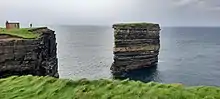
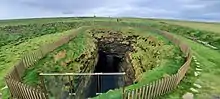
Another location associated with Crom Dubh is Downpatrick Head in County Mayo. According to Irish legend, St. Patrick came to the headland to confront Crom Dubh, who is variously identified as a pagan chieftan, god, pirate, or robber. Crom Dubh attempted to throw St. Patrick into an eternal fire, but Patrick countered by drawing a cross on a stone and casting it into the fire, which became Poll a' Sean Tine (the hole of the old fire). Crom Dubh was then driven by St. Patrick into his home of Dun Briste, which Patrick separated from the mainland by driving his crozier into the ground. The site of Downpatrick Head became an important place of ritual and pilgrimage during the Festival of Lughnasadh - similar to Croagh Patrick. The alternate names associated with Crom Dubh at Downpatrick Head include Cormac Dubh, Geodrisg, Deodrisg and Leodrisg. In other stories St. Patrick banishes the snakes of Ireland to Dun Briste. [4]
According to another local folktale, Crom Dubh was a servant of St. Patrick who gathered wood for the Saint to cook food for the needy. Crom Dubh interrupted St. Patrick during Mass on Crom Dubh Sunday by asking when the Sluagh Sidhe would go to Paradise, to which St. Patrick responded they would not go there until the Last Judgment. Before that day, the people would put their sickles in the corn and their spades in the ground, and the invisible Sidhfir would do the agricultural work for them, but after that day, the Sidhfir would no longer do any work.[5]
See also
References
- Nutt, The Celtic Doctrine of Re-Birth (1897), p. 149.
- "The Book of Fermoy", Proceedings of the Royal Irish Academy, Dublin. M.H. O'Neil, 1870, p.30
 This article incorporates text from this source, which is in the public domain.
 - "Celtic Gods, Crom Cruaich". Magic of Mythology. Archived from the original on 4 July 2010. Retrieved 9 December 2010.
Festivals: Domhnach Crom Dubh - Last Sunday in July or First Sunday in August. During Lughnasadh - (The August festival of Lugh)...
- "Majestic Downpatrick Head, Ballycastle, Co. Mayo". North Mayo. Retrieved 1 November 2021.
- Fitzgerald, David (1880). Popular Tales of Ireland. Revue Celtique. p. 175. Retrieved 6 November 2021.
This article incorporates text from "Dwelly's [Scottish] Gaelic Dictionary" (1911).