Cross-cap
In mathematics, a cross-cap is a two-dimensional surface in 3-space that is one-sided and the continuous deformation of a Klein bottle that intersects itself in an interval. In the domain, the inverse image of this interval is a longer interval that the mapping into 3-space "folds in half". At the point where the longer interval is folded in half in the image, the nearby configuration is that of the Whitney umbrella.
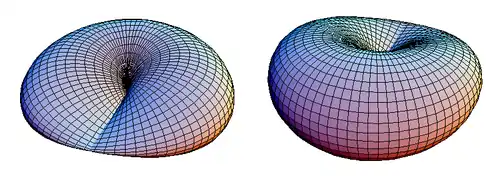
A cross-cap can be constructed by pulling both ends of the sling of a Klein bottle, finally making the original eversion to a ring like shape. This is equivalent to a torus, where both surfaces are connected by a ring, that connects the inner with the outer. This ring can then be shrunk to a line or other edge like shapes, but not a point, since this would change the Euler characteristic. It is similar to the creation process of a Möbius strip without self intersection, the latter being the lower dimensional equivalent. It is therefore homeomorphic to a Klein bottle. It is the pinched torus immersion of the latter.
An important theorem of topology, the classification theorem for surfaces, states that each two-dimensional compact manifold without boundary is homeomorphic to a sphere with some number (possibly 0) of "handles" and 0, 1, or 2 cross-caps.