Cubic equations of state
Cubic equations of state are thermodynamic models for modelling the pressure as a function of temperature and density. Yet, using classical relations of thermodynamics, these models can also be used for determining caloric properties. Cubic equations of state are highly relevant for industry application. Yet, physically-based equations of state based on more rigorous statistical mechanics are the state-of-the art today and routinely used in academia.
Cubic equations of state are called such because they can be rewritten as a cubic function of .

Van der Waals equation of state
The Van der Waals equation of state may be written:
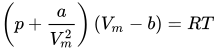
where is molar volume. The substance-specific constants and can be calculated from the critical properties , , and (noting that is the molar volume at the critical point) as:


Also written as
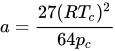

Proposed in 1873, the van der Waals equation of state was one of the first to perform markedly better than the ideal gas law. In this landmark equation is called the attraction parameter and the repulsion parameter or the effective molecular volume. While the equation is definitely superior to the ideal gas law and does predict the formation of a liquid phase, the agreement with experimental data is limited for conditions where the liquid forms. While the van der Waals equation is commonly referenced in text-books and papers for historical reasons, it is now obsolete. Other modern equations of only slightly greater complexity are much more accurate.
The van der Waals equation may be considered as the ideal gas law, "improved" due to two independent reasons:
- Molecules are thought as particles with volume, not material points. Thus cannot be too little, less than some constant. So we get () instead of .
- While ideal gas molecules do not interact, we consider molecules attracting others within a distance of several molecules' radii. It makes no effect inside the material, but surface molecules are attracted into the material from the surface. We see this as diminishing of pressure on the outer shell (which is used in the ideal gas law), so we write ( something) instead of . To evaluate this ‘something’, let's examine an additional force acting on an element of gas surface. While the force acting on each surface molecule is ~, the force acting on the whole element is ~~.


With the reduced state variables, i.e. , and , the reduced form of the Van der Waals equation can be formulated:


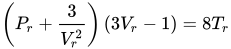
The benefit of this form is that for given and , the reduced volume of the liquid and gas can be calculated directly using Cardano's method for the reduced cubic form:



For and , the system is in a state of vapor–liquid equilibrium. The reduced cubic equation of state yields in that case 3 solutions. The largest and the lowest solution are the gas and liquid reduced volume.


Redlich-Kwong equation of state[1]
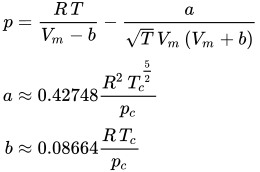
Introduced in 1949, the Redlich-Kwong equation of state was a considerable improvement over other equations of the time. It is still of interest primarily due to its relatively simple form. While superior to the van der Waals equation of state, it performs poorly with respect to the liquid phase and thus cannot be used for accurately calculating vapor–liquid equilibria. However, it can be used in conjunction with separate liquid-phase correlations for this purpose.
The Redlich-Kwong equation is adequate for calculation of gas phase properties when the ratio of the pressure to the critical pressure (reduced pressure) is less than about one-half of the ratio of the temperature to the critical temperature (reduced temperature):

Soave modification of Redlich-Kwong[2]
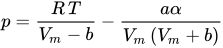
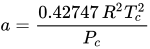
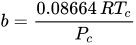


Where ω is the acentric factor for the species.
This formulation for is due to Graboski and Daubert. The original formulation from Soave is:


for hydrogen:

We can also write it in the polynomial form, with:


then we have:

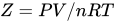
where is the universal gas constant and Z=PV/(RT) is the compressibility factor.

In 1972 G. Soave[3] replaced the 1/√T term of the Redlich-Kwong equation with a function α(T,ω) involving the temperature and the acentric factor (the resulting equation is also known as the Soave-Redlich-Kwong equation of state; SRK EOS). The α function was devised to fit the vapor pressure data of hydrocarbons and the equation does fairly well for these materials.
Note especially that this replacement changes the definition of a slightly, as the is now to the second power.
Volume translation of Peneloux et al. (1982)
The SRK EOS may be written as

where
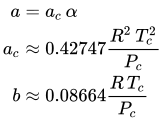
where and other parts of the SRK EOS is defined in the SRK EOS section.
A downside of the SRK EOS, and other cubic EOS, is that the liquid molar volume is significantly less accurate than the gas molar volume. Peneloux et alios (1982)[4] proposed a simple correction for this by introducing a volume translation

where is an additional fluid component parameter that translates the molar volume slightly. On the liquid branch of the EOS, a small change in molar volume corresponds to a large change in pressure. On the gas branch of the EOS, a small change in molar volume corresponds to a much smaller change in pressure than for the liquid branch. Thus, the perturbation of the molar gas volume is small. Unfortunately, there are two versions that occur in science and industry.

In the first version only is translated,[5] [6] and the EOS becomes


In the second version both and are translated, or the translation of is followed by a renaming of the composite parameter b − c.[7] This gives

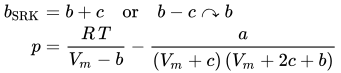
The c-parameter of a fluid mixture is calculated by

The c-parameter of the individual fluid components in a petroleum gas and oil can be estimated by the correlation

where the Rackett compressibility factor can be estimated by


A nice feature with the volume translation method of Peneloux et al. (1982) is that it does not affect the vapor-liquid equilibrium calculations.[8] This method of volume translation can also be applied to other cubic EOSs if the c-parameter correlation is adjusted to match the selected EOS.
Peng–Robinson equation of state
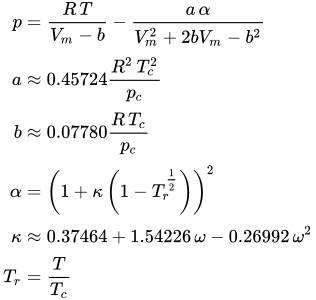
In polynomial form:



where is the acentric factor of the species, is the universal gas constant and is compressibility factor.

The Peng–Robinson equation of state (PR EOS) was developed in 1976 at The University of Alberta by Ding-Yu Peng and Donald Robinson in order to satisfy the following goals:[9]
- The parameters should be expressible in terms of the critical properties and the acentric factor.
- The model should provide reasonable accuracy near the critical point, particularly for calculations of the compressibility factor and liquid density.
- The mixing rules should not employ more than a single binary interaction parameter, which should be independent of temperature, pressure, and composition.
- The equation should be applicable to all calculations of all fluid properties in natural gas processes.
For the most part the Peng–Robinson equation exhibits performance similar to the Soave equation, although it is generally superior in predicting the liquid densities of many materials, especially nonpolar ones.[10] The departure functions of the Peng–Robinson equation are given on a separate article.
The analytic values of its characteristic constants are:



Peng–Robinson-Stryjek-Vera equations of state
PRSV1
A modification to the attraction term in the Peng–Robinson equation of state published by Stryjek and Vera in 1986 (PRSV) significantly improved the model's accuracy by introducing an adjustable pure component parameter and by modifying the polynomial fit of the acentric factor.[11]
The modification is:

where is an adjustable pure component parameter. Stryjek and Vera published pure component parameters for many compounds of industrial interest in their original journal article. At reduced temperatures above 0.7, they recommend to set and simply use . For alcohols and water the value of may be used up to the critical temperature and set to zero at higher temperatures.[11]


PRSV2
A subsequent modification published in 1986 (PRSV2) further improved the model's accuracy by introducing two additional pure component parameters to the previous attraction term modification.[12]
The modification is:

where , , and are adjustable pure component parameters.


PRSV2 is particularly advantageous for VLE calculations. While PRSV1 does offer an advantage over the Peng–Robinson model for describing thermodynamic behavior, it is still not accurate enough, in general, for phase equilibrium calculations.[11] The highly non-linear behavior of phase-equilibrium calculation methods tends to amplify what would otherwise be acceptably small errors. It is therefore recommended that PRSV2 be used for equilibrium calculations when applying these models to a design. However, once the equilibrium state has been determined, the phase specific thermodynamic values at equilibrium may be determined by one of several simpler models with a reasonable degree of accuracy.[12]
One thing to note is that in the PRSV equation, the parameter fit is done in a particular temperature range which is usually below the critical temperature. Above the critical temperature, the PRSV alpha function tends to diverge and become arbitrarily large instead of tending towards 0. Because of this, alternate equations for alpha should be employed above the critical point. This is especially important for systems containing hydrogen which is often found at temperatures far above its critical point. Several alternate formulations have been proposed. Some well known ones are by Twu et al. or by Mathias and Copeman.
Peng-Robinson-Babalola equation of state (PRB)
Babalola [13] modified the Peng–Robinson Equation of state as:

The attractive force parameter ‘a’, which was considered to be a constant with respect to pressure in Peng–Robinson EOS. The modification, in which parameter ‘a’ was treated as a variable with respect to pressure for multicomponent multi-phase high density reservoir systems was to improve accuracy in the prediction of properties of complex reservoir fluids for PVT modeling. The variation was represented with a linear equation where a1 and a2 represent the slope and the intercept respectively of the straight line obtained when values of parameter ‘a’ are plotted against pressure.
This modification increases the accuracy of Peng–Robinson equation of state for heavier fluids particularly at pressure ranges (>30MPa) and eliminates the need for tuning the original Peng-Robinson equation of state. Values for a
Elliott, Suresh, Donohue equation of state
The Elliott, Suresh, and Donohue (ESD) equation of state was proposed in 1990.[14] The equation seeks to correct a shortcoming in the Peng–Robinson EOS in that there was an inaccuracy in the van der Waals repulsive term. The EOS accounts for the effect of the shape of a non-polar molecule and can be extended to polymers with the addition of an extra term (not shown). The EOS itself was developed through modeling computer simulations and should capture the essential physics of the size, shape, and hydrogen bonding.

where:
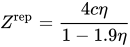
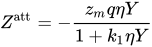
and
- is a "shape factor", with for spherical molecules
- For non-spherical molecules, the following relation is suggested

- where is the acentric factor.

- The reduced number density is defined as


where
- is the characteristic size parameter
- is the number of molecules
- is the volume of the container


The characteristic size parameter is related to the shape parameter through

where
- and is Boltzmann's constant.


Noting the relationships between Boltzmann's constant and the Universal gas constant, and observing that the number of molecules can be expressed in terms of Avogadro's number and the molar mass, the reduced number density can be expressed in terms of the molar volume as
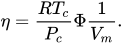
The shape parameter appearing in the Attraction term and the term are given by


- (and is hence also equal to 1 for spherical molecules).

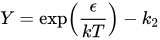
where is the depth of the square-well potential and is given by


- , , and are constants in the equation of state:
- for spherical molecules (c=1)
- for spherical molecules (c=1)
- for spherical molecules (c=1)



The model can be extended to associating components and mixtures of nonassociating components. Details are in the paper by J.R. Elliott, Jr. et al. (1990).[14]
Cubic-Plus-Association
The Cubic-Plus-Association (CPA) equation of state combines the Soave-Redlich-Kwong equation with the association term from SAFT[15][16] based on Chapman's extensions and simplifications of a theory of associating molecules due to Michael Wertheim.[17] The development of the equation began in 1995 as a research project that was funded by Shell, and in 1996 an article was published which presented the CPA equation of state.[17][18]

In the association term is the mole fraction of molecules not bonded at site A.

References
- Redlich, Otto.; Kwong, J. N. S. (1949-02-01). "On the Thermodynamics of Solutions. V. An Equation of State. Fugacities of Gaseous Solutions". Chemical Reviews. 44 (1): 233–244. doi:10.1021/cr60137a013. ISSN 0009-2665. PMID 18125401.
- Soave, Giorgio (1972). "Equilibrium constants from a modified Redlich-Kwong equation of state". Chemical Engineering Science. 27 (6): 1197–1203. doi:10.1016/0009-2509(72)80096-4.
- Soave, Giorgio (1972). "Equilibrium constants from a modified Redlich-Kwong equation of state". Chemical Engineering Science. 27 (6): 1197–1203. doi:10.1016/0009-2509(72)80096-4.
- Peneloux, A.; Rauzy, E.; Freze, R. (1982). "A Consistent Correction for Redlich-Kwong-Soave Volumes". Fluid Phase Equilibria. 8 (1982): 7–23. doi:10.1016/0378-3812(82)80002-2.
- Soave, G.; Fermeglia, M. (1990). "On the Application of Cubic Equation of State to Synthetic High-Pressure VLE Measurements". Fluid Phase Equilibria. 60 (1990): 261–271. doi:10.1016/0378-3812(90)85056-G.
- Zéberg-Mikkelsen, C.K. (2001). Viscosity study of hydrocarbon fluids at reservoir conditions - modeling and measurements. Ph.D. Thesis at the Technical University of Denmark. Department of Chemical Engineering. June. pp. 1–271. ISBN 9788790142742.
- Pedersen, K. S.; Fredenslund, Aa.; Thomassen, P. (1989). Properties of Oils and Natural Gases. Book Published by Gulf Publishing Company, Houston. 1989. pp. 1–252. ISBN 9780872015883.
- Knudsen, K. (1992). "Phase Equilibria and Transport of Multiphase Systems". Ph.D. Thesis at the Technical University of Denmark. Department of Chemical Engineering (1992).
- Peng, D. Y.; Robinson, D. B. (1976). "A New Two-Constant Equation of State". Industrial and Engineering Chemistry: Fundamentals. 15: 59–64. doi:10.1021/i160057a011.
- Pierre Donnez (2007). "Essentials of Reservoir Engineering". 1: 151. Cite journal requires
|journal=(help) - Stryjek, R.; Vera, J. H. (1986). "PRSV: An improved Peng–Robinson equation of state for pure compounds and mixtures". The Canadian Journal of Chemical Engineering. 64 (2): 323–333. doi:10.1002/cjce.5450640224.
- Stryjek, R.; Vera, J. H. (1986). "PRSV2: A cubic equation of state for accurate vapor—liquid equilibria calculations". The Canadian Journal of Chemical Engineering. 64 (5): 820–826. doi:10.1002/cjce.5450640516.
- "(PDF) A comparative analysis of the performance of various equations of state in thermodynamic property prediction of reservoir fluid systems". ResearchGate. Retrieved 2021-01-08.
- J. Richard Jr. Elliott; S. Jayaraman Suresh; Marc D. Donohue (1990). "A Simple Equation of State for Nonspherical and Associating Molecules". Ind. Eng. Chem. Res. 29 (7): 1476–1485. doi:10.1021/ie00103a057.
- Chapman, Walter G. (1988). "Theory and Simulation of Associating Liquid Mixtures". Doctoral Dissertation, Cornell University.
- Chapman, Walter G.; Jackson, G.; Gubbins, K.E. (11 July 1988). "Phase equilibria of associating fluids: Chain molecules with multiple bonding sites". Molecular Physics. 65: 1057–1079. doi:10.1080/00268978800101601.
- Kontogeorgis, Georgios M.; Michelsen, Michael L.; Folas, Georgios K.; Derawi, Samer; von Solms, Nicolas; Stenby, Erling H. (2006). "Ten Years with the CPA (Cubic-Plus-Association) Equation of State. Part 1. Pure Compounds and Self-Associating Systems". Industrial and Engineering Chemistry Research. 45 (14): 4855–4868. doi:10.1021/ie051305v.
- Kontogeorgis, Georgios M.; Voutsas, Epaminondas C.; Yakoumis, Iakovos V.; Tassios, Dimitrios P. (1996). "An Equation of State for Associating Fluids". Industrial & Engineering Chemistry Research. 35 (11): 4310–4318. doi:10.1021/ie9600203.