Cut-off low
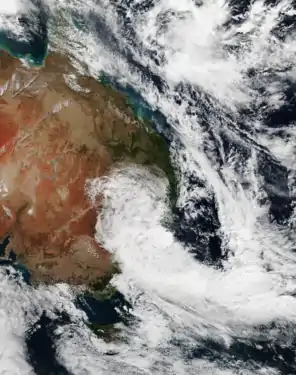
A cut-off low (COL), which is known to meteorologists as the weatherman's woe, a closed low or a cold pool, is defined as "a closed upper-level low which has become completely displaced (cut off) from basic westerly current, and moves independently of that current" by the National Weather Service. Cut-off lows form in mid-latitudes (usually in the subtropics or between 20° and 45°) and would remain nearly stationary for days.[1]
Formation
A cut-off low is a cold low where polar air is cut off from the primary subpolar belt of westerly trough of low pressure and cold air, which is the standard track of depressions. Cut-off low would first arise as a trough in the upper-air flow that close in circulation and then would reach down to the earth. It is defined by concentric isotherms around the core of the low. They are more common in times when there is low index circulation. They can also be at any platform in the atmosphere, and as such, they may not be visible on surface charts. At times, a cut-off low would occur with a cut-off high over higher latitudes, which are typically in blocking circumstances and they can last for a week.[2]
Furthermore, they may also form in an unstable easterly flow on the northern wing of a blocking high. Australian east coast lows are a type of an intense cut-off low system, but would have characteristics of subtropical cyclones as they are extratropical cyclones. Whilst cut-off lows can form at any time of the year, they are more common in autumn, winter and spring in much of the areas affected.[3]
Effects
Cut off lows typically create unsettled weather and, in the warm season, they may produce a lot of thunderstorms. A cut-off low has a slow movement, typically over a confined region, where it produces heavy rainfall. They are volatile, baroclinic systems that meander to the west with strong convergence and an ascending motion, especially when they are deepening.[4] In eastern Australia, a cut-off low can bring accumulating and widespread snowfall at low-level areas and as well as elevated regions in the subtropics.[5]
Regions
In the southern hemisphere, cut-off lows are common in South Africa, Namibia, South America and southern Australia.
In the northern hemisphere, they can occur in Europe, China and Siberia, North Pacific, Northeastern United States and the northeast Atlantic.
References
- Buzz word: 'Cut-off low' to bring rain to DMV most of the week WUSA-TV
- Cut-off low by Weather Online
- Cut-off Lows by the Bureau of Meteorology
- Cut-Off Low pressure systems - Meteorological Physical Background EUMeTrain
- Sydney shivers through coldest day since 1984 as snow blankets NSW By Sarah McPhee and Daniella White from The Daily Telegraph. June 10, 2021