DX-Ball 2
DX-Ball 2 is a brick buster game for Microsoft Windows, developed by Longbow Games. As a follow up to DX-Ball by Michael P. Welch, the sequel is foremost remarked by the introduction of its 16-bit high-colour engine, presenting textured bricks and background graphics in vivid colours. The game also features two new Power-Ups, an easy to play "Kid-Mode", and a hotseat multiplayer mode, alongside an original soundtrack by SideWinder. DX-Ball 2 also introduces the feature of board-set selection, allowing the player to select between different sets of boards to play. The free demo thereby comes packed with a total of 24 boards divided into 6 board-sets of 4 boards search. Additional board packs can then be installed for more boards, whereas Board Pack 1 will expand the demo board-sets to 25 boards each, for a total of 150 boards. While a total of five board packs were released for the game, DX-Ball 2 was eventually succeeded by Rival Ball in 2001. A 20th Anniversary edition was announced on August 23, 2018 and was released on November 21, 2018, which features a new high resolution boardset, new power ups, online leaderboard and boardset editor.[1]
| DX-Ball 2 | |
|---|---|
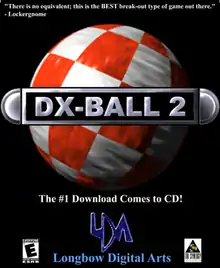 Boxart from the boxed CD version of the game | |
| Developer(s) | Longbow Digital Arts |
| Publisher(s) | Longbow Digital Arts |
| Designer(s) | Seumas McNally |
| Composer(s) | Eric "SideWinder" Gieseke |
| Platform(s) | Windows |
| Release | December 16, 1998 |
| Genre(s) | Brick buster |
| Mode(s) | Single-player, multiplayer |
Gameplay
As a common Breakout-style game, the object is to clear the screen of all bricks, in order to advance to the next board. The player controls a paddle at the bottom of the screen by using the mouse, keeping one or more balls in play by bouncing them into a field of bricks to clear them. Some bricks will take multiple hits before they clear, while other bricks will appear to be unbreakable, invisible or combustible. As bricks are being cleared, random Power-Ups will occasionally released upon impact (see Power-Ups). The player may choose to catch these with the paddle, or avoid them, depending on the specific Power-Up and its effect. For instance, some Power-Ups may speed up game progress by enhancing the paddle with guns or splitting the ball into multiple balls, while other Power-Ups may increase the difficulty by speeding up the ball or shrinking the paddle. If the player misses the last or only ball in play, a paddle will be lost. The game will end once all spare paddles have been lost, or after the selected board-set has been completed.
Unlike other Breakout clones, the ball on DX-Ball 2 can travel freely at any angle and trajectory instead of being fixed at certain angles. The ball's trajectory will also differ depending on how the player controls it with the paddle. The speed of the ball gradually increases over time as the game continues, and will produce sparks and unique sound on the paddle when it has reached its maximum speed. Sharper angles can be achieved by bouncing the ball up with the paddle's edges while moving, which results in a much precision trajectory.
The difficulty level of the game can be switched between Normal and Kid-Mode. This is done by pressing F4 on the title screen, which allows the player to toggle between the two modes. Kid-Mode makes the game easier to play by excluding certain Power-Ups; reducing the ball speed (fixed in half of the highest speed); and letting the player start each board with 1 set of extended paddle and a permanent big ball. The excluded Power-Ups include Kill Paddle, Super Shrink and Shrink Ball. Hence the ball will always remain big, while the paddle may still be shrunk down by the regular Shrink Paddle power-up. Notably, Kid-Mode has its own high score table, which is separate from the high score table in Normal difficulty.
Rehab Mode is a more recent addition to the game, being introduced with version 1.3.2. While this feature is considered an advanced option, it is only accessible from the game's advanced configurations file. This file is located in DX-Ball 2's main directory as config.cfg<, and can safely be opened and edited in Notepad or any text editor. When Rehab Mode is enabled, the player will have infinite playing chances, and also be able to change the speed of the ball by pressing the number keys on the keyboard, going from 1 (slowest) to 0 (the highest speed in Kid-Mode). Consequently, the Fast Ball, Slow Ball and Eight Ball Power-ups will not affect the ball speed in Rehab Mode. The player will not be able to submit a high score when Rehab Mode is enabled.
The hotseat multiplayer mode can be activated from the game's title screen by pressing F3, allowing up to four players. Unlike 1 player mode, multiplayer mode do not allowed cheat codes to prevent spamming free power-ups, instead it replaced any key to release ball and shoot brick shots. After selecting which board-set to play, Player 1 will occupy the game until a paddle has been lost or the board-set has been completed. Whichever comes first, Player 2 takes turn subsequently, and so on, until the cycle starts over. If one player loses all their paddles, the game is left to the remaining players. At the end of the game, only the players who made it through the board-set will be allowed to submit their score on the high score screen.
Categorised by colour, the game features twenty Power-Ups in groups of ten blue, five red, and five grey. Basically, the blue Power-Ups are considered good, while red increase the difficulty, and grey may vary depending on the situation.
Aside from the main objective is clear one's way through the selected board-set, the player is also rewarded points during gameplay, that may award a position on the leaderboard for the specific board-set. By default, 10 points are earned for each brick cleared. However, this number can increase from a variety of factors, including the ball speed, and the size of both the ball and the paddle. Ultimately, if the player is able to control a small ball in at the highest speed, with the smallest paddle size, each brick cleared will earn a total of 40 points. However, if the FireBall is obtained, each brick cleared will only earn 8 points, regardless of any other conditions. This is also true for explosive bricks in general, including adjacent pieces that are destroyed and for all bricks shot with Shooting Paddle. Multi-hit bricks will only earn 2 points per hit, before the final hit, with exception of invisible bricks, which only reward points as they are cleared. Points are also earned by collecting any of the available power-ups, which is worth 50 points each. The player is unable to save their high score if Rehab Mode or Cheat Code (1 player only) is activated.
Development
Programmed by Seumas McNally, DX-Ball 2 was first released on December 16, 1998.[2] The game was an updated version of the classic DX-Ball by Michael P. Welch, on which Seumas had contributed with graphic and level design.[lower-roman 1] It retained the basic gameplay of the original game, while also recycling the sound effects, and the graphics for the paddle and Power-Ups. However, with the advantage of running in high colour mode, DX-Ball 2 presented a significant upgrade from its predecessor in the visual aspect, delivering colorful board designs with textured bricks and background graphics; enhanced explosion animation with sparks; ray traced balls; and screens of fiery plasma effects. Also unique to DX-Ball 2 was the ability to select between multiple board-sets to play, enhancing the gameplay experience with varying themes and graphical styles. Among other new features, the game also introduced two new Power-Ups: Mega Ball and Eight Ball; an easy-to-play Kid-Mode; and a euro-techno soundtrack by SideWinder, accompanying the addition of an integrated module player.
A 20th Anniversary Edition of the game was announced on August 23, 2018 with the release set for Fall of 2018 on Steam. New features include a new boardset, a level editor and online leaderboards.[3]
Board Packs
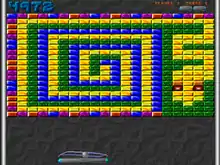
When DX-Ball 2 was initially released, it came as a free demo with 24 boards divided into six board-sets of 4 boards each. Its complementary was then known as the DX-Ball 2 Board Pack, or Board Pack 1, which expands the demo board-sets into their entirety of 25 boards each, for a total of 150 boards.[4] More boards were eventually also made available, as the additions of Board Pack 2 and Classic Pack were released on June 13, 1999.[5]
Board Pack 2 featured 150 new boards by lead board designer Wendy McNally, presented in four board-sets of 25 boards, and one board-set of 50 boards. As in line with the style presented in Board Pack 1, Wendy's designs feature unique themes for each board-set, presenting artistic illustrations of various ideas and concepts. Furthermore, the board pack also featured new backgrounds to go with the new board-sets.[lower-roman 3]
The Classic Pack featured another 150 boards, designed by Michael and Sarah Welch, including the 50 original boards from DX-Ball, and two new board-sets of 50 boards each. As a homage to the original game, the graphics for the Classic Pack were designed to retain the classic style, sporting a softer look to the bricks and a faintly textured black background.[lower-roman 3]
Following the passing of Seumas, Board Pack 3 was released on May 19, 2000. Conforming to the style of the previous board pack, Board Pack 3 contained 150 new boards by Wendy McNally, spanning four board-sets of 25 boards, and one board-set of 50 boards.[6]
The game's final board pack, Memorial Pack was presented on July 19, 2000.[7] In commemoration of Seumas, the board pack contained a dedicated memorial set of 100 boards (formerly exclusive to Playmachine.net);[lower-roman 4] two board-sets of 25 boards; and a bonus alphabet board-set of 26 boards, adding to a total of 176 boards. As a special feature exclusive to the board pack, three of the board-sets featured a special set of bricks, that combines the three distinct brick styles seen in the game, while also introducing a couple of new ones. The board pack also featured new backgrounds for one of the board-sets.[lower-roman 3]
Although Board Pack 1 is considered the full version of DX-Ball 2, the board packs can be installed and played in any desired order, independent of each other. For instance, Board Pack 3 can safely be installed without any previous installation of Board Pack 1, in which case the initial demo board-sets will remain intact.[8]
Music
The music in DX-Ball 2 was written by Eric Gieseke, also known as SideWinder.[lower-roman 5] The complete soundtrack contains 15 songs in a melodic euro-techno style, with various branches and influences ranging from hardcore, techno, breakbeat, jazz, house, and rock. Initially, the game came bundled with only 4 tracks, encompassing three title screen songs and a high score theme. However, with the release of DX-Ball 2 version 1.2, support was added for in-game music. While this allowed for the three title screen songs to be played back in-game, a separate Music Pack was simultaneously made available for download, adding 11 new songs to the game.[9] Notably, though, the Music Pack was discontinued as of version 1.3.2, as the 11 in-game songs are now included with the basic installation.
The in-game songs are played in a random order per game, and the player can easily skip between tracks or turn the music off by pressing F5: the first press unloading the music, and the next press loading a new song. DX-Ball 2 also permits the in-game music to be customised by adding or removing files from the InGameMods subdirectory. However, the game will only support tracker modules of the .mod, .xm and .s3m formats. The modules may use up to 24 channels, but the game will initially only allow up to 8 channels. In order to increase this value, it must be changed from the game's advanced configurations file (see Kid-Mode and Rehab Mode). Incidentally, as a related option under the advanced configurations, the playback rate of all sound is set to 22 kHz by default, and may be increased to 44.1 kHz for improved sound quality.
Boxed version
For a limited time, starting November 2000, DX-Ball 2 was made available as a boxed CD version in the U.S., being published by Tri Synergy and retailed through Babbage's, Software ETC and Game Stop. The choice of publishing a boxed version of the game was foremost in response to a public request for a gift option, while it also served as an experiment for Longbow Digital Arts to evaluate its ability to self-publish into regular retail channels. The boxed CD featured the main game, Board Pack 1, the Music Pack, and the alphabet board-set from Memorial Pack as an added bonus, summing up to a total of 176 boards.[10][11]
Reception
DX-Ball 2 was met with an overall positive reception from both editors and players. Games Domain reviewer Zack Schiel praised it for addictive gameplay, and noted it as the "best-looking Breakout game ever made". However, he also noted that the "overall graphics [were] not up to today's retail standards".[12] ZDNet rated it 5/5 stars.[13]
Successor
As a spiritual sequel to DX-Ball 2, Longbow Games released Rival Ball in 2001. While the new title recycled the engine of DX-Ball 2, it also introduced many new features, including a buttoned layout with cursor-based navigation; two new Power-Ups (replacing two older ones); new graphics for the Power-Ups; new square shaped bricks; 4 difficulty modes; new sound effects and music; and 1-on-1 split screen network play. In addition, it also featured the ability to set timers, randomise board order and repeat board sets, also including support for DX-Ball 2 boards.[1]
Notes
- For Seumas McNally's involvement with the original DX-Ball, see that game's opening credits.
- The board-set is featured in Board Pack 2.[4]
- For the visual features presented in the different board packs, see DX-Ball 2's website for related screenshots.[4]
- The board-set file for "Seumas Memorial 100" is named playmachine.bdz, indicating that this is the same board-set that was used for the Playmachine.net version of the game.
- For the author of the music in DX-Ball 2, see the game's opening credits.
References
- "Topic: Announcing Rival Ball". March 19, 2001. Longbow Digital Arts. Retrieved June 28, 2012.
- "Topic: DX-Ball 2 Available for Download!". December 16, 1998. Longbow Digital Arts. Retrieved June 27, 2012.
- "Topic: DX-Ball 2: 20th Anniversary Edition!". August 23, 2018. Longbow Digital Arts. Retrieved September 12, 2018.
- "DX-Ball 2". Longbow Digital Arts. Retrieved June 27, 2012.
- "Topic: More DX-Ball 2 Boards!". June 13, 1999. Longbow Digital Arts. Retrieved June 27, 2012.
- "Topic: Announcing DX-Ball 2 Board Pack #3". May 19, 2000. Longbow Digital Arts. Retrieved June 27, 2012.
- "Topic: Announcing DX-Ball 2 Memorial Pack and Particle Fire 2". July 19, 2012. Longbow Digital Arts. Retrieved June 27, 2012.
- LDA Kusari (January 1, 2002). "Ordering DX-Ball 2 - Longbow Digital Arts Discussion". Longbow Digital Arts. Archived from original Archived 2012-06-28 at WebCite on June 28, 2012. Retrieved June 28, 2012.
- "Topic: DX-Ball 2 Version 1.2". May 12, 1999. Longbow Digital Arts. Retrieved June 27, 2012.
- "Topic: Tread Marks and DX-Ball 2 on Store Shelves". November 24, 2000. Longbow Digital Arts. Retrieved June 27, 2012.
- LDA (January 21, 2001). "purchasing - Longbow Digital Arts Discussion". Longbow Digital Arts. Archived from original Archived 2012-06-25 at WebCite on June 25, 2012. Retrieved June 27, 2012.
- Games Domain Review" (Archive). Zack Schiel. Games Domain. Retrieved June 27, 2012.
- "ZDNet: DX-Ball 2" (Archive). January 17, 1999. ZDNet. Retrieved June 27, 2012.