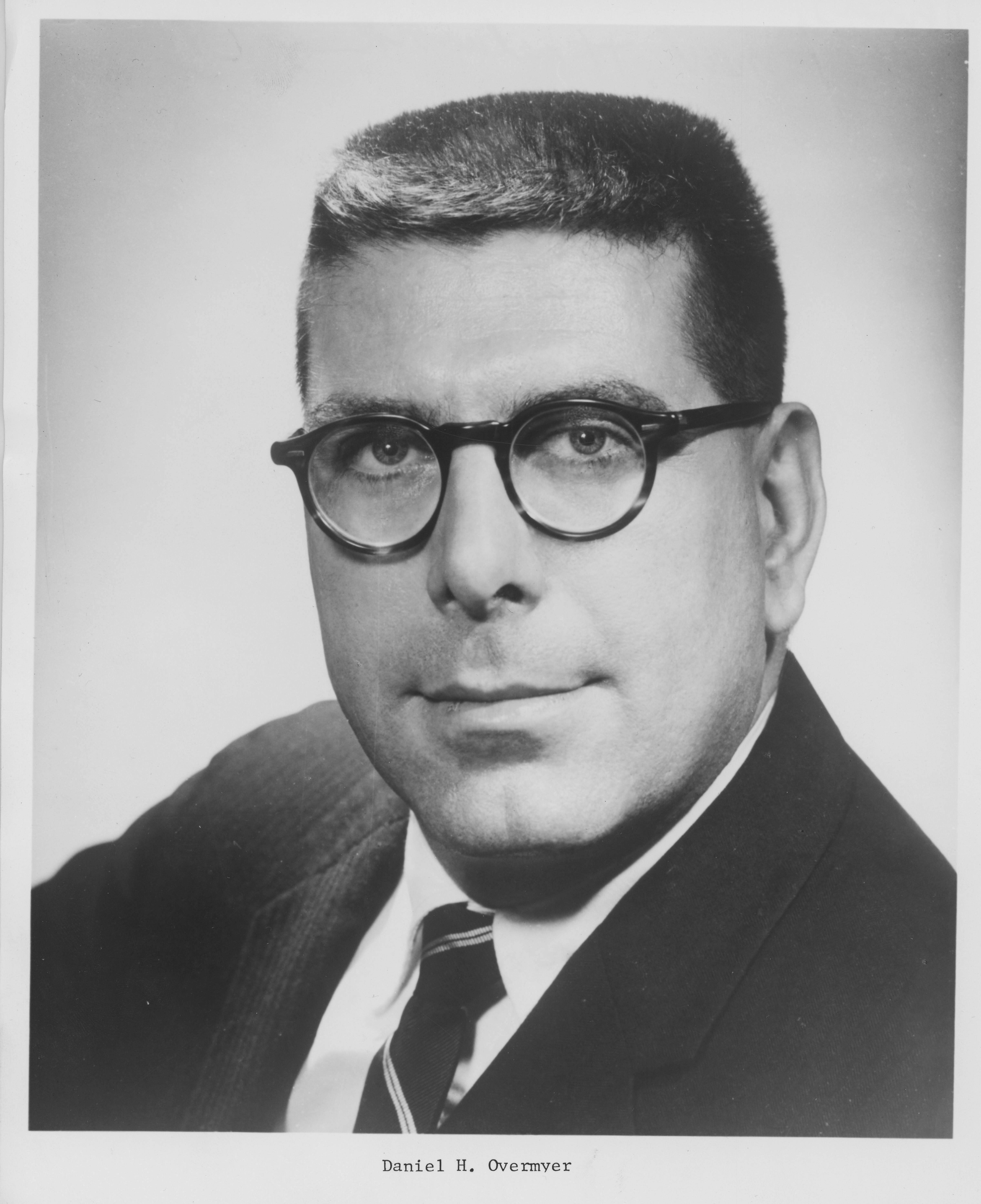
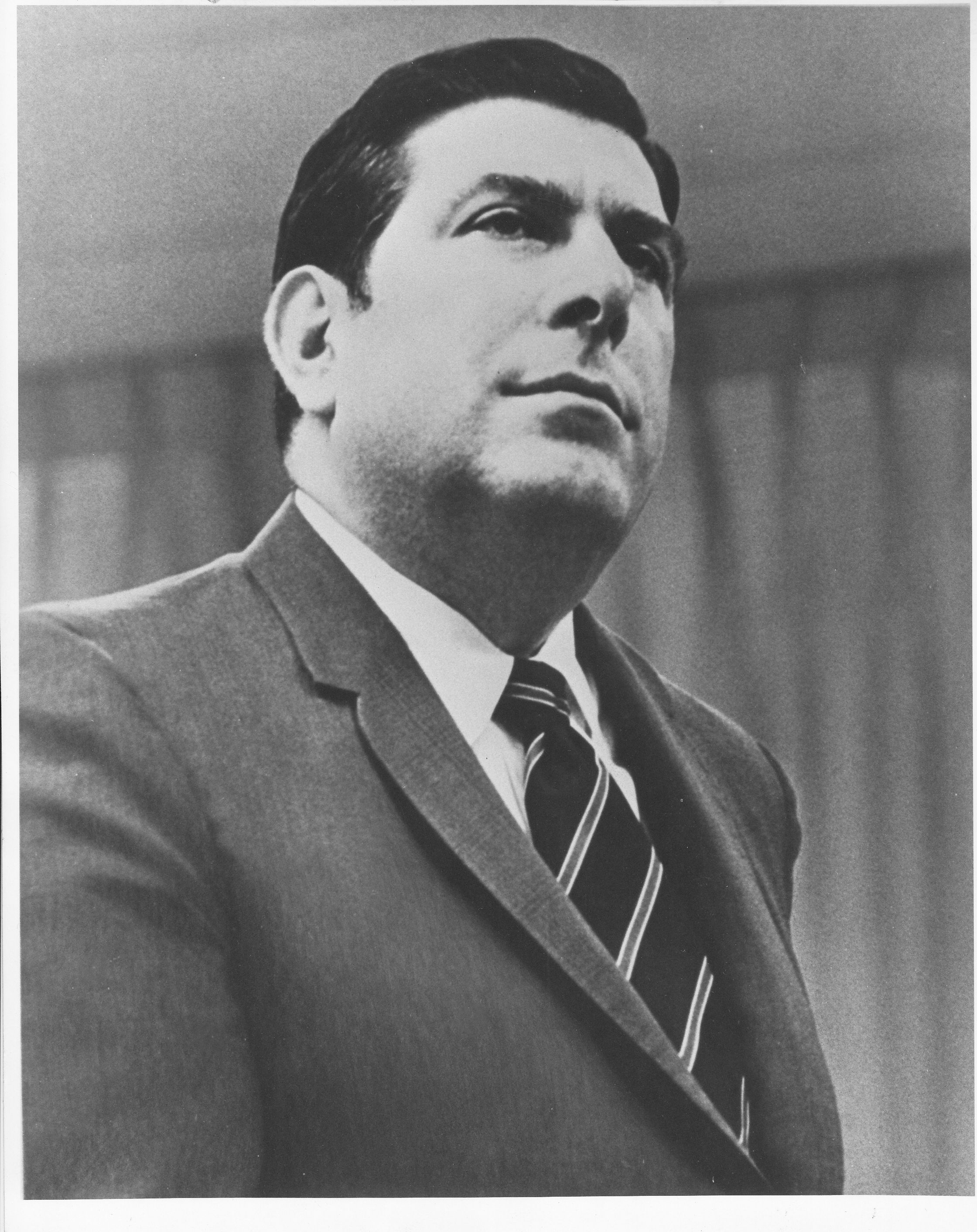
Daniel H. Overmyer
Daniel Harrison Overmyer (December 6, 1924 – July 24, 2012) was an American businessman and warehouse mogul. During the height of his career, Overmyer was referred to as "the king of warehousing."[1]
Daniel H. Overmyer | |
|---|---|
| Born | Daniel Harrison Overmyer December 6, 1924 Toledo, Ohio, U.S. |
| Died | July 24, 2012 (aged 87) Tarzana, Los Angeles, California, U.S. |
| Alma mater | Denison University |
| Occupation | Businessman, warehouse mogul |
| Years active | 1947–1986 |
| Spouse(s) | Shirley Overmyer
(m. 1943; died 1994) |
| Children | 5 |
Overmyer founded and operated the D. H. Overmyer Warehouse Company, which included more than 350 warehouses and 32 million square feet of space in North America and Europe. In 1964, Overmyer also established the D. H. Overmyer Communications Company to own and operate several ultrahigh frequency television stations as part of the larger Overmyer Network, an attempt by Overmyer to create a fourth television network. In March 1967, control of the Overmyer Network passed to new owners who changed the name to the United Network before broadcasting started on May 1, 1967. The network was unsuccessful and ceased operation after one month, with the last broadcast occurring on May 31.[2]
Early life and education
Overmyer was born in Ohio's fourth-largest city, Toledo. He was the only child of Harrison Morton "Harry" Overmyer and his wife Cora Belle Overmyer (November 11, 1887 – December 14, 1963).[3]
Overmyer's father, who was of German descent, owned and operated a chain of grocery stores in and around Toledo before he went into the warehousing business. His father founded the Merchants and Manufacturers Warehouse Co., which operated from Atlanta until the mid-20th century.[4]
Overmyer, although born in Toledo, grew up in the nearby village of Ottawa Hills. He graduated from Ottawa Hills High School then attended and graduated from Denison University in Granville, Ohio.[1] During his time at Denison in 1943, Overmyer was drafted into the army. He served as a private and a transport warrant officer during World War II. Overmyer helped with barge unloadings during the landings in Normandy on D-Day.[5]
Career
Warehousing
In 1947, Overmyer opened his first warehouse in Toledo and later grew his warehouse chain to Akron and Canton, Ohio. Soon after that expansion, Overmyer founded the D. H. Overmyer Warehouse Company, further enlarging his company to include all of Ohio. During the 1960s, Overmyer's warehouse company quickly broadened across the United States, Canada, and Europe with 350 warehouses and 32 million square feet of space.[1]
Overmyer Communications Company
In 1963, Overmyer turned his attention to television. On April 15, as an individual rather than under a corporate name, he applied to the Federal Communications Commission (FCC) for Toledo's first ultrahigh frequency (UHF) television station on channel 79.[6] Toledo had two commercial very high frequency (VHF) stations: CBS affiliate WTOL-TV and WSPD-TV (now WTVG), an NBC affiliate; the stations shared ABC programming.[7] UHF television stations were a risky investment due to the low number of UHF equipped TV sets; however, the recent passage into law of the All-Channel Receiver Act would gradually increase the percentage of UHF capable TV receivers.[8] Producers Incorporated and Springfield Television Broadcasting Corporation also filed applications for channel 79.[9][10] In February 1964, the FCC announced a comparative hearing would be necessary before awarding the construction permit.[11] On March 2, 1964, Springfield Television Inc. petitioned the FCC to add the issue of Overmyer's financial qualifications to the hearing. Springfield claimed the bank loans Overmyer intended to use were not firm commitments, and the warehouse company had insufficient funds to make loans to construct and operate the TV station. On April 29, 1964, the FCC denied the petition to add these considerations to the proceedings and said Overmyer had already satisfied the financial qualifications requirement.[12] Under different circumstances, the U.S. House of Representatives would hold a hearing in 1968 to examine these same financial qualifications in greater detail. In September 1964, Overmyer reached an agreement with the two competitors for the Toledo station to withdraw their applications in return for his payment of their out-of-pocket expenses.[13] On March 11, 1965, Overmyer was awarded the construction permit for channel 79.[14] The requested call letters were WDHO-TV based on Overmyer's initials.[15][16] On August 6, 1965, Overmyer received approval from the FCC to change from channel 79 to 24. WDHO-TV signed on the air May 3, 1966, as an independent station with no network affiliation.[17][18][19] On April 28, 1966, before WDHO-TV began operation, Overmyer applied to the FCC to change its ownership from himself as an individual to D. H. Overmyer Telecasting Company.[20] WDHO-TV lost $1.3 million during its first two years of operation.[21]
In June 1964, Robert F. Adams, the executive vice president, announced the formation of the D. H. Overmyer Communications Company (Overmyer Communications Company). The company was solely owned by Overmyer and headquartered in New York City. The company began to acquire the full complement of TV properties allowed by FCC rules.[22][23]Overmyer Communications Company purchased the construction permits of three UHF TV stations: August 17, 1964, dark station WATL-TV channel 36 in Atlanta (operated 1954–55 as WQXI-TV); September 2, 1964, WNOP-TV channel 74 in Newport, Kentucky (in the Cincinnati area); and on November 16, 1964, KBAY-TV channel 20 in San Francisco.[24][25][26] WNOP-TV and KBAY-TV had never been constructed.[27][28][29][30][31][32][33] The Overmyer Communications Company also applied for new UHF stations in three markets: October 21, 1964, channel 55 in Stamford, Connecticut; November 10, 1964, channel 29 in Dallas; and February 12, 1965, channel 17 in Rosenberg, Texas (in the Houston area).[34][35][36] Overmyer also requested a waiver from the FCC's rule limiting ownership to seven stations. If approved, the eighth would be the UHF dark station WAND-TV, which operated during 1953–54 as WKJF-TV channel 53 in Pittsburgh (application submitted February 12, 1965).[37][38]After the FCC denied his waiver request, Overmyer withdrew the application for the Stamford station on May 11, 1965, and re-submitted the WAND-TV application on May 18, 1965.[39][40][41]
The FCC approved several construction permits in 1965: WNOP-TV in Cincinnati on March 10; WATL-TV in Atlanta on May 12; WAND-TV in Pittsburgh on July 28; Houston on August 12 (FCC granted channel 58); and KBAY-TV in San Francisco on October 20 (Overmyer held 80 percent[42]).[43][44][45][46][47] Overmyer's interest in KBAY-TV differed from the other stations because the original owner, Sherrill C. Corwin, retained 20 percent of the stock. Overmyer held an option to purchase Corwin's stock interest between the 49th and 63rd months after the station started operation. Overmyer was never awarded a construction permit for the Dallas station, and in the fall of 1967, he withdrew the application. The stations were incorporated separately as subsidiaries under the Overmyer Communications Company, but D. H. Overmyer Telecasting Company separately owned WDHO-TV:[48][49]
D. H. Overmyer Broadcasting Co., Inc., a Texas corporation (KJDO-TV, Houston)
D. H. Overmyer Communications Co., Inc., a Georgia corporation (WBMO-TV, Atlanta)
D. H. Overmyer Broadcasting Co., Inc., an Ohio corporation (WSCO-TV, Cincinnati)
D. H. Overmyer Communications Co., Inc., a Pennsylvania corporation (WECO-TV, Pittsburgh)
D. H. Overmyer Communications Co., Inc., a California corporation (KEMO-TV, San Francisco)
The call letters chosen for the stations were the initials of Overmyer's family members.[50] The company began large-scale purchases of equipment for the TV stations in the fall of 1965.[51][52][53][54] During 1966, purchases of programming for the stations were made for $3 million.[55] Sites had been established for most of the stations by late 1966.[56] Construction of the stations in Atlanta and Pittsburgh had been delayed due to the difficulty in finding suitable sites for the tall towers needed for the antennas.[57][58] At the start of 1967, the stations were in various stages of development: KEMO-TV in San Francisco had some construction at the transmitter site, and the studio building was about to undergo remodeling; WSCO-TV in Cincinnati had begun construction at the transmitter, but there were no final plans for remodeling the studio; WBMO-TV in Atlanta and WECO-TV in Pittsburgh had chosen sites, and some equipment had been delivered, but no construction work had started; KJDO-TV in Houston had no transmitter or studio sites, and no equipment had been delivered.[59][60][61] WDHO-TV in Toledo had been the only station to go into operation.
In the fall of 1966, Overmyer discovered the non-affiliated company managing the construction of his warehouses was in considerable financial difficulty. Payments to the subcontractors had stopped, which resulted in liens being placed on the unfinished warehouse properties. All warehouse construction ended, and no funding sources were found to finance the expansion of the warehouse company. D. H. Overmyer Company Inc. (Ohio), without legal obligation, guaranteed the $6 million debt assumed by its warehouse subsidiaries from the Green & White Construction Company.[62][63] Guaranteeing the debt removed the liens on the buildings, and warehouse construction was resumed. However, the increased debt load restricted the funds needed to finance further growth of the warehouse company and the TV stations. The original plan was for the warehouse company profits to aid in financing the construction of the TV stations and their early operational deficits. By assuming the Green & White debt, Overmyer was forced to redirect the warehouse profits into paying off that obligation over several years.[64] Therefore, the Overmyer Communications Company was forced to find outside funding to continue constructing the five unfinished television stations.[65]
In March 1967, Overmyer held negotiations with AVC Corporation to sell an interest in five of his construction permits. None of the stations involved in the sale had been placed in operation. AVC was created in 1963 when the American Viscose Corporation, a manufacturer of industrial fibers, sold its manufacturing operations to FMC Corporation. The investments held initially by American Viscose Corporation were transferred to a new non-affiliated corporation named AVC, which was created to be a diversified investment company. American Viscose continued operation under its name and became a division of the FMC Corporation. AVC was headquartered in Wilmington, Delaware, and was listed on the American Stock Exchange.[66][67] Overmyer agreed to sell 80 percent of the stock in each of his subsidiary corporations that held the construction permits for Atlanta (WBMO-TV), Cincinnati (WSCO-TV), San Francisco (KEMO-TV), Pittsburgh (WECO-TV), and Houston (KJDO-TV). AVC desired to purchase total ownership of the construction permits but was turned down by Overmyer during the sale negotiations.[68] The consideration for Overmyer's stock was 80 percent of the out-of-pocket expenses approved by the FCC—but not to exceed $1 million. Overmyer insisted on a $3 million loan as a condition for the stock sale to AVC; in response, AVC included an option in the contract to acquire the remaining 20 percent stock in the stations and received the assignment of Overmyer's option to purchase Corwin's 20 percent stock in KEMO-TV.[69] Joseph L. Castle, a partner with the Philadelphia investment banking firm of Butcher & Sherrerd, acted as a broker for the sale. Castle was also a stockholder in the Philadelphia UHF station WPHL-TV.[70][71][72][73][74][75][76] Butcher & Sherrerd also held stock in WPHL-TV, and partner Howard Butcher was on the board of directors of AVC Corporation.[77] On March 28, 1967, AVC and Overmyer signed the Stock Purchase and Loan Agreements to transfer control—if the FCC approved—of the Overmyer subsidiary corporations to AVC.[78] The corporate names were later changed to reflect the majority ownership by AVC.[79] After signing the sale agreement with Overmyer, AVC formed a wholly-owned subsidiary, the U.S. Communications Corporation, headquartered in Philadelphia (incorporated in Wilmington, Delaware).[80][81]On June 6, 1967, AVC assigned to U.S. Communications Corporation all of the contractual rights and options negotiated with Overmyer in the March 28, 1967 agreement.[82]On June 8, 1967, AVC arranged a merger of Philadelphia Television Broadcasting Company (owners of WPHL-TV) into U.S. Communications Corporation, which—with later FCC approval—would result in a total transfer of six stations in the top 50 markets to a single owner.[83] If the FCC allowed the sale, U.S. Communications would control the five former Overmyer subsidiaries and own all of the stock in a newly-formed subsidiary corporation (PTBC Inc.) that would hold WPHL-TV. On June 30, 1967, the FCC received Overmyer's application for the sale of 80 percent of the stock in each of his five subsidiary corporations that were the permittees of the construction permits.[84] The FCC commissioners voted to approve both the Overmyer and WPHL-TV transfers to U.S. Communications Corporation on December 8, 1967.[85][86][87][88][89][90] WDHO-TV in Toledo was not involved in the sale and remained wholly-owned by D. H. Overmyer Telecasting Company Inc. Overmyer withdrew his application for the Dallas station, which the FCC deleted on October 17, 1967.[91][92]
The FCC's consent to the transfers was controversial because of waiving its policy entitled "Public Notice: Interim Policy Concerning Acquisition of Television Broadcast Stations"—the so-called Top Fifty Interim Policy—which was adopted on June 21, 1965. In addition, the transfer of the construction permits from Overmyer to AVC was also questionable because the sale price might violate FCC policy. The Top Fifty Interim Policy was applied while undergoing public comment before possible adoption as a rule. It restricted ownership to seven TV stations (not more than five VHF), with only three (no more than two VHF) allowed in the top 50 markets. It was adopted to promote diversity of ownership and competition in the largest media markets.[93][94][95] The FCC awarded Overmyer's permits in 1965 under the old policy limiting the applicant to seven TV stations (not more than five VHF) with no restriction on market ranking. Since the policy's adoption, the FCC had approved a waiver in every case where it had arisen in transfer proceedings.[96][97][98] The commissioners' approval of the transfer of twice the allowed number of construction permits was characterized by FCC Commissioner Kenneth A. Cox as follows:
The majority's action here further erodes our interim policy against concentration of control of television facilities in the top 50 markets, but even more serious are the blows it strikes at our long established policy against allowing the holder of a construction permit to sell it for more than the out-of-pocket expenses reasonably incurred in acquiring the permit. As a consequence, I view this action as one of the most serious instances of the Commission's inability or unwillingness to discharge its regulatory functions that I know anything about.[99]
The FCC had a long-standing policy limiting compensation in the sale of construction permits—as opposed to operational TV stations—to legitimate out-of-pocket expenses made in obtaining the permit and those related to the station's construction:
There is no FCC out-of-pocket expense rule with respect to the transfer or assignment of CP's [construction permits]. There is, however, an FCC out-of-pocket expense policy relating to this subject, which is based on the language of section 311 (c) (3) and enunciated in decisions of the Commission. Administered by the FCC on an ad hoc basis, it is designed to limit the consideration which can be received by the transferor of a CP to (a) expenses legitimately and prudently expended by such transferor in obtaining a permit, such as costs of professional services, travel, printing, market research, surveys, etc.; and (b) funds, spent after granting of the CP and prior to licensing, for acquisition of land, buildings, equipment, film rights, furniture, and fixtures. However, the Commission has neither defined out-of-pocket expenses nor provided any regulatory guidelines for classifying the numerous kinds of expenditures which might be reimbursable to a transferor.[100]
The FCC approved an expense claim of $1,331,900.00, so the final sale price was $1 million.[101] Half of the expenses were submitted using documented evidence, and the remainder was based on an unusual approximation method the FCC had never encountered before.[102] The undocumented portion involved services performed by Overmyer's non-broadcast companies for the benefit of the broadcasting company. Although these expenses occurred from July 1964 through March 1967, Overmyer stated that records were only available from a base period of September through December 1966.[103][104][105]The Overmyer Company Inc. managers created a formula to approximate the undocumented portion of the out-of-pocket expenses using the available records from the base period:
1. An estimate for each employee's time spent on communications company activity during the base period was divided by the total time worked—by that same employee—during the same period. The result was a percentage of that employee's time expended for the communications company.
2. The percentage from step 1—unique for each employee—was multiplied by the employee's salary paid during the base period.
3. This portion of each employee's salary from step 2 was added to those (calculated in the same way) of all employees in their particular department.
4. The sum found in step 3 was divided by the total salaries paid to all employees in that department during the base period in order to form a percentage applicable to communications services performed by the entire department.
5. The percentage found in step 4—unique for each department—was multiplied by the total expenses of that department accrued during the base period.
6. The expenses found in step 5—for all departments—were added to form the total expenses attributable to communications activities—performed by the non-communications companies—during the base period.
The total base period expenses found in step 6 were used to approximate the entire undocumented portion of the out-of-pocket costs. The estimated activity levels of communications efforts during several intervals outside the base period were compared to those within the base period. These resulting activity percentages were used to apply several modified base period expenses to intervals outside the base period—where no records were available. This process estimated the expenses of Overmyer's non-communications companies for services they provided for the communications company from July 1964 through March 1967. A deduction was made to account for communications activities unrelated to the transferred permits. The result was the reimbursable portion of the undocumented out-of-pocket expenses.[106] [107] The FCC's acceptance of this unusual method despite the lack of evidence supporting half of Overmyer's expenses illustrated weaknesses in the out-of-pocket expense policy.[108][109][110] Commissioner Cox commented on the out-of-pocket expenses submitted in the application:
We have been quite strict in holding sellers of [construction] permits to their actual expenses, and have often required the elimination of improper or doubtful items. Here, however, the majority has allowed Overmyer to claim credit for more than twice the amount spent directly by or for the five permittees. The balance ($666,514) represents unreimbursed staff services furnished the permittees by other Overmyer companies, including legal, accounting, payroll, personnel, messenger, public relations and other services. The method of calculating this sum, as outlined by our staff, seems very complicated and open to possible abuse. Certainly it represents a novel approach which I think would have to be tested in a hearing before it could be accepted.
But even if we assume that Overmyer has actually reasonably spent $1,331,900 in acquiring the five permits here involved, I think this transaction still violates fundamental policy. If one accepts this figure, this would mean, under our normal practice, that Overmyer could sell all his permits outright for $1,331,900. Certainly that would be a clean transaction raising a minimum of questions. But that sum apparently is not large enough to take care of his other financial problems. If he is to be able to use the permits to resolve his difficulties, he must arrange matters so that he can produce a substantially larger amount in the immediate future. . . .
It seems to me that the realities of the situation are as follows. I think Overmyer is willing to dispose of 100% of his construction permits, but not for $1,331,900 which our policies would allow him to realize—if one accepts his claims as to out-of-pocket expenses. I think he is willing to sell out completely for $4,000,000. On the other hand, I think AVC would much rather acquire all of Overmyer's interest in the permits, and that it is willing to pay $4.000,000 to achieve this result. After all, I know of no other way in which AVC can acquire five authorizations in the top 25 markets for so little—or, indeed, at all.[111]
The sale also included a $3 million loan to warehouse subsidiaries of D. H. Overmyer Company Inc. (Ohio) and an option for U.S. Communications to purchase the remaining 20 percent of the TV stations; Commissioner Cox's dissenting statement said the option ensured that Overmyer would not have to repay the loan if it were exercised:
So for these reasons, as stated above, I think that AVC is willing to meet Overmyer's terms— but they were no doubt told that the Commission would not approve sale of the permits for so high a price. The result, I think, is this elaborate transaction now before us. If I am right in my appraisal, consider how things will work out. Overmyer will get $4,000,000 to meet his immediate and urgent needs—in fact, he has already received $2,500,000 of that sum. While this is cast partially in the form of a loan, I don't think Overmyer will ever repay the $3,000,000 which he is purportedly borrowing—and I don't think the parties ever contemplated that he would. Instead, having received $1,000,000 outright for 80% of his interest in these permits, Overmyer is getting an additional $3,000,000 for the remaining 20%—a mark-up of 12 to 1 for this last fifth of his present holdings. I think this represents profiteering from the sale of permits in violation of our past policies and practices. I think this entire complex transaction has been carefully designed to achieve exactly this heretofore prohibited result. . . .
. . . In fact, for all practical purposes the parties have made a present contract for the complete sale of Overmyer's five construction permits for $4,000,000—they have simply deferred part of the transaction for up to four years in an attempt to get around our policy of limiting the price for permits to the holder's reasonable expenses in acquiring them. In other words, I think the parties bargained for the sale and purchase of these permits as if our policies didn't even exist; then, having agreed to the overall price, they sought to fit their transaction to the policies which we have been following for years. The result is to violate the spirit of our rules in a way which I find intolerable. . . .
. . . I object strenuously to the result which is to be achieved through these business arrangements. I think we have to look underneath the surface to the real nature of what the parties are accomplishing. I don't think the staff [FCC Broadcast Bureau] ever reached that stage. [112]
In later congressional testimony, Commissioner Cox criticized both of these aspects of the sales agreement as affording a profit in violation of the FCC's out-of-pocket expense policy and indicated a hearing should have been held to examine these matters more closely.[113] FCC Commissioner Robert T. Bartley issued a dissenting statement concurring with the views expressed by Commissioner Cox:
In light of Commissioner Cox's dissenting statement, it is inconceivable to me that a majority of the Commission could vote to grant its consent to this transfer.
If this case should become precedent, I think the Congress may as well repeal Section 310(b) of the Communications Act [of 1934] and recognize that it is public policy that, once a [construction] permit is granted, it can be bartered at the convenience of the private parties, without placing on the Commission any responsibility for making a determination that the transfer is in the public interest.
The policy against profiteering from [construction] permits is one which has been followed by this Commission prior to the incumbency of any present member.
The [Top Fifty] Interim Policy, worked out after years of effort, had as one of its prime objectives the prohibition against sales of blocks of stations. Some of us in the majority believe that this would lead eventually to less concentration of the medium into fewer and fewer hands—even in the cases which were grandfathered in.
If I sense a trend in policies of multiple owners correctly, it will not be long before the antitrust laws will come into play, which will result in the divestiture by some of the grandfathered groups.
If there is a majority of the Commission prepared to scrap the Interim Policy, it should be done forthrightly and not on a case-to-case basis.[114]
FCC Commissioner Nicholas Johnson, voting against the transfer, stated, "I strongly regret the majority's faithlessness to Commission policy and its cynical refusal to attempt even a token effort at defending its result with reasons. I join the articulate and thoughtful opinions of my colleagues Commissioners Cox and Bartley."[115] FCC Commissioner Lee Loevinger wrote the only statement in support of the Overmyer construction permit transfers:
Two objections are urged against the proposal. First, it is argued that a Commission policy against permitting transfers that will result in a licensee holding more than three UHF licenses is violated; and second, it is objected that the transferor here will profit from sale of the construction permits, which is also contrary to Commission policy. These arguments are not without some force, and the issues are not free from all doubt, but, on balance, I think that the public interest objectives of competition and diversity will be better served by permitting the proposed transaction than by forbidding it. . . .
A significant number of licensees now hold more than the number of licenses specified under the interim policy. If that policy is now construed or applied so that whenever any licensees (or permittees) seek to transfer their holdings the Commission will require that the group be broken up, this will inevitably result in decreased competition and increased concentration. One thing quite certain is that of the present group licensees it will be the weak ones (like Overmyer) rather than the strong ones (like RCA, Westinghouse and GE) which will from time to time find it necessary or advantageous to transfer their stations. Consequently the weaker of the group licensees will eventually be broken up and only the few very largest and strongest will survive. Further, the policy will prevent any other large or strong enterprise from acquiring group holdings. The result of such a course will be to leave us finally with a very few large and strong corporations holding the maximum number of licenses now permitted under the rules, while all others will be limited to two or three licenses, and will be prevented by FCC rule from acquiring broadcasting facilities that permit them to compete with or challenge the few large protected group licensees. Thus I believe that the position contended for by Commissioner Cox proceeds from an inadequate and unrealistic economic and market analysis and moves in the direction of promoting monopoly rather than competition.
The contention that the transferor here may in fact profit from this transaction has more weight than the argument concerning competition. However, accounting involving substantial sums in complex corporate organizations is not yet an exact science. The Commission staff has examined and analyzed the showing made by applicants and has concluded that the financial arrangements do not, in themselves, afford any profit to the transferor for his Construction Permits, or otherwise violate Commission policy. I do not see that there is anything to be gained by holding a hearing on this issue.[116]
To regulate broadcast services in 1967, the FCC had seven commissioners—the Commission—appointed by the President and assisted by the Broadcast Bureau (Bureau) staff; the Bureau was responsible for investigating applications and making recommendations to the commissioners who vote on final decisions.[117] [118] The vote of the Commission was 4-to-3 to approve the sale. The written statements of the FCC commissioners formed much of the basis of a subsequent congressional investigation. Chairman Rep. Harley O. Staggers (D-WV) of the Special Subcommittee on Investigations of the Committee on Interstate and Foreign Commerce House of Representatives, which oversees the FCC, called the Commission to a hearing regarding their consent to the transfer. The initial hearing covered the concerns expressed by the dissenting commissioners regarding the waiver of the Top Fifty Interim Policy and the profit potential for Overmyer in violation of FCC policy.[119] At the December 15, 1967 meeting, Staggers said additional hearings would be held in the next congressional session where principals in the transfer of construction permits would be asked to testify.[120][121] On February 7, 1968, the FCC terminated the Top Fifty Interim Policy limiting TV station ownership in the largest TV markets. Although the proposed rule was dropped, the FCC stated, "[W}e will expect a compelling public interest showing by those seeking to acquire more than three stations (or more than two VHF stations) in those markets."[122][123][124]
On January 15, 1968, at Overmyer's New York City headquarters, the closing for the sale of the five construction permits to U.S. Communications Corporation was held.[125] AVC was a diversified investment company with no experience in television broadcasting or the operation of companies; consequently, its relationship with U.S. Communications was generally limited to providing financing.[126] Included in the management team of U.S. Communications Corporation were two of the former owner-managers of WPHL-TV, Leonard Stevens and Aaron Katz, who brought their broadcasting experience to the station group as vice presidents.[127][128][129][130][131] In an article in Broadcasting magazine on June 19, 1967, Katz stated, "U.S. Communications will represent a merger of AVC capital and WPHL-TV know-how to get the five CP's [construction permits] on the air and in the black 'within the next three-to-four years.' "[132] Joseph Castle, the partner in Butcher & Sherrerd who brokered the sale of Overmyer's construction permits to AVC, became a director and chairman of the board of U.S. Communications Corporation.[133] Frank H. Reichel Jr., president of AVC, was appointed president of U.S. Communications Corporation. After completion of the transfers, AVC owned 70 percent of U.S. Communications Corporation, while the former owners of WPHL-TV held the remaining 30 percent of the company[134] Overmyer had no ownership interest—or management role—in AVC or U.S. Communications Corporation; however, he owned 20 percent of the stock in each of four subsidiaries of U.S. Communications Corporation: U.S. Communications of Georgia Inc. (WATL-TV in Atlanta); U.S. Communications of Pittsburgh Inc. (WPGH-TV in Pittsburgh); U.S. Communications of Ohio Inc. (WXIX-TV in Cincinnati); and U.S. Communications of Texas Inc. (KJDO-TV in Houston).[135][136][137][138][79] Overmyer did not own any interest in WPHL-TV in Philadelphia or KEMO-TV in San Francisco. Twenty percent of the U.S. Communications of California Inc. was held by Corwin—Overmyer's original partner in KEMO-TV. U.S. Communications Corporation had an option to buy Overmyer's remaining 20 percent interest in the stations and an assignment of his option to purchase Corwin's interest in KEMO-TV.[139][140][79][141][142][143][144][145][146] The U.S. Communications Corporation could exercise the Overmyer option between January 16, 1971, and January 15, 1972.[147] Payment of the interest on the $3 million loan was due until U.S. Communications exercised the option or the option period expired. If U.S. Communications did not pick up the option, the $3 million loan principal would be due. If the U.S. Communications Corporation did pick up the option, then the loan principal would be due, and the $3 million loan payoff amount would be reduced by a purchase price calculated using a formula. The sale price calculation was determined by using one of two methods as outlined in Overmyer's contract with AVC:
The price shall be fixed by multiplying 20% by five times the gross receipts of the TV Companies during the 12 full calendar months immediately preceding the date on which the option shall be exercised, provided that if any of the television stations of the TV Companies has not been continuously operating on a schedule of at least 112 hours per week throughout the 18-month period immediately preceding the date on which the option shall be exercised, or if the gross receipts of any of such stations cannot be or are not for any reason included in this computation, then the gross receipts for such 12-month period for such station shall be deemed to be that share of the "total broadcast revenues" in the latest report then available of TV Broadcast Financial Data published by the Federal Communications Commission for the several markets as indicated below:
San Francisco 3%
Houston 5%
Atlanta 5%
Cincinnati 8%
Pittsburgh 8%
To the foregoing shall be added or subtracted, as the case may be, 20% of the net amount for all the TV Companies of the aggregate amount of cash on hand or on deposit, accounts receivable, prepaid expense and other current assets on the one hand, and of the aggregate of all debts and liabilities of the TV companies, such amounts to be determined as of the last day of the 12-month period immediately preceding the exercise of the option provided that the aggregate of all debts and liabilities for any one of the TV Companies shall for purposes hereof be considered not to exceed $500,000.[148]
During the option period, Overmyer could require U.S. Communications to make an immediate decision whether or not to exercise the option. If U.S. Communications declined the option, then the loan principal would be due. If U.S. Communications picked up the option, then the purchase procedure described previously would be activated.[149] The highest purchase price was limited to $3 million, which happened to be the amount loaned to Overmyer. The loan was secured by second mortgages on several of Overmyer's warehouse properties and his remaining 20 percent interest in the TV stations.[150] The U.S. Communications Corporation never executed their option to buy the 20 percent owned by Overmyer and Corwin in the stations.[151] Overmyer did repay the $3 million loan in full.[152]
Four of the five stations transferred from Overmyer to U.S. Communications Corporation signed on in 1968–69: KEMO-TV channel 20 in San Francisco (no Overmyer ownership interest) on April 1, 1968; WXIX-TV channel 19 in Cincinnati on August 1, 1968; WPGH-TV channel 53 in Pittsburgh on February 1, 1969; and WATL-TV channel 36 in Atlanta on August 16, 1969. The U.S. Communications group also included WPHL-TV channel 17 in Philadelphia (no Overmyer ownership interest), which began operation on September 17, 1965.[153][154][155] The FCC deleted the construction permit of KJDO-TV channel 45 in Houston—which was never constructed—on October 13, 1971.[156][157]
Allegations made in dissenting statements by FCC commissioners that the FCC failed to protect the public interest in approving the transfers of the Overmyer permits to U.S. Communications Corporation attracted the attention of the U.S. House of Representatives, which resulted in a congressional investigation in 1968.[158][159][160][161][162][163][164] Additional hearings on the Acquisition and Transfer of Five Overmyer Television Construction Permits[165] were held in Washington, D.C. on July 16, 17, 19, 31, and August 1 of 1968. Overmyer and several associates, along with FCC staff and commissioners, testified before the Special Subcommittee on Investigations of the Committee on Interstate and Foreign Commerce House of Representatives.[166][167][168][169] The investigation was wide-ranging; it expanded beyond the initial concerns of the dissenting FCC commissioners into examining Overmyer's financial qualifications to obtain the original construction permits and irregularities regarding applications for additional time to construct the stations. The Subcommittee investigators also looked into the loan and purchase option and the potential profit for Overmyer in violation of FCC policy. A central issue explored was the method Overmyer used to calculate the out-of-pocket expenses. The Overmyer Company's managers based half of the expenses on opinion instead of hard documented evidence.[170] The Broadcast Bureau acknowledged this approach was unusual but had not recommended the Commission hold a hearing to examine the method in detail.[171]The report by the Bureau of the Overmyer out-of-pocket expenses was outlined in an FCC Staff Memorandum 6738 (November 8 and 15, 1967) to the Commission recommending approval of the transfer. However, the Bureau's consent was not based on an in-depth analysis but instead on Overmyer's enthusiasm for UHF:
The claim for expenses falling in the second category presents a novel question, i.e., the right to reimbursement for "out-of-pocket" which are substantiated by opinion evidence. The Bureau believes that in the particular circumstances here reimbursement for expenses in this category should be allowed. Considering the enthusiasm of Overmyer's commitment to entering UHF, there is no question that substantial expenses were incurred in attempting to get the station on the air. The extent of Overmyer's efforts here (which include putting the San Francisco and Newport [Cincinnati] stations in a position where they are almost ready to go on the air) is made clear by supporting exhibits. And the supporting affidavits of the various department heads ( General Counsel, etc.) who rendered staff services to the permittees reveal, on close readings, that every effort has been made to be completely fair and objective in appraising the value of departmental contributions to the permittees. In view of this, the fact that expenses were incurred (a) under a former organizational setup which did not maintain complete cost records, and (b) were incurred at a time when transfer of the permits was the last thing in Overmyer's mind, should not bar recovery here.[172]
The Broadcast Bureau's memorandum to the Commission also stated, "In the Bureau's view the financial arrangements here are compatible with the public interest, and out-of-pocket expenses (which are subject to a question of proof) have been proven adequately."[173] During the congressional hearings, the following testimony given by Edward Hautanen, an attorney with the Broadcast Bureau, responding to questions from Robert Lishman, Chief Counsel for the Subcommittee on Investigations, revealed no investigation was done by the Broadcast Bureau's staff on the out-of-pocket expenses claimed by Overmyer:[174]
Mr. Lishman. Couldn't the Commission have made some kind of investigation as to whether or not these out-of-pocket expenses had actually been incurred?
Mr. Hautanen. I suppose such an investigation might have been made.
Mr. Lishman. Has the Commission made it in other cases?
Mr. Hautanen. Not that I am aware of, any case I have worked on.
In later questioning by Subcommittee member Rep. Hastings Keith (R-MA), Hautanen revealed that because of certification by the applicant, the documents are generally accepted at face value with no further investigation:[175]
Mr. Keith. What kind of certification was on that application?
Mr. Hautanen. The certification I refer to is the warning on the cover of the application which states that any false statements subject you to criminal punishment under section 1001 of title 18.
Mr. Keith. Does that include also omissions as well as errors of commission?
Mr. Hautanen. Yes, sir.
Mr. Keith. You have to take that at its face value because you have to have something to go on and these men do this under a certain penalty.
Mr. Hautanen. That is the assumption. When they file an application, and so certify it as a responsible application, they will be held to it.
Mr. Keith. You never seek to go back of that to check into the validity of that document?
Mr. Hautanen. Generally speaking, no.
Commissioner Cox testified in the hearing regarding his view of the need for a hearing to examine the out-of-pocket expenses:
I proceeded, . . . basically on the document, the staff report, that was before the Commission and on the answers I got from questions to the staff [Broadcast Bureau] in the course of our deliberations. I did not have the opportunity to dig into the applications themselves. It seemed to me, on the face of the analysis that the staff had made, that this was the first instance in which we had had this kind of effort to establish out-of-pocket expenses. Also, the method they outlined, as I understood it, seemed to be open to serious question. The position I took was not that I had gone into the files and really satisfied myself that the out-of-pocket expenses were something else, but that it appeared to me that if this was really what the applicant was doing, we clearly needed a hearing to explore this, because it seemed to me it would probably require more than simply the analysis and study of the application to find out what was the actual basis for some of the estimates that went into the out-of-pocket calculations. . . .
. . . [I]t was the lack, really, of precise information that made me feel we should have a hearing. We don't really have staff enough to explore all of these things in the field, as perhaps might be desirable. If we are not able to satisfy ourselves on the basis of the information supplied by the parties, we would normally designate the matter for hearing, and call witnesses.[176]
The Subcommittee also considered Overmyer's failure to include required information in applications filed with the FCC for extension of time to complete construction of the stations. Investigators indicated that the extension requests should have revealed the financial conditions preventing the completion of the stations and the intention to sell the construction permits. The extension applications were never amended to indicate the construction permits had been sold to AVC. The Subcommittee said that these omissions constituted a violation of FCC Rule 1.65, which was created to keep the Commission notified of all changes in the information needed to make decisions on the applications.[177] Subcommittee investigators viewed this failure as deliberate concealment of facts to keep the permits in salable condition.[178] Filing of the sale agreement with the FCC had taken place by letter, rather than as an amendment to the extension applications; however, the FCC had mistakenly not shared the letter with congressional investigators. The Broadcast Bureau considered the violation of Rule 1.65 as only a technical infraction because Overmyer filed the transfer contracts with the ownership section of the FCC on April 28, 1967, which was within 30 days as required by the rule, rather than by an amendment of the extension applications. FCC Chairman Rosel Hyde stated, "I will agree that there ought to have been an appropriate reference in the [extension] applications to the filing of material in the ownership file. The fact it wasn't there does not mean that the Commission would not be on notice."[179] The Subcommittee indicated that the unusual aspects of this transfer should have required a hearing, and the FCC had accepted the application without verification of the supplied information. Hyde said the Top Fifty Interim Policy was waived to ensure the five stations could quickly make it on the air. He also cited the All-Channel Receiver Act, signed in to law by President John Kennedy on July 10, 1962, as justification for the waiver because it prioritized UHF TV development. He testified that imposing a hearing, which would increase cost and result in lengthy delays, would likely result in withdrawal of the transfer application; comparative hearings would then be required to examine new applications, which would result in long waits to start a new TV service. Hyde also said a hearing was unnecessary because all of the information needed for the Commission to vote on the transfer was available. Furthermore, the Broadcast Bureau found the loan and option arrangements were acceptable based on precedents, collateral, and interest charges at the prevailing rate.[180][181][182][183][184][185][186][187][188] In the Broadcast Bureau's memorandum to the Commission recommending the approval of the transfer, the loan was partially justified by Overmyer's genuineness of dedication to UHF:
The Bureau recognizes that the extension of loans by a transferee to a transferor presents an unusual situation, which should be approached with some skepticism. With this in mind, the Bureau has carefully scrutinized the underlying loan agreements and is satisfied that they are consistent with the public interest. The loans are fully collateralized by mortgages and notes on various Warehouse properties: they bear interest at the prevailing market (Philadelphia) rate plus a quarter of a percentage point premium; interest is payable currently; and principal is repayable in three years. These considerations justify the conclusion that the loans are bona fide transactions involving the warehouse properties, and are designed to permit Overmyer to save the Warehouse group. Beyond these strictly legal considerations, there are-in the particular factual setting here-certain equities which weigh in Overmyer's favor. We have in mind here his dedication to UHF and losses suffered in efforts to establish a fourth network. The genuineness of his dedication to UHF is unquestioned, and there is nothing to suggest the permits were acquired as mere paper speculations, with no intention of building.[189]
Commissioner Cox testified in the congressional hearing regarding his view of the loan and stock option:
Aside from the out-of-pocket expenses, this aspect of the transaction also bothered me greatly. It seems that, even assuming that Mr. Overmyer had had expenses of $1,300,000, the most he could have obtained under the Commission's policy was that amount, but that in effect, . . . by taking two steps he has gotten a million dollars in cash for out-of-pocket expenses, 80 percent. He has kept a 20 percent stock equity, on which he gave an option to AVC. They were to provide all further financing, so that if these businesses thrived and his stock would increase in value it would be due to no contribution on his part. Meanwhile, not only did he receive $1 million on the day of signing the contract, and before it was filed with the Commission, he also received $1.5 million of the $3 million that was later to be loaned on the security of his stock and of the second mortgage on the warehouses at about the time, or before, the contracts were filed and months before the Commission acted. It seemed to me in effect that he, rather than selling for $1.3 million, had held out for $4 million for his interest in these permits, which clearly would represent a profit and violate our policy. And while it was cast in another form, that seemed to me to be the reality of what had happened.[190]
Despite their justifications for approving the transfer, the FCC proposed new rules that would tighten control over construction permit transfers.[191]
On May 19, 1969, The Special Subcommittee Report, entitled Trafficking in Broadcast Station Licenses and Construction Permits, was published. It was a critical review of the FCC's grant of the construction permits to Overmyer and their subsequent approval of the transfer to U.S. Communications Corporation.[192] The report criticized the FCC's consent to the transfer without holding a public hearing to investigate the underlying nature of the transaction. The Subcommittee investigators said the FCC had not fulfilled its statutory obligations: "Instead of basing its findings upon an evidentiary record, the Commission relied upon unsubstantiated representations and refused to subject them either to staff analysis or to the scrutiny of the hearing process."[193] The investigation first focused on the initial grants of the permits to Overmyer in 1965. The Subcommittee investigators stated, "Each of his applications submitted to the Commission failed to supply the appropriate financial information required."[194] The investigators indicated that financial statements were not certified, and no firm bank loan commitments or proof of the ability of the warehouse company to supply the needed funds were submitted. In addition, the Subcommittee said that Overmyer's applications for the initial grants did not provide sufficient evidence for the estimated first-year income from station advertising; this justification is required when including the advertising income in the financing plan for construction and operation of the stations. The FCC established this new financial standard in the Ultravision Decision (FCC 65-581) released on July 2, 1965:
[W]e shall hereafter require all applicants for commercial broadcast facilities, whether AM, FM, VHF-TV or UHF-TV, to demonstrate their financial ability to operate for a period of one year after construction of the station. In those instances where operation during the first year is dependent upon estimated advertising revenues, the applicants will be required to establish the validity of the estimate.[195]
The estimated costs of station construction and operation exceeded the actual available funds presented by Overmyer in the applications to meet the Ultravision standard. Despite Overmyer's lack of financial showing, the Broadcast Bureau made estimates of station income to justify there was sufficient financing to award the permits. The Subcommittee characterized the Broadcast Bureau's estimates of advertising income as having been made with no more evidence than Overmyer submitted in his applications.[196] Despite FCC requirements, Overmyer's applications did not provide statements of net income for him personally or for the warehouse company for the last two years. The Broadcast Bureau ignored this omission and never requested the information before recommending the Commission approve the construction permits. The Subcommittee Report characterized the FCC's examination of Overmyer's initial applications:
Commission testimony concerning each one of the five Overmyer CP [construction permit] applications, including Cincinnati, disclosed that the Commission not only failed to perform its legal duty to carefully examine all of his [Overmyer's] submissions presented for the record, but, more inexplicably, failed to take any action whatsoever in connection with the very obvious defects appearing on the face of the applications themselves. Such glaring inconsistencies surely would have been noticed if only the most superficial review had been rendered. An awareness of these patent deficiencies, in turn, perhaps would have cautioned the Commission’s staff [Broadcast Bureau] to scrutinize, in some detail, other portions of Overmyer’s presentations.
"We didn’t go behind the document submitted in the application,”[197] Martin I. Levy, FCC Chief, Broadcast Facilities Division, stated. None of the five applications contained written evidence that the required analysis had been performed. [198]
The Subcommittee investigators stated, "A review of the facts pertaining to each of the CP [construction permit] applications led to one conclusion only: The Commission carelessly and in disregard of the law and its own requirements, committed serious errors in making permit grants to Overmyer in the first instance, and compounded that error by subsequently approving their transfers."[194] The Subcommittee characterized the loan and stock option arrangement with the U.S. Communications Corporation as a "sham," guaranteeing Overmyer a profit in violation of the FCC's out-of-pocket expense policy.[199] Under the Communications Act of 1934, the FCC can consent to a construction permit transfer only after determining it is in the public interest.[200][201][202] The Subcommittee insisted the FCC had abdicated this responsibility by not adequately investigating the profit potential of the transaction either inside or outside of a hearing.[203][204][205][206] The Subcommittee investigators' analysis revealed that if the U.S. Communications Corporation picked up the option, using either of the two option price methods, the purchase price was designed to exceed $3 million, so the loan would not have to be repaid.[207][208] The Special Subcommittee Report stated, "The option price formula was an ill-disguised means of circumventing the Commission's out-of-pocket expenses policy—a paper attempt to legitimize for FCC consumption the unauthorized $3 million stock payment afforded earlier to Overmyer under the mask of a loan."[209] The report concluded the stock option and loan arrangement was obviously a profit-taking device:
Such a pecuniary scheme should have immediately raised the spector of trafficking and called for a full-fledged review in a public hearing of Overmyer’s activities. Failure of the FCC staff [Broadcast Bureau] to conduct an analysis of the price formula, among other essentials of this loan arrangement, was contrary to the public interest mandate of the Communications Act [of 1934]. And, the nature of this option arrangement, which places beyond doubt its exercise at a price of $3 million, results in a flagrant violation of the Commission’s out-of-pocket expense policy. By any standard, $3 million for five bare CP’s [construction permits] would be sheer profit taking even assuming the validity of all out-of-pocket expenses which Overmyer has claimed.[210]
The report included a detailed examination of the out-of-pocket expenses claimed in the sale of permits to the U.S. Communications Corporation. The Subcommittee investigators found overcharges for services, charging for services never rendered, and expenses listed that did not apply to the actual permits transferred. The FCC had "accepted without question the unverified material Overmyer submitted in support of these expenditures."[211] The Subcommittee Report was critical of the FCC's failure to closely examine Overmyer's out-of-pocket expense submissions:
[T]he Commission chose here to rely completely on the information submitted by the applicant without conducting its own independent staff inquiry to determine the validity of the presentation. . . . [W]hen discrepencies [sic] developed or facts were lacking in Overmyer's applications, the Commission failed to require evidentiary hearings prior to making its determination. This refusal to subject unsupported claims to the test of proof was particularly flagrant in light of the many novelties involved in Overmyer's expense submissions.[212]
The Subcommittee noted Overmyer had not filed the required updates to applications for extension of time to construct the TV stations:
Although there was some doubt whether Overmyer filed a copy of all the pertinent contracts and agreements involved in the AVC stock sale and loan, pursuant to FCC Rules 1.613 and 1.615, such filings, in any event, would not have satisfied the disclosure requirements of Rule 1.65. To discharge its duties under this rule, a permittee must file an amendment to the pending application. . . . [213]
. . . Overmyer's violation of this essential rule should have caused the Commission to hold an evidentiary hearing on his qualifications to continue as a permit holder. Instead, the Commission ignored Overmyer's rule infraction and approved his transfer application, thus breaching its own regulations and policies and enabling Overmyer to evade the legal consequences of his misdeed.[214]
The FCC's Top Fifty Interim Policy required a hearing if the applicant would own or transfer more broadcast properties than the proposed rule would permit. The hearing requirement would be waived if the applicant met the standard of a "compelling affirmative showing" that the public interest would be served: The "compelling affirmative showing" Overmyer presented was "transfer of the permits to individual buyers is impractical, and the resources of a financially strong owner are needed to meet competition."[215] The Broadcast Bureau reasoned the waiver was warranted to "foster the development of UHF television stations" and "be consistent with the Commission's effort to provide a more competitive nationwide television service to the public."[216] The Subcommittee noted that the FCC abdicated its duty to protect the public interest by not subjecting this transfer application to a hearing. The Special Subcommittee stated, "[T]he FCC proceeded to violate the letter and intent of its own rules, simply by disregarding them, and the Communications Act [of 1934] by failing to base its public interest determinations on findings of fact."[217] The Subcommittee said that in using the All-Channel Receiver Act to justify the transfer, the FCC's "main concern here was to safeguard the UHF investments of broadcast entrepreneurs and insure [sic] new sources of UHF capital are given regulatory accommodation even over the proper administration of the law."[218] The lack of hearings by the FCC was of particular concern to the Subcommittee:
In preceding paragraphs, the Commission’s own descriptive terminology for certain more obvious uncertainties about the transaction have been underscored. "A novel question," "an unusual situation" was the way some of these very apparent and unprecedented features were referenced. Yet, despite this realization that Overmyer’s submissions might not, on closer examination, measure up to the law and its own standards, the Commission refused to effect the needed review in or out of the hearing process. Indeed, FCC staff [Broadcast Bureau] refused to recognize the many incompatibilities and discrepancies evident on the face of the documents presented. These issues alone should have provoked a hearing, not to mention the larger policy and public interest implications of the transfer which should have mandated an evidentiary review.
In lieu of facts. the Commission substituted "belief" and "dedication" and "enthusiasm." In place of findings, the Commission recited a string of contentions supported by no factual evidence of record.[219]
The report suggested new legislation and changes in FCC rules that would prevent profit from construction permit transfers.[220] Although Congress did not pass any new laws, in March 1969, the FCC changed many policies and rules to prevent the profit-taking methods exposed during the investigation. Among these was requiring hearings for any sale involving partially retained stock ownership and any arrangement involving stock options or loans. In addition, the existing policy preventing recovery of more than out-of-pocket expenses in the sale of construction permits was codified as a rule. Also, a new requirement was added for transfer applicants to file an itemized out-of-pocket expense list and further defined the specific expenses the FCC would approve. The transfer applicants must also declare no other agreements exist outside those disclosed in the application.[221][222][223][224]
The Federal Communications Commission held hearings investigating Overmyer lasting from 1970 until 1980.[225][226][227][228][229][230][231][232] The Commission announced on August 26, 1970, a hearing would be held regarding the transfers of construction permits from Overmyer to U.S. Communications Corporation.[233] FCC Memorandum Opinion and Order (70-911) set the purpose of the hearing on two issues:
Accordingly, IT IS ORDERED, That there be a hearing at a time and place to be specified in a subsequent Order, upon the following issues:
1. To determine, whether, in the application for transfer of control of D. H. Overmyer Communications Co., Inc. and D. H. Overmyer Broadcasting Co., Inc. the transferor, D. H. Overmyer, misrepresented to the Commission the amount of out-of-pocket expenses incurred in obtaining and developing the construction permits held by the above companies.
2. To determine, whether, in light of the evidence adduced under the foregoing issue, the executory option held by the U.S. Communications Corporation or any assignee thereof, to purchase D. H. Overmyer's interests in the holders of the above-mentioned construction permits should be declared void; whether D. H. Overmyer should be required to transfer to U.S. Communications Corporation his interests in the holders of the construction permits and, if so, whether he should be permitted to receive any consideration for the transfer of his interests.
IT IS FURTHER ORDERED, That D. H. Overmyer, AVC Corporation, U.S. Communications Corporation and its subsidiary holders of the five construction permits, and the Commission's Broadcast Bureau are made parties to this proceeding.
IT IS FURTHER ORDERED, That the burdens of going forward with the evidence and of proof shall be on D. H. Overmyer. [234]
Despite WDHO-TV not being involved in the transfer, the FCC could legally move against its license if Overmyer were found not to have the character qualifications to remain a licensee due to intentional misrepresentation of the expenses.[235][236] In August 1970, the FCC deferred WDHO-TV's license renewal, which was due to be acted upon on October 1, 1970, pending the results of the hearing.[237] Overmyer petitioned the Commission and the FCC's Review Board to reconsider the order designating the case for a hearing; he maintained the FCC had no jurisdiction to act under Issue No. 2 since the sale approval was more than two years old and FCC rules indicated time for judicial appeal had lapsed. Overmyer requested Issue No. 2 in the hearing order be deleted, and the burden of proof for Issue No. 1 be shifted to the FCC's Broadcast Bureau; he noted the Communications Act of 1934 placed the burden of proof on the Commission when the restructuring of final actions are contemplated. On February 8, 1971, the FCC's Review Board issued Memorandum Opinion and Order (71R-43), stating it had no jurisdiction to fundamentally change the nature of the hearing order, and the Commission would have to rule on those issues. On March 3, 1971, the Commission adopted Memorandum Opinion and Order (71-213) denying Overmyer's petition to delete Issue No. 2 and stated it had the "affirmative duty" to re-examine the original transfer agreement to ensure the approval was not obtained by fraudulent misrepresentation. The Commission further said, "Both Court and Commission case precedents have recognized an inherent power to require a judgment at any time where it is procured by fraud."[238][239][240][241] On August 18, 1971, the Commission adopted Memorandum Opinion and Order (71-842) shifting the burden of proof to the Broadcast Bureau due to "the seriousness of charges which Overmyer is required to answer."[242] Overmyer was required to make a prima facie showing substantially supporting his out-of-pocket expenses, but the Broadcast Bureau would have to prove misrepresentation.[243]
In the Initial Decision, Administrative Law Judge Herbert Sharfman outlined his interpretation of the hearing order:
Although the Commission used the term "misrepresentation" in its memorandum opinion of designation, there is nothing to indicate, beyond some reference to possible factual discrepancies in Paragraph 3, that it was primarily concerned with "fraudulent" misrepresentation or with the "character" qualifications of Overmyer. What it was trying to do was to follow—so far, apparently, as it thought it now could—the Subcommittee's injunction that it satisfy itself as to the appropriateness of the consideration for the transfer. The Subcommittee, as has already been noted, suggested that the Commission set aside the entire transfer, lock, stock and barrel, but the Commission let the basic transfer stand and confined itself . . . to a consideration only of the expected sale of the 20% interest. The Subcommittee was interested in the enforcement of the Commission's policy (at that time not yet embodied in the rules) against profiting from the sale of construction permits.
In its designation Memorandum Opinion and Order, then, the Commission evinced its interest in a finding as to the adequacy of Overmyer's claim of expenses incurred to justify the option price. It repeated the term "misrepresentation" in the issues, but again in the context already discussed, and not as a basis for an inquiry into Overmyer's personal qualifications. . . . [244]
. . . [The findings of the Initial Decision will] center on the question of the conformity of the claimed to the actual expenditures. It has been thought unduly and unnecessarily complicating to import into the discussion the inflammatory subject of "fraudulent" misrepresentation, except as the facts incidentally bear on the matter of the expenditures; such misrepresentation, in short, will not be a topic for independent consideration. . . . To repeat, however: the initial aim of the proceeding, as it appears to the writer of this initial decision, is to assess the validity of the Overmyer assertion of expenditures; "fraud" and "innocence" are not in themselves objects of decision. . . . The Commission, as stated above, did not constitute the proceeding an investigation into Overmyer's general qualifications, and it will not be so transformed.[245]
In the Initial Decision Sharfman indicated that Overmyer's attempt to meet the burden of proof in the hearing used the same justification for the out-of-pocket expenses made in the construction permit transfer application filed in June 1967; no new evidence was introduced expanding the representations made in the transfer proceeding or the congressional investigation. Instead, Overmyer's executives repeated their earlier sworn statements regarding the accuracy of the approximation formula, then denied any attempt to deceive the Commission.[246] Testimony was given by Thomas J. Byrnes, executive vice president of The Overmyer Company, revealing financial records did exist for times outside of the base period of September to December 1966. This testimony contradicted his sworn statement in the transfer application filed with the FCC in 1967 and his testimony given in the 1968 congressional hearings. The complete unavailability of records outside of the base period had been the justification for the elaborate out-of-pocket expense formula used by Overmyer in the transfer application.[247] [248]Byrnes not only changed his position on the records' unavailability but further claimed they were "inaccurate" and could not be used. He admitted the documents had not been examined to determine their accuracy relative to the approximation formula.[249] Although an outside audit of the records was available, no evidence was presented in the hearing to support Byrnes's claim the records were inaccurate.[250] [251]Overmyer maintained the existence of the financial records was inconsequential because any costs taken from them would be no more accurate than those from the approximation formula.[252] The Broadcast Bureau believed Overmyer's presentation failed to carry the burden of proof required in the hearing order. In addition, the Bureau insisted concealment of the records was evidence of fraud in the transfer application. [253]Examining the documents, the Bureau claimed the approximation formula had overstated Overmyer's out-of-pocket expenses by $227,000.00.[254]
On April 30, 1973, Sharfman issued the Initial Decision (73D-23): "It is therefore held that in the applications for transfer of control Overmyer misrepresented to the Commission the amount of out-of-pocket expenses incurred in obtaining and developing the construction permits."[255] However, Sharfman went on to explain the term misrepresentation: " 'Misrepresentation,' as has been emphasized, does not connote culpably false statements or intent to mislead the Commission."[256] Sharfman said, "It should, however, be understood that no certificate of innocence is intended; whether Overmyer acted from blackest motives or was merely mistaken is immaterial."[257] Concluding Issue No. 1, Sharfman noted that "it cannot be found that there is a reasonable concordance between the represented and 'actual' expenses. This is 'misrepresentation.' "[258] Sharfman's ruling on Issue No. 2 pointed out possible limitations in the FCC's jurisdiction over contracts:
The Commission is not limited, as a court might be, in the enforcement of its policy and its necessity to protect the public interest. . . . But this does not mean that it can assume powers over contracts—a subject peculiarly within a court's purview—which even a court of equity could not exercise. Courts cannot remake contracts or reform them beyond the parties' agreements . . . ; they do not exercise a cy pres power over contracts as they do over decedents' trusts. Yet here the Commission, with no discernible relation to the public interest, would transfer a minority interest from Overmyer to U.S. Communications on terms which were not in contemplation of the contracting parties. The logic of conferring upon U.S. Communications an unexpected windfall does not commend itself. It is not immediately clear how the public interest is benefited by taking from Overmyer and giving to U.S. Communications so that the latter would have 100% ownership instead of the 80% which the Commission had not interfered with. Even if Overmyer were held guilty of “fraudulent misrepresentation”—and it has several times been stated that the initial decision would steer away from this area, Occam's Razor—it is impossible to see how divesting Overmyer of his share and conferring it on an entity which stands in the shoes of a participant—even though not particeps criminis—in the original transaction would benefit the public.[259]
At the time of the Initial Decision, the option for U.S. Communications to purchase Overmyer's 20 percent interest in the TV stations had expired. In addition, several of the stations had gone off the air and some had been sold at a substantial financial loss. KJDO-TV had never been constructed, and its construction permit was deleted.[260] [261]In effect, the value of Overmyer's interest in the group of stations was minimal. Essentially, Issue No. 2 of the hearing order had been resolved without intervention by the FCC. Reaching a ruling on this point, Sharfman wrote, "Cast about as one will, one cannot grant affirmative relief under Issue No. 2."[262]
The Broadcast Bureau recognized the narrow interpretation of misrepresentation in the Initial Decision (73D-23) failed to address possible fraudulent conduct by Overmyer, which could affect his character qualification to continue as the licensee of WDHO-TV. In October 1973, Overmyer filed a petition with the FCC Review Board requesting the hearing be terminated or send the case back to Sharfman to resolve the character issue. On December 28, 1973, the FCC's Review Board released Memorandum Opinion and Order (FCC 73R-420) remanding the case back to Sharfman to decide if Overmyer committed any fraudulent conduct. No new evidence or testimony was introduced in the remand proceeding; the decision was based on the existing record of the initial hearing.[263] On May 13, 1974, Sharfman issued a Supplemental Initial Decision (74D-29) stating, "It must therefore be concluded, in the terms of the remand, that Mr. D. H. Overmyer did not 'intentionally or fraudulently misle[a]d the Commission.' "[264] In addition, there was "a complete failure of the record to inculpate Mr. Overmyer personally, directly or by implication."[265][266][267] During the remand proceeding, Sharfman noted that "[t]o resolve any doubt on the score, Overmyer has stated that he stands ready to transfer to AVC or its designee whatever remaining interests he may still have in any of the permits without any additional consideration."[268]
The Broadcast Bureau filed an appeal for review of the Supplemental Initial Decision (74D-29) by the FCC Review Board. On August 21, 1975, the Review Board released Decision (FCC 75R-313), which affirmed the Supplemental Initial Decision (74D-29). The Review Board stated, "[W]e cannot determine on the basis of the record that the Bureau's estimate of communications expenses is any more accurate than Overmyer's estimate of the expenses."[269] The Review Board expressed that "we are of the opinion that the Bureau failed to sustain its burden of proof, i.e., that it failed to establish by a preponderance of the evidence that Overmyer fraudulently misrepresented its claimed out-of-pocket expenses for the permits to the Commission."[270] In this final review of the case, the Review Board cleared Overmyer of any wrongdoing under Issue No. 1 specified in the hearing order:
Therefore, in conclusion, based upon the Bureau's failure to sustain its burden of proof under the issue specified herein, we are unable to make an affirmative finding on the basis of the record here before us that D. H. Overmyer fraudulently misrepresented to the Commission his out-of-pocket expenses incurred in obtaining and developing the construction permits by the Overmyer companies and that Issue number 1 must be resolved in Overmyer's favor.[271]
The Broadcast Bureau applied for a review by the Commission of the Review Board's Decision (FCC 75R-313). On July 1, 1980, the Commission adopted Memorandum Report and Order (FCC 80-391), denying the request by the Broadcast Bureau for further review of the Overmyer case.[272] The Commission noted WDHO-TV was in bankruptcy; there was no point in continuing the delay of its license renewal to determine Overmyer's character qualifications to remain the licensee. Also, the option held by U.S. Communications to purchase Overmyer's interest had passed unexercised. Additionally, the U.S. Communications' stations where Overmyer held an interest had all been sold at a loss or never constructed, which resulted in minimal compensation.[273][274][275] The Commission also indicated if a review were held that reversed the Review Board's Decision (FCC 75R-313), there was no relief possible under Issue No. 2: In effect, the contemplated relief methods in the hearing order had become moot.
Overmyer Network
On July 12, 1966, Overmyer announced plans to create a fourth television network to compete against the Big Three television networks. He named it the Overmyer Network (ON) and hired former ABC president Oliver Treyz.[276] Overmyer also received exclusive rights to the Continental Football League. He also had plans to begin a daily late-night talk show from Las Vegas. By December 1966, the Overmyer Network had signed 123 affiliated TV stations, with 24 of the top 25 markets covered.[277] However, Overmyer and Treyz did not have enough finances to launch the network in the fall of 1967 as they had hoped. So in early 1967, Overmyer officials went to the board of directors of the Mutual Broadcasting System to discuss a merger of the two networks, requesting some $500,000 to crank up production of the late-night show and more money to keep the network going until advertising dollars began to come in.
However, Overmyer and Treyz did not have enough finances to launch the network in the fall of 1967 as they had hoped. So in early 1967, Overmyer officials went to the board of directors of the Mutual Broadcasting System to discuss a merger of the two networks, requesting some $500,000 to crank up production of the late-night show, and more money to keep the network going until advertising dollars began to come in.
The Mutual board of directors turned down the merger proposal. But three Mutual stockholders; Texas oil operator Jack McGlothlin; grain dealer, an oil investor and land developer Willard Garvey; and James Nichols, a Texas advertising and public-relations man; thought enough of the idea to form a separate group with 11 wealthy western businessmen to buy the Overmyer Network and rename it the United Network.[278]
The United Network and The Las Vegas Show hosted by Bill Dana premiered on May 1, 1967. Due to insufficient advertising revenue and costly AT&T distribution charges, the United Network folded one month after it started on June 1, 1967.[279][280] The last broadcast feed from the network of The Las Vegas Show was May 31.
A lawsuit was filed by LewRon Television, the television production services company, against D. H. Overmyer Leasing Company regarding payment on services provided to telecast The Las Vegas Show.[281][282]
Bankruptcy
Due to poor advertising revenue, WATL-TV in Atlanta and KEMO-TV in San Francisco left the air on March 31, 1971, with WPGH-TV in Pittsburgh following on August 16, 1971.[283][284][285] All three TV stations were sold and returned to the air with the same call letters: WATL-TV on July 5, 1976; KEMO-TV on February 4, 1972; and WPGH-TV on January 14, 1974. After nearly being taken off the air on August 6, 1971, WXIX-TV was sold in 1972, for the assumption of a $3 million debt, to station group owner Metromedia Corporation.[286][287][288][289][290][291][292] WPGH-TV in Pittsburgh was the only station of the U.S. Communications Corporation group to enter receivership or bankruptcy.[293][294][295][296][297][298][299][300] These sales ended Overmyer's interest in the U.S. Communications Corporation's subsidiaries; however, WDHO-TV remained on the air as Toledo's ABC network affiliate (affiliated in 1969[301]). The Toledo station was then the only operational TV station owned by Overmyer. The D. H. Overmyer Telecasting Company (Telecasting), founded in 1966, was the holding company for WDHO-TV.[302][303] Overmyer pledged the stock of Telecasting to the First National Bank of Boston (FNBB) as security for a $6 million loan in 1971.[304][305]
In 1973, Overmyer's warehouses began shutting down production and entered Chapter 11 in New York.[306] Alleged improper conduct by Federal Bankruptcy Judge Roy Babitt and the court officers he appointed to the Overmyer bankruptcy proceedings were investigated in 1978.[307][308][309][310][311][312] Overmyer's attorneys requested Babitt to remove himself from the case, which he refused to do.[313][314][315][316][317][318][319] A grand jury was eventually called to investigate these allegations, and in May 1978, Federal Judge Lloyd F. MacMahon ordered the removal of Babitt from the case.[320][321][322] On April 7, 1978, the order declaring the Overmyer Co. bankrupt was vacated, although a receiver was appointed. Murray Guy, a court appointee, pleaded guilty to fraud and cooperated with investigators against other persons involved in the kickbacks occurring during the Overmyer Co. bankruptcy proceedings.[323] A five-member Bankruptcy Committee, made up of judges from the United States District Court for the Southern District of New York, criticized Babitt for using "poor judgment" in appointing his brother's accounting firm to aid the receiver in the Overmyer bankruptcy. The Bankruptcy Committee further stated, "While Referee Babitt acted in good faith, he should have been aware that the appearance of influence was ever present, and the situation should have been avoided."[324] The U.S. Bankruptcy Court of the Southern District of New York subsequently ordered the sale of the assets of the D. H. Overmyer Co. Inc.[325]
In 1976, after defaulting on the FNBB loan, Telecasting filed a petition under Chapter 11 bankruptcy in New York.[326][327][328] This proceeding was dismissed in 1980 and appealed by Overmyer. The court denied the appeal, and on the same day, Telecasting refiled under Chapter 11 in Cleveland. In the interim, Overmyer operated WDHO-TV in a debtor in possession arrangement with the court. On March 25, 1981, the Cleveland bankruptcy court awarded control of Telecasting to FNBB. Overmyer filed objections with the FCC claiming the court-ordered transfer violated the FCC rules regarding the transfer of control of broadcast station licenses. On May 12, 1983, the FCC rejected the petition and issued an order transferring control of WDHO-TV from Telecasting—a debtor in possession—to FNBB.[329] FNBB eventually sold WDHO-TV through bankruptcy to a local group, Toledo Television Investors, Ltd., for $19.6 million in 1986.[330][331] The call letters of WDHO-TV were changed to WNWO-TV.
On August 7, 1981, the Overmyer leasing company (Hadar), which was in Chapter 11 bankruptcy, filed a proof of claim for $859,481.80 in the Telecasting bankruptcy proceedings. This would lead to the indictment of Overmyer and attorney Edmund M. Connery.[332] Hadar purchased broadcasting equipment that it leased to Telecasting for use by WDHO-TV. The Government charged that aspects of the leases were falsified to the bankruptcy court to inflate the Hadar claim and unjustly enrich Overmyer.
On January 28, 1986, Overmyer and Connery were indicted in the United States District Court for the Northern District of Ohio. The indictment charged Overmyer and Connery with six counts of bankruptcy fraud, two counts of conspiracy to commit bankruptcy fraud, and one count of mail fraud. Connery, charged in six counts, was granted a separate trial.[333] Overmyer was convicted by a federal jury in Akron, Ohio of one count of filing a false bankruptcy claim. Connery was convicted of one count of aiding and abetting the filing of a false bankruptcy claim. The trial judge overturned the convictions, finding there was insufficient evidence to find the defendants guilty. The prosecution appealed the judge's decision to the United States Court of Appeals for the Sixth Circuit in Cincinnati, which reinstated the convictions.[334][335] In 1989, Overmyer was sentenced to three years in federal prison (with six months in custody), three years probation, and a $5000 fine. On May 10, 1990, the United States Court of Appeals for the Sixth Circuit denied an appeal from Overmyer and left standing the conviction.[336] Overmyer appealed to the Supreme Court and was denied a hearing on October 29, 1990.[337][338] Connery was sentenced to two years on probation and a $5000 fine.[339] Connery was also disbarred from practicing law in New York State.[340] On May 15, 1991, Overmyer was released from the Federal Correctional Institute (FCI) Englewood in Littleton, Colorado. [341]
Personal life
Marriage and children
Overmyer married his wife Shirley in 1943. They had four children; John, Edward, Barbara, Elizabeth. His daughter Olga was an adopted child from his second marriage. Overmyer's wife Shirley preceded him death in 1994 and then his daughter Barbara preceded him in death in February 2005.
Illness and death
In the mid-1980s, Overmyer and Shirley relocated to Denver. In 2009, Overmyer suffered a debilitating stroke. Shortly after, he moved to an assisted living facility in Tarzana, California to be closer to his son John. Overmyer died on July 24, 2012, at the Providence Tarzana Medical Center in Tarzana. He was 87 years old. His funeral was held on Sunday July 29 at the Reeb Funeral Home in Sylvania, Ohio. He was buried in Toledo Memorial Park in Sylvania, Ohio.[342]
References
- Zaborney, Mark (July 28, 2012). "Daniel H. Overmyer, 1924-2012: Warehouse mogul started TV station". The Toledo Blade. The Toledo Blade. Retrieved August 12, 2015.
- "Dana Clarifying Downfall of The Las Vegas Show", Bob Thomas, Nashua Telegraph (via AP), 7 June 1967
- "Daniel H Overmyer in the 1940 Census". www.ancestry.com. Retrieved August 12, 2015.
- Proceedings of the annual meeting of the American Warehousemen's Association, Volume 30. The University of California. 1921. p. 12. Retrieved August 12, 2015.
- "Daniel H Overmyer - United States World War II Army Enlistment Records". familysearch.org. familysearch.org. Retrieved August 12, 2015.
- "Broadcasting April 22, 1963 Page 96 Applications – Toledo, Ohio" (PDF). americanradiohistory.com.
- "Broadcasting Yearbook 1963 p. A-71 and A-72". americanradiohistory.com.
- Longley, Lawrence. "The FCC and the All-Channel Receiver Bill of 1962" (PDF).
- "Broadcasting April 29, 1963 Page 72 New TV stations Toledo, Ohio" (PDF). americanradiohistory.com.
- "Broadcasting February 18, 1963 Page 135 New tv stations Toledo, Ohio" (PDF). americanradiohistory.com.
- "Broadcasting February 17, 1964 Page 138 Designated for Hearing; Springfield Television Broadcasting Corp., D.H. Overmyer, Producers Inc" (PDF). americanradiohistory.com.
- "Part2HouseInvestigation.pdf Pages 331 and 335". HouseInvestigation. Data Which the Commission Considered in Granting Construction Permits to D.H. Overmyer.
- "Broadcasting September 14, 1964 Page 100 Routine roundup; Actions by Review Board" (PDF). americanradiohistory.com.
- "Broadcasting March 22, 1965 Page 166 New TV stations" (PDF). americanradiohistory.com.
- "New Call Letters Requested Toledo, Ohio" (PDF). americanradiohistory.com. Broadcasting Magazine March 29, 1965 Page 124.
- "Call Letters Assigned; WDHO-TV Toledo, Ohio" (PDF). americanradiohistory.com. Broadcasting Magazine May 10, 1965 Page 84.
- "WDHO-TV Toledo, Ohio" (PDF). americanradiohistory.com. Broadcasting Magazine August 16, 1965 Page 100.
- "Broadcasting May 9, 1966 Page 60 and 61 New TV stations; WDHO-TV Toledo, Ohio" (PDF). americanradiohistory.com.
- "TV Factbook No. 37 1967 Page 548-b". americanradiohistory.com.
- "Broadcasting May 9, 1966 Page 120 WDHO-TV Ownership Change Action April 28, 1966" (PDF). americanradiohistory.com.
- "Part1HouseInvestigation.pdf Testimony of former Overmyer Communications Executive Vice-President Robert Adams July 16, 1968 p. 101-102". HouseInvestigation.
- "New group plans to enter radio-TV" (PDF). americanradiohistory.com. Broadcasting Magazine June 29, 1964 Pages 55.
- "Overmyer looks for New York staff" (PDF). americanradiohistory.com. Broadcasting Magazine July 26, 1965 Page 73.
- "Broadcasting August 24, 1964 Page 98 WATL-TV" (PDF). americanradiohistory.com.
- "Broadcasting September 14, 1964 Page 98 WNOP-TV" (PDF). americanradiohistory.com.
- "Broadcasting December 7, 1964 Page 86 KBAY-TV" (PDF). americanradiohistory.com.
- "Part2HouseInvestigation.pdf Page 360". HouseInvestigation. FCC memo on WNOP-TV sale to D.H. Overmyer.
- "Broadcasting December 22, 1952 Page 70 Lawrence Harvey Channel 20 San Francisco" (PDF). americanradiohistory.com.
- "Broadcasting January 10, 1955 Page 91 KBAY-TV Transfer" (PDF). americanradiohistory.com.
- "Broadcasting February 25, 1957 Page 58 FCC Must Save the Day" (PDF). americanradiohistory.com.
- "KBAY-TV". americanradiohistory.com. 1960 Broadcasting Yearbook Page A-28.
- "KBAY-TV, Permittee Bay TV (not on air, target date unknown)". americanradiohistory.com. Broadcasting Yearbook 1964 Page A-8.
- "KBAY-TV sale set for hearing by FCC" (PDF). americanradiohistory.com. Broadcasting Magazine May 17, 1965 Page 81.
- "Broadcasting November 9, 1964 Page 73 Stamford, Conn" (PDF). americanradiohistory.com.
- "Broadcasting February 22, 1965 Page 127 Rosenberg, Tex" (PDF). americanradiohistory.com.
- "Broadcasting November 23, 1964 Page 83 Dallas" (PDF). americanradiohistory.com.
- "Broadcasting February 22, 1965 Page 130 WAND-TV Pittsburgh" (PDF). americanradiohistory.com.
- "Broadcasting February 15, 1965 Page 50 Overmyer wants okay to exceed U limit" (PDF). americanradiohistory.com.
- FCC Report 65-320, FCC Reports, Volume 54, Part 2, February 24, 1964 to July 26, 1965 page 2272. "FCC Report 65-320" (PDF). Public Folder.CS1 maint: multiple names: authors list (link)
- "Part2HouseInvestigation.pdf Page 363". HouseInvestigation. FCC Interoffice Memorandum June 14, 1965.
- "Broadcasting April 26, 1965 Page 50 UHF ownership limit waiver denied Overmyer" (PDF). americanradiohistory.com.
- "Broadcasting October 25, 1965 Page 67 KBAY-TV Sold by Sherrill C. Corwin, retains 20 percent" (PDF). americanradiohistory.com.
- "Broadcasting March 15, 1965 Page 163 KNOP-TV [sic] Newport, Ky" (PDF). americanradiohistory.com.
- "Broadcasting May 24, 1965 Page 97 WATL-TV" (PDF). americanradiohistory.com.
- "Broadcasting August 2, 1965 Page 79 WAND-TV" (PDF). americanradiohistory.com.
- "Broadcasting August 23, 1965 Page 83 Rosenberg, Tex" (PDF). americanradiohistory.com.
- "Broadcasting Yearbook 1968 Page A-83 KEMO-TV". americanradiohistory.com.
- "Part2HouseInvestigation.pdf Page 777". HouseInvestigation. House Investigation Subcommittee July 31, 1968.
- "Broadcasting May 9, 1966 Page 120 WDHO-TV Ownership Change Action April 28, 1966" (PDF). americanradiohistory.com.
- "He's hitched his wagon to a UHF star" (PDF). americanradiohistory.com. Broadcasting Magazine May 30, 1966 Page 93.
- "GE sells Overmyer five UHF transmitters" (PDF). americanradiohistory.com. Broadcasting Magazine October 25, 1965 Page 81.
- "Overmyer signs for Visual, RCA gear" (PDF). americanradiohistory.com. Broadcasting Magazine January 17, 1966 Page73.
- "Overmyer signs for RCA tape equipment" (PDF). americanradiohistory.com. Broadcasting Magazine February 7, 1966 Page 89.
- "General Electric Company Zig Zag antenna advertisement" (PDF). americanradiohistory.com. Broadcasting Magazine May 30, 1966 Page 61.
- "Testimony of Robert Bryan President Overmyer Communications July 16, 1968 U.S. House of Representatives Hearings". HouseInvestigation. Part1HouseInvestigation.pdf Page 102.
- "Part2HouseInvestigation.pdf p. 850 Attachment II-A , Exhibit II (June 1967), Activities of D.H. Overmyer Companies in Connection with TV Stations in Atlanta, San Francisco, Newport (KY.), Pittsburgh, and Rosenberg (TEX)". Public Folder/ House Investigation.
- "Testimony of Robert F. Adams V.P. of Overmyer Communications at U.S. House of Representatives hearings July 16, 1968". HouseInvestigation. Part1HouseInvestigation.pdf Page 57.
- "Mines Beneath Site Delay WECO-TV". Newspapers.com. The Pittsburgh Post-Gazette July 28, 1966 p. 36. Retrieved February 15, 2019.
- "Item 15 Part2HouseInvestigation.pdf Overmyer Current TV Status January 19, 1967 p. 539". Public Folder\ House Investigation.
- "Item 16 Part2HouseInvestigation.pdf p. 541 Inventory of Real Property, Tangible Personal Property, and Programming Contracts Acquired from D.H. Overmyer on January 15, 1968, Submitted by U.S. Communications Corp". Public Folder\ House Investigation.
- "Long Way Down The Cincinnati Enquirer Cincinnati, Ohio April 22, 1967 p. 13". Newspapers.com.
- "Part2HouseInvestigation.pdf Item 11 (f) (2) Dun and Bradstreet Report September 28, 1967 p 422". HouseInvestigation.
- "Item 35 Part2HouseInvestigation.pdf FCC Staff Memorandum Dated November 8 and 15, 1967, Recommending Approval of AVC Transfer p.889". HouseInvestigation.
- "Part2HouseInvestigation.pdf". HouseInvestigation. Item 33 Reasons for Proposed Transfer p. 803.
- "Part2HouseInvestigation.pdf Page 391". HouseInvestigation.
- "FCC Interoffice Memoranda 8082 November 15, 1967 Part2HouseInvestigation.pdf p. 896". HouseInvestigation.
- "Avisco Stock Sold to FMC To Protect Market Price". Newspapers.com. The Philadelphia Inquirer December 3, 1963 p. 3.
- "HouseFinalReport.pdf p. 5 Citation 7; statement made to Special Subcommittee staff by Mr. Joseph L. Castle, partner in Butcher & Sherrerd, financial advisors to AVC" (PDF). HouseInvestigation.
- Item 19; Subcommittee Staff Memorandum - Report on Review of Federal Communications Commission's Examination of Loans Made by AVC to D.H. Overmyer; April 26, 1968; p562. "Part2HouseInvestigation.pdf".CS1 maint: multiple names: authors list (link)
- "Part1HouseInvestigation.pdf Testimony of Dr. Frank Reichel , President AVC, given July 16, 1968 p. 106". HouseInvestigation.
- "People in Business January 19, 1968 p. 22". Newspapers.com. The Philadelphia Inquirer. Retrieved September 4, 2019.
- "Butcher&Sherrerd.pdf Securities and Exchange Commission, NEWS DIGEST July 3, 1969 and July 22, 1970" (PDF). Public Folder.
- "The Philadelphia Inquirer September 26, 1969 p. 29 , SEC Urged to Probe A.V.C." Newspapers.com.
- "Part2HouseInvestigation.pdf WPHL Agreement p. 491". HouseInvestigation.
- "Securities and Exchange Commission, Decisions and Reports, Vol. 44, July 1, 1969 to June 30, 1972, Page 389" (PDF). PublicFolder.
- "Federal Register, Vol. 34, Number 133 July 12, 1969 Pages 11533-11574; Securities and Exchange Commission, A.V.C. Corp. ET AL. , Page 11566" (PDF). PublicFolder.
- "Part2HouseInvestigation.pdf FCC Interoffice Memoranda 8082 , November 15, 1967, p. 897". House Investigation.
- Part 2 House Investigation, p. 440 and 448. "Stock Purchase and Loan Agreements" (PDF).
- "Special Subcommittee Staff Memorandum D.H. Overmyer Ownership Interest after Sale to AVC". HouseInvestigation. Part2HouseInvestigation.pdf p. 777.
- "Part2HouseInvestigation.pdf Appendix C(2) p. 625 Plan and Agreement of Merger". HouseInvestigation.
- "Broadcasting Yearbook 1968 Page A-117 U.S. Communications Stns". americanradiohistory.com.
- "HouseFinalReport.pdf May 19, 1969 p. 21". HouseInvestigation.
- "Part2HouseInvestigation.pdf p. 491 WPHL Agreement". HouseInvestigation.
- "Testimony of Samuel Saady, Chief TV Branch FCC, July 31, 1968". HouseInvestigation. Part1HouseInvestigation.pdf p. 179.
- "Broadcasting April 3, 1967 Page 80 Overmyer selling control of outlets" (PDF). americanradiohistory.com.
- "Once again" (PDF). americanradiohistory.com. Broadcasting Magazine November 13, 1967 Closed Circuit Section.
- "Second looks" (PDF). americanradiohistory.com. Broadcasting Magazine November 20, 1967 Closed Circuit Section.
- "Overmyer stalled" (PDF). americanradiohistory.com. Broadcasting Magazine November 27, 1967 Closed Circuit Section.
- "Squeaky vote" (PDF). americanradiohistory.com. Broadcasting Magazine December 11, 1967 Closed Circuit Section.
- "Broadcasting January 22, 1968 Page 37 Overmyer sale papers are signed" (PDF). americanradiohistory.com.
- "Broadcasting October 23, 1967 Page 84 The squeeze on Overmyer" (PDF). americanradiohistory.com.
- "Part2HouseInvestigation.pdf p. 334". HouseInvestigation.
- "FCC issues its ban on bigness" (PDF). americanradiohistory.com. Broadcasting Magazine June 28, 1965 Page 50.
- "Dissenting Statement of Commissioner Kenneth A. Cox". HouseInvestigation. Part2HouseInvestigation.pdf p. 308.
- Docket No. 16068; FCC 65-547 Multiple Ownership of Television Broadcast Stations Adopted June 21, 1965. "Federal Register Vol. 30 No. 122 June 25, 1965 Page 8166" (PDF). Public Folder.CS1 maint: multiple names: authors list (link)
- Top-50 policy set for burial. "Broadcasting Magazine, December 18, 1967 p. 64" (PDF).
- Report of the Committee on Investigations of the Committee on Interstate and Foreign Commerce House of Representatives House Report 91-256 Issued May 19, 1969. "Trafficking in Broadcast Station Licenses and Construction Permits Page 10" (PDF). /PublicFolder.
- Brakes eased on group growth. "Broadcasting Magazine, February 12, 1968 p. 40" (PDF).
- Dissenting Statement of Commissioner Kenneth A. Cox. "Part2HouseInvestigation.pdf p. 306".
- Trafficking in Broadcast Station Licenses and Construction Permits, Report of the Special Committee on Investigations of the Committee on Interstate and Foreign Commerce, Report 91-256, Released May 19, 1969. "HouseFinalReport.pdf p. 11". HouseInvestigation.CS1 maint: multiple names: authors list (link)
- "HouseFinalReport.pdf p. 4" (PDF). HouseInvestigation.
- "Testimony of FCC Commissioner Kenneth Cox; December 15, 1967 p. 28; August 1, 1968 p. 266" (PDF). Part1HouseInvestigation.
- "FCC Report 73D-23, Released May 4, 1973, p. 1093 and 1094" (PDF).
- "FCC Report 74D-29, Released May 17, 1974, p. 923 to 927" (PDF).
- "FCC Review Board Report FCC 75R-313, Released August 21, 1975, p. 1051 to 1053" (PDF).
- Federal Communications Commission Reports. "FCC 73D-23 Issued April 30, 1973 p. 1092" (PDF).
- ReimbursableExpenses.pdf. "Formula used to calculate indirect out-of-pocket expenses" (PDF). Public Folder. Retrieved August 7, 2021.
- "HouseFinalReport.pdf p. 57" (PDF). HouseInvestigation.
- "Part1HouseInvestigation.pdf Testimony of FCC Commissioner Kenneth Cox p. 20, 28, 266-269". HouseInvestigation.
- "Part1HouseInvestigation.pdf Testimony of Edward Hautanen Attorney FCC; July 31, 1968 page 197-200". HouseInvestigation.
- Dissenting Statement of Commissioner Kenneth A. Cox. "Part2HouseInvestigation.pdf p. 307, 308".
- Dissenting Statement of Commissioner Kenneth A. Cox. "Part2HouseInvestigation.pdf p. 308, 312".
- "Part1HouseInvestigation.pdf Testimony of Kenneth Cox FCC Commissioner December 15, 1967 p. 20 and 28; August 1, 1968 p. 266, 267 and 288". HouseInvestigation.
- Dissenting Statement of Commissioner Robert T. Bartley. "Part2HouseInvestigation.pdf p. 305".
- Dissenting Statement of Commissioner Nicholas Johnson. "Part2HouseInvestigation.pdf p. 313".
- Concurring Statement of Commissioner Lee Loevinger. "Part2HouseInvestigation.pdf p. 312, 313".
- the "Commission" can refer to either the commissioners as a group or the FCC as an agency
- "Communications Act of 1934; SEC. 4. [47 U.S.C. 154] PROVISIONS RELATING TO THE COMMISSION section (a) , p. 8" (PDF).
- "Part1HouseInvestigation.pdf Transcript of December 15, 1967 Hearing with Special Subcommittee on Investigations p. 1 through 37". HouseInvestigation.
- "Broadcasting December 18, 1967 Page 9 FCC under fire on Overmyer approval" (PDF). americanradiohistory.com.
- "Top-50 policy set for burial" (PDF). americanradiohistory.com. Broadcasting Magazine December 18, 1967 Page 64.
- "FCC Report and Order 22 FCC 2d 696 docket 16068 February 7, 1968" (PDF). /PublicFolder.
- Brakes eased on group growth. "Broadcasting Magazine February 12, 1968 p. 40" (PDF). worldradiohistory.com.
- FCC rebuked by Staggers. "Broadcasting Magazine February 19, 1968 p. 62" (PDF). worldradiohistory.com.
- Overmyer sale papers are signed. "Broadcasting Magazine January 22, 1968 p, 37" (PDF).
- Part 2 House Investigation, p. 895 Paragraph 24. "FCC Order Adopted December 8, 1967" (PDF).
- "FCC Interoffice Memorandum 8082 November 13, 1967". HouseInvestigation. Part2HouseInvestigation.pdf P. 896.
- "FCC Interoffice Memorandum 6738 November 8, 1967". HouseInvestigation. Part2HouseInvestigation.pdf p. 890.
- "7-Station UHF Net Planned". Newspapers.com. The Philadelphia Inquirer May 15, 1967 p 8.
- "WPHL to Head New Six-Station Group". Newspapers.com. The Philadelphia Inquirer June 13, 1967 p 15.
- "Actions; KEMO -TV San Francisco, WMBO -TV (sic) Atlanta, WSCO -TV Newport, Ky., WECO -TV Pittsburgh and KJDO -TV Rosenberg, Tex ; WPHL -TV Philadelphia" (PDF). americanradiohistory.com. Broadcasting Magazine December 18, 1967 p. 95-96.
- "U.S. Communications plans UHF group" (PDF). americanradiohistory.com. Broadcasting Magazine June 19, 1967 Page 63.
- "Part2HouseInvestigation.pdf WPHL Agreement June 8, 1967 p. 492 paragraphs 1 (d) and (e)". HouseInvestigation.
- "Part2HouseInvestigation.pdf p.889 paragraphs 21 through 26". HouseInvestigation. FCC Staff Memorandum Dated November 8 and 15, 1967, Recommending Approval of AVC Transfer.
- "Part2HouseInvestigation.pdf". HouseInvestigation. Item 11 (p) WPHL Agreement p. 492 Paragraph 1.
- Directors and officers of U.S. Communications Corporation. "Part2HouseInvestigation.pdf p. 492 Merger of WPHL into Communications 1. (d) and (e)". HouseInvestigation.
- "House Investigation Subcommittee Hearings Hearing of July 31, 1968 Pages 211-217". HouseInvestigation. Part1HouseInvestigation.pdf.
- "Broadcasting Yearbook 1968 Page A-117 U.S. Communications Corp Stns". americanradiohistory.com.
- "KBAY-TV San Francisco" (PDF). americanradiohistory.com. Broadcasting Magazine October 25, 1965 p. 67.
- "FCC Interoffice Memorandum 74174 September 22, 1965". HouseInvestigation. Part2HouseInvestigation.pdf p. 365.
- "Overmyer sale papers are signed" (PDF). americanradiohistory.com. Broadcasting Magazine January 22, 1968 p. 37.
- "Part2HouseInvestigation.pdf p. 456 Loan Agreement". HouseInvestigation.
- "Part2HouseInvestigation.pdf". HouseInvestigation. Attachment III-K (1) p.887.
- "HouseFinalReport.pdf May 19, 1969 p. 20". HouseInvestigation.
- "Legal Notice". Newspapers.com. The San Francisco Examiner October 14, 1971 p. 64. Retrieved September 10, 2018.
- "Notice". Newspapers.com. The San Francisco Examiner September 1, 1971 p. 8. Retrieved September 11, 2018.
- "HouseFinalReport.pdf p. 4 citation 5". HouseInvestigation.
- Part 2 House Investigation, p. 455. "ITEM 11(h)(2) Loan Agreement" (PDF).
- "Part2HouseInvestigation.pdf Item 11 (h) (2) Loan Agreement Article VIII (A); p. 454". HouseInvestigation.
- "Part2HouseInvestigation.pdf Item 35 FCC Staff Memorandum Dated November 8 and 15, 1967, Recommending Approval of AVC Transfer p. 891". HouseInvestigation.
- "FCC_1980_OvermyerOpinion" (PDF). Public Folder.
- "FCC Report 73D-23 Issued April 30, 1973 p. 1079 Note 2" (PDF). PublicFolder.
- "TV Factbook 1968 Page 603-b WPHL-TV Ownership section". americanradiohistory.com.
- "Broadcasting January 22, 1968 Pages 37 and 38 Overmyer sale papers are signed" (PDF). americanradiohistory.com.
- "TV Factbook 1970-71 See Index to locate each station's page". americanradiohistory.com.
- "Broadcasting November 1, 1971 Page 52 Other actions; Review board in Tampa, Fla" (PDF). americanradiohistory.com.
- channel for KJDO-TV changed from 58 to 45. "Broadcasting Magazine November 7, 1966 p. 107" (PDF).
- FCC under fire on Overmyer approval. "Broadcasting Magazine December 18, 1967 AT DEADLINE p. 9" (PDF).
- A sudden review of Overmyer case on the hill. "Broadcasting Magazine December 18, 1967 p. 65" (PDF).
- "Broadcasting January 22, 1968 Page 37 Overmyer sale papers are signed" (PDF). americanradiohistory.com.
- "Hill letter seeks more Overmyer data" (PDF). americanradiohistory.com. Broadcasting Magazine January 29, 1968 Page 82.
- "Broadcasting February 12, 1968 Page 21 New threat to station trading; Page 40 Brakes eased on group growth" (PDF). americanradiohistory.com.
- "FCC rebuked by Staggers" (PDF). americanradiohistory.com. Broadcasting Magazine February 19, 1968 Page 62.
- "Broadcasting July 8, 1968 Page 38 House sets Overmyer hearing" (PDF). americanradiohistory.com.
- "Hearings Before the Special Subcommittee on Investigatlon of the House Committee on Interstate and Foreign Commerce. 90th Cong., 1st and 2d Sess., serial 90-50 and 90-51, pts. 1 and 2 (1967-68)".
- "Witnesses named for Overmyer hearing" (PDF). americanradiohistory.com. Broadcasting Magazine July 15, 1968 Page 48.
- "Broadcasting July 22, 1968 Page 40 No let_up in Overmyer probe" (PDF). americanradiohistory.com.
- "Broadcasting August 5, 1968 Page 19 Tightening noose of regulation; Page 20 Moss and company again turn on the heat" (PDF). americanradiohistory.com.
- "Part1HouseInvestigation.pdf ; Contains transcripts of testimony given at hearing before the House Special Investigative Subcommittee in July and August of 1968". HouseInvestigation.
- "Part1HouseInvestigation.pdf Testimony given July 31, 1968 pages 195 through 199; August 1, 1968 pages 277 through 278". HouseInvestigation.
- "Part2HouseInvestigation.pdf p. 889 paragraphs 9 through 15". HouseInvestigation. FCC Staff Memorandum Dated November 8 and 15, 1967, Recommending Approval of AVC Transfer.
- Part 2 House Investigation, p. 893. "FCC Order Adopted December 8, 1967" (PDF).
- Part 2 House Investigation, p. 889. "FCC Order Adopted December 8, 1967" (PDF).
- "Part1HouseInvestigation.pdf Testimony of Edward Hautanen Attorney FCC; July 31, 1968 page 197". HouseInvestigation.
- {{cite web|url=https://filedn.com/l3gMCfBQjG7hi1PuiUEDhgp/House%20Investigation/|title=Part1HouseInvestigation.pdf Testimony of Edward Hautanen Attorney FCC; July 31, 1968 page 199-200|website=HouseInvestigation}}
- "Part1HouseInvestigation.pdf Testimony of FCC CommissionerKenneth Cox; August 1, 1968 page 266, 267". HouseInvestigation.
- FCC Rule 1.65 Part 1 of FCC Rules and Regulations. "FCC Rules and Regulations Volume 1- November 1963; Part 1- Practices and Procedures". Public Folder/ FCC Rules.
- "Part1HouseInvestigation.pdf Testimony given July 31, 1968 pages 178 through 190; August 1, 1968 pages 241 through 252". HouseInvestigation.
- "Part1HouseInvestigation.pdf Testimony of Rosel Hyde Chairman of FCC ; p. 252".
- "Part1HouseInvestigation.pdf Testimony of Rosel Hyde Chairman of FCC ; December 15, 1967 pages 9, 23, 29, 32, 33, 34, 35; July 17, 1968 pages 138, 161, 162; July 19; pages 161, 166; August 1, 1968 pages 275, 280, 285, 286, 290". HouseInvestigation.
- "Part1HouseInvestigation.pdf Testimony of Edward Hautanen Attorney FCC; July 31, 1968 pages 201, 222". HouseInvestigation.
- "Part1HouseInvestigation.pdf Testimony of Robert Rawson Chief, Renewal and Transfer Division FCC July 31, 1968 pages 182, 214, 215". HouseInvestigation.
- "Part1HouseInvestigation.pdf Testimony of Martin Levy Chief, Broadcast Facilities FCC July 31, 1968 p. 209". HouseInvestigation.
- "Part1HouseInvestigation.pdf Testimony of George Smith Chief, Broadcast Bureau FCC July 31, 1968 pages 194, 221". HouseInvestigation.
- "Part1HouseInvestigation.pdf Testimony of Kenneth Cox FCC Commissioner August 1, 1968 p. 247, 287". HouseInvestigation.
- "Part1HouseInvestigation.pdf Testimony of Robert Lee FCC Commissioner; August 1, 1968 page 273". House Investigation.
- FCC Interoffice Memorandum 6738, November 8 and 15, 1967. "Part2HouseInvestigation.pdf p. 893 paragraph 17".CS1 maint: multiple names: authors list (link)
- Precedent setting cases involving loan-option agreements on which the Commission relied for action taken in approving Overmyer-AVC transfer. "Part2HouseInvestigation.pdf p. 783".
- Part 2 House Investigation, p. 893. "FCC Order Adopted December 8, 1967" (PDF).
- {{cite web|url=https://filedn.com/l3gMCfBQjG7hi1PuiUEDhgp/House%20Investigation/|title=Part1HouseInvestigation.pdf Testimony of FCC Commissioner Kenneth A. Cox; July 31, 1968 page 276|website=HouseInvestigation}}
- "Broadcasting September 9, 1968 Page 57 Tighter reins on CP transfers" (PDF). americanradiohistory.com.
- "91st Congress 1st session United States congressional serial set No. 12839-2 , Vol. 3-2, May 19, 1969, Report 91-256, Trafficking in broadcast station licenses and construction permits". babel.hathitrust.org. United States Government Printing Office.
- Trafficking in Broadcast Station Licenses and Construction Permits, Report of the Special Committee on Investigations of the Committee on Interstate and Foreign Commerce, Report 91-256, Released May 19, 1969. "HouseFinalReport.pdf p. 35". HouseInvestigation.CS1 maint: multiple names: authors list (link)
- Trafficking in Broadcast Station Licenses and Construction Permits, Report of the Special Committee on Investigations of the Committee on Interstate and Foreign Commerce, Report 91-256, Released May 19, 1969. "HouseFinalReport.pdf p. 22". HouseInvestigation.CS1 maint: multiple names: authors list (link)
- Part 2 House Investigation, p. 407. "FCC Order 65-595 Adopted July 7, 1965" (PDF).
- Trafficking in Broadcast Station Licenses and Construction Permits, Report of the Special Committee on Investigations of the Committee on Interstate and Foreign Commerce, Report 91-256, Released May 19, 1969. "HouseFinalReport.pdf p. 32". HouseInvestigation.CS1 maint: multiple names: authors list (link)
- "Part1HouseInvestigation.pdf Testimony of Martin Levy Chief, Broadcast Facilities FCC July 31, 1968 p. 254". HouseInvestigation.
- Trafficking in Broadcast Station Licenses and Construction Permits, Report of the Special Committee on Investigations of the Committee on Interstate and Foreign Commerce, Report 91-256, Released May 19, 1969. "HouseFinalReport.pdf p. 28". HouseInvestigation.CS1 maint: multiple names: authors list (link)
- Trafficking in Broadcast Station Licenses and Construction Permits, Report of the Special Committee on Investigations of the Committee on Interstate and Foreign Commerce, Report 91-256, Released May 19, 1969. "HouseFinalReport.pdf p. 55". HouseInvestigation.CS1 maint: multiple names: authors list (link)
- "Communications Act of 1934 (1969 Version)" (PDF).
- "Part1HouseInvestigation.pdf Testimony of Rosel Hyde Chairman of FCC ; December 15, 1967 page 10". HouseInvestigation.
- "Communications Act of 1934 (amended)" (PDF).
- Trafficking in Broadcast Station Licenses and Construction Permits, Report of the Special Committee on Investigations of the Committee on Interstate and Foreign Commerce, Report 91-256, Released May 19, 1969. "HouseFinalReport.pdf p. 55". HouseInvestigation.CS1 maint: multiple names: authors list (link)
- Part 2 House Investigation, p. 312. "Dissenting Opinion of FCC Commissioner Kenneth Cox" (PDF).
- "Part1HouseInvestigation.pdf Testimony of Rosel Hyde Chairman of FCC ; December 15, 1967 pages 33 to 36". HouseInvestigation.
- "Part1HouseInvestigation.pdf Testimony of FCC Commissioner Kenneth Cox FCC ; August 1, 1968 pages 286 and 288". HouseInvestigation.
- "ITEM 19, Subcommittee Staff Memorandum Part2HouseInvestigation.pdf p. 559-563". HouseInvestigation.
- "ITEM 23, Subcommittee Staff Memorandum Part2HouseInvestigation.pdf p. 590, 591". HouseInvestigation.
- Trafficking in Broadcast Station Licenses and Construction Permits, Report of the Special Committee on Investigations of the Committee on Interstate and Foreign Commerce, Report 91-256, Released May 19, 1969. "HouseFinalReport.pdf p. 54". HouseInvestigation.CS1 maint: multiple names: authors list (link)
- Trafficking in Broadcast Station Licenses and Construction Permits, Report of the Special Committee on Investigations of the Committee on Interstate and Foreign Commerce, Report 91-256, Released May 19, 1969. "HouseFinalReport.pdf p. 55". HouseInvestigation.CS1 maint: multiple names: authors list (link)
- Trafficking in Broadcast Station Licenses and Construction Permits, Report of the Special Committee on Investigations of the Committee on Interstate and Foreign Commerce, Report 91-256, Released May 19, 1969. "HouseFinalReport.pdf p. 45". HouseInvestigation.CS1 maint: multiple names: authors list (link)
- Trafficking in Broadcast Station Licenses and Construction Permits, Report of the Special Committee on Investigations of the Committee on Interstate and Foreign Commerce, Report 91-256, Released May 19, 1969. "HouseFinalReport.pdf p. 45". HouseInvestigation.CS1 maint: multiple names: authors list (link)
- House Report p. 38. "Trafficking in Broadcast Station Licensing and Construction Permits, Report of the Special Subcommittee on Investigations, 91st Congress, 1st Session 91-256, House of Representatives House Report 91-256, May 19, 1969" (PDF).
- Trafficking in Broadcast Station Licenses and Construction Permits, Report of the Special Committee on Investigations of the Committee on Interstate and Foreign Commerce, Report 91-256, Released May 19, 1969. "HouseFinalReport.pdf p. 40". HouseInvestigation.CS1 maint: multiple names: authors list (link)
- Part 2 House Investigation, p.894. "FCC Staff Memo 6738, November 8 and 15, 1967" (PDF).
- Part 2 House Investigation, p. 305. "FCC Order Adopted December 8, 1967" (PDF).
- House Report p. 59. "Trafficking in Broadcast Station Licensing and Construction Permits, Report of the Special Subcommittee on Investigations, 91st Congress, 1st Session 91-256, House of Representatives House Report 91-256, May 19, 1969" (PDF).
- House Report p. 58. "Trafficking in Broadcast Station Licensing and Construction Permits, Report of the Special Subcommittee on Investigations, 91st Congress, 1st Session 91-256, House of Representatives House Report 91-256, May 19, 1969" (PDF).
- Trafficking in Broadcast Station Licenses and Construction Permits, Report of the Special Committee on Investigations of the Committee on Interstate and Foreign Commerce, Report 91-256, Released May 19, 1969. "HouseFinalReport.pdf p. 56". HouseInvestigation.CS1 maint: multiple names: authors list (link)
- House Report p. 60. "Trafficking in Broadcast Station Licensing and Construction Permits, Report of the Special Subcommittee on Investigations, 91st Congress, 1st Session 91-256, House of Representatives House Report 91-256, May 19, 1969" (PDF).
- "Broadcasting May 19, 1969 Page 45 FCC flunks in trafficking report" (PDF). americanradiohistory.com.
- "Broadcasting March 10, 1969 Page 53 Antitrafficking rules spelled out by FCC" (PDF). americanradiohistory.com.
- "FCC Report 69-209 Adopted March 5, 1969" (PDF). PublicFolder.
- FCC Docket No. 18305; FCC 69-209; Part 1 Practice and Procedure; Assignment and Transfer of Construction Permits for New Broadcast Stations. "Federal Register Volume 34 Number 48; March 12, 1969 Page 5102" (PDF). Public Folder.CS1 maint: multiple names: authors list (link)
- "Broadcasting August 31, 1970 Page 30 Overmyer case surfaces again" (PDF). americanradiohistory.com.
- "Broadcasting March 8, 1971 Page 37 FCC plans to go ahead with Overmyer hearing" (PDF). americanradiohistory.com.
- "Broadcasting May 7, 1973 Page 13 Overmeyer [sic] statements held not to be misleading" (PDF). americanradiohistory.com.
- "Broadcasting January 7, 1974 Page 21 FCC relights fire under Overmyer case" (PDF). americanradiohistory.com.
- "Broadcasting May 27, 1974 Page 33 Sharfman rules record doesn't support charges against Overmyer costs" (PDF). americanradiohistory.com.
- "Broadcasting September 1, 1975 Page 31 Media Briefs; Upheld" (PDF). americanradiohistory.com.
- "Broadcasting July 14, 1980 Law and Regulation Section Page 45" (PDF). americanradiohistory.com.
- "FCC_1980_OvermyerOpinion" (PDF). Public Folder.
- Federal Communications Commission Reports. "FCC Report 70-911 Adopted August 26, 1970" (PDF). PublicFolder.
- "FCC Memorandum Opinion and Order; 70-911 Adopted August 26, 1970; p. 444" (PDF).
- "Part1HouseInvestigation.pdf". HouseInvestigation. Testimony of Edward Hautanen FCC Attorney July 31, 1968 p. 210.
- "Part2HouseInvestigation.pdf". HouseInvestigation. Attachment B p. 782.
- "Overmyer case surfaces again Broadcasting Magazine August 31, 1970 p. 30" (PDF). americanradiohistory.com.
- Federal Communications Commission Reports. "FCC Report 71-213 Adopted March 3, 1971, p. 984" (PDF). PublicFolder.
- "FCC Report 71-842 Adopted August 18, 1971" (PDF). PublicFolder.
- "Broadcasting March 8, 1971 Page 37 FCC plans to go ahead with Overmyer hearing" (PDF). americanradiohistory.com.
- Murchison, Brian (1985). "Misrepresentation and the FCC" (PDF). Public Folder.
- "FCC Memorandum Opinion and Order 71-842; Adopted August 18, 1971; p. 204" (PDF).
- "FCC_1980_OvermyerOpinion.pdf p. 26; footnote (4a)" (PDF).
- Federal Communications Commission Reports, Initial Decision of Administrative Law Judge Herbert Sharfman, Issued April 30, 1973. "FCC 73D-23, p. 1085" (PDF).CS1 maint: multiple names: authors list (link)
- Federal Communications Commission Reports, Initial Decision of Administrative Law Judge Herbert Sharfman, Issued April 30, 1973. "FCC 73D-23, p. 1086" (PDF).CS1 maint: multiple names: authors list (link)
- "FCC 73D-23 Released May 4, 1973, p. 1125-1126" (PDF).
- "FCC 73D-23 Released May 4, 1973 p. 1093-1094" (PDF).
- "FCC 74D-29 Released May 17, 1974 p. 923-926" (PDF).
- "FCC 73D-23 Released May 4, 1973 p. 1096" (PDF).
- "FCC 73D-23 Released May 4, 1973 p. 1094" (PDF).
- "FCC 74D-29 Released May 17, 1974 p. 924-925" (PDF).
- "FCC 73D-23 Released May 4, 1973 p. 1106, 1108" (PDF).
- "FCC 73D-23 Released May 4, 1973 p. 1106" (PDF).
- "FCC 73D-23 Released May 4, 1973 p. 1096" (PDF).
- Federal Communications Commission Reports. "FCC 73D-23 Issued April 30, 1973 p. 1126" (PDF).
- Federal Communications Commission Reports. "FCC 73D-23 Issued April 30, 1973 p. 1126" (PDF).
- Federal Communications Commission Reports. "FCC 73D-23 Issued April 30, 1973 p. 1126" (PDF).
- Federal Communications Commission Reports. "FCC Report 73D-23 Issued April 30, 1973, p. 1126" (PDF). PublicFolder.
- Federal Communications Commission Reports, Initial Decision of Administrative Law Judge Herbert Sharfman, Issued April 30, 1973. "FCC 73D-23, p. 1128" (PDF).CS1 maint: multiple names: authors list (link)
- Federal Communications Commission Reports. "FCC 73D-23 Issued April 30, 1973 p. 1080" (PDF).
- Deletion of KJDO-TV construction permit. "F.C.C. 71R-305 Adopted October 13, 1971" (PDF).
- Federal Communications Commission Reports. "FCC 73D-23 Issued April 30, 1973 p. 1128" (PDF).
- "FCC 74D-29 Released May 17, 1974 p. 921" (PDF).
- Federal Communications Commission Reports. "FCC 74D-29 Issued May 13, 1974 p. 931" (PDF).
- Federal Communications Commission Reports. "FCC Report 74D-29 Issued May 13, 1974, p. 930" (PDF). PublicFolder.
- "Broadcasting May 27, 1974 Page 33 Sharfman rules record doesn't support charges against Overmyer costs" (PDF). americanradiohistory.com.
- "Broadcasting Magazine May 27, 1974 p. 63 New TV Stations Initial Decision" (PDF). americanradiohistory.com.
- Federal Communications Commission Reports. "FCC 74D-29 Issued May 13, 1974 p. 931. footnote 19" (PDF).
- Federal Communications Commission Reports. "FCC 75R-313 Adopted August 5, 1975, p, 1057" (PDF).
- Federal Communications Commission Reports. "FCC 75R-313 Adopted August 5, 1975, p. 1048" (PDF).
- Federal Communications Commission Reports. "FCC 75R-313 Adopted August 5, 1975, p. 1060" (PDF).
- "Broadcasting Magazine July 14, 1980 p. 61 FCC decisions" (PDF). americanradiohistory.com.
- "FCC_1980_OvermyerOpinion.pdf p. 26; paragraph 6" (PDF). Public Folder.
- "FCC 74D-29 Issued May 13, 1974 p. 919 Paragraph 4" (PDF). PublicFolder.
- "FCC Report 74D-29 Issued May 13, 1974 p. 931 Note 19" (PDF). PublicFolder.
- "Broadcasting July 18, 1966 Page 25 Bold venture in TV networking" (PDF). americanradiohistory.com.
- "Broadcasting Magazine December 5, 1966 p. 42 ON claims 123 affiliates" (PDF). americanradiohistory.com.
- "Broadcasting March 13, 1967 Page 23 New blood in new network" (PDF). americanradiohistory.com.
- "Broadcasting June 5, 1967 Page 34 United network forced to quit" (PDF). americanradiohistory.com.
- "UHF History Overmyer Network". uhftelevision.com.
- "LewRon Television Inc. vs. D.H. Overmyer Leasing Co". scribd.com. SCRIBD. Retrieved March 28, 2018.
- "Broadcasting July 24, 1967 p. 30 Overmyer and United in $117,000 suit" (PDF). americanradiohistory.com.
- "Broadcasting March 29, 1971 Page 96 Group Mothballs two U's; cites low ad revenues" (PDF). americanradiohistory.com.
- "Broadcasting August 9, 1971 Page 8 Two UHF's kept on air" (PDF). americanradiohistory.com.
- "Broadcasting October 25, 1971 Page 11 One went off, one stayed on" (PDF). americanradiohistory.com.
- "19 Chief Says WSJ Blackout Story Untrue". Newspapers.com. The Cincinnati Enquirer August 6, 1971 p. 8. Retrieved May 6, 2018.
- "Channel 19 Blackout Canceled". Newspapers.com. The Cincinnati Enquirer August 7, 1971 Page 1. Retrieved August 20, 2018.
- "Broadcasting August 9, 1971 Page 8 Two UHF's kept on air" (PDF). americanradiohistory.com.
- "Broadcasting September 13, 1971 Page 7 Nibbler" (PDF). americanradiohistory.com.
- "Broadcasting October 11, 1971 Page 48 WXIX-TV to Metromedia in $3 million sale" (PDF). americanradiohistory.com.
- "FCC Approves WXIX Sale". Newspapers.com. The Cincinnati Enquirer August 10, 1972 Page 43.
- "Broadcasting August 14, 1972 Page 37 Metromedia gets its Cincinnati U" (PDF). americanradiohistory.com.
- "The Pittsburgh Post-Gazette February 23, 1972 p. 4 WPGH Files Plea". Newspapers.com. The Pittsburgh Post-Gazette. Retrieved August 13, 2019.
- "The Pittsburgh Post-Gazette May 18, 1972 p. 13 Public Notice". Newspapers.com. The Pittsburgh Post-Gazette. Retrieved August 13, 2019.
- "The Pittsburgh Post-Gazette Legal Notices April 11, 1973 p.11". Newspapers.com. The Pittsburgh Post-Gazette. Retrieved May 17, 2018.
- "Broadcasting Magazine December 31, 1973 Ownership Changes Actions WPGH-TV p. 74" (PDF). americanradiohistory.com.
- "The Atlanta Constitution Legal Notices January 29, 1972 p. 8". Newspapers.com. The Atlanta Constitution. Retrieved April 26, 2018.
- "Broadcasting Magazine July 29, 1974 p. 50 actions WATL-TV" (PDF). americanradiohistory.com.
- "The San Francisco Examiner Legal Notice October 14, 1971 p. 64". Newspapers.com. The San Francisco Examiner.
- "Broadcasting Magazine February 7, 1972 p. 96 Actions KEMO-TV" (PDF). americanradiohistory.com.
- "Broadcasting June 16, 1969 Page 62 WDHO-TV plugs into ABC-TV" (PDF). americanradiohistory.com.
- "Broadcasting Yearbook 1973 Page A-42". americanradiohistory.com.
- "Broadcasting May 9, 1966 Page 120 WDHO-TV Ownership Change Action April 28, 1966" (PDF). americanradiohistory.com.
- "In re D.H. Overmyer Telecasting Co., United States Bankruptcy Court N.D. Ohio September 24, 1982 paragraph 5.1". casemine.com.
- "Chicago Tribune, Chicago, IL, Real Estate Section, p. 1A Section 16, July 15, 1984". Newspapers.com.
- "Overmyer Firm Is Bankrupt, The Cincinnati Enquirer, Cincinnati, OH, December 1, 1973, p. 20". Newspapers.com.
- "Playing the Bankruptcy Game, Daily News, New York, New York, March 20, 1978 p. 3". newspapers.com.
- "The Milking of a Troubled Company, Daily News, New York, New York, March 20, 1978 p. 28". Newspapers.com.
- "It Is Much Better to Receive, Daily News, New York, New York, March 20, 1978 p. 29". Newspapers.com.
- "Set Probe Of Judge in Bankruptcy, Daily News, New York, New York, March 21, 1978, p. JL5". Newspapers.com.
- "Feds Step Up Probe of Big Bankruptcy Case,, Daily News, New York, New York, March 22, 1978, p. 5". Newspapers.com.
- "Overmyer Case Takes a Blind Turn Up Blind Nashville Alley, Daily News, New York, New York, March 23, 1978, p. 21". Newspapers.com.
- "Bankruptcy Files Sealed, Daily News, New York, New York, March 30, 1978, p. 50". Newspapers.com.
- "Ask Judge in Overmyer Case to Quit, Daily News, New York, New York, March 31, 1978 p. 13". Newspapers.com.
- "Overmyer's Lawyers Probing Company's Bankruptcy Case, Daily News, New York, New York, April 4, 1978 p. 39". Newspapers.com.
- "Overmyer Case Witness Tells of Pressure to Change Story, Daily News, New York, New York, April 5, 1978 p. 68". Newspapers.com.
- "Sell Firms, Overmyer Judge Rules, Daily News, New York, New York, April 7, 1978 p. 5". Newspapers.com.
- "Bankruptcy Judge Orders Overmyer to Pay Creditors". Newspapers.com. The New York Times, April 7, 1978.
- "Name Ex-Fed to Dissolve Overmyer Co., Daily News, New York, New York, April 8, 1978, p. 7". Newspapers.com.
- "Grand Jury Hears Testimony in Overmyer Case, Daily News, New York, New York, April 11, 1978 p. 18". Newspapers.com.
- "Head of Bankrupt Warehouses Charges Huge Losses in Assets". Newspapers.com. The New York Times, April 21, 1978.
- "Dump Babitt In Bankruptcy, Daily News, New York, New York, May 24, 1978, p. 52". Newspapers.com.
- "Bilked Overmyer, Maintenance Chief Admits, Daily News, New York, New York, July 26, 1978, p. 25". Newspapers.com.
- "Babitt Cleared in Bankruptcy Case, The Advocate, Fordham Law School, October 6, 1978, p. 2" (PDF). PublicFolder.
- "Chicago Tribune, Chicago, IL, Real Estate Section, p. 1A Section 16, July 15, 1984". Newspapers.com.
- "Broadcasting January 12, 1976 Page 28 Media Briefs; Hold that gavel" (PDF). americanradiohistory.com.
- "Broadcasting March 15, 1976 Page 107 Actions; WDHO-TV Toledo, Ohio" (PDF). americanradiohistory.com.
- "The First breaks into (Ohio TV) show biz on loan default, The Boston Globe, Boston, MA, May 24, 1974, p. 15". Newspapers.com.
- "FCC Memorandum Opinion and Order 83-224 Adopted May 12, 1983" (PDF). PublicFolder.
- "Broadcasting June 10, 1985 Page 107 Changing Hands; WDHO-TV Toledo, Ohio" (PDF). americanradiohistory.com.
- "Broadcasting May 26, 1986 Page 73 Advetisement; WDHO-TV to Toledo Television Investors" (PDF). americanradiohistory.com.
- "867 F.2d 937 - United States of America, Plaintiff-Appellant, v. Daniel H. OVERMYER, Defendant-Appellee". openjurist.org. openjurist.org. Retrieved August 12, 2015.
- "United States of America v. Edmund M. Connery No. 87-3508 United States Court of Appeals Sixth Circuit". openjurist.org.
- "Conviction reinstated in U.S. District Court , Lancaster Eagle-Gazette, Lancaster, Ohio, February 11, 1989 p. 6". Newspapers.com.
- "Daniel H. Overmyer, Petitioner v. United States of America". justice.gov. Retrieved August 12, 2015.
- "United States v. Daniel H. Overmyer, 899 F. 2d 457 (6th Cir 1990)". CourtListener.com.
- "Daniel H. Overmyer, Petitioner v. United States of America No. 90-247 Brief for The United States in Opposition October Term 1990 In The Supreme Court of The United States" (PDF). PublicFolder.
- "Journal of the October 1990 term of The Supreme Court of The United States, Page 194, No. 90-247, Daniel H. Overmyer , Petitioner v. United States, October 29, 1990" (PDF). PublicFolder.
- "United States of America, Plaintiff-Appellant v. Edmund M. Connery, Defendant-Appellee No. 87-3508 United States Court of Appeals, Sixth Circuit. Decide February 10, 1989". openjurist.org.
- "In the Matter of Edmund M. Connery, an Attorney,Respondent. Grievance Committee for the Ninth Judicial District, Petitioner 157 A.D.2d 12 April 16, 1990". cite.case.law.
- "Inmate Releases FCI Englewood". inmatereleases.org. Retrieved October 29, 2019.
- Legacy.com: "Daniel H. Overmyer (1924-2012)"
External links
- Daniel H. Overmyer at Find a Grave
- Written opinions of FCC commissioners on sale of construction permits to AVC
- Daniel H. Overmyer Profile: Broadcasting May 30, 1966 Page 93
- FCC History Cards for WDHO-TV, WATL-TV, WXIX-TV, KEMO-TV and WPGH-TV
- House Investigation Subcommittee Records from 1968 Hearing
- Trafficking in Broadcast Station Licenses and Construction Permits; Hearings Before the Special Subcommittee on Investigations of the Committee on Interstate and Foreign Commerce House of Representatives; Serial No. 90-50 90th Congress; December 15, 1967; July 16, 17, 19, 31 and August 1, 1968
- 91st Congress 1st session Report 91-256 United States Congressional Serial Set no. 12839-2, Vol. 3-2, May 19, 1969 Trafficking in broadcast station licenses and construction permits
- FCC Report 73D-23 Issued April 30, 1973
- FCC Report 74D-29 Issued May 13, 1974
- FCC Review Board Report 75R-313 Issued August 5, 1975
- FCC Memorandum Opinion and Order 80-391 Adopted July 1, 1980
- Photograph of D.H. Overmyer taken 7-15-1966 (JPEG Format 948 KB)
- Photograph of D.H. Overmyer taken 7-29-1983 (JPEG Format 880 KB)