David Berman (musician)
David Cloud Berman (David Craig Berman; January 4, 1967 – August 7, 2019) was an American musician, singer and poet. In 1989, with Pavement's Stephen Malkmus and Bob Nastanovich, he founded the indie rock band Silver Jews, and was its only constant member until its dissolution in 2009. He provided the Silver Jews' characteristic lyrics and, with Malkmus, the simple country-rock sound they developed from their early lo-fi recordings. His abstract, autobiographical lyrics were his creative priority, and he extensively labored over them. Despite believing his work was unappreciated, Berman cultivated a passionate following and became an influential figure in indie rock, known for his unadorned voice.
David Berman | |
|---|---|
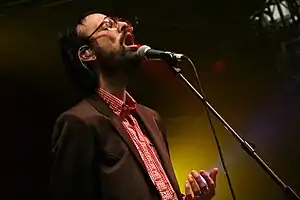 Berman performing at All Tomorrow's Parties in 2008 | |
| Born | January 4, 1967 |
| Died | August 7, 2019 (aged 52) Brooklyn, New York City, U.S. |
| Alma mater | University of Virginia University of Massachusetts Amherst |
| Occupation |
|
| Years active | 1989–2009, 2019 |
| Spouse(s) | |
| Parents |
|
| Musical career | |
| Origin | Hoboken, New Jersey |
| Genres | |
| Instruments |
|
| Labels | Drag City |
| Associated acts | |
| Signature | |
.png.webp) | |
Actual Air, Berman's only published volume of poetry, appeared in 1999. By that time, he had begun to use heroin and crack cocaine. Eventually, his struggle with substance abuse, depression and anxiety overcame his career decisions, and he attempted suicide in 2003. Afterward, he underwent rehabilitation, engaged with Judaism, and—alongside his wife, Cassie Berman—toured for the first time. In 2009, he announced his withdrawal from music.
Although his music and poetry were relatively successful, his life was marred by financial difficulties which, along with marriage breakdown, resulted in his return to music in 2019. He adopted the band name Purple Mountains and released an eponymous debut album that July, and planned a tour to pay off a $100,000 credit card debt. He died by suicide in August 2019.
Biography
Early life
.jpg.webp)
David Craig Berman was born on January 4, 1967, in Williamsburg, Virginia.[1] At that time, his father Richard Berman worked as a attorney practicing labor law for the United States Chamber of Commerce, while his mother was a housewife.[2] He came from a secular Jewish family, whom he said had no literary or artistic inclinations. Raised mostly in Texas, he did not personally know or interact with many other Jews.[3] He later said he had identified with Jews for he "felt like an outsider" in his youth.[4] For most of his life Berman identified as "ethnically Jewish" but not religious.[5] In adulthood, he developed a deep interest in the spiritual aspects of Judaism, though he also maintained distance from the faith; for example, he never worshiped at a synagogue. His mother had undergone conversion to Judaism without the supervision of an Orthodox rabbi, and for that reason neither she nor he would be considered Jews under certain criteria.[6]
Berman's parents divorced when he was seven. Thereafter, he split time between each parent's household until he entered college.[7] His father relocated to Dallas for a position as a lobbyist on behalf of foodservice businesses, while his mother moved back in with her parents in Wooster, Ohio and became a teacher there.[2] He later described his childhood as "grindingly painful" and said he kept "mostly independent of family things" into his adulthood.[8] While he was an adolescent, his father rose to prominence as a corporate lobbyist representing firearms, alcohol, and other industries.[9] Berman came to dislike his father at an early age.[10] He was compelled to live with his father after 1979, despite his wishes to the contrary, because of concern he was "growing up to be a wimp".[11]
He attended high school at Greenhill School in Addison, Texas.[12] During his teenage years, his father sent him to see a psychiatrist.[13] Berman suffered from depression throughout his life and later said the condition had become resistant to treatment.[2] By the age of 15, he said he began taking "every drug in every way", and claimed to have smoked PCP on a daily basis in his sophomore year of college.[11]
For Berman, the burgeoning new wave scene in Dallas served as an early source of musical inspiration.[2] He took an interest in a friend's rare Fairlight keyboard, and in the music of bands like Art of Noise, Prefab Sprout, X, the Replacements, the Cure, New Order, and Echo and the Bunnymen.[14] In high school, he began experimenting with poetry by writing to girlfriends, considering the line "A cartoon lake. Wolf on skates" to be his first true foray into poetry.[15] Berman hoped that his poetry would resemble the lyrics of punk singers Jello Biafra and Exene Cervenka.[16] He read Henry Miller's The Rosy Crucifixion when he was 14: "It gave me permission to enjoy life".[17] Reading significantly in his life, Berman said, reinforced his empathy, especially for those also troubled.[18]
Berman went to the University of Virginia in 1985.[12] He had been—by his own admission—"too lazy" to apply for college, so his father's secretary completed and submitted applications on his behalf.[11] At university, Berman met fellow students Stephen Malkmus, Bob Nastanovich, and James McNew.[1] He frequently attended concerts, shared records, and discussed obscure bands with Malkmus and Nastanovich, having first encountered the former in a carpool to a show.[19] The quartet formed the band Ectoslavia.[20] Berman ultimately took control of Ectoslavia, having excluded Malkmus and Nastanovich.[21] He graduated in 1989 with a bachelor's degree in English literature.[22]
Origin of Silver Jews: 1989–1994
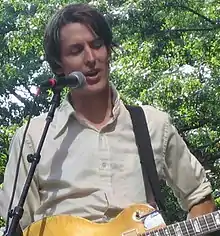
Upon graduation, Berman, Malkmus, and Nastanovich moved to Hoboken, New Jersey, where they shared an apartment.[23] In 1989, they adopted the band name Silver Jews and recorded discordant tapes in their living room.[24][lower-alpha 1] Around this time, Malkmus and Berman worked as security guards at New York's Whitney Museum of American Art; they would "get high" on their lunch breaks and Berman would write lyrics and poems while working—Malkmus would occasionally act as co-writer alongside Berman.[26] According to Berman's long-time friend Kevin Guthrie, Malkmus and Berman had a harmonious friendship, and Nastanovich revered both artists' creativity.[27] "It was mostly drinking beer and seeing grunge bands" Malkmus said regarding this time period; Berman recalled a diminished sense of being authentically Jewish.[28] Malkmus recalled that Berman appeared as a somewhat "scary goth" but was kind and enthusiastic.[29]
Berman begrudged Silver Jews being sometimes viewed as a side-project to Malkmus' band Pavement but the connection led to Berman signing with indie label Drag City, which would later release all of his albums—the Pavement relation was responsible for them amassing a "national audience", a notice great enough that the resulting sales meant Berman didn't have to tour.[30] The band's first extended-plays (EPs) Dime Map of the Reef and The Arizona Record were not commercially successful but gained them attention in a cult-like manner.[1] Kim Gordon was an admirer and Will Oldham said Dime Map of the Reef inspired him to send recordings to Drag City.[31][lower-alpha 2] He later characterized his resentment at the erroneous perception of Silver Jews as entitled, noting by 2000 it was less of an issue.[33]
Following the EPs, Berman began studying for a master's degree in poetry at the University of Massachusetts Amherst.[34] Dubbing this time an "academic exile", Matthew Shaer, in a 2006 Boston Globe article, speculated that Berman's extended time studying may have been an attempt to distance himself from Pavement.[35] Three years earlier, Berman reflected upon his time there: after "meet[ing] grown dignified men who play with fucking words all day" he felt he was bestowed "the permission to believe that I could try for that life".[17] The supposed 'centeral command' of art, found at university, he held reservations about.[18] He tried to get a substantial amount of poems published in the American Poetry Review but was roundly rejected—which increased his interest in music, "despite scarcely knowing how to sing or play guitar".[22] As of 2005, Berman's public appearances mostly consisted of poetry readings.[36][lower-alpha 3]
By October 1994, Silver Jews had enough material for their debut album Starlite Walker.[38] The release established respect in the indie rock scene, although with some detractors.[39] Malkmus and Nastanovich's involvement with Pavement meant they were unavailable for the next Silver Jews album The Natural Bridge, and only Berman and Peyton Pinkerton continued writing for it.[40] Pavement's success proved difficult for Berman, who became suspicious of fame and resented the people with whom he interacted, deeming them "cruel".[36] He felt somewhat abandoned by Malkmus and Nastanovich, although he understood the circumstances permitted little else.[41] Berman's personal life was affected by the deaths of friends, which would influence his songwriting; a close friendship between Oldham and Berman arose at this time and the two conceptualized a collaborative project, entitled Silver Palace.[42]
Silver Jews was part of a "moment in underground music" of songwriters who looked to the 1970s and 1980s for inspiration, and were one of Drag City's seminal groups alongside Smog, Pavement, Royal Trux, and Palace, bands that "made American music frightening again by tapping into its most tangled roots".[43] Berman wished to "distinguish his brand of songwriting from the depressive-narcissistic strain of 1990s rock" and later sought to break away from Drag City's "cryptic and prankish" style.[44] The line-up of Silver Jews constantly changed around Berman, who remained its principal songwriter and "main creative driver", having led the band's creative direction since the start.[45]
Critical acclaim and substance abuse: 1996–2001
The composition of The Natural Bridge (1996) left Berman distraught; he appeared to be "haunted by ghosts" and was hospitalized with sleep deprivation.[46] "When the songs were being recorded, things got darker in my life", he recollected, in an aloof manner, also noting that "recording was a process of calming myself down"—although doing so was so "searing that I couldn't listen to music".[47] According to Oldham, the album's producer Mark Nevers "had sort of held Berman’s hand".[48] Although it received positive reviews in music publications—Berman having now "established himself as a world-class rock lyricist"—he chose not to tour due to a fear of performing.[49] After The Natural Bridge, Berman decided he wanted Malkmus and Nastanovich, both of whom felt betrayed by Berman's hostility toward them, to be involved with all subsequent Silver Jews albums.[50]
The resulting pain helped Berman, alongside Malkmus, to formulate a new Silver Jews album American Water.[46] It was significant to Berman and the band's progression.[51] They had now "stepped out of Pavement's shadow...This was clearly his project and represented his vision", his songwriting having been at the foreground of the former album.[52][lower-alpha 4] Berman's drug use continued; using them during studio sessions. Despite his personal turmoil, Berman wanted the album to be joyous like "other people['s] records" rather than grim. The band intended to tour in late 1998 but plans were ended after a fistfight led to his eardrum rupturing.[46]
Actual Air, Berman's first collection of poetry, was released in 1999 by Open City Books, which had been founded to publish the collection.[55] Actual Air amassed critical acclaim—Carl Wilson called it "even better than [Berman's] albums".[56] The book's unusually high sales of over 20,000 copies bolstered Berman's musical career.[57] Its marketing was akin to that of an album, which contributed to its success; Drag City and record stores were the avenues from which a "significant portion of those sales" arose.[58] In 2001, he was offered a job as poet-in-residence on a postgraduate course; the prospect thrilled Berman however he chose not to apply out of apprehension.[59] Four years later, proposed with a similar question in an interview, he expressed uncertainty on genuinely taking a offer: "I should stay away from the rock clubs and the English departments if I can".[18]
Although he did publish some poems afterwards—his poetry being featured in journals such as The Baffler, Open City and The Believer—and had reported working on a follow-up, Actual Air remained his only book of poetry.[60] In his later years, Berman stopped writing poetry though a lack of motivation and a feeling of partial inadequacy in comparison to younger poets; another collection failed to materialize due to a lack of purpose and innovation.[61] By 2003, his perception of songwriting and poetry as unified was no more and felt that older age rendered him less capable of working in both mediums.[17] "Poetry can never counter propaganda. A song might be able to".[62]
Around this time, Berman, who no longer "[had] to work", estimated he made $23,000 a year; by 2001, he earned $45,000 from his music.[63] That year saw the release of the Silver Jews album Bright Flight, which featured his wife Cassie Berman. Their relationship started two years earlier at a party; Berman awoke in Cassie's house and learned she owned every Silver Jews album.[64] "I was really depressed and had nothing to lose at that time. I was so ugly".[65] Cassie was a source of relief for Berman and she helped him feel young, later considering their relationship the "best thing that ever happened to me".[66] They lived together in Nashville for 19 years, where they moved to aid Berman's music career; later buying a house alleviated quandaries for Berman and the perceived ubiquity and understanding of music as a career was praised by him.[67]
Berman began to take hard drugs in 1998, during a period of depression.[68] He began to take heroin, methamphetamine and crack cocaine, with his use of the latter reaching the point of addiction.[69] Several of Berman's friends died from drug-related causes in the years that followed, including Robert Bingham, the founder and editor of Open City,[55] who passed in 1999 after a heroin overdose.[70] Malkmus and Berman performed at Bingham's wedding.[71] Berman twice unintentionally overdosed; one incident followed the release party for Bright Flight.[72] That album's darker sound reflected his struggles with substance abuse.[73]
Attempted suicide, rehab and career progression: 2003–2008
.jpg.webp)
On November 19, 2003, Berman attempted suicide in Nashville by consuming crack cocaine, alcohol and tranquilizers.[1] He wrote a short note to Cassie—the brevity of which Berman would later regret—put on his wedding suit, and went to a "crack house" he frequented. When discovered by Cassie, he verbally lashed out and refused treatment. He was eventually taken to Vanderbilt University Medical Center, awakening three days later.[36]
Around a year later, Berman checked in for drug rehabilitation, which was paid for by his father, and encouraged by his mother and Cassie. Berman said he had relapsed but that by August 2005 he was not using drugs.[74] During his rehabilitation, Berman embraced Judaism, choosing to study the Torah and sought to be a "better person" who was "easier" to Cassie and staff at Drag City; he would soon consider Judaism as that which he would labour over for the rest of his life.[75] Reflecting upon his suicide attempt, five years later, Berman noted that he was not unprivileged and without career opportunities, although this was not evident at the time.[76] He began to excessively take antidepressants and his sobriety made him more receptive to candidness.[77]
In 2005, and by means of "saving [himself]", Silver Jews, with a lineup including Cassie, Malkmus, Nastanovich, Bobby Bare Jr., Paz Lenchantin, and William Tyler, released Tanglewood Numbers.[78] Soon after, the band began to tour, with 100 shows from 2006 to 2009 taking place; to cope with the hectic nature, he became "a daily pot smoker", in defiance of his sobriety.[79][lower-alpha 5] Before Berman toured, he occasionally made caricatures of fans, considering it more rewarding.[59]
By this time, Silver Jews had sold 250,000 records.[55][lower-alpha 6] Berman and Cassie still experienced financial difficulties; Cassie worked an office job and Berman struggled to get medical insurance for the removal of a keratoconus, eventually acquiring it from the Country Music Association.[81] In 2005, Jeremy Blake enlisted Berman for Sodium Fox, an artwork centered around Berman.[82] Blake's suicide and Berman's eye operation would affect the next Silver Jews album.[83] Lookout Mountain, Lookout Sea was released in 2008 to lukewarm reviews.[84][lower-alpha 7] The album was their most commercially successful.[86]
Berman's decision to tour, no longer dependent on drugs, was based upon his greater age—which to him meant he was "uncorruptable"—his expanded discography, and the infuriation caused by separation from his audience. Although he said meeting fans is "not necessarily nutritional for your creativity" doing so "softened his naturally gruff exterior" and was a highlight for him; touring was otherwise "a spiritual and intellectual deadzone".[87][lower-alpha 8] Berman found touring with Cassie eased the experience, considering her a necessary component, noting that if he was alone he'd likely act to his detriment.[90]
Hiatus from music: 2009–2017
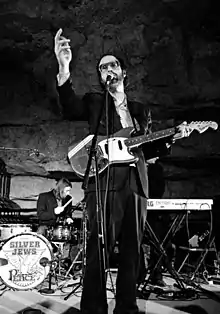
On January 22, 2009, Berman disbanded Silver Jews, and their final show was played the following week at Cumberland Caverns in McMinnville, Tennessee. He said that he "always...would stop before we got bad", and during the performance at Cumberland Caverns, claimed that "I always wanted to go out on top, but I much prefer this".[91] Reflective of Silver Jews' impact on Nashville's mid-2000s music scene, the final show meant "a chapter in this city’s artistic evolution closed".[92]
Alongside the news of the band's dissolution, Berman publicly announced, for the first time, that his father was the lobbyist Richard Berman, who he viewed as markedly loathsome and from whom he had been estranged since 2006.[93] Berman reported being indebted to Richard and once donated to a supposed investigation of Richard.[94] Upon considering the commercialization of modern musicians, he began to see his and Richard's lives intertwining; this, alongside his guilt about his father, were the reasons he retired Silver Jews, saying:
This winter I decided that [Silver Jews] were too small of a force to ever come close to undoing a millionth of all the harm he has caused … Previously I thought through songs and poems and drawings I could find and build a refuge away from his world, but there is the matter of Justice. And I'll tell you it's not just a metaphor. The desire for it actually burns. It hurts. There needs to be something more.[95]
After Silver Jews disbanded, Berman became a recluse.[1] The "hermit, solitary aspect to the way [Berman] live[d]" predated this time, according to a 2008 interview—and Nastanovich reflected two years earlier that Berman had "gotten more reclusive".[96] In 2005, posed with the question if he had chosen between vulgarity or loneliness, Berman said "it’s been loneliness up till now but it looks like things are changing for the better/worse".[18] His public perception became intertwined with fabrications—significant speculation upon the events of his suicide attempt had reportedly occurred before this time.[97]
Berman published a 2009 book of surreal, minimalist cartoons called The Portable February to mixed reviews.[98][lower-alpha 9] He would later work with German artist Friedrich Kunath on the book You Owe Me a Feeling (2012), which features paintings and poetry by Kunath and Berman, respectively.[100][lower-alpha 10] Cassie sought a career in pediatric therapy.[101] In 2010, he spoke about his difficulties with writing about his father—seeking to become his "nemesis"; HBO nearly adapted the book however Berman canceled production, saying he did not want to glamorize his father.[102] In an article about Berman, Derek Robertson said that a significant amount of his personal life was a "explicit rebuke" to Richard and an attempt to evade institutional power—Thomas Beller interpreted Berman's disdain as both political and personal.[103]
By 2016, Berman had experienced the deaths of both his friend Dave Cloud and his mother, which compelled him to adopt the middle name Cloud and write the song "I Loved Being My Mother's Son", respectively.[104] He was still in contact with Malkmus and maintained a close relationship with Silver Jews drummer Brian Kotzur.[105] According to Nastanovich, at one point Berman intended to write new Silver Jews songs, for an undisclosed purpose, however he ultimately became more interested in a new style.[106]
Purple Mountains and death: 2018–2019
If Silver Jews closed out their career with odes to the open field of possibility, Berman here inaugurated what would have been a different artistic phase with a series of songs about the disappointments of expectations unfulfilled.
In 2018, Berman and Cassie separated. Lacking money and living off royalties from Drag City, from June he lived in a room above the label's Chicago office.[20] According to Berman, they "never had the kind of conflict that results in divorce" but had a "kind of need to live [their] lives without the other one".[108] Berman thought his chronic depression meant he was "unfit to be anyone's husband".[109] He and Cassie maintained a shared bank account and owned a house together, while he considered her part of his family and was "all [he] had".[108]
He briefly lived in Miller Beach and Gary, Indiana.[20] At one point, he asked a friend to give him heroin but was refused, for which he was ultimately grateful, having not used heroin or cocaine since October 2003.[110] He had grown disillusioned with Judaism, saying his belief in God lasted from 2004 to 2010; in 2008 he voiced a disconnect from Judaism, positioning himself as adjacent to Jews.[111][lower-alpha 11]
In 2018, Berman co-produced Yonatan Gat's album Universalists having met Gat during a 2006 tour of Israel and helped get him signed to Drag City—"[The] shows we played in Israel were pretty much the most amazing experience of my life".[113] Following the release of two singles under his new moniker Purple Mountains, an eponymous debut album was released in July 2019.[114] An "Instantly mythologized" album, Berman received heightened attention and very positive reviews: "Purple Mountains looked like the start to an unexpected second act for David Berman".[115] Berman worked on Purple Mountains with Woods and Berman's friend Dan Auerbach, with whom he had worked in 2015; Auerbach has called Berman "one of [his] heroes".[116]
Berman's financial difficulties, the breakdown of his marriage, and encouragement from Drag City's president Dan Koretzky were impetuses for Berman's new music.[117] Berman hoped to resolve the $100,000 of loan and credit card debt he had amassed as a result of his drug use; in a 2005 interview, he said; "I've got a credit card rotisserie system that would dazzle the ancients".[118] He stated this was the only reason he intended to tour.[2] He expressed worries about the tour and notified the accompanying band that his depression may interfere but was excited for his "solitude to end".[119]
In June 2019, Berman said: "There were probably 100 nights over the last 10 years where I was sure I wouldn't make it to the morning".[108] Berman died on August 7, 2019, having hanged himself in an apartment in Park Slope, Brooklyn, New York.[120] It is unclear whether Berman's suicide was spontaneous or deliberated upon; according to The Philadelphia Inquirer's Dan DeLuca; "The warning signs were all over Purple Mountains".[121] A private funeral attended by "Friends and family, along with the Jewish community" took place on August 16—a memorial, by filmmaker Lance Bangs, at New York's Met Breuer Museum, the former location of the Whitney, was held earlier.[122]
Posthumous tributes
Many artists paid tribute to Berman following his suicide. Malkmus and Nastanovich both commented on his death and performed shows in his honor.[123] Drag City released a tribute cover of "The Wild Kindness", sung by Bill Callahan, Will Oldham, and Cassie Berman. The cover albums Approaching Perfection: A Tribute To DC Berman and Late Homework: The Songs of David Berman were released two months after his death.[124]
A number of musicians recorded tributes :
- Twice collaborators, The Avalanches in the song "Running Red Lights" from the album We Will Always Love You [125]
- Fleet Foxes: Shore [126]
- Mogwai: As the Love Continues [127]
- Daniel Blumberg: On&On [128]
- The Mountain Goats: Dark in Here [129]
- Cassandra Jenkins: An Overview on Phenomenal Nature [130]
- John Vanderslice: I can’t believe civilization is still going here in 2021! Congratulations to all of us, Love DCB [131]
The Tennessee Titans, Berman's favorite football team, displayed the message "Nashville (and the world) will always love David Berman" on its Jumbotron.[132] Fans shared lyrics on social media, and major publications wrote obituaries and tributes; according to Pitchfork's Sam Sodomsky: "In the wake of Berman’s death ... His voice never felt louder or more vital", said .[133] The 62nd Annual Grammy Awards' memorial reel's exclusion of Berman was criticized.[134]
After his son's death, Richard Berman said; "Despite his difficulties, he always remained my special son. I will miss him more than he was able to realize."[135]
Artistry
Lyrics
Having given up on albums because he was unable to complete the lyrics, Berman spent most of his creative time working on them, to the point of obsession; Koretzky reportedly saw Berman spend months working on a single line.[140] Berman's process involved considering his audience's understanding; he juxtaposed his abstract lyrics with simple melodies and rhyme schemes.[141] He recalled a disconnect to his audience—"an indie rock crowd"—while writing Bright Flight due to the disorder of his associates. Berman deemed all of this a "major problem".[142] He had a didactic approach with Tanglewood Numbers and Lookout Mountain, Lookout Sea, wanting to give "instructions" on forgoing depression with the former.[143] Mark Richardson, writing for Pitchfork, and Randall Roberts of the Los Angeles Times, noted Berman's proficiency for minimalist compression.[144][lower-alpha 13]
Berman's songs often use country music tropes and his themes tend to focus on music, nature, beauty, disconnection, drugs, sports, America and god.[146] As influences on his writing, Berman thought highly of America although hoped for a "redemption".[147] His artistic perception of America has been noted as idiosyncratic, narrow and poignant,[148] while forlornness often arose as humor.[149] Religion is a recurring element in Silver Jews albums, while Purple Mountains evokes Jewish mysticism.[150]
From Bright Flight his lyrics became more autobiographical and dramatic, and he came to view the preceding works as "make-believe"; on Tanglewood Numbers he documented his struggle with substance abuse.[151] Roberts called Purple Mountains "nearly as autobiographical as a memoir".[152] Berman discussed his isolation, divorce—Silver Jews songs about Cassie having been plentiful—and death, which had a particular presence.[153] By this point, his music had less humor, misdirection, irony or embellishment; he was interested in being direct.[154]
On the Silver Jews albums, Berman represented his alienation via substitutes, his characters composed of traits originating from either real-life people, fictional characters or archetypes.[155] His fictional narratives often start relatively straightforwardly and then become bizarre; the songs of American Water conjure an "absurdist landscape" and "grow more obtuse in proportion to tunefulness".[156] His stories present a literary aesthetic that is "equal parts rural shack and gothic zen" and his characters often resided in "half-empty country-and-western bars and backwater burgs".[157]
Having found a wider audience with Actual Air, Berman's lyrics were held to a higher standard; and he has been praised for diverging from his peers.[158] Per his lyrics, he's been credited with influencing indie rock and other musicians.[159] Pitchfork deemed him one of "the most influential" musicians of the quarter-century following the publication's launch in 1996.[160]
Sound
Silver Jews' early work is defined by an ultra lo-fi aesthetic, starting as ostensibly "avant-gardist" within the framework of "traditional" pop songs.[161] Their work before Starlite Walker is "regarded as the lowest fidelity recordings of the first lo-fi movement".[162] The changing line-up influenced the sound, Berman's musical approach became simplified and the band moved further towards a country sound; Purple Mountains eschewed the previous punk rock strand.[163] Purple Mountains is Berman's most direct, conventional album, although all of his discography is relatively conventional.[164] Berman's vocal delivery has been identified as brusque, dry and mostly uninflected—his register described as baritone and he would concurrently sing and speak.[165] Reviewing Starlite Walker for The Guardian, Jonathan Romney described Berman's approach as "whiny, archetypally slackerish" with "vaguely country inflections"—the early country aspects being mostly humorous.[166]
Silver Jews' songs were often sparse and deceptively simple, usually with three or four chords, the kind Berman said "you might learn in beginner’s guitar lessons".[167] Berman understood his musical abilities were limited, the nature of which was initially obscured by the lo-fi sound.[168] For a while, he questioned as to why he was without natural talent, eventually renouncing his self-consciousness.[169] His austere style proved to be influential.[170]
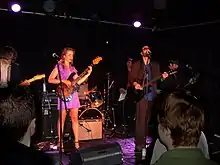
Berman had spent significant time without playing his guitar and said his process of creating albums begun with conceptualization and than daily refinement, typically writing the music first.[171] For the first four Silver Jews albums, Berman wrote all the songs—to Malkmus' gratitude who comparative to Pavement played more melodic and simple material.[172] The pair had differing approaches and were "longtime musical foil[s]".[173] With Tanglewood Numbers, Berman exercised greater care and control, in regards to its final state—Shaer observed soon after its release that the album "represents Berman's most comprehensive effort to focus his songwriting".[174]
The pair having "shared a brightening chemistry", Cassie's calm disposition onstage provided stability to Berman's electric presence, him embellishing a concert documented on the film Silver Jew with incisive gestures.[175] Everett True and Berman concurred that he was a natural performer.[176] Berman also performed in a rigid manner, reading sheet music "like it’s a literary reading"; Marc Hirsh of the Boston Globe said Berman used a music stand to create a barrier between himself and the audience.[177] Cassie compared Berman's early showmanship to a child beginning to ride a bicycle. She did recall that their first performance belied his reluctance, as he was loquacious to the extensive audience.[65]
Poetry
Berman said in 2002 that he "started writing poems because [he] wanted to make poems so good they would make everyone else quit. I don't have the voice or the technical skills to blow people away with my music. But I have a chance to do that with my poetry".[59] With regards to composition, he allocated the same time to both: two or three hours, in a daily manner, poetry being the more vigorous undertaking.[17] He began to pursue the prospect of publication by age 22—two years before, by his judgement, his "first worthwhile song".[17] Although his lyrics and poetry remain distinct from each other,[178] critics have found they share certain defining characteristics, such as:
Unlike his music, Berman's poetry did not feature rhyme and the poems in Actual Air were written in free verse—he composed his poems using written notes and disclosed that he "didn't know anything about form, rhythm or meter", surmising his structure to be accidental or instinctual.[186] Berman noted a static, conventional, nature to his poetry—greater than his music—in which there are "no left hooks and speeding trains".[187] He had expressed dismay that poetry offered too much freedom.[188] James Tate, under whom Berman studied, said the poems are "narratives that freeze life in impossible contortions", whereas Berman called them "psychedelic soap operas"; Heidi Julavits noted that Berman often distorted familiar concepts in his poetry.[189]
Writing with direct attention on emotions, Actual Air's poems include small-scale scenes and situations he extensively explores.[190] The world concocted, analogous to that featured in his songs, is eccentric—with "plausible contexts" quickly altered by "an odd word" and domestic scenes "tinged with gothic weirdness".[191] The collection, which treads "between surrealism and confession", "reads like a novel written in two-sentence paragraphs".[192][lower-alpha 15]
Berman's poetry has amassed admiration, being praised by Dara Wier and Billy Collins—the latter featuring him in a poetry anthology.[194] Rich Smith of The Stranger summarized Berman's poetic output as a "master[y of] the opening line, the surprising image, the lyric narrative, the warm abstraction, and the crucial skill of knowing when to use the Latin word or the German word".[39] Aaron Calvin, in an article for Pitchfork, wrote that the intersection of Berman's lyrics and poetry bolsters his legacy.[178]
Image and self-perception
Here was a man too brilliant for his own health, held captive by unseen forces.[195]
— Marc Hogan of Pitchfork on the opening lyrics to "Random Rules" and general perception of Berman's career
Berman was acutely aware of his public image. After the release of Purple Mountains he feared he would be seen as a "sad sack", and had earlier wished he could convey a less abrasive persona.[196] He kept note of musicians who had mentioned him in interviews and believed his music was unappreciated, having never held his work in esteem, besides his lyrical capability.[197] Berman did not view Silver Jews as a "band that other bands would namedrop", in contrast to the likes of Smog or Will Oldham's bands.[198] Although he once expressed a need for outside validation, he refused to read reviews or articles concerning him. By 2005, hoping to separate his self-perception from others, he had installed an external blocking device on his computer for this very reason.[199]
Although he'd later just consider himself an artist, Berman had been surprised that his songwriting gained more attention than his poetry, thinking of himself as more a poet than a songwriter.[200] Others perceived him as an earnest poet; Adam Rothband of Tiny Mix Tapes considered Berman "synonymous with what he created".[201] In music and poetry, Berman felt his peers saw him as "moonlighting".[lower-alpha 16] He once expressed interest in remaining "a stranger" in both fields.[203]
Berman was seen as a "cult hero" due in part to his aversion to promotion and his initial refusal to tour generated a sense of mystique.[204][lower-alpha 17] With little interest in promotion, Berman relied upon word of mouth and positive reviews, although dismissed the notion of being critically acclaimed—he felt disregarded by critics; he resented and ruminated upon some who reviewed his work and hoped to sabotage their careers.[206] He expressed ambivalence toward his inability to reach a larger audience and had amassed a reputation as "perhaps the finest lyricist of his generation" with his diligence being a frequent point of discussion.[207][lower-alpha 18] He credited his musical sound and singing with his relative obscurity, which was a source of motivation and justification for Berman.[210]
Timothy Michalik of Under The Radar said Berman had a simultaneously lowbrow and highbrow persona to which fans could relate; by 2006, Berman, according to Leon Neyfakh, was "increasingly well-known as an eccentric outsider artist".[211][lower-alpha 19] Berman's return to music prompted a jovial and personal response from major publications, with concern for Berman having been identified as instrumental to his fervent fanbase.[213] Reception of Purple Mountains was significantly altered following Berman's suicide: critics wrote "it [is] impossible to hear this album in any other context", and "[n]ow, instead of worrying, you mourn".[214]
Influences
Berman said his influences include Tate—discernible via a similar and blunt approach to surrealism and, in Actual Air, per style and focus upon location and person; Russell Edson, Kenneth Koch, Ben Katchor, Bruce Nauman, Jean-Michel Basquiat, Sherri Levine, Louise Lawler, Wallace Stevens, Charles Wright, and Emily Dickinson.[215] Studying the Torah helped him learn more about poetry; the Whitney Museum of American Art influenced, by means of considering his intital work as conceptual art, his music.[216]
Discography
- With Silver Jews:
- Starlite Walker (1994)
- The Natural Bridge (1996)
- American Water (1998)
- Bright Flight (2001)
- Tanglewood Numbers (2005)
- Lookout Mountain, Lookout Sea (2008)
- With Purple Mountains:
- Purple Mountains (2019)
- Guest Apperances:
- Thank You – Royal Trux (1995)[217]
- Joya – Will Oldham (1997)[218]
- Sings Greatest Palace Music – Bonnie 'Prince' Billy (2004)[219]
- A Cowboy Overflow of the Heart – The Avalanches (2012)[220]
- Wildflower – The Avalanches (2016)[221]
Bibliography
- Actual Air (1999)
- The Portable February (2009)
Notes
- On the band's early recordings, Malkmus and Nastanovich used aliases.[25]
- The similar but greater status of Berman's later music would aid him in recruiting musicians to perform with him.[32]
- His means of deciding the locations for a set of readings, the year prior, was composed of multiple reasons: a favor for Drag City and Open City, a desire to visit where he had not been before and resulting stopover at an old friend's house; to benefit the "Arkansas literacy project" and to be "the object of an assembly [at Greenhill School]".[37]
- The album's creation, which took four days, also affected Malkmus, making him "realize that there’s such a better way to be making records" than he had before.[53] American Water would be an inspiration for the Pavement album, Terror Twilight.[54]
- Their first tour was documented in the 2007 film Silver Jew.[80]
- Berman said he made $16,000 in 2004, from his first four albums.[11]
- Carl Wilson, retroactively, speculated that the album's reception may have contributed towards the Silver Jews' end.[85]
- At a younger age, Berman thought of touring as too significant a commitment and considered the stress to be intolerable, in contrast to his new-found acceptance.[88] Playing live appeared to him as "like some unnecesary post-invention marketing effort" and had not elicited much "satisfaction" in the past.[89]
- Berman had composed a book of drawings beforehand, which inspired the title of Pavement's debut album, Slanted and Enchanted.[99]
- Kunath and Berman continued to work together, creating a "collaborative show" that was showcased after Berman's death.[100]
- Goldman and Arielle Angel of Jewish Currents would reflect upon Berman saying that he represented Jews "spiritually" and "positionally", and people they dubbed "Silver Jews". In his withdrawal, they said he "[fixed] himself in Jewish tradition".[112]
- Dan Bejar, who worked with Berman in the early recording sessions of Purple Mountains, reflected that there once was "lots of really wild lines that would have fit in more with ’90s Berman—just blasting images, more manic, which was actually the state he was in". As the process continued, Berman became disinterested in said lyrical material, hoping to explore new avenues, and resultingly abandoning the previous work.[139]
- Richardson compared it to a haiku and Roberts noted it was used in Lookout Mountain, Lookout Sea for "universal themes of life, death and finding meaning in-between".[145]
- According to Ethan A. Paquin, Berman "examine[d] the pathos underpinning banal scenery and situations" with a focus upon "beauty and transcendence".[183]
- Berman and Roberts identified a "miniature" quality to Berman's poetry.[193]
- He said similar of Nick Cave and Richard Hell, whose novels Berman felt were "contextualised as 'moonlighting'" as a result of their musical careers, affecting "how the books were actually read".[202]
- As of 2005, Silver Jews had only purchased one advertisement in Alternative Press in 1994, for The Arizona Record.[11] He reportedly refused to let Drag City promote his music.[205]
- Eric Clark of The Gazette, in his review for Lookout Mountain, Lookout Sea, said the lo-fi sound of Silver Jews' music "kept the band miles away from the mainstream for most of its existence".[208] Writing for Rolling Stone, Ted Drozdowski recognized the lo-fi sound as a byproduct of the band's determination to release music: "they'll record with bearskins and flints if that gets the music out".[209]
- Elsewhere Berman said, to be an artist, he had to "exist in a time where high and low art mix easily".[212]
References
- Cartwright 2019.
- Lingan 2019.
- Barshad 2008.
- Davidson 2006.
- Friedman 2019.
- Kaufmann 2008.
- Blume 2006.
- Freeman 2008.
- Cartwright 2019; Blume 2006; Barshad 2008.
- Kofman 2015.
- Tucker 2005.
- Bailey 2008.
- Edwards 1998.
- Kavanagh 2020; Lingan 2019; Tucker 2005.
- Poetry Society of America 2003.
- Marx 2008.
- Rooney 2003.
- Taylor 2005.
- Charles 2010, p. 27; Blume 2006.
- Kavanagh 2020.
- Charles 2010, p. 27.
- Smith 2019a.
- Deluca 2018.
- Stolworthy 2019; Deluca 2018.
- Oakes 2009, p. 140.
- DeLuca 2008; Hinson 2008; Kornhaber 2019b.
- Valania 2001; Nashville Scene writer 2019.
- Timberg 2004; Feldman 1997.
- Timberg 2019.
- Cartwright 2019; Shteamer & Newman 2019; Pfafflin 2002; Wild 2006.
- Weidenfeld 2005; Gross 2019.
- Guarino 2006.
- Assar 2006.
- Larson 2019; Mason 2005.
- Shaer 2006.
- Weidenfeld 2005.
- Tucker 2004.
- Larson 2019.
- Smith 2019b.
- Cartwright 2019; Rutledge 2019b.
- Wagons 2019, 6:50-7:20.
- Hyden 2019a; Taylor 2005.
- Powell 2017; Raymond & Callahan 2009.
- Dollar 2008b; Lucas 2018.
- Tucker 2005 (identifying Berman as the principal songwriter); Kornhaber 2019a ("main creative driver"); Shteamer & Newman 2019 (identifying the changing line-up); Blume 2006 (identifying Berman as whom steered the band since the start).
- Powell 2017.
- Feldman 1997; Lewis 1996; True 2006.
- Licht 2012, p. 159.
- Cartwright 2019; Hart 2019.
- Walsh 2016.
- Hogan & Sodomsky 2019; Sheffield 2019.
- Masters 2010; Wilson 2001.
- Valania 2001.
- Sheffield 2001.
- Mason 2005.
- Mason 2005; Wilson 2002.
- Lingan 2019; Oakes 2009, p. 146.
- Elaine 2000.
- Costa 2002.
- Kavanagh 2020 (identifying the minimal amount of poetry published afterwards); Timberg 2004 (identifying the journals) Tucker 2004 (reported the follow-up).
- Kavanagh 2020; Diver & Wolstenholme 2008.
- Dansby 2019.
- Tucker 2005 ($45,000); Richardson 2002 ($23,000); Oakes 2009, p. 148 (quotation).
- Howe 2005; Malitz 2019; Barshad 2008.
- True 2006.
- Kissinger 2006; Goldsmith 2019.
- Nashville Scene writer 2019; Paulson 2019; True 2006; Taylor 2005.
- Cartwright 2019; Lingan 2019.
- Wilson 2019; Roberts 2019.
- Lingan 2019; Sackllah 2019.
- Beller, Thomas (2001). "Enter The Riddler". Spin. 17 (3). Retrieved December 10, 2021.
- Weidenfeld 2005; Nichols 2019.
- Malitz 2019.
- Blume 2006; Tucker 2005.
- Cartwright 2019; Weidenfeld 2005; Taylor 2005.
- Marvar 2008.
- Dollar 2008b; Wilson 2008.
- Hogan & Sodomsky 2019; DeLuca 2008.
- Kavanagh 2020; Nichols 2019.
- Riesman 2019.
- Currin 2008.
- Blair 2007.
- Marvar 2008; Kelly 2008.
- Shteamer & Newman 2019; Wilson 2019.
- Wilson 2019.
- Beller 2012.
- Marvar 2008; Brinn 2006.
- Feldman 1997; DeLuca 2008.
- Feldman 1997; Truman 2008.
- Diver & Wolstenholme 2008; Brinn 2006.
- Philips 2009; Rodgers 2009.
- Maloney 2019.
- Philips 2009; Harriet staff 2010; Devinantz 2010.
- Tucker 2005; Lozano 2009.
- Shteamer & Newman 2019 (extended quotation); Bergen 2010 (identified Berman and Richard's lives intertwining).
- Shaer 2006; Newlin 2008.
- Hinson 2008; Lucas 2018.
- Beaumont-Thomas 2019; Michalik 2019; Ivry 2009.
- Robbins 1997.
- Yoo 2019.
- Bishop 2018.
- Beller 2012; Bergen 2010.
- Robertson 2019; Beller 2012.
- Lingan 2019; Rutledge 2019a.
- Kavanagh 2020; Khomami 2015.
- Stewart 2016.
- Goldman 2019.
- Khanna 2019.
- Goldsmith 2019.
- Lingan 2019; Moon 2021.
- Kavanagh 2020; Gross 2019; Barshad 2008.
- Angel & Goldman 2019.
- Bonner 2019; Dollar 2008a; Wild 2006.
- Schatz 2019.
- Ruttenberg 2020 (first quotation); Sackllah 2019 (identified the attention and reviews); Bobkin 2019 (second quotation).
- Malitz 2019; Camp 2015; Rodman 2015.
- Kornhaber 2019b (identified financial difficulties); Hart 2019 (identified relation to his marriage's breakdown); Lingan 2019 (identified Koretzky).
- Jenkins 2019 (identified $100,000 of loan and credit card debt); Oakes 2009, p. 148 (identified the drug use); Tucker 2005 (quotation).
- Hyden 2019b; Currin 2020.
- Aniftos 2019.
- Pfarrer 2019; DeLuca 2019.
- The Tennessean writer 2019; Yoo 2019.
- Minsker 2019; Ruiz 2019; Arcand 2020.
- Strauss 2021; Gregory 2019.
- Henry 2019; Spin staff 2020.
- Strauss 2020.
- Trendell 2021.
- Bray 2020.
- Dolan 2021.
- Grant 2021.
- Albertson 2021.
- Sodomsky 2019c.
- Sodomsky 2019b; Sackllah 2019; Pfarrer 2019.
- Clarke 2020.
- Kennedy 2019.
- Hogan & Sodomsky 2019 (identified Malkmus); Terich 2014 (identified deadpan delivery); Meyer 2020 (identified the wry delivery); Rutledge 2019b (identified dadaist poetry).
- Rutledge 2019b.
- Sodomsky 2019a.
- Dombal 2020.
- Cartwright 2019; Lingan 2019; Malitz 2019.
- Kornhaber 2019a; Diver & Wolstenholme 2008.
- Malitz 2008.
- Dollar 2008b; Bickford 2008.
- Richardson 2002; Roberts 2019.
- Roberts 2019; Richardson 2002.
- Sackllah 2019 (identified the country music tropes); Kornhaber 2019b (identified the themes of America, music, nature, beauty, death, drugs and disconnection); Sodomsky 2019c (identified the presence of sports); Johnson 2019 (identified the themes of god).
- Kornhaber 2019b; Gross 2019; Sheffield 2019.
- Lucas 2018; Salmon 1998; O'Reilly 1998.
- Rosenberg 2019.
- Goldman 2019; Dodero 2007.
- Mason 2005; Nichols 2019; Nachmann 2005.
- Roberts 2019.
- Johnson 2019; Sackllah 2019; Rutledge 2019b.
- Mcleod 2019.
- Arcand 2019; Paulson 2008.
- Kelly 2008; Martin 1998.
- Orlov 2001; Plagenhoef & Schriber 2008.
- Oakes 2009, p. 146 (identified the greater audience); Mason 2005 ("has access to a syntax I could never touch"); Wilson 2019 ("[Berman] ventur[ed] into the rhetorical ionosphere that’s always set him apart").
- Kornhaber 2019a ("Berman would become the standard-bearer for [a] kind of writing"); Kennedy 2019 (David Berman...whose witty lyrics...influenced scores of band); Hockley-Smith 2019 ("he helped define what we understand indie rock to be"); Oakes 2009, p. 153 ("Poet/songwriters like Berman...changed the rules of indie songwriting")
- Pitchfork contributors 2021.
- Cartwright 2019; Jenkins III, Shattuc & McPherson 2003, p. 367.
- Earles 2014, p. 284.
- Costa 2002; Richardson 2002; Goldman 2019.
- Kornhaber 2019a; Rothband 2019.
- Lingan 2019 (identified his delivery as baritone); Shteamer & Newman 2019 (identified his delivery as dry); Mason 2005 (identified his delivery as mostly uninflected) Sackllah 2019 (identified his delivery as brusque); Masters 2021 (identified that Berman would speak/sing).
- Romney 1994; Nichols 2008.
- Kavanagh 2020; Hyden 2019b; Johnson 2019.
- Kavanagh 2020; Nichols 2008.
- Marvar 2008; Malitz 2008.
- Rosenblatt 2007.
- Academy of American Poets writer 2014; Richardson 2002.
- Blume 2006; Edwards 1998; Rutledge 2019b.
- Kavanagh 2020; Dombal 2020.
- Blume 2006; Shaer 2006.
- Malitz 2019; Dolan 2019; Chen 2019.
- True 2006; Michalak 2008.
- Silver 2007; Hirsh 2006.
- Calvin 2020.
- Michalik 2019.
- Bergen 2010.
- Dodero 2007.
- Somers 2019.
- Paquin 2000.
- Quart 2019.
- Believer contributors 2020.
- Clark & Toth 2019; Ward 2000; Kavanagh 2020; Rooney 2003.
- Nelson 1999.
- Gross 2019.
- Academy of American Poets writer 2014; Timberg 2004.
- Hunter 1999; Roberts 1999.
- Ward 2000; Christophersen 2000; Elaine 2000; Coney 2019.
- Wilson 2001; Billet 2021.
- Nelson 1999; Roberts 1999.
- Timberg 2004; Pfarrer 2019; Baker 2019; Best 2005.
- Hogan & Sodomsky 2019.
- Malitz 2019; Nashville Scene writer 2019; Hyden 2019b.
- Hyden 2019b; Howe 2019; Rowe 2008.
- Newlin 2008.
- Souza 2005; Tucker 2004.
- Mason 2005; Truman 2008.
- Wilson 2008; Evans 2008; Rothband 2019.
- Simpson 1999.
- Marx 2008; Academy of American Poets writer 2014.
- Riesman 2019; Malitz 2019.
- Lucas 2018.
- Kavanagh 2020; Feldman 1997; Guzmán 2006; Rowe 2008; Chun 2008.
- Hyden 2019b; Brinn 2019; Sullivan 2021.
- Clark 2008.
- Drozdowski 1995.
- Rowe 2008.
- Michalik 2019; Neyfakh 2006.
- Kelly 2008.
- Howe 2019; Calvin 2020; Richardson 2019.
- Snapes 2019; Claymore 2019 (first quotation); DeVille 2019 (second quotation).
- Nichols 2019; Academy of American Poets writer 2014; Newlin 2008.
- Dollar 2008b; Seigel 2008.
- Trux 1995.
- Licht 2012, pp. 12, 126.
- Billy 2004.
- Minsker, Evan (August 20, 2012). "Listen: New Avalanches Demo: "A Cowboy Overflow of the Heart" ft. David Berman". Pitchfork. Archived from the original on August 24, 2012. Retrieved August 21, 2012.
- Wildflower (liner notes). The Avalanches. Modular Recordings. 2016.CS1 maint: others in cite AV media (notes) (link)
Sources
- Academy of American Poets writer (February 20, 2014). "David Berman: Poems, Songs, and Psychedelic Soap Operas". Academy of American Poets. Archived from the original on August 11, 2020. Retrieved April 5, 2021.
- Albertson, Jasmine (July 15, 2021). "John Vanderslice Breaks Down His Dark and Feverish Tribute EP to David Berman (KEXP Track-by-Track)". KEXP. Archived from the original on July 15, 2021. Retrieved August 21, 2021.
- Angel, Arielle; Goldman, Nathan (August 9, 2019). "Kaddish for David Berman". Jewish Currents. Archived from the original on December 15, 2020. Retrieved April 7, 2021.
- Aniftos, Rania (August 9, 2019). "David Berman's Cause of Death Revealed". Billboard. Archived from the original on August 21, 2019. Retrieved September 11, 2019.
- Arcand, Rob (December 17, 2019). "The 10 Best Albums of 2019 | 2. Purple Mountains Purple Mountains". Spin. Archived from the original on December 17, 2019. Retrieved November 24, 2021.
- Arcand, Rob (January 5, 2020). "Stephen Malkmus and Bob Nastanovich Cover David Berman Songs at Birthday Memorial Show". Spin. Archived from the original on April 19, 2021. Retrieved August 21, 2021.
- Assar, Vijiah (March 9, 2006). "Silver Jews: David Berman clears things up". The Hook. Archived from the original on September 25, 2021. Retrieved September 25, 2021.
- Bailey, Noah (September 18, 2008). "Silver Lining". Dallas Observer. Archived from the original on August 23, 2021. Retrieved August 23, 2021.
- Baker, Emily (October 3, 2019). "19 renowned lyricists who also do 'proper' poetry". NME. Archived from the original on August 27, 2021. Retrieved August 27, 2021.
- Barshad, Amos (June 17, 2008). "The Silver Jews' David Berman Is Currently Accepting Intern Applications". Vulture. Archived from the original on September 17, 2021. Retrieved September 17, 2021.
- Beaumont-Thomas, Ben (August 8, 2019). "David Berman, acclaimed US indie songwriter, dies aged 52". The Guardian. Archived from the original on November 27, 2020. Retrieved March 14, 2021.
- Beller, Thomas (December 13, 2012). "A Tribute to David Berman, the Silver Jews' Genius of Free Association, on the Occasion of his Yahrtzeit". Tablet. Archived from the original on September 25, 2021. Retrieved September 25, 2021.
- Believer contributors (February 5, 2020). "'Final Words Are So Hard to Devise'". Believer. Archived from the original on August 20, 2021. Retrieved August 20, 2021.
- Bergen, Mark (July 26, 2010). "Punk in the Beerlight". Tablet. Archived from the original on August 29, 2021. Retrieved August 20, 2021.
- Best, Sophie (November 4, 2005). "Tanglewood Numbers". The Age.
- Bickford, Randy (September 10, 2008). "Silver Jews' David Berman wants his new songs to be instructive". Indy Week. Retrieved April 8, 2021.
- Billet, Alexander (August 21, 2021). "David Berman and the Re-Enchantment of Life". Jacobin. Archived from the original on August 20, 2021. Retrieved August 20, 2021.
- Billy, Bonnie 'Prince' (2004). Sings Greatest Palace Music (liner notes). Drag City.
- Bishop, Syd (November 28, 2018). "Louisville native and former Silver Jews bassist Cassie Berman joins Hotel Ten Eyes". Louisville Eccentric Observer. Archived from the original on September 25, 2021. Retrieved September 25, 2021.
- Blair, Elizabeth (October 27, 2007). "Exhibit Honors Young Artist Whose Star Was Rising". NPR. Archived from the original on October 22, 2020. Retrieved May 14, 2021.
- Blume, Karla S. (September 7, 2006). "Silver Jews Singer Polishes Up Dirty Past". Jewish Journal. Archived from the original on June 13, 2020. Retrieved August 20, 2021.
- Bobkin, Matt (December 4, 2019). "Exclaim!'s 20 Best Pop and Rock Albums of 2019 | 7. Purple Mountains – Purple Mountains (Drag City)". Exclaim!. p. 2. Archived from the original on October 22, 2021. Retrieved October 7, 2021.
- Bonner, Michael (August 8, 2019). "Tributes paid to Silver Jews' David Berman, who has died aged 52". Uncut. Archived from the original on August 8, 2019. Retrieved March 27, 2021.
- Bray, Elisa (July 30, 2020). "Album reviews: The Psychedelic Furs and Daniel Blumberg". The Independent. Archived from the original on March 1, 2021. Retrieved April 8, 2021.
- Brinn, David (July 6, 2006). "Off drugs and on stage". The Jerusalem Post. Archived from the original on August 24, 2021. Retrieved August 24, 2021.
- Brinn, David (August 8, 2019). "David Berman, Silver Jews' founder, dead at 52". The Jerusalem Post. Archived from the original on August 24, 2021. Retrieved August 24, 2021.
- Calvin, Aaron (April 17, 2020). "The Curious Case of the Bootleg David Berman Literary Collection". Pitchfork. Archived from the original on September 8, 2021. Retrieved September 8, 2021.
- Camp, Zoe (November 23, 2015). "The Black Keys' Dan Auerbach's the Arcs Share 'Young', Written with Silver Jews' David Berman". Pitchfork. Archived from the original on October 31, 2020. Retrieved March 15, 2021.
- Cartwright, Garth (August 9, 2019). "David Berman obituary". The Guardian. Archived from the original on March 8, 2021. Retrieved March 12, 2021.
- Charles, Bryan (2010). Wowee Zowee. 33⅓. 72. New York & London: Continuum International Publishing Group. ISBN 978-0-8264-2957-5.
- Chen, Nick (August 14, 2019). "The history of the film that documented Silver Jews' earliest live shows". Dazed. Archived from the original on March 18, 2021. Retrieved April 3, 2021.
- Christophersen, Bill (December 2000). "Classical Virtues—and Vices". Poetry. 177 (2): 217–224. JSTOR 20605134. ProQuest 217781508.
- Chun, Kimberly (2008). "Everyone's A Critic". San Francisco Bay Guardian. 42 (52). Retrieved December 10, 2021.
- Clark, Eric (October 9, 2008). "Silver Jews on 'Lookout' for a wider audience". The Gazette. Archived from the original on September 12, 2021. Retrieved September 12, 2021.
- Clark, Chad; Toth, James (August 10, 2019). "Silver Jews' David Berman Remembered by His Peers, in His Own Words". NPR. Archived from the original on January 3, 2021. Retrieved April 3, 2021.
- Clarke, Patrick (January 27, 2020). "Keith Flint, Scott Walker and more omitted from Grammys' 'In Memoriam' video". NME. Archived from the original on October 21, 2020. Retrieved April 8, 2021.
- Claymore, Gabriela Tully (December 3, 2019). "The 50 Best Albums of 2019 | Purple Mountains – Purple Mountains (Drag City)". Stereogum. Archived from the original on October 7, 2021. Retrieved October 7, 2021.
- Coney, Brian (August 8, 2019). "David Berman Knew Exactly How to Find Beauty in Sadness". Vice. Retrieved December 2, 2021.
- Costa, Maddy (February 22, 2002). "Watching the detective: Maddy Costa meets the deceptively gentle David Berman—poet, singer with the Silver Jews and occasional private eye". The Guardian. Archived from the original on October 7, 2021. Retrieved October 7, 2021.
- Currin, Grayson (August 18, 2008). "Silver Jews". Pitchfork. Archived from the original on December 13, 2020. Retrieved March 13, 2021.
- Currin, Grayson Haver (May 19, 2020). "Woods Became David Berman's Band. Then They Picked Up the Pieces". The New York Times. ISSN 0362-4331. Archived from the original on October 7, 2021. Retrieved October 7, 2021.
- Dansby, Andrew (August 8, 2019). "Remembering David Berman and a special Houston show". Houston Chronicle. Retrieved December 8, 2021.
- Davidson, Sarah (March 17, 2006). "Indie band plays in Cambridge". The Jewish Advocate. Gale A204420358.
- DeLuca, Dan (September 5, 2008). "An old band's new life". The Philadelphia Inquirer. Archived from the original on August 27, 2021. Retrieved August 27, 2021.
- DeLuca, Dan (December 14, 2019). "The best albums of 2019, with Lana Del Rey, Brittany Howard, Nick Cave, and more". The Philadelphia Inquirer. Archived from the original on October 9, 2021. Retrieved October 9, 2021.
- Deluca, Leo (October 19, 2018). "Silver Jews' 'American Water' Turns 20". Stereogum. Archived from the original on July 11, 2019. Retrieved August 8, 2019.
- DeVille, Chris (November 4, 2019). "The 100 Best Albums of the 2010s | 68 Purple Mountains – Purple Mountains (Drag City, 2019)". Stereogum. Archived from the original on October 7, 2021. Retrieved October 7, 2021.
- Devinantz, Victor G. (2010). "The 'Rogue Employer Thesis' Revisited: The Fallacy Behind the Center for Union Facts' 'Union Math, Union Myths'". Labor Law Journal. 61 (1). ProQuest 195076100.
- Diver, Mike; Wolstenholme, Gary (June 14, 2008). "Silver Jews' David Berman in conversation". Drowned In Sound. Archived from the original on May 15, 2021. Retrieved May 15, 2021.
- Dodero, Camille (October 24, 2007). "Provincializm #13: Silver Jew, David Berman, Part Two". The Village Voice. Archived from the original on August 20, 2021. Retrieved August 20, 2021.
- Dolan, Jon (July 15, 2019). "Purple Mountains' Debut is a Richly Bummed-Out Comeback Album from a Brilliant Songwriter". Rolling Stone. Archived from the original on August 21, 2021. Retrieved August 21, 2021.
- Dolan, Jon (June 29, 2021). "Mountain Goats Mix Terror and Beauty on 'Dark in Here'". Rolling Stone. Archived from the original on July 4, 2021. Retrieved July 3, 2021.
- Dollar, Steve (April 16, 2008a). "Wild and Crazy Guys". The New York Sun.
- Dollar, Steve (June 15, 2008b). "David Berman Finds Comfort in His Own Head". The New York Sun. Archived from the original on October 18, 2016. Retrieved September 25, 2021.
- Dombal, Ryan (January 14, 2020). "Destroyer's Dan Bejar Serenades the Apocalypse". Pitchfork. Retrieved October 28, 2021.
- Drozdowski, Ted (March 23, 1995). "Sebadoh: Low-Fi Romantics". Rolling Stone.
- Souza, Nandini (2005). "The Chosen One". Women's Wear Daily.
- Earles, Andrew (2014). "Silver Jews – Starlite Walker (1994, Drag City)". Gimme Indie Rock: 500 Essential American Underground Rock Albums 1981–1996. Minneapolis: Voyageur Press. p. 284. ISBN 978-0-76034-648-8.
- Edwards, Mark (October 18, 1998). "On record". The Sunday Times. ProQuest 320590469.
- Elaine, Blair (2000). "The fantastic journal". The Village Voice. ProQuest 232276924.
- Evans, Clarie (July 1, 2008). "Lookout Mountain, Lookout Sea". Bitch. 40.
- Feldman, Steve (May 1, 1997). "Listen Up: Rocker Proving His Mettle with Silver Jews". Jewish Exponent. ProQuest 227253777.
- Freeman, Doug (September 19, 2008). "Lunacy and Sorrow". Austin Chronicle. Archived from the original on September 25, 2021. Retrieved September 25, 2021.
- Friedman, Gabe (August 8, 2019). "David Berman, indie rocker known for fronting band the Silver Jews, dead at 52". Jewish Telegraphic Agency. Archived from the original on August 23, 2021. Retrieved August 23, 2021.
- Grant, Sarah (April 2, 2021). "Cassandra Jenkins, in Bloom". Spin. Archived from the original on July 29, 2021. Retrieved July 29, 2021.
- Gregory, Allie (October 18, 2019). "David Berman Celebrated with Another Tribute Compilation". Exclaim!. Archived from the original on August 22, 2021. Retrieved August 22, 2021.
- Gross, Julie (August 14, 2019). "Remembering David Berman, Leader of Silver Jews and Purple Mountains". Louisville Eccentric Observer. Archived from the original on February 14, 2021. Retrieved April 2, 2021.
- Goldman, Nathan (August 9, 2019). "David Berman's Parting Gift". The Nation. ISSN 0027-8378. Archived from the original on September 15, 2021. Retrieved September 15, 2021.
- Goldsmith, Mike (July 9, 2019). "Simply the Everest: Ex-Silver Jews man returns to extend his appeal beyond the cult". Record Collector. Archived from the original on August 24, 2021. Retrieved August 24, 2021.
- Guarino, Mark (April 14, 2006). "The Silver Jews with Why?". The Daily Herald. Archived from the original on September 13, 2021. Retrieved September 13, 2021.
- Guzmán, Rafer (March 21, 2006). "After dark skies, poet finds a silver lining". Newsday.
- Harriet staff (August 3, 2010). "The wild kindness vs. the dedicated evil". Poetry Foundation. Archived from the original on August 20, 2021. Retrieved August 20, 2021.
- Hart, Otis (August 7, 2019). "Silver Jews' David Berman Dies at 52". NPR. Archived from the original on March 13, 2021. Retrieved March 14, 2021.
- Henry, Dusty (August 8, 2019). "R.I.P. David Berman of Silver Jews and Purple Mountains". KEXP. Archived from the original on August 21, 2021. Retrieved August 21, 2021.
- Hinson, Mark (September 12, 2008). "Poet-singer David Berman paid his dues with Silver Jews". Tallahassee Democrat.
- Hirsh, Marc (March 21, 2006). "Onstage, the Silver Jews need more luster". The Boston Globe. Archived from the original on September 25, 2021. Retrieved September 25, 2021.
- Hockley-Smith, Sam (August 8, 2019). "David Berman was in it with the rest of us". Entertainment Weekly. Archived from the original on August 11, 2020. Retrieved April 2, 2021.
- Hogan, Marc; Sodomsky, Sam (August 9, 2019). "15 Songs That Defined David Berman's Heavy Magic". Pitchfork. Archived from the original on January 25, 2021. Retrieved March 15, 2021.
- Howe, Brian (October 21, 2005). "Silver Jews: Tanglewood Numbers". Pitchfork. Archived from the original on August 10, 2019. Retrieved August 10, 2019.
- Howe, Brian (July 16, 2019). "David Berman's 'Purple Mountains' Is a Welcome Return from an Old Master". Spin. Archived from the original on October 30, 2020. Retrieved August 21, 2021.
- Hunter, James (September 16, 1999). "Rocklit". Rolling Stone.
- Hyden, Steven (June 26, 2019a). "Indie Hero David Berman Disappeared for a Decade — and Now He's Back". Uproxx. Archived from the original on March 10, 2021. Retrieved April 4, 2021.
- Hyden, Stephen (August 8, 2019b). "David Berman Was One of Indie's Greatest Songwriters". Uproxx. Archived from the original on November 27, 2020. Retrieved March 14, 2021.
- Ivry, Sara (July 9, 2009). "Silver Jew Is Genius Cartoonist, or Not". Tablet. Retrieved August 20, 2021.
- Jenkins, Dafydd (August 6, 2019). "Purple Mountains – the eventual return of Silver Jews' David Berman". Loud and Quiet. Archived from the original on August 8, 2019. Retrieved August 8, 2019.
- Jenkins III, Henry; Shattuc, Jane; McPherson, Tara, eds. (2003). Hop on Pop: The Politics and Pleasures of Popular Culture. Duke University Press. p. 367. doi:10.1515/9780822383505. ISBN 978-0-8223-8350-5.
- Johnson, Kjerstin (August 8, 2019). "Blue Arrangements: Remembering David Berman". The Ringer. Archived from the original on November 8, 2020. Retrieved March 13, 2021.
- Kaufmann, David (June 11, 2008). "The Reciprocal Antagonist". The Forward. Archived from the original on August 24, 2021. Retrieved August 24, 2021.
- Kavanagh, Adalena (January 31, 2020). "An Interview with David Berman". Believer. Archived from the original on January 21, 2021. Retrieved April 3, 2021.
- Kelly, Jennifer (June 16, 2008). "Clearer Vision: An Interview with David Berman of the Silver Jews". PopMatters. Archived from the original on January 22, 2021. Retrieved May 14, 2021.
- Kennedy, Mark (August 9, 2019). "David Berman, founder of indie rockers Silver Jews, dies". Associated Press. Archived from the original on April 17, 2021. Retrieved March 27, 2021.
- Khanna, Vish (June 27, 2019). "David Berman Discusses Every Song on Purple Mountains' Self-Titled New Album". Exclaim!. Archived from the original on December 20, 2020. Retrieved March 27, 2021.
- Khomami, Nadia (February 19, 2015). "Stephen Malkmus rejects Pavement bandmates' reunion offer". NME. Retrieved November 4, 2021.
- Kissinger, Michael (September 1, 2006). "Silver Jew on a Mission from God". Vancouver Courier. ProQuest 359373382.
- Kofman, Ava (January 11, 2015). "Forgive My Father, For He Has Sinned". Los Angeles Review of Books. Archived from the original on September 23, 2021. Retrieved September 25, 2021.
- Kornhaber, Spencer (August 8, 2019a). "David Berman Sang the Truth". The Atlantic. Archived from the original on March 1, 2021. Retrieved March 13, 2021.
- Kornhaber, Spencer (August 13, 2019b). "David Berman Saw the Source of American Sadness". The Atlantic. Archived from the original on January 30, 2021. Retrieved March 13, 2021.
- Larson, Sarah (August 8, 2019). "David Berman Made Us Feel Less Alone". The New Yorker. Archived from the original on August 10, 2019. Retrieved August 10, 2019.
- Lewis, Angela (September 27, 1996). "Angela Lewis on Pop". The Independent. ProQuest 312501216.
- Licht, Alan, ed. (2012). Will Oldham on Bonnie 'Prince' Billy. New York & London: W. W. Norton & Company. ISBN 978-0-393-34433-2.
- Lingan, John (July 10, 2019). "David Berman Returns". The Ringer. Archived from the original on December 8, 2020. Retrieved March 13, 2021.
- Lozano, Alice (January 27, 2009). "David Berman calls it quits, lambastes father on Drag City website". Los Angeles Times. Archived from the original on August 11, 2021. Retrieved September 25, 2021.
- Lucas, Madelaine (August 22, 2018). "I Only Want to Die in Your Eyes". The Believer. Archived from the original on September 26, 2021. Retrieved September 26, 2021.
- Malitz, David (June 27, 2008). "Post Rock Podcast: David Berman of Silver Jews, Part 3". Washington Post. Archived from the original on January 29, 2021. Retrieved September 17, 2021.
- Malitz, David (June 3, 2019). "David Berman was the cult musician who went away for 10 years. What made him finally come back?". Washington Post. ISSN 0190-8286. Archived from the original on February 7, 2021. Retrieved March 13, 2021.
- Maloney, Sean L. (August 16, 2019). "Exploring the Majesty of Purple Mountains". Nashville Scene. Archived from the original on August 19, 2021. Retrieved August 19, 2021.
- Martin, Richard (November 1998). "Silver Jews – American Water – Drag City". CMJ New Music Monthly. No. 63. Great Neck, New York: College Media Inc. p. 54. ISSN 1074-6978. Archived from the original on November 24, 2021. Retrieved November 24, 2021.
- Marvar, Alexandra (October 10, 2008). "Just the Gist: Silver Jews' David Berman". Vanity Fair. Archived from the original on October 23, 2020. Retrieved May 14, 2021.
- Marx, Jonathan (March 9, 2008). "Poet, musician David Berman reflects on his writing life". The Tennessean.
- Mason, Wyatt (October 19, 2005). "So You Want to Be a Poet, I Mean Rock Star, I Mean Poet". The New York Times. ISSN 0362-4331. Archived from the original on November 20, 2020. Retrieved March 13, 2021.
- Masters, Marc (August 30, 2010). "The Top 200 Tracks of the 1990s | 103. Silver Jews 'Random Rules' [Drag City; 1998]". Pitchfork. Retrieved October 28, 2021.
- Masters, Marc (October 6, 2021). "Myriam Gendron: Ma délire - Songs of love, lost & found". Pitchfork. Retrieved October 28, 2021.
- Mcleod, Kembrew (August 13, 2019). "'There is a time for every season': David Berman discusses grief and inspiration in one of his final interviews". Little Village. Retrieved December 8, 2021.
- Meyer, Jack (July 23, 2020). "The 15 Best David Berman Songs | 1. 'Random Rules'". Paste. Archived from the original on September 17, 2021. Retrieved September 17, 2021.
- Michalak, Melinda (August 1, 2008). "Silver Jews Are Getting Back Into You". The Nerve. Retrieved December 8, 2021.
- Michalik, Timothy (August 9, 2019). "On the Last Day of Your Life, Don't Forget to Die: Remembering David Berman". Under The Radar. Archived from the original on January 31, 2020. Retrieved April 3, 2021.
- Minsker, Evan (August 8, 2019). "Silver Jews' David Berman Remembered by Stephen Malkmus, Bob Nastanovich, Bill Callahan, Kurt Vile, More". Pitchfork. Archived from the original on January 17, 2021. Retrieved March 15, 2021.
- Moon, Mark E. (August 10, 2021). "Bitter Memories of David Berman's Suffering Linger 2 Years After His Suicide". Dallas Observer. Archived from the original on August 19, 2021. Retrieved August 19, 2021.
- Nachmann, Ron (November–December 2005). "Tanglewood Numbers". Tikkun. 20 (16): 80. Gale A138144119.
- Nashville Scene writer (August 15, 2019). "Friends and Bandmates Reflect on the Life of David Berman". Nashville Scene. Archived from the original on August 18, 2021. Retrieved August 18, 2021.
- Nelson, Chris (October 30, 1999). "Silver Jews Leader Delivers Poetic Contradictions with 'Actual Air'". MTV News. Archived from the original on August 24, 2021. Retrieved August 24, 2021.
- Newlin, Jimmy (June 15, 2008). "Interview: David Berman on Silver Jews's Lookout Mountain, Lookout Sea". Slant Magazine. Archived from the original on May 12, 2021. Retrieved May 12, 2021.
- Neyfakh, Leon (March 24, 2006). "Becoming Berman". Boston Phoenix. Retrieved December 10, 2021.
- Nichols, M. David (June 15, 2008). "Silver Jews' latest album mostly loses its way". Chicago Tribune. Retrieved November 3, 2021.
- Nichols, Travis (July 12, 2019). "Actual Air in the Purple Mountains: An Interview with David Berman by Travis Nichols". Poetry Foundation. Archived from the original on February 3, 2021. Retrieved March 14, 2021.
- Oakes, Kaya (2009). Slanted and Enchanted: The Evolution of Indie Culture. New York: Henry Holt and Company. ISBN 978-1-4299-3572-2 – via the Internet Archive (registration required).
- Orlov, Piotr (December 10, 2001). "Silver Jews – Bright Flight (Drag City)". CMJ New Music Report. Vol. 69 no. 11. New York: The CMJ Network. p. 12. ISSN 0890-0795. Archived from the original on November 24, 2021. Retrieved November 24, 2021 – via Google Books.
- O'Reilly, John (December 11, 1998). "This week's pop CD releases: Silver Jews, American Water (Domino Records)". The Guardian. Gale A76054987.
- Paquin, Ethan A. (June 1, 2000). "Microreviews: Summer 2000 - Actual Air, David Berman". Boston Review. Archived from the original on August 22, 2021. Retrieved November 24, 2021.
- Paulson, Dave (July 20, 2008). "David Berman moves his Silver Jews further out of hiding with 'Lookout Mountain'". The Tennessean.
- Paulson, Dave (August 8, 2019). "David Berman: For 19 years, one of Nashville's most vivid, singular songwriters". The Tennessean. Retrieved October 23, 2021.
- Pfafflin, Jennifer (March 28, 2002). "Milwaukee & Madison: Eclectic trio plays Cactus Club". Green Bay Press Gazette. ProQuest 892600035.
- Pfarrer, Steve (September 25, 2019). "Remembering David Berman: Late singer-songwriter and poet had key ties to the Valley". Daily Hampshire Gazette. Archived from the original on September 25, 2021. Retrieved September 25, 2021.
- Philips, Amy (January 23, 2009). "Silver Jews' David Berman Calls It Quits". Pitchfork. Archived from the original on June 24, 2017. Retrieved August 18, 2014.
- Pitchfork contributors (October 4, 2021). "The 200 Most Important Artists of the Last 25 Years". Pitchfork. Archived from the original on October 7, 2021. Retrieved October 7, 2021.
- Plagenhoef, Scott; Schriber, Ryan, eds. (2008). The Pitchfork 500 : Our Guide To The Greatest Songs From Punk To The Present. Simon & Schuster. p. 148. ISBN 1416562028.
- Powell, Mike (July 30, 2017). "Silver Jews – American Water". Pitchfork. Archived from the original on August 13, 2019. Retrieved August 10, 2019.
- Poetry Society of America (2003). "New American Poets: David Berman". Poetry Society of America. Archived from the original on September 13, 2021. Retrieved September 13, 2021.
- Quart, Alissa (September 12, 2019). "David Berman of Silver Jews Remembered". The New York Review of Books. Archived from the original on April 11, 2021. Retrieved April 3, 2021.
- Raymond, Jon; Callahan, Bill (2009). "Bill Callahan". Bomb (108): 42–47. ISSN 0743-3204. JSTOR 40428263.
- Richardson, Mark (January 1, 2002). "Silver Jews". Pitchfork. Archived from the original on March 16, 2021. Retrieved March 15, 2021.
- Richardson, Mark (August 8, 2019). "David Berman Changed the Way So Many of Us See the World". Pitchfork. Archived from the original on January 28, 2021. Retrieved September 8, 2021.
- Riesman, Abraham (August 8, 2019). "David Berman Struggled to Feel the Joy He Brought Us". Vulture. Archived from the original on April 17, 2021. Retrieved April 3, 2021.
- Robbins, Ira (March 1997). "Pavement". Pulse!. Retrieved November 24, 2021 – via Rock's Backpages (subscription required).
- Roberts, Randall (August 1999). "Actual Air by David Berman (Open City Books)". CMJ New Music Monthly. No. 72. Great Neck, New York: College Media Inc. p. 73. ISSN 1074-6978. Archived from the original on November 24, 2021. Retrieved November 24, 2021.
- Roberts, Randall (August 8, 2019). "David Berman, acclaimed indie-rock singer-songwriter and poet, dies at 52". Los Angeles Times. Archived from the original on January 19, 2021. Retrieved March 27, 2021.
- Robertson, Derek (December 29, 2019). "David Berman: The Poet of Gen X's Tortured Political Consciousness". Politico. Archived from the original on August 24, 2021. Retrieved August 24, 2021.
- Rodgers, D. Patrick (December 10, 2009). "The Year in Music: Top Shows | Silver Jews in the Cave". Nashville Scene. Archived from the original on August 19, 2021. Retrieved August 19, 2021.
- Rodman, Sarah (December 9, 2015). "Dan Auerbach's career takes new Arcs". The Boston Globe. Retrieved October 23, 2021.
- Romney, Jonathan (December 2, 1994). "Music: Your essential guide to new CDs - Pop | Silver Jews: Starlite Walker (Domino)". The Guardian. Gale A170659798.
- Rooney, Kathleen (2003). "Interview with David Berman". Beacon Street Review. 16 (2): 90–97. ISSN 1535-6639.
- Rosenberg, Jacob (August 8, 2019). "David Berman Treated Ennui Seriously Enough to Make It Into a Joke". Mother Jones. Retrieved December 2, 2021.
- Rosenblatt, Josh (March 9, 2007). "Perfect Liberty". Austin Chronicle. Archived from the original on September 25, 2021. Retrieved September 25, 2021.
- Rothband, Adam (August 9, 2019). "In Memoriam: David Berman". Tiny Mix Tapes. Archived from the original on December 3, 2019. Retrieved April 3, 2021.
- Rowe, Michael (May 13, 2008). "Freedom from Ickiness with David Berman". Utne Reader. Retrieved December 8, 2021.
- Ruiz, Matthew Ismael (December 18, 2019). "Stephen Malkmus and Bob Nastanovich to Perform at David Berman Tribute Show in Portland". Pitchfork. Archived from the original on March 18, 2021. Retrieved March 15, 2021.
- Rutledge, Chris (July 10, 2019a). "Purple Mountains: Any Way You Hear It". American Songwriter. Archived from the original on July 10, 2019. Retrieved July 21, 2019.
- Rutledge, Chris (July 10, 2019b). "The Natural Bridge: A Silver Jews Primer". American Songwriter. Archived from the original on August 27, 2021. Retrieved August 27, 2021.
- Ruttenberg, Jay (June 6, 2020). "Woods Strange to Explain". The New Yorker. Archived from the original on October 9, 2021. Retrieved October 9, 2021.
- Sackllah, David (August 8, 2019). "Remembering David Berman, An Artist Who Often Approached Perfection". Billboard. Archived from the original on November 8, 2020. Retrieved April 8, 2021.
- Salmon, Peter (December 1998). "CD and Book Reviews". Texas Monthly. Archived from the original on October 9, 2021. Retrieved October 9, 2021.
- Schatz, Lake (July 12, 2019). "David Berman's Purple Mountains reveals debut album: Stream". Consequence. Archived from the original on August 23, 2021. Retrieved August 23, 2021.
- Seigel, Stephen (September 18, 2008). "Discoveries of Everyday Life". Tucson Weekly. Retrieved December 8, 2021.
- Shaer, Matthew (March 19, 2006). "Stepping out of the shadows". The Boston Globe. Archived from the original on August 24, 2021. Retrieved August 24, 2021.
- Sheffield, Rob (April 12, 2001). "Cool rock: Stephen Malkmus". Rolling Stone (866). p. 99. ProQuest 220172762.
- Sheffield, Rob (August 8, 2019). "Remembering David Berman's Wild Kindness". Rolling Stone. Archived from the original on January 20, 2021. Retrieved April 2, 2021.
- Shteamer, Hank; Newman, Jason (August 7, 2019). "Silver Jews' David Berman Dead at 52". Rolling Stone. Archived from the original on August 8, 2019. Retrieved August 8, 2019.
- Silver, Kate (February 12, 2007). "Ber-mitzvah!". Seattle Weekly. Archived from the original on September 25, 2021. Retrieved September 25, 2021.
- Simpson, Dave (November 22, 1999). "Arts: Paperback writers: It keeps Michael Stipe up at night and gives Bono a break from the day job. But Nick Cave got it out of his system years ago. Dave Simpson on pop's love affair with the novel". The Guardian. Gale A75868562.
- Smith, Rich (August 8, 2019a). "David Berman Is Dead". The Stranger. Archived from the original on August 22, 2021. Retrieved August 22, 2021.
- Smith, Harrison (August 20, 2019b). "Remembering David Berman, the Silver Jews singer who excelled at elaborate, world-weary lyrics". The Independent. Retrieved October 24, 2021.
- Snapes, Laura (December 20, 2019). "The 50 best albums of 2019: the full list | 45 Purple Mountains – Purple Mountains". The Guardian. Archived from the original on October 6, 2021. Retrieved October 7, 2021.
- Sodomsky, Sam (May 17, 2019a). "Purple Mountains – 'All My Happiness Is Gone'". Pitchfork. Archived from the original on October 7, 2021. Retrieved October 7, 2021.
- Sodomsky, Sam (October 8, 2019b). "The 200 Best Albums of the 2010s | 153. Purple Mountains: Purple Mountains (2019)". Pitchfork. Archived from the original on March 14, 2020. Retrieved October 7, 2021.
- Sodomsky, Sam (November 11, 2019c). "David Berman Gets Tribute at Tennessee Titans Football Game". Pitchfork. Archived from the original on February 2, 2021. Retrieved March 15, 2021.
- Somers, Erin (August 8, 2019). "David Berman, Slacker God". The Paris Review. Archived from the original on January 20, 2021. Retrieved August 22, 2021.
- Spin staff (March 18, 2020). "The Avalanches Share 'Running Red Light' Featuring Rivers Cuomo and Pink Siifu". Spin. Archived from the original on March 21, 2021. Retrieved March 28, 2021.
- Stewart, Allison (April 1, 2016). "Between Pavement and Silver Jews, Bob Nastanovich had difficulties". Chicago Tribune. Retrieved October 23, 2021.
- Stolworthy, Jacob (August 8, 2019). "David Berman, frontman of indie rock band Silver Jews, dies, aged 52". The Independent. Archived from the original on August 23, 2021. Retrieved August 23, 2021.
- Strauss, Matthew (September 23, 2020). "Fleet Foxes – Shore". Pitchfork. Archived from the original on March 20, 2021. Retrieved April 2, 2021.
- Strauss, Matthew (February 19, 2021). "Bill Callahan, Bonnie 'Prince' Billy, and Cassie Berman Cover Silver Jews' 'The Wild Kindness'". Pitchfork. Archived from the original on April 2, 2021. Retrieved April 3, 2021.
- Sullivan, Matt (April 8, 2021). "Through Lines: Albums Highlighting Nashville's 2000s Underground Explosion | Silver Jews, Tanglewood Numbers (Drag City, 2005)". Nashville Scene. Archived from the original on August 19, 2021. Retrieved August 19, 2021.
- Taylor, Justin (October 1, 2005). "'A Limited Edition of One' In Conversation, sort of, with David Berman". Brooklyn Rail. Retrieved December 8, 2021.
- Terich, Jeff (December 8, 2014). "Lyric of the Week: Silver Jews, 'Random Rules'". American Songwriter. Archived from the original on September 17, 2021. Retrieved September 17, 2021.
- The Tennessean writer (August 14, 2019). "David Berman Obituary (1967 – 2019)". The Tennessean. Retrieved November 3, 2021.
- Timberg, Scott (March 24, 2004). "The Delphic oracle of indie rock: a Nashville poet". Los Angeles Times. Retrieved October 23, 2021.
- Timberg, Scott (May 10, 2019). "All the Poets (Musicians on Writing): Stephen Malkmus". Los Angeles Review of Books. Retrieved December 8, 2021.
- True, Everett (August 2006). "There is a Place". Plan B. No. 13. Retrieved December 1, 2021 – via the Internet Archive (registration required).
- Truman, Deanna (October 9, 2008). "Q&A with David Berman". Iowa City Press-Citizen.
- Trendell, Andrew (January 12, 2021). "Mogwai share beautiful 'Ritchie Sacramento' video and talk 'positive' new album". NME. Archived from the original on February 27, 2021. Retrieved April 3, 2021.
Trux, Royal (1995). Thank You (liner notes). Drag City.
- Tucker, Ashford (April 15, 2004). "Berman Reads his Poems at the College of Charleston". The Post and Courier. ProQuest 374253349.
- Tucker, Ashford (August 8, 2005). "Silver Jews". Pitchfork. Archived from the original on March 26, 2021. Retrieved March 15, 2021.
- Valania, Jonathan (April 1, 2001). "Stephen Malkmus: Being Stephen Malkmus". Magnet. Archived from the original on August 20, 2021. Retrieved August 20, 2021.
- Walsh, Ryan H. (October 3, 2016). "The Untold Story of Silver Jews' The Natural Bridge: How David Berman Lost His Mind, Left Pavement Behind, and Made a Masterpiece". Stereogum. Archived from the original on November 25, 2020. Retrieved March 14, 2021.
- Ward, David C. (March–April 2000). "The boy's a bit clever". PN Review. 26 (4): 54–55. ProQuest 2418404625.
- Wagons, Henry (July 15, 2019). "Interview: David Berman's Purple Mountains". Tower of Song (Podcast). ABC. Event occurs at 6:50-7:20. Archived from the original on August 29, 2021. Retrieved August 25, 2021.
- Weidenfeld, Nick (August 2005). "The Fader 2005 interview with David Berman". The Fader. Archived from the original on March 3, 2021. Retrieved April 2, 2021.
- Wild, Peter (July 20, 2006). "A Surprise In Itself: An Interview With David Berman". 3:AM Magazine. Retrieved December 9, 2021.
- Wilson, Carl (May 9, 2002). "The sounds of poetic licence". The Globe and Mail. Retrieved November 4, 2021.
- Wilson, Carl (September 2, 2008). "The picaresque poet". The Globe & Mail.
- Wilson, Carl (July 11, 2019). "The Greatest Songwriter You've Never Heard of Is Back". Slate. Archived from the original on July 14, 2019. Retrieved August 20, 2021.
- Wilson, Kathleen (December 6, 2001). "The Gift of Travel". The Stranger. Retrieved October 28, 2021.
- Yoo, Noah (November 14, 2019). "Drag City Announces New Art Show Inspired by David Berman's Music". Pitchfork. Archived from the original on August 5, 2020. Retrieved March 15, 2021.
Authority control  | |
|---|---|
| General | |
| National libraries | |
| Other | |