David Stewart, Duke of Rothesay
David Stewart (24 October 1378 – 26 March 1402) was heir apparent to the throne of Scotland from 1390 and the first Duke of Rothesay from 1398. He was named after his great-great-uncle, David II of Scotland, and also held the titles of Earl of Atholl (1398–1402) and Earl of Carrick (1390–1402). He shares with his uncle and arch-rival, Robert Stewart, first Duke of Albany, the distinction of being first dukes to be created in the Scottish peerage. David never became king. His marriage to Mary Douglas, daughter of Archibald the Grim,[1] the third Earl of Douglas, was without issue.
| David Stewart | |
|---|---|
| Duke of Rothesay, Earl of Atholl & Carrick | |
| Born | 24 October 1378 |
| Died | 26 March 1402 Falkland Palace |
| Spouse | Mary Douglas |
| House | Stewart |
| Father | Robert III of Scotland |
| Mother | Anabella Drummond |
Life
David Stewart, as eldest son of King Robert III and his wife, Anabella Drummond, was heir to the throne of Scotland. About 1396 he was entrusted with the government or pacification of the northern parts of the kingdom.[2][3] At a meeting of the Estates held in January 1399 it was resolved that he, as heir to the throne, should be appointed "lieutenant" of the kingdom with full sovereign powers for three years, partly due to the infirmity of his father and at a time of civil unrest and conflict with England.[4] Although this gave him an opportunity to flex political muscle, his room for manoeuvre was significantly constrained, however, by a combination of youthful inexperience and the ultimately mortal rivalry of his uncle, Robert Stewart (brother of Robert III; the latter was named John before he became king), Duke of Albany, who had been protector of the kingdom prior to David's lieutenancy. Albany was a ruthlessly effective politician with a well-developed power base, and his designs on the throne were well understood. In 1395 David was betrothed to Elizabeth de Dunbar, daughter of George Dunbar, 10th Earl of March. This was a strong political alliance because the Earl of March was one of the most powerful and influential men of his time, rivaled only by Archibald Douglas, 3rd Earl of Douglas. A Papal mandate for the marriage was approved but the couple had not wanted to wait and were married before the mandate arrived in August 1395. As a result they were censured. After applying for absolution for not waiting, the Pope issued a dispensation to the couple dated 10 March 1397 granting that they could ‘remarry’ after a period of separation. Archibald Douglas "The Grim" influenced King Robert, and instead of remarrying Elizabeth, his wife of almost 2 years, David was betrothed to and married Marjorie Douglas, daughter of the 3rd Earl of Douglas instead. Understandably, the Dunbar family were more than upset. They had lost an important political alliance to their greatest rival, Elizabeth's honor and marriage prospects were sullied and the entire family insulted. George Dunbar, Earl of March did not react favorably. As a result of the broken betrothal he left Scotland entirely and joined King Henry IV of England. This was potentially very dangerous for Scotland. David is known to have involved himself in the political life of the kingdom, playing a role for instance in peace negotiations with John of Gaunt in the Marches.
David appears to have had an ally in his mother, the Queen, who had worked to strengthen her son's hand, arranging the great tournament of 1398 in Edinburgh when he was knighted[5] and being present, along with the king, in that same year when David was created Duke of Rothesay, in the same ceremony, performed by Walter Trail, Archbishop of St Andrews, which also created the title Duke of Albany for his uncle. But both the Queen and Archbishop were dead by 1401. His father, the King, appears to have had little ability by that date to influence events effectively.
Death
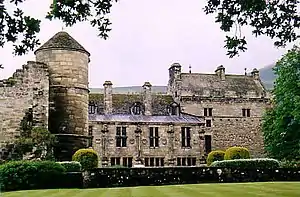
In late February 1402, while travelling officially to St Andrews, David was arrested just outside the city at Strathtyrum in a sting operation which had been arranged by Albany, at that time in complicit alliance with David's brother-in-law, Archibald, the fourth Earl of Douglas, who was offended with Rothesay for his unfaithfulness to his wife, the sister of Douglas. (David's father-in-law, the highly influential third Earl, had died two years before, in 1400.) The pretext for David's arrest was that the three-year period of his lieutenancy had expired. He was initially held captive in St Andrews Castle, and soon afterwards taken to Falkland Palace, Albany's residence in Fife. According to Bower, the prince spent the journey hooded and mounted backwards on a mule. At Falkland David remained a prisoner and shortly died there, reputedly of starvation.
He was buried at Lindores Abbey. The King founded a chaplaincy in the parish church of Dundee to pray for his soul, and daily masses were to be said at Deer Abbey and Culross.[6] A few weeks after the funeral, in May 1402, a public enquiry into the circumstances of David's death exonerated Albany of all blame.[7][8]
Four years later, in 1406, David's younger brother, James Stewart, succeeded Robert III as king (although at that time remaining uncrowned and in captivity in England) while Albany secured himself as de facto ruler of Scotland.
Fictional portrayals
As well as featuring in relevant historical novels by Nigel Tranter, David appears as a principal character in Walter Scott's The Fair Maid of Perth.
Notes
- "The Oxford Dictionary of National Biography". Oxford Dictionary of National Biography (online ed.). Oxford University Press. 2004. doi:10.1093/ref:odnb/54172. (Subscription or UK public library membership required.)
- Tytler 1887, page 5.
- citing Burnett, ed. (1878). Rotuli scaccarii regum Scotorum = The Exchequer Rolls of Scotland. Edinburgh: H.M. General Register House. p. 402.
- The Records of the Parliaments of Scotland to 1707, K.M. Brown et al eds (St Andrews, 2007-2019), 1399/1/3. Date accessed: 3 October 2019
- Marshall, Rosalind K. (2019). Scottish Queens, 1034–1714. ISBN 9781788851848.
- George Burnett, Exchequer Rolls of Scotland: 1379-1406, vol. 3 (Edinburgh, 1880), pp. xcii, 549, 626, 631.
- Tytler 1887, page 21.
- citing Dalrymple, David (1773). Remarks on the History of Scotland. Edinburgh: Balfour & Smellie. p. 278.
Sources
Tytler, Patrick Fraser (1887). The history of Scotland from the accession of Alexander III. to the union. II. Edinburgh: W. P. Nimmo.
| Edward I (1239–1307) King of England | |||||||||||||||||||||||||||||||||||||||
| Edward of Caernarfon (1284–1327) 1st Prince of Wales later, King Edward II of England | |||||||||||||||||||||||||||||||||||||||
| Edward III (1312–1377) King of England | |||||||||||||||||||||||||||||||||||||||
| Edward the Black Prince (1330–1376) 2nd Prince of Wales Duke of Cornwall | John of Gaunt (1340–1399) Duke of Lancaster | Edmund of Langley (1341–1402) Duke of York | Lionel of Antwerp (1338–1368) Duke of Clarence | ||||||||||||||||||||||||||||||||||||
| Richard of Bordeaux (1367–1400) 3rd Prince of Wales Duke of Cornwall later King Richard II of England | John Beaufort (c. 1371–1410) | Henry IV (1366–1413) King of England | Philippa of Clarence (1355–1382) | ||||||||||||||||||||||||||||||||||||
| Robert III (1337–1406) King of Scots | Henry of Monmouth (1386–1422) 4th Prince of Wales Duke of Cornwall later King Henry V of England | Roger Mortimer (1374–1398) | |||||||||||||||||||||||||||||||||||||
| David Stewart (1378–1402) Duke of Rothesay | James (1394–1437) Duke of Rothesay later King James I of Scots | Richard of Conisburgh (c. 1375–1415) Earl of Cambridge | Anne de Mortimer (1390–1411) | ||||||||||||||||||||||||||||||||||||
| John Beaufort (1404–1444) Duke of Somerset | Henry (1421–1471) Duke of Cornwall later King Henry VI of England | ||||||||||||||||||||||||||||||||||||||
| Alexander Stewart (1430) Duke of Rothesay | James (1430–1460) Duke of Rothesay later King James II of Scots | Edward of Westminster (1453–1471) 5th Prince of Wales Duke of Cornwall | Richard Plantagenet (1411–1460) Duke of York 6th Prince of Wales | ||||||||||||||||||||||||||||||||||||
| Lady Margaret Beaufort (1441/1443–1509) | Edward IV (1442–1483) later King Edward IV of England | Richard III (1452–1485) King of England | |||||||||||||||||||||||||||||||||||||
| James (1451–1488) Duke of Rothesay later King James III of Scots | Henry VII (1457–1509) King of England | Edward V of England (1470–?) 7th Prince of Wales Duke of Cornwall later King Edward V of England | Edward of Middleham (c. 1473–1484) 8th Prince of Wales Duke of Cornwall | ||||||||||||||||||||||||||||||||||||
| James (1473–1513) Duke of Rothesay later King James IV of Scots | Margaret Tudor (1489–1541) | Arthur Tudor (1486–1502) 9th Prince of Wales Duke of Cornwall | Henry VIII (1491–1547) 10th Prince of Wales Duke of Cornwall later King Henry VIII of England | ||||||||||||||||||||||||||||||||||||
| Arthur Stewart (1509–1510) Duke of Rothesay | James (1512–1542) Duke of Rothesay later King James V of Scots | Henry (1511) Duke of York Duke of Cornwall | Edward Tudor (1537–1553) 11th Prince of Wales Duke of Cornwall later King Edward VI of England | ||||||||||||||||||||||||||||||||||||
| James Stewart (1540–1541) Duke of Rothesay | Mary, Queen of Scots (1542–1587) Queen of Scotland | ||||||||||||||||||||||||||||||||||||||
| James (1566–1625) Duke of Rothesay later King James VI of Scotland and James I of England | |||||||||||||||||||||||||||||||||||||||
| Henry Frederick Stuart (1594–1612) 12th Prince of Wales Duke of Cornwall and Rothesay | Elizabeth Stuart (1596–1662) | Charles Stuart (1600–1649) 13th Prince of Wales Duke of Cornwall and Rothesay later King Charles I of England and Scotland | |||||||||||||||||||||||||||||||||||||
| Sophia of Hanover (1630–1714) | Charles James (1629) Duke of Cornwall and Rothesay styled Prince of Wales | Charles Stuart (1630–1685) 14th Prince of Wales Duke of Cornwall and Rothesay later King Charles II of England and Scotland | James II/VII (1633–1701) King of England and Scotland | ||||||||||||||||||||||||||||||||||||
| George I (1660–1727) King of Great Britain | |||||||||||||||||||||||||||||||||||||||
| George Augustus (1683–1760) 16th Prince of Wales Duke of Cornwall and Rothesay later King George II of Great Britain | James Francis Edward Stuart (1688–1766) 15th Prince of Wales Duke of Cornwall and Rothesay | ||||||||||||||||||||||||||||||||||||||
| Frederick Louis (1707–1751) 17th Prince of Wales Duke of Cornwall and Rothesay | |||||||||||||||||||||||||||||||||||||||
| George William Frederick (1738–1820) 18th Prince of Wales later King George III of Great Britain | |||||||||||||||||||||||||||||||||||||||
| George Augustus Frederick (1762–1830) 19th Prince of Wales Duke of Cornwall and Rothesay later King George IV of Great Britain | Edward Augustus (1767–1820) Duke of Kent and Strathearn | ||||||||||||||||||||||||||||||||||||||
| Victoria (1819–1901) Queen of Great Britain | |||||||||||||||||||||||||||||||||||||||
| Albert Edward (1841–1910) 20th Prince of Wales Duke of Cornwall and Rothesay later King Edward VII of Great Britain | |||||||||||||||||||||||||||||||||||||||
| George Frederick Ernest Albert (1865–1936) 21st Prince of Wales Duke of Cornwall and Rothesay later King George V of Great Britain | |||||||||||||||||||||||||||||||||||||||
| Edward Albert Christian George Andrew Patrick David (1894–1972) 22nd Prince of Wales Duke of Cornwall and Rothesay later King Edward VIII of Great Britain later Duke of Windsor | George Frederick Ernest Albert (1895–1952) later King George VI of Great Britain | ||||||||||||||||||||||||||||||||||||||
| Elizabeth II (1926–present) Queen of Great Britain | |||||||||||||||||||||||||||||||||||||||
| Charles Philip Arthur George (1948–present) 23rd Prince of Wales Duke of Cornwall and Rothesay | |||||||||||||||||||||||||||||||||||||||
| William Arthur Philip Louis (1982–present) Duke of Cambridge | |||||||||||||||||||||||||||||||||||||||
| George Alexander Louis (2013–present) | |||||||||||||||||||||||||||||||||||||||
|  | |