Deepstaria enigmatica
https://en.wikipedia.org/w/index.php?title=Deepstaria_enigmatica&action=edit
| Deepstaria enigmatica | |
|---|---|
 | |
Scientific classification  | |
| Kingdom: | Animalia |
| Phylum: | Cnidaria |
| Class: | Scyphozoa |
| Order: | Semaeostomeae |
| Family: | Ulmaridae |
| Genus: | Deepstaria |
| Species: | D. enigmatica |
| Binomial name | |
| Deepstaria enigmatica Russell, 1967 | |
Background
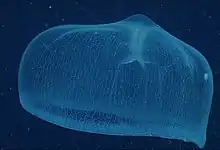
Deepstaria enigmatica is a very rarely seen giant jellyfish of the family Ulmaridae first described in 1967 by F. S. Russell. The bell of this jellyfish is very thin and wide (up to 60 cm or 2 ft),[1] and resembles a translucent, undulating sheet, lava lamp, or plastic bag as the animal moves. They are usually found in Antarctic and near-Antarctic seas but have been spotted in waters near the United Kingdom and Gulf of Mexico, at depths of 600 to 1,750 meters.[1][2] Unlike many other jellyfish, they lack tentacles.[3] They also are solitary creatures and live all by themselves, contrary to the group living style of many jellyfish. The large bell of the jellyfish has been proposed to be used for either locomotion or feeding when closed. The gastrovascular system of this jellyfish can be clearly seen through its skin as well.[3] The Deepstaria also has a geometric mesh pattern throughout its entire body. The mesh delivers nutrients to the entire jelly as it stretches and contracts to move and capture prey.[4]
Locomotion and Body Structure
Members of Deepstaria have a thin, umbrella-like membrane, a gastrovascular cavity, and lack tentacles. Deepstaria enigmatica move by peristalsis. This is done through contractions that travel in wave-like motion throughout its body. They have no tentacles, so they use the peristaltic wave as means of locomotion and capturing prey.[4] The enigmatica jellyfish begin these wave-like contractions by opening the mouth of the bell as a wave travels through their body. A bulge forms in the center of the body and remains as long as the mouth of the bell remains closed.[4]
Deepstaria Jelly Fall
Deepstaria enigmatica have been observed during jelly-falls. This happens when a jellyfish carcass falls through the water column to the ocean floor. The first time the Deepstaria enigmatica was observed during a jelly fall, it occured in the lower portion of the oxygen minimum zone of the ocean. It was observed as shrimp and crabs were scavenging its carcass.[4] These jelly falls are advantageous to the ocean floor, causing a source of organic enrichment. The carcasses lead to a restoration of degraded mineral content in the water column. The contribution of these jelly falls is underestimated. The Deepstaria enigmatica fall shows an increase in oxygen availability and organic matter, benefiting the ecosystems found at the bottom of the ocean.[4]
Symbiotic Relationship
As mentioned above, Deepstaria open and close their bell, or stomach cavity, allowing them to take in prey. This motion also allows isopods (a member of the crustacean family) to enter and live inside the jellyfish. Although the nature of this relationship is not fully understood, scientists currently believe that the isopod rides along and gains nutrients from the Deepstaria while being protected from predators. When the isopod and Deepstaria were seen together in a 1967 dive, scientists reported that the isopod was bright red, around 8 cm in length, and very much alive, suggesting some form of symbiotic relationship. This dive and other findings were recorded in a 1969 article by E.G. Barham and G.V. Pickwell. Their paper identifies the isopod as member of the genus Anuropus. The authors also suggest the possibility of the symbiotic relationship being parasitic.[5][6]
How the Deepstaria Jellyfish Eats Its Prey
The Deepstaria Jellyfish is translucent, shapeshifting, and tentacle lacking jellyfish. Normally jellyfish use their stinging tentacles to grab prey to eat but the Deepstaria Jellyfish uses a different method to obtain its prey. Instead, they trap their prey inside the bell bag-like structure. A complication of this method is that other organisms can become stowaways inside the jellyfish. Often inside of the bell cavity isopods can be found. (See Symbiotic Relationship)[7]
Discovery
In the 1960s Jacques Cousteau, a French explorer, unexpectedly found the Deepstaria Jellyfish in a deep-sea exploration mission. He was exploring the deep sea near Southwest Baker Island in a submarine called the Deepstar 4000 which became the inspiration for the name of this jellyfish. The Deepstaria Jellyfish has been found in the Gulf of Mexico, Antarctic, and the Pacific Ocean. In all of these locations the unusual shape shifting jellyfish is found 3000 feet below sea level.[8]
References
- "Deepstaria enigmatica". Antarctic Invertebrates. Smithsonian Institution. Retrieved 4 December 2018.
- "The Cascade Creature". Antarctic Invertebrates. Smithsonian Institution. Archived from the original on 19 May 2012. Retrieved 19 May 2012.
- "Rare Deep-Sea Jellyfish Spotted, Looks Like Plastic Bag". Animals. 2018-05-14. Retrieved 2021-12-09.
- Gruber, David F.; Phillips, Brennan; Marsh, Leigh; Sparks, John S. (May 2018). "Supplemental Material for 'In situ observations of the meso-bathypelagic scyphozoan, Deepstaria enigmatica (Semaeostomeae, Ulmaridae). (American Museum novitates, no. 3900)'". American Museum of Natural History Research Library. Retrieved 2021-12-09.
- "Translucent Deepstaria Jelly Whorls With Resident Isopod | Nautilus Live". nautiluslive.org. 2019-09-04. Retrieved 2021-12-09.
- Barham, E. G.; Pickwell, G. V. (1969-11-01). "The giant isopod, Anuropus: A scyphozoan symbiont". Deep Sea Research and Oceanographic Abstracts. 16 (5): 525–529. doi:10.1016/0011-7471(69)90040-0. ISSN 0011-7471.
- U.S Fish and Wildlife Services (September 15, 2019). "It's Complicated. The Amazing Relationships of the Deep".
- Hughes, Christy (March 18, 2021). "Meet the Shapeshifter of the Sea, Deepstaria Jellyfish".
Further reading
- Russell, F. S. (1967). "On a Remarkable New Scyphomedusan". Journal of the Marine Biological Association of the United Kingdom. 47 (3): 469–73. doi:10.1017/S0025315400035098. Archived from the original on 2012-10-25.