Delahaye 175
The Delahaye Type 175 is a luxury automobile built by French manufacturer Delahaye from 1948 to 1951. It was offered in a variety of custom body styles by independent coachbuilders such as Figoni et Falaschi, Henri Chapron, Saoutchik, and Carrosserie Pourtout.
| Delahaye 175/178/180 | |
|---|---|
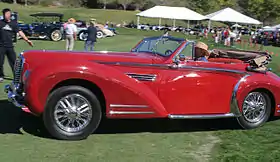 1947 Delahaye 175 bodied by Henri Chapron | |
| Overview | |
| Manufacturer | Delahaye |
| Production | 1948–1951 |
| Designer | Coachbuilders |
| Body and chassis | |
| Class | Luxury car |
| Body style | coachbuilt styles |
| Layout | FR layout |
| Related | Delahaye 135 |
| Powertrain | |
| Engine | 4,455 cc type 183 OHV I6 |
| Transmission | 4-speed pre-selector (Cotal) |
| Dimensions | |
| Wheelbase | 2.95-metres |
| Length | 4.62-metres |
| Width | 1.69-metres |
| Height | various |
| Curb weight | 1,050 kg (2,310 lb) |
| Chronology | |
| Predecessor | Delahaye Type 165 |
| Successor | Delahaye Type 235 |
A fire in the factory sometime during 1953 decimated the company's administration facilities, and very little data survived, which resulted in little being known about the Type 175 and its two siblings, the sequentially longer wheelbase Types 178 and 180. 107 examples were built in total, of which 24 have been recorded as survivors by Club Delahaye, the global authority on the brand and permanent holder of the registered Delahaye trademark.
Two fires occurred between 1944 and 1953. (Robb Report article on Delage by Dennis Adler; Club Delahaye Journal article). The first fire was an accident that occurred as Canadian soldiers liberated the factory from German guards in late August 1944. The second fire decimated the drawing and administration offices. Most of the company's records were gone (Club Delahaye members' journal). The 1953 fire was allegedly started by a group of disgruntled workers who failed to get management to address their grievances after 200 workers were let go when the French Army cancelled its Light Reconnaissance Vehicle contract in 1951; the fire virtually put Delahaye out of business.
Club Delahaye reportedly had "no technical information whatsoever" on the 4.5-litre, six-cylinder, modern chassis-series (Club Delahaye historian Andre Vaucourt). Technical production drawings and business and historical records were lost.
The Type 175 superseded the costly Type 165, of which only four were made. Both Figoni roadsters still exist (Mullin Motoring Museum; Club Delahaye; various magazine articles; Pebble Beach Concour d'Elegance), but both Chapron cabriolets were destroyed during World War II. (Club Delahaye Journal article).
The Type 175 was supposed to be introduced by the October 1940 Paris Auto Salon to sustain public interest generated by the Type 165, but the 1939 show was canceled without notice due to World War II, and the salon did not reopen until October 1946.
In mid-1938, the shareholders decided to replace the Type 165 with a new model that could compete with rivals like Talbot-Lago, Bugatti, and Hotchkiss. A rationalized, large-displacement chassis-series was needed to replace its outdated, smaller engine. Production of Types 145, 155 and 165 with V12 engines had already ended. From the twelve sets of V12 engine parts made, nine cars resulted: four Type 145 sports-racers; one Type 155 grand-prix monoposto; and, four Type 165 touring cars.
The Type 175 featured Dubonnet's independent front suspension, built by Delahaye under license from the inventor; an independent de Dion rear suspension system; large, finned Lockheed hydraulic brakes; a four-speed, semi-automatic, Cotal transmission; and, an entirely new chassis. (Club Delahaye Journal).
Developmental evolution was adversely impacted by the death of chief engineerJean Francois. Delahaye had nobody qualified to assume his position, which resulted in delays (Club Delahaye archive; DELAHAYE Le Grand Livre by Jacque Dorizon) that caused Delahaye to reintroduce its outdated Types 134, 135, and 148 to generate essential revenue. (Club Delahaye Journal and archive).
Of those built on the 2.95-meter wheelbase, 12 Type 175 cars reportedly exist, most being the optional 175S variant. The Type 178, built on a 3.15-meter wheelbase, was a four-passenger, touring model, of which 38 were built, and recently a seventh was registered. The Survivors include 820001 and 820038 as recorded survivors. Two Type 180 chassis were built as armoured limousines, for the senior executives of France's Communist Party, by Henri Chapron (numbers 825007 and 825008). Those two and four others are recorded survivors (Club Delahaye Journal; Club Delahaye archive, and research by Club Delahaye president Jean-Paul Tissot).
The six pre-production chassis were referred to by the factory with painted reference numbers: 90001; 91001; 91002; 92001; 92002; and, the unnumbered Paris show-chassis. (auto-historian Jean-Paul Tissot, author, and Club Delahaye president).
Managing director Charles Weiffenbach devised the sequence to intentionally obfuscate the identity of the evolutionary forerunners, and the separate prototype, so that all seven could be surreptitiously liquidated. His strategy was eventually discovered. (Club Delahaye president Jean-Paul Tissot).
Technical information on this series was lost in 1953 to the fire allegedly set by disgruntled factory workers after failing to get senior management to address their issues and demands. In desperation to salvage the company, and keep the remaining workers employed, after he furloughed two hundred, Weiffenbach tried to amalgamate with various French automakers before entering a merger agreement with Hotchkiss, but by December 31, 1954, Delahaye was defunct. Hotchkiss and Delahaye, and therefore Delage, was absorbed by the Brandt Organization, simply for their premises, and machine tools. Brandt was disinterested in automobiles.
There were 51 Type 175 and/or 175S cars; numbering from 815001 to 815051 inclusive; 38 Type 178 cars numbering from 820001 to 820038 inclusive; and, 18 Type 180 cars numbering from 825001 to 825018 inclusive. The production run totalled 107 cars that included all six pre-production units. (Documented data provided by Club Delahaye president Jean-Paul Tissot, from France's Ministry of Mines archive).
Initial design
During the creation of the Type 175, 178 and 180, the company's shareholders realized that a 4.5-litre-engined chassis was essential to meet the public's expectation, especially with Talbot-Lago being the prime competitor. The existing Delahaye V12 could not be cost-effectively made in small numbers, and the Type 135 based chassis was outdated.
The engineer responsible for the Type 175's conception and development did not survive World War II.
Types 175, 178, and 180 were under development prior to the outbreak of war in 1939. It had a one-litre larger displacement than the Type 135, four-wheel independent suspension for the first time by Delahaye and was built exclusively in left-hand drive.[1]
The postwar front design was created by in-house industrial designer Philippe Charbonneaux, who developed the distinctive Delahaye "face". His effort provided the design of the entire front with a narrower, elongated, heart-shape grille with horizontal bars, and low horizontal grilles on the sides.
Delahaye required its coachbuilders to use the new front, although the more well known coachbuilders, such as Figoni et Falaschi, Henri Chapron, Jacques Saoutchik, and Marcel Pourtout, were given artistic license, subject to the managing director's approval of their proposed designs.
Development
Although production officially started in early 1948, there were six pre-production units in existence by 1946, that were known about to a select few factory-workers and those with inside knowledge of the company, one of those being Fernand Lacour, the owner of The Wilson Garage, who was a regular engine consultant, even before chief design-engineer Jean Francois' death in April 1944. The earliest six were referred to at the factory, for their continued development, as: 90001; 91001, 91002, 92001, 92002; and, the un-numbered 1946-1949 Paris Auto Salon show-chassis: exhibited in optional Type 175S guise.
One of the six was the Type 175/178/180 series prototype. It was eventually identified through research jointly conducted by Club Delahaye president Jean-Paul Tissot, in conjunction with auto-historians Brian Arthur Johnston, Andre Vaucourt, and Philippe Bavouzet, in 2014, as being 92002. Weiffenbach personally devised the intentionally convoluted and confusing reference numbering strategy to obscure the prototype's identity. It took over half a century of research to determine his strategy and arrive at conclusions about what happened to the early pre-production chassis. All six were sold off after having been formally stamped with production build numbers in early 1948, to be homologation tested, certified, registered, and licensed as coach-built motorcars.
After World War II, Delahaye created a new chassis with four-wheel independent suspension, hydraulic brakes; a semi-automatic transmission; and, left-hand-drive for the first time by the company. The second-generation large displacement chassis series was evidently destined for the export market, ostensibly in North America. But Delahaye had not established a real presence in the United States and/or Canada, with its francophone province of Quebec. Montreal could have been a more likely prospect than New York.
Austrian-born Max Hoffman, of half-Jewish parentage, abandoned Europe and sailed to America in 1939 to avoid potential Nazi persecution in France. After establishing himself as a producer of affordable costume jewelry in America, Hoffman opened his downtown New York City imported luxury auto emporium in 1947.
Delahaye's new 4.5-litre engine was an overhead-valve, inline, six-cylinder, similar to the preceding Type 135, but a litre larger in displacement, and internally improved, with seven main bearings, versus four, and the cylinder-head had six intakes, and six exhaust ports, twelve in all, versus nine in the Type 135 (there were two Type 135S factory racing-engines with special twelve port heads). Unlike the cast-iron block and head of previous models, the 4.5-liter engine had a cast aluminum block under its cast-iron head, separated by an asbestos and copper head-gasket. The compression ratio was 6.5:1, but was subtly increased in the Type 175S that had three Solex 40AiP carburetors, and chrome Rudge-Whitworth wire wheels on splined hubs, instead of five-bolt, stamped steel wheels. Those standard wheels were seen on most Delahayes, as well as Citroën, Peugeot, Talbot, and others as there were few wheel manufacturers at the time.
Rudge invented the wire-spoked wheel and splined hub. Borrani, in Italy, licensed Rudge's patent and produced clones in steel, as well as sports-oriented versions with polished aluminum rims and chromed steel hubs, as seen on prewar Maseratis and postwar Ferraris.
By 1946, those familiar with the workings of Delahaye knew of the six pre-production chassis-units, which included the developmental experiment that was presented to the shareholding directors in March 1944 personally by Weiffenbach, in the unavoidable absence of chief design-engineer Jean Francois, for production approval. The prototypical chassis remained unidentified until late 1945, when it was referred to as 92002, as was necessary when the second and third pre-production units (reference numbers 90001 and 91001) were being sequentially fabricated in late 1945, to be assembled in early 1946. The 1946–49 Paris Auto Salon Type 175S show-chassis was the fourth unit built. The show-chassis was not an operational example, as it was not fully completed prior to being shown; there was no fuel-line, nor a battery and cables, as evidenced by published period photographs when it was on display.
Five of the initial six units were reference numbered, and not stamped. Factory-workers needed identification to differentiate one from another for continuing modifications, production-oriented change orders, and testing. There were reference numbers hand-painted on the left front frame-rails (Club Delahaye president Jean-Paul Tissot) these being: 90001; 91001; 91002; 92001 and 92002. The glitzy finished show-chassis had no need of a reference number. It was the fourth of the six, and was a strange amalgamation of approved production changes, blended with Jean Francois' unproven original details. The numerical sequence was Weiffenbach's strategy to thoroughly obfuscate the prototype's identity so that it could be surreptitiously liquidated; his objective was to recover the new chassis-series' development costs.
Chassis
The new chassis-series introduced the semi-monocoque concept for the first time. The chassis was completely different from the foregoing Type 135 in dimensions, proportions, and structural design. The sole commonality was the stressed-steel floor-pan, which, in the new chassis, was dramatically larger, with parallel sides instead of the Type 135'frame rails that tapered progressively narrower from the aft cockpit crossmember forward.
The Type 135 had an independent front suspension, but it was a proprietary system that was shared with Delage and Talbot-Lago. The new 4.5-liter chassis had a previously untried, independent front suspension system, that was totally unfamiliar to Delahaye. This was the recently invented Dubonnet system, licensed to Delahaye. It replaced the proprietary system Delahaye employed in the Types 135, 145, 148L, 155, and 165, as well as the Delage D6 and D8 models that were also built by Delahaye at that time (Delahaye acquired the assets of the bankrupt Delage in 1935). The Dubonnet system had seen previous use prior to the 135, having been licensed by General Motors in 1933, as well as by Alfa-Romeo, Simca, and Vauxhall. After WW2, only Vauxhall and Delahaye retained the Dubonnet system. Others had moved on to the unequal-length A-arm approach, pioneered by Cadillac's senior engineer, Maurice Olly, and licensed to Rolls Royce for use in their models in 1935
The Dubonnet independent front suspension system proved to be problematic, unless fastidiously serviced and rigorously maintained. Oil-seal leaks caused component seizures leading to internal parts failures. Front suspension collapses occurred and accident damage resulted. It was this latter that doomed the new chassis series to abject failure, damaging Delahaye's revered reputation for its cars respected as being "Solide comme un Delahaye".
The weight of the custom coachwork on these already heavy chassis adversely affected the acceleration and speed of these cars. It was evident that coachbuilders employing antiquated traditional building methods and materials were oblivious to excess weight. In France, all but Henri Chapron and Olivier Lecanu-Deschamp, who were familiar with working in aluminum, were building their custom bodies with hand-hammered steel panels mechanically fastened over hardwood body support structures. They were inordinately heavy, and contributed to the mechanical failures experienced by an estimated dozen or so, early purchasers. Broken suspension components resulted in Delahaye being obliged to buy back the offending coachbuilt luxury cars, at a dramatic cost to the company, as was required to avoid litigation.
The Type 175S racing-engines Delahaye developed for Charles Pozzi, and French champion driver Eugene Chabaud reportedly had a 9.1:1 compression ratio, and with the three Stromberg dual-choke carburetors, delivered slightly in excess of 220 bhp, parallel that of three of the four Type 145 cars (48772, 48773, and 48775). Only the more highly tuned 48771 had a recorded 244.8 BHP.
The Type 175S had just two factory options: Rudge wire-spoked wheels; and three Solex 40AiP down-draft carburetors. The coachbuilders addressed everything else a customer desired and specified.
The new 4.5-litre engine carried the "183" casting-code and was made in two visually distinct forms. The initial engines were stamped: Type 1AL-183, as found in all six pre-production units known about by 1946; and, the two Type 175S racing-engines that Delahaye loaned to Charles Pozzi and his Ecurie Lutetia co-owning team-mate, Eugene Chabaud. Three Type 175S racing-engined competition coupes were built for Jean Trevou (815042, 815050 and 815051).
Most production motors were stamped Type 2AL-183 (Auto-historians Andre Vaucourt, and jean-Paul Tissot). These came out of the same, but revised, casting-mold number "183". Modifications had been made for production efficiency, cost-effectiveness, and alleged internal reinforcement made to the crankcase. The latter allegation has not been substantiated and may be an assumption. Cost-effectiveness was the more probable rationale, especially since a number of examples of the "early-series" Type 1AL-183 engines are found throughout the production run, from beginning to end.
History
After having spent much of World War II building railroad rolling stock parts (for freight-train cars) for the German occupiers, Delahaye was included in deputy director General Paul-Marie Pons' 1945 plan Pons for French industry and engineering, which was a five-year program to rebuild the French industry, and a source for needed incoming capital for French companies. The plan gave Delahaye the position of building sports and luxury cars for the export market to generate foreign currency for France's struggling postwar economy. Over 80 percent of the company's automobile chassis were exported to France's colonies, including those in Africa and Asia. In consideration of the expense of continuing the limited production of the complicated and expensive V-12, with its exotic alloys, as was used in the Type 145 sports-racers, the solitary Type 155 monoposto (all five racecars were made exclusively for Lucy O'Reilly Schell for her team Écurie Bleue), as well as in the four Type 165 grand-touring cars, V12 production ended in 1938, with twelve sets of engine parts having been made.
The V-12 was replaced by a new, much less complex, inline, overhead-valve, six-cylinder engine of the same 4.5-liter displacement displacement.[2] The Type 175 debuted as a show-chassis with partial front coachwork, submitted by prominent coachbuilders Letourneur and Marchand to demonstrate Delahaye's new postwar "face". It was one of a few new machines to debut at the first postwar Paris Auto Salon of October 1946. It garnered considerable attention, particularly from the coachbuilders, and was Delahaye's first model produced exclusively in left-hand drive.[3]
The chassis was not fully developed by October 1946, nor was it adequately tested before being put into production in late November 1947. Problems with the Dubonnet front suspension became apparent. The same unchanged show-chassis reappeared on Delahaye's stand in 1947,1948, and 1949, with progressively more but still limited front coachwork. The extended delay into early 1948, instead of an early 1946 start-up, was due to Francois' unanticipated death in April 1944, and there was nobody qualified at Delahaye to take his place.[4]
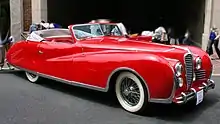
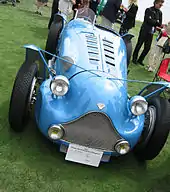
The company's production build number list verified that 51 Type 175 chassis were built (815001 to 815051 inclusive). That most probably included the Paris Type 175S Show-chassis, that was believed to have been cycled back into production, after the October 1949 autoshow. It likely went into the tail-end of Type 175S production. Nobody knows with certainty, and the show-chassis never appeared again, in recognizable form, in whole or in part.[1][5] with no differentiation explaining which of these were Type 175 or optional 175S chassis. While not a large success in the marketplace, a Type 175S won the 1951 Monte Carlo Rally,[6] the same car (815042) finished twelfth in the Carrera Panamericana, while a second Motto-bodied 175S coupe (815051) was disqualified on a technicality.(DELAHAYE Sport et Prestige by Francois Jolly)[7] The optional 175S came with three carburettors and like the 175, had a short 2.95-metre wheelbase; two longer wheelbased versions, Types 178 and 180, with single carburetors and 140 HP were also built: The Production Build List confirms there were 38 of the 3.15-metre wheelbase Type 178 chassis built; and, 18 of the 3.35-meter wheelbase Type 180 chassis [2] and 180 (333.5 cm) were produced, mainly for heads of state, dignitaries, and the like. Two Henri Chapron-bodied, fully armoured Type 180 limousines were built for the leaders of the French Communist Party in 1948.[1] A prototype "Delage D180" was also developed on this basis, but never entered production, as Delahaye focused its Delage production on the D6-70 model.[7] Production of three-chassis series, including the prototype, and the show-chassis, was 107 total units. (substantiated by Club Delahaye president Jean-Paul Tissot, from archived company records) [7]
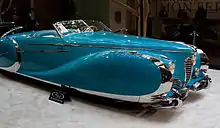
.jpg.webp)
The rear-wheel drive Type 175, 178 and 180 chassis is considerably more sophisticated than its Type 135 predecessor, the front suspension being independent with pivoting horizontal cylinders that contained a powerful coil-spring and hydraulic shock absorber in an oil-bath Dubonnet. The rear was by de Dion, with semi-elliptical springs. Brakes were hydraulic type made by Lockheed. The brake-drums were of deeply finned cast-iron, actuated by dual master cylinders with a balance-bar.[7]
Delahaye's reputation took a hit in consequence. The custom bodies of these cars were often much too heavy for what the chassis had originally been engineered for. In dry conditions, they were fast cars, but wet-weather handling was unpredictable.[2] Another culprit was inferior quality of high-tensile-strength steel in the early postwar era. The engineer's specified grade was depleted by the war, and what little could be acquired afterward came through the French government, which had not prioritized luxury carmakers. The Types 175, 178 and 180 ceased production in 1951. Although Delahaye managed to introduce the Type 235 in 1951, it was only an updated variation of the Type 135. The company closed down in December 31, 1954.[8] Delahaye was absorbed by Hotchkiss in 1953, which was in turn bought by Brandt.[2]
Bibliography
- Hull, Peter. Delahaye: Famous on Road and Race Track, in Ward, Ian. World of Automobiles, Volume 5, pp. 521–524. London: Orbis, 1974.
References
- "Delahaye 180 (Lot 14 / Sale 5001)". Christie's. Archived from the original on 2021-03-24.
- Le Roux, André. "Delahaye 180" (in French). Carcatalog. Archived from the original on 2011-07-20. Retrieved 2010-10-19.
- Hull, p. 524.
- Phedor. "Les Delahaye 175-178-180 (1946-51): le destin d'une reine éphémère..." [The Delahaye 175-178-180 (1946-51): The fate of an ephemeral sovereign] (in French). Club Doctissimo. Retrieved 2010-10-19.
- "BBC News - Diana Dors sports car to be sold". Bbc.co.uk. 2010-08-15. Retrieved 2010-08-14.
- Hull, Peter. "Delahaye: Famous on Road and Race Track", in Ward, Ian, executive editor. World of Automobiles (London: Orbis, 1974), Volume 5, p. 524.
- Rousseau, Jacques; Caron, Jean-Paul (1988). "134". Guide de l'Automobile Française. Paris: Solar. ISBN 2-263-01105-6.
- Club Delahaye journal; auto-historians Andre Vaucourt, Jacques Dorizon and Phillippe Bavouzet, Jean-Pierre Bernard; Jean-Paul Tissot; and, Brian Arthur Johnston; Adatto, Richard S; Meredith, Diana E. (2006). Delahaye Styling and Design. Deerfield, IL: Dalton Watson Fine Books. ISBN 978-1-85443-221-6.