Gray asexuality
Gray asexuality or gray-sexuality is the spectrum between asexuality and sexuality.[1][2] Individuals who identify with gray asexuality are referred to as being gray-A, or a gray ace, and make up what is referred to as the "ace umbrella".[3] Within this spectrum are terms such as demisexual, semisexual, asexual-ish and sexual-ish.[4]
| Sexual orientation |
|---|
 |
| Sexual orientations |
| Related terms |
| Research |
| Animals |
| Related topics |
|

| Part of a series on |
| LGBT topics |
|---|
 LGBT portal LGBT portal |
| Part of a series on |
| Asexuality topics |
|---|
| Related orientations |
| General topics |
| Studies |
| Attitudes and discrimination |
| Asexual community |
| Lists |
|
| Portals |
|

The emergence of online communities, such as the Asexual Visibility and Education Network (AVEN), have given gray aces locations to discuss their orientation.[5]
Definitions
General
Gray asexuality is considered the gray area between asexuality and sexuality, in which a person may only experience sexual attraction on occasion.[1][2] The term 'demisexuality' was coined in 2006 by Asexual Visibility and Education Network (AVEN).[3] The prefix 'demi-' derives from the Latin dimidium, meaning "divided in half". The term 'demisexual' comes from the concept being described as being "halfway between" sexual and asexual.
The term 'gray-A' covers a range of identities under the asexuality umbrella, or on the asexual spectrum, including demisexuality.[6] Other terms within this spectrum include 'semisexual', 'asexual-ish' and 'sexual-ish'.[4] The gray-A spectrum usually includes individuals who very rarely experience sexual attraction; they experience it only under specific circumstances.[2][7] Sari Locker, a sexuality educator at Teachers College of Columbia University, argued during a Mic interview that gray-asexuals "feel they are within the gray area between asexuality and more typical sexual interest".[8] A gray-A identifying individual may have any romantic orientation, because sexual and romantic identities are not necessarily linked.[3][4]
Demisexuality

A demisexual person does not experience sexual attraction until they have formed a strong emotional connection with a prospective partner.[2][5] The definition of "emotional bond" varies from person to person inasmuch as the elements of the split attraction model can vary.[10][11] Demisexuals can have any romantic orientation.[12][13] People in the asexual spectrum communities often switch labels throughout their lives, and fluidity in orientation and identity is a common attitude.[3]
Demisexuality, as a component of the asexuality spectrum, is included in queer activist communities such as GLAAD and The Trevor Project, and itself has finer divisions.[14][15]
Demisexuality is a common theme (or trope) in romantic novels which has been termed 'compulsory demisexuality'.[16] Within fictitious prose, the paradigm of sex being only truly pleasurable when the partners are in love is a trait stereotypically more commonly associated with female characters. The intimacy of the connection also allows for an exclusivity to take place.[17][13]
Post-doctorate research on the subject has been done since at least 2013, and podcasts and social media have also raised public awareness of the sexual orientation.[18] Some public figures who have come out as demisexual, such as Michaela Kennedy-Cuomo, have also raised awareness, though typically face some degree of ridicule for their sexuality.[19]
Community
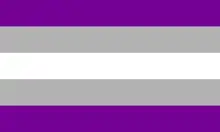
Online communities, such as the Asexual Visibility and Education Network (AVEN), as well as blogging websites such as Tumblr, have provided ways for gray-As to find acceptance in their communities.[5][7] While gray-As are noted to have variety in the experiences of sexual attraction, individuals in the community share their identification within the spectrum.[21] A black, gray, white, and purple flag is commonly used to display pride in the asexual community. The gray bar represents the area of gray sexuality within the community.[22]
Research
As of 2019, asexuality in general is relatively new to academic research and public discourse.[5]
References
- Bogaert, Anthony F. (January 4, 2015). Understanding Asexuality. Rowman & Littlefield. p. 85. ISBN 978-1-4422-0100-2.
- Decker JS (2015). "Grayromanticism". The Invisible Orientation: An Introduction to Asexuality. Simon and Schuster. ISBN 978-1510700642.
- McGowan, Kat (February 18, 2015). "Young, Attractive, and Totally Not Into Having Sex". Wired. Retrieved March 4, 2015.
- Mosbergen, Dominique (June 19, 2013). "The Asexual Spectrum: Identities In The Ace Community (INFOGRAPHIC)". Huffington Post. Retrieved March 5, 2015.
- Buyantueva R, Shevtsova M (2019). LGBTQ+ Activism in Central and Eastern Europe: Resistance, Representation and Identity. Springer Nature. p. 297. ISBN 978-3030204013.
- Weinberg, Thomas S.; Newmahr, Staci (March 6, 2014). Selves, Symbols, and Sexualities: An Interactionist Anthology. SAGE Publications. ISBN 978-1-4833-2389-3.
- Shoemaker, Dale (February 13, 2015). "No Sex, No Love: Exploring asexuality, aromanticism at Pitt". The Pitt News. Archived from the original on February 17, 2015. Retrieved March 4, 2015.
- Zeilinger, Julie (May 1, 2015). "6 Actual Facts About What It Really Means to Be Asexual". Mic. Retrieved December 31, 2015.
- Ender, Elena (June 21, 2017). "What the Demisexual Flag Really Represents A more specific, symbolic and subtle flag to wave at your pride events". Entity. Retrieved December 22, 2019.
- "Split Attraction Model". Princeton Gender + Sexuality Resource Center.
- "Bustle". www.bustle.com. Retrieved December 16, 2016.
- "What Does It Mean To Be Demisexual And Demiromantic? - HelloFlo". HelloFlo. June 2, 2016. Retrieved December 16, 2016.
- "Asexuality, Attraction, and Romantic Orientation". The LGBTQ Center at The University of North Carolina at Chapel Hill. Retrieved July 23, 2020.
- Pasquier, Morgan (October 18, 2018). "Explore the spectrum: Guide to finding your ace community". glaad.org.
- "Asexual".
- McAlister, Jodi. "First Love, Last Love, True Love: Heroines, Heroes, and the Gendered Representation of Love in the Category Romance Novel." Gender & Love, 3rd Global Conference. Mansfield College, Oxford, UK. Vol. 15. 2013
- McAlister, Jodi (September 1, 2014). "'That complete fusion of spirit as well as body': Heroines, heroes, desire and compulsory demisexuality in the Harlequin Mills & Boon romance novel". Australasian Journal of Popular Culture. 3 (3): 299–310. doi:10.1386/ajpc.3.3.299_1.
- Klein, Jessica. "Why demisexuality is as real as any sexual orientation". www.bbc.com.
- López, Canela. "Andrew Cuomo's daughter says she's demisexual. Here's what that means". Insider.
- emarcyk (March 29, 2017). "Word of the Week: Gray-A". Rainbow round table news. Retrieved July 16, 2021.
- Cerankowski, Karli June; Milks, Megan (March 14, 2014). Asexualities: Feminist and Queer Perspectives. Routledge. ISBN 978-1-134-69253-8.
- Williams, Isabel. "Introduction to Asexual Identities & Resource Guide". Campus Pride. Archived from the original on August 26, 2015. Retrieved March 5, 2015.CS1 maint: bot: original URL status unknown (link)
Bibliography
- Bogaert, Anthony F. (2012). Understanding Asexuality. Rowman & Littlefield Publishers, Inc. ISBN 978-1-4422-0099-9. Retrieved March 4, 2015.
- Cerankowski, Karli June; Milks, Megan (2014). Asexualities: Feminist and Queer Perspectives. Routledge. ISBN 978-0-415-71442-6. Retrieved March 4, 2015.
- Weinberg, Thomas S.; Newmahr, Staci D. (2015). Selves, Symbols, and Sexualities: An Interactionist Anthology. SAGE Publications, Inc. ISBN 978-1-4522-7665-6. Retrieved March 4, 2015.
External links
| |||||
| General | | ||||
| Community | |||||
| History | |||||
| Asexuals |
| ||||
| |||||
