Democracy in America
De La Démocratie en Amérique (French pronunciation: [dəla demɔkʁasi ɑ̃n‿ameˈʁik]; published in two volumes, the first in 1835[1] and the second in 1840)[2] is a classic French text by Alexis de Tocqueville. Its title translates as On Democracy in America, but English translations are usually simply entitled Democracy in America. In the book, Tocqueville examines the democratic revolution that he believed had been occurring over the previous several hundred years.
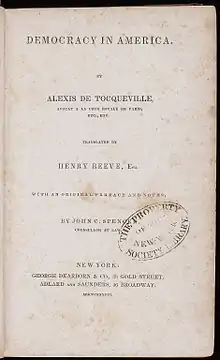 Title page of Democracy in America by Alexis de Tocqueville, printed at New York, 1838 | |
| Author | Alexis de Tocqueville |
|---|---|
| Original title | De la démocratie en Amérique |
| Language | French |
| Publisher | Saunders and Otley (London) |
Publication date | 1835–1840 |
In 1831, Alexis de Tocqueville and Gustave de Beaumont were sent by the French government to study the American prison system. In his later letters Tocqueville indicates that he and Beaumont used their official business as a pretext to study American society instead.[3] They arrived in New York City in May of that year and spent nine months traveling the United States, studying the prisons, and collecting information on American society, including its religious, political, and economic character. The two also briefly visited Canada, spending a few days in the summer of 1831 in what was then Lower Canada (modern-day Quebec) and Upper Canada (modern-day Ontario).
After they returned to France in February 1832, Tocqueville and Beaumont submitted their report, Du système pénitentiaire aux États-Unis et de son application en France (On the Penitentiary System in the United States and its Application in France), in 1833. When the first edition was published, Beaumont was working on another book, Marie, ou, L'esclavage aux États-Unis (Marie, or, Slavery in the United States, published as two volumes in 1835), a social critique and novel describing the separation of races in a moral society and the conditions of slaves in the United States. Before finishing Democracy in America, Tocqueville believed that Beaumont's study of the United States would prove more comprehensive and penetrating.[4]
Democracy in America was written in France after the Great Revolution. At that time, the kingship had been overthrown, but the French society was in turmoil. Although the demands of democracy have been temporarily suppressed, Tocqueville, who has a strong political acumen, has realized that democracy is an unstoppable historical trend. Sooner or later, the old hierarchical system will enter the "legacy pile" of history. The new era of equal status for all is coming, and democracy will inevitably and universally arrive all over the world. [5] For the writing of Democracy in America, Tocqueville seldom relied on the written materials of the past and the same time, but through interviews with people from all walks of life in the United States, direct inspections of society, and personal experience of the American social system, human rights, Religious beliefs, economics and other aspects. [6]
Purpose
He begins his book by describing the change in social conditions taking place. He observed that over the previous seven hundred years the social and economic conditions of men had become more equal. The aristocracy, Tocqueville believed, was gradually disappearing as the modern world experienced the beneficial effects of equality. Tocqueville traced the development of equality to a number of factors, such as granting all men permission to enter the clergy, widespread economic opportunity resulting from the growth of trade and commerce, the royal sale of titles of nobility as a monarchical fundraising tool, and the abolition of primogeniture.[7]
Tocqueville described this revolution as a "providential fact"[7] of an "irresistible revolution," leading some to criticize the determinism found in the book. However, based on Tocqueville's correspondences with friends and colleagues, Marvin Zetterbaum, Professor Emeritus at University of California Davis, concludes that the Frenchman never accepted democracy as determined or inevitable. He did, however, consider equality more just and therefore found himself among its partisans.[8]
Given the social state that was emerging, Tocqueville believed that a "new political science" would be needed, in order to:
[I]nstruct democracy, if possible to reanimate its beliefs, to purify its motives, to regulate its movements, to substitute little by little the science of affairs for its inexperience, and knowledge of its true instincts for its blind instincts; to adapt its government to time and place; to modify it according to circumstances and men: such is the first duty imposed on those who direct society in our day.[9]
The remainder of the book can be interpreted as an attempt to accomplish this goal, thereby giving advice to those people who would experience this change in social states.
Tocqueville's message is somewhat beyond the American democracy itself, which was rather an illustration to his philosophical claim that democracy is an effect of industrialization. This explains why Tocqueville does not unambiguously define democracy and even ignores the intents of the Founding Fathers of the United States regarding the American political system:
To pursue the central idea of his study — a democratic revolution caused by industrialization, as exemplified by America — Tocqueville persistently refers to democracy. This is in fact very different from what the Founding Fathers of the United States meant. Moreover, Tocqueville himself is not quite consistent in using the word ‘democracy’, applying it alternately to representative government, universal suffrage or majority-based governance:
The American institutions are democratic, not only in their principle but in all their consequences; and the people elects its representatives directly, and for the most part annually, in order to ensure their dependence. The people is therefore the real directing power; and although the form of government is representative, it is evident that the opinions, the prejudices, the interests, and even the passions of the community are hindered by no durable obstacles from exercising a perpetual influence on society. In the United States the majority governs in the name of the people, as is the case in all the countries in which the people is supreme. Democracy in America, Book I, Ch IXSuch an ambiguous understanding of democracy in a study of great impact on political thought could not help leaving traces. We suppose that it was Tocqueville’s work and not least its title that strongly associated the notion of democracy with the American system and, ultimately, with representative government and universal suffrage. The recent ‘Tocqueville renaissance’, which enforces the democratic image of the United States and, correspondingly, of other Western countries, also speaks for the role of Tocqueville’s work.
Main themes
The Puritan founding
Tocqueville begins his study of the U.S. by explaining the contribution of the Puritans. According to him, the Puritans established the U.S. democratic social state of equality. They arrived equals in education and were all middle class. In addition, Tocqueville observes that they contributed a synthesis of religion and political liberty in America that was uncommon in Europe, particularly in France. He calls the Puritan Founding the "seed" of his entire work.
The Federal Constitution
Tocqueville believed that the Puritans established the principle of sovereignty of the people in the Fundamental Orders of Connecticut. The American Revolution then popularized this principle, followed by the Constitutional Convention of 1787, which developed institutions to manage popular will. While Tocqueville speaks highly of the U.S. Constitution, he believes that the mores, or "habits of mind" of the American people play a more prominent role in the protection of freedom. These include:
- Township democracy
- Mores, laws, and circumstances
- Tyranny of the majority
- Religion and beliefs
- The family
- Individualism
- Associations
- Self-interest rightly understood
- Materialism
Situation of women
Tocqueville was one of the first social critics to examine the situation of U.S. women and to identify the concept of separate spheres.[11] The section Influence of Democracy on Manners Properly So Called of the second volume is devoted to his observations of women's status in U.S. society. He writes: "In no country has such constant care been taken as in America to trace two clearly distinct lines of action for the two sexes and to make them keep pace one with the other, but in two pathways that are always different."[12]
He argues that the collapse of aristocracy lessened the patriarchal rule in the family where fathers would control daughters' marriages, meaning that women had the option of remaining unmarried and retaining a higher degree of independence. Married women, by contrast, lost all independence "in the bonds of matrimony" as "in America paternal discipline [by the woman's father] is very relaxed and the conjugal tie very strict."[13] Tocqueville considered the separate spheres of women and men a positive development, stating:[11]
As for myself, I do not hesitate to avow that although the women of the United States are confined within the narrow circle of domestic life, and their situation is in some respects one of extreme dependence, I have nowhere seen women occupying a loftier position; and if I were asked, ... to what the singular prosperity and growing strength of that people ought mainly to be attributed, I should reply,—to the superiority of their women.[14]
Equality, Freedom, and Democracy
In the book Democracy in America, the meaning of "democracy" is somewhat confusing, and its basic core meaning is the trend toward equality in all aspects of society. The benefits of democracy are obvious: "Democratic laws generally tend to promote the welfare of the greatest possible number; for they emanate from the majority of the citizens, who are subject to error, but who cannot have an interest opposed to their own advantage. The laws of an aristocracy tend, on the contrary, to concentrate wealth and power in the hands of the minority; because an aristocracy, by its very nature, constitutes a minority. It may therefore be asserted, as a general proposition, that the purpose of a democracy in its legislation is more useful to humanity than that of an aristocracy."[15] Tocqueville said Equality does not refer to the equality of property, but the equality of rights, that is, "the general equality of condition among the people". In Tocqueville's theory, equality is a fundamental matter, and all individual things are produced by him. "I readily discovered the prodigious influence that this primary fact exercises on the whole course of society; it gives a peculiar direction to public opinion and a peculiar tenor to the laws; it imparts new maxims to the governing authorities and peculiar habits to the governed."[16]
Tocqueville believes that equality will bring about demands for freedom. "The principle of equality, which makes men independent of each other, gives them a habit and a taste for following in their private actions no other guide than their own will. This complete independence, which they constantly enjoy in regard to their equals and in the intercourse of private life, tends to make them look upon all authority with a jealous eye and speedily suggests to them the notion and the love of political freedom."[17]
Freedom and equality have their harmonious side: "men will be perfectly free because they are all entirely equal; and they will all be perfectly equal because they are entirely free. "[17] However, equality and freedom do not develop in a proportional relationship. Especially in a democratic society, "Among these nations equality preceded freedom; equality was therefore a fact of some standing when freedom was still a novelty; the one had already created customs, opinions, and laws belonging to it when the other, alone and for the first time, came into actual existence. Thus the latter was still only an affair of opinion and of taste while the former had already crept into the habits of the people, possessed itself of their manners, and given a particular turn to the smallest actions in their lives."[17] Therefore, although people in democratic countries love freedom by nature, their passion for equality is even more difficult to stop. "they call for equality in freedom; and if they cannot obtain that, they still call for equality in slavery."[17] It is precisely because of the admiration of freedom that Tocqueville inherited Constant's idea that the democratic system may be transformed into a tyranny of despotism, and described it as "Tyranny of the majority".[18] In his opinion, the dangers that democracy can produce are: on the one hand, there is the tendency of anarchism, which has been widely discussed; on the other hand, the tyranny of the majority, that is, the stifling of individual freedom by absolute authority. Compared with the former, the latter is more severe. Tocqueville believes that autocracy is what scares people the most in the democratic era. How to effectively guarantee freedom in a democratic society is the core issue of Tocqueville's American democratic outlook. Combined with the actual investigation of American society, he proposed to implement a series of measures such as federalism, separation of powers, local autonomy, and freedom of the press in a democratic society to ensure freedom and prevent Tyranny of the majority.
Table of Contents[19]
- The Author's Preface
Volume I
- Chapter I: The Exterior Form of North America
- Chapter II: Origin of the Anglo-Americans, and the Importance of this Origin in Relation to their Future Condition.
- Chapter III: Social Condition of the Anglo-Americans.
- Chapter IV: The Principle of the Sovereignty of the People of North America.
- Chapter V: The Necessity of Examining the Condition of the States Before that of the Union at Large.
- Chapter VI: Judicial Power in the United States and its Influence on Political Society.
- Chapter VII: Political Jurisdiction in The United States.
- Chapter VIII: The Federal Constitution.
- Chapter IX: How it can be Strictly Said That the People Govern in The United States.
- Chapter X: Parties in the United States
- Chapter XI: Liberty of the Press in The United States.
- Chapter XII: Political Associations in The United States.
- Chapter XIII: Government of the Democracy in The United States.
- Chapter XIV: What are the Advantages which American Society Derives from a Democratic Government?
- Chapter XV: Unlimited Power of the Majority in The United States, and its Consequences.
- Chapter XVI: Causes which Mitigate the Tyranny of the Majority in The United States.
- Chapter XVII: Principal Causes which Serve to Maintain the Democratic Republic in The United States.
- Chapter XVIII: The Present and Probably Future Condition of the Three Races that Inhabit the Territory of The United States.
Volume II
- Introduction to the Second Volume.
FIRST BOOK: Influence of Democracy on the Action of Intellect in The United States.
- Chapter I: Philosophical Method of The Americans.
- Chapter II: Of the Principal Source of Belief Among Democratic Nations.
- Chapter III: Why the Americans Show More General Aptitude and Taste for General Ideas that their Forefathers, The English.
- Chapter IV: Why the Americans have never been so Eager as the French for General Ideas in Political Affairs.
- Chapter V: How Religion in The United States Avails itself of Democratic Tendencies.
- Chapter VI: The Progress of Roman Catholicism in The United States,
- Chapter VII: What Causes Democratic Nations to Incline toward Pantheism,
- Chapter VIII: How Equality Suggests to the Americans the Indefinite Perfectibility of Man.
- Chapter IX: The Example of the Americans does not Prove that a Democratic People can have no Aptitude and no Taste for Science, Literature, or Art.
- Chapter X: Why the Americans are more Addicted to Practical rather than Theoretical Science.
- Chapter XI: In What Spirit the Americans Cultivate the Arts.
- Chapter XII: Why the Americans Raise Some Insignificant Monuments and Others that are Very Grand.
- Chapter XIII: Literary Characteristics of Democratic Times.
- Chapter XIV: The Trade of Literature.
- Chapter XV: The Study of Greek and Latin Literature is Peculiarly Useful in The United States.
- Chapter XVI: How American Democracy has Modified the English Language.
- Chapter XVII: Of Some Sources of Poetry Among Democratic Nations.
- Chapter XVIII: Why American Writers and Orators Use an Inflated Style.
- Chapter XIX: Some Observations of the Drama among Democratic Nations.
- Chapter XX: Some Characteristics of Historians in Democratic Times.
- Chapter XXI: On Parliamentary Eloquence in The United States.
SECOND BOOK: Influence of Democracy on the Feelings of Americans.
- Chapter I: Why Democratic Nations Show a more Ardent and Enduring Love of Equality than of Liberty.
- Chapter II: Of Individualism in Democratic Countries.
- Chapter III: Individualism Strong at the Close of a Democratic Revolution than at Other Periods.
- Chapter IV: That the Americans Combat the Effects of Individualism with Free Institutions.
- Chapter V: Of the Uses which the Americans Make of Public Associations.
- Chapter VI: Of the Relation of Public Associations and the Newspapers.
- Chapter VII: Relation of Civil to Political Associations.
- Chapter VIII: How the Americans Combat Individualism by the Principle of Self-Interest Rightly Understood.
- Chapter IX: That the Americans Apply the Principle of Self-interest Rightly Understood to Religions Matters.
- Chapter X: Of the Taste for Physical Well-being in America.
- Chapter XI: Peculiar Effects of the Love of Physical Gratification in Democratic Times.
- Chapter XII: Why Some Americans Manifest a Sort of Spiritual Fanaticism.
- Chapter XIII: Why the Americans are so Restless in the Midst of their Prosperity.
- Chapter XIV: How the Taste for Physical Gratification's is United in America to Love of Freedom and Attention to Public Affairs.
- Chapter XV: How Religious Belief Sometimes Turns Americans to Immaterial Pleasures.
- Chapter XVI: How Excessive Care for Worldly Welfare may Impair that Welfare.
- Chapter XVII: How, When Conditions are Equal and Skepticism is Rife, it is Important to Direct Human Actions to Distant Objects.
- Chapter XVIII: Why Among the Americans All Honest Callings are Considered Honorable.
- Chapter XIX: What Causes Almost All Americans to Follow an Industrial Calling.
- Chapter XX: How an Aristocracy may be Created by Manufactures.
THIRD BOOK: Influence of Democracy on Manners Properly so Called.
- Chapter I: How Customs are Softened as Social Conditions become more Equal.
- Chapter II: How Democracy Renders the Social Intercourse of the Americans Free and Easy.
- Chapter III: Why the Americans Show so Little Sensitiveness in their own Country and are so Sensitive in Europe.
- Chapter IV: Consequences of the Preceding Three Chapters.
- Chapter V: How Democracy Affects the Relations of Masters and Servants.
- Chapter VI: How Democratic Institutions and Manners Tend to Raise Rents and Shorten the Terms of Leases.
- Chapter VII: Influence of Democracy on Wages.
- Chapter VIII: Influence of Democracy on the Family.
- Chapter IX: Education of Young Women in The United States.
- Chapter X: The Young Woman in the Character of the Wife.
- Chapter XI: How Equality of Condition Contributes in America to Good Morals.
- Chapter XII: How Americans Understand the Equality of the Sexes.
- Chapter XIII: How the Principle of Equality Naturally Divides the Americans into a Multitude of Small Circles.
- Chapter XIV: Some Reflections on American Manners.
- Chapter XV: Of the Gravity of the Americans and why it does not Prevent them from often doing Inconsiderate Things.
- Chapter XVI: Why the National Vanity of the Americans is more Restless and Captious than that of the English. 1
- Chapter XVII: How the Aspect of Society in The United States is at once Excited and Monotonous.
- Chapter XVIII: Of Honor in The United States and in Democratic Communities.
- Chapter XIX: Why so many Ambitious Men and so Little Lofty Ambition are to be Found in The United States.
- Chapter XX: The Trade of Place-hunting in Certain Democratic Societies.
- Chapter XXI: Why Great Revolutions Will become More Rare.
- Chapter XXII: Why Democratic Nations Naturally Desire Peace, and Democratic Armies, War.
- Chapter XXIII: Which is the Most Warlike and Revolutionary Class in Democratic Armies .
- Chapter XXIV: Causes Which Render Democratic Armies Weaker than Other Armies at the Outset of a Campaign, and More Formidable in Protracted Warfare.
- Chapter XXV: Of Discipline in Democratic Armies.
- Chapter XXVI: Some Considerations on War in Democratic Communities.
FOURTH BOOK: Influence of Democratic Ideas and Feelings on Political Society.
- Chapter I: Influence of Democratic Ideas and Feelings on Political Society.
- Chapter II: That the Opinions of Democratic Nations about Government are Naturally Favorable to the Concentration of Power.
- Chapter III: That the Sentiments of Democratic Nations Accord with their Opinions in Leading them to Concentrate Political Power.
- Chapter IV: Of Certain Peculiar and Accidental Causes which either Lead a People to Complete the Centralization of Government or Divert them from it.
- Chapter V: That Among the European Nations of our Time the Sovereign Power is Increasing, Although the Sovereigns are Less Stable.
- Chapter VI: What sort of Despotism Democratic Nations have to Fear.
- Chapter VII: Continuation of the Preceding Chapters.
- Chapter VIII: General Survey of the Subject.
Summary
The primary focus of Democracy in America is an analysis of why republican representative democracy has succeeded in the United States while failing in so many other places. Tocqueville seeks to apply the functional aspects of democracy in the United States to what he sees as the failings of democracy in his native France.[20]
Tocqueville speculates on the future of democracy in the United States, discussing possible threats to democracy and possible dangers of democracy. These include his belief that democracy has a tendency to degenerate into "soft despotism" as well as the risk of developing a tyranny of the majority. He observes that the strong role religion played in the United States was due to its separation from the government, a separation all parties found agreeable. He contrasts this to France, where there was what he perceived to be an unhealthy antagonism between democrats and the religious, which he relates to the connection between church and state.
Tocqueville also outlines the possible excesses of passion for equality among men, foreshadowing the totalitarian states of the twentieth century.
Insightful analysis of political society was supplemented in the second volume by description of civil society as a sphere of private and civilian affairs, mirroring Hegel.[21]
Tocqueville observed that social mechanisms have paradoxes, as in what later became known as the Tocqueville effect: "social frustration increases as social conditions improve".[22] He wrote that this growing hatred of social privilege, as social conditions improve, leads to the state concentrating more power to itself.
Tocqueville's views on the United States took a darker turn after 1840, however, as made evident in Craiutu and Jennings' Tocqueville on America after 1840: Letters and Other Writings.[23]
Structure
In volume I of his work, Tocqueville analyzes the elements of American society that have allowed the development of its democratic, republican and representative system of government. At the same time, he constantly compares them with his native France –– and with Europe, in general–– and criticizes any extreme that has been or could be reached: both an absolute government and a broadly democratic one, since both involve risks. The first volume is divided into part I and part II.
On the other hand, volume II deals with American society as such: its customs, its ideas, its philosophical methods, and how certain factors, even individual or family, develop phenomena that allow it to be at peace. The second volume is divided into four parts: the influence of democracy on intellectual movements in the United States; the influence of democracy on the feelings of Americans; the influence of democracy on customs; and, finally, the influence that democratic ideas and feelings have on political society.
Volume I
The first part mentions the social state of Anglo-Americans, which is defined as "the product of a fact, or even laws, or both together, that define the cause that rife the customs and regulatory ideas of the conduct of nations" (p. 111); Likewise, it declares it as imminently democratic, governed by state laws with effects on property not only material or territorial, but also family, as well as the effect of its egalitarian division: the destruction of the connection between the spirit of the family and the preservation of the land.
On the other hand, he also talks about the political consequences, mainly in what he defines as the law of laws: the principle of sovereignty –– which was the one that governed most of the English colonies in America–– latent and crucial, since ensures that each individual has an equal portion of sovereignty and, therefore, will seek to respect society and its different unions –– in three ways: the township, the county and the State–– simply by knowing it is useful to him or herself. and necessary to regulate[1]. It analyzes the types of decentralized administration and their consequences in the United States, and mentions that, although there is a governmental centralization[2], this is manifested mainly in society, since Americans "do not obey a man, but justice or the law." (p. 146), and it is the action of individual forces that is combined with social ones[3].
In the second part, Tocqueville continues with the ideas of the first. He begins by stating that, in America, “people are the ones who create the law and execute it”[4] (p. 206), however, it also allows an imminent phenomenon to occur: that the democratic and representative government, in reality, is that of the majority of citizens ––who, however, seek the good of the country––. To explain the participation of citizens[5], Tocqueville talks about political parties, associations[6], and how they converge in democracy and representation[7]; He also mentions an interesting phenomenon: the tyranny of the majority, which is an obstacle to democratic governments[8]. It also maintains that "democratic institutions awaken and activate the passion for equality, without being able to fully satisfy it" through universal suffrage, and this contributes to the fact that arbitrariness in public positions does not represent a danger, even though the "media class” is what the law makes (p.237). However, despite recognizing that the political constitution of the United States is one of the forms that democracy can exist, American institutions are not the only ones that should be adopted. (p. 252).
He establishes the United States as with a "government that follows the will of its people"[9] (p.245), that has not participated in wars and has an unknown recruitment of men. Therefore, Tocqueville considers democracies as the most appropriate forms of directing a peaceful society[10], since they favor the growth of the internal resources of the State, and favor the defense of rights[11] and interests[12] within its vast freedom.
In the economic aspect he mentions the question of taxes and how they affect the different classes, as well as the fixing of salaries (specifically those of the officers) and the way in which they decrease the higher the rank. The reason for this is that "democracy uses an enormous sum to satisfy the needs of the people" (p.240).
[1] Likewise, he highlights that there is no society more educated and involved in its politics than the American one. Therefore, it is clear that participation is crucial for the United States.
[2] As well as an administrative. (p.227)
[3] In addition, he establishes that it will always be the strength of the citizens as a group that will prevail and cause greater well-being, rather than a figure of governmental authority, since it is impossible for it to have the details of the life of its entire population.
[4] That is why the same population appoints their representatives every year, to ensure that the government remains truly representative.
[5] However, and as will be mentioned later, at the risk of tyranny of majority, the parties constantly provoke disturbances and strive to seek their support.
[6] Within which another important issue is manifested, a null hatred between social classes. (p.228). However, he does recognize the existence of three classes: the rich, those who are not, but live with good and facilities, and those who have little or no property. (p.236)
[7] Made up of minorities.
[8] Although, however, it benefits them that there are two elections for the Senate. In the same way, he considers that, in a democracy, the government is known to be a “necessary evil” (p. 232)
[9] However, he also acknowledges the "irritable patriotism" of the Americans. (p. 257).
[10] Furthermore, he recognizes that a great privilege of Americans is to be able to repair their mistakes.
[11] That they are nothing more than "the virtue introduced to the political world." (p. 258).
[12] Of the greatest number of people of a certain sector or class.
Volume II
The first part deals with the philosophical method of the Americans, how they are guided by the same rules imposed by themselves, although also influenced by religion[1], specifically Christianity. For this very reason, Americans are forced to accept the dogmas and moral truths of Christianity. (p. 400). Tocqueville emphasizes that, although the United States has a democratic state and constitution, its revolution was not. Likewise, he has perceived that in America, the "majority" is in charge of creating opinions[2]. It is precisely the tyranny of the majority that also oppresses them, and accustoms them to given truths, immediate pleasures, and simple successes.
However, he also recognizes that religion represents the most desirable dogmatic beliefs, and that men always have a vested interest in creating fixed ideas about God. Despite this, he also states that while men live in greater equality and similarity, it is more important that religion does not clash with socially accepted ideas and the general interests of the majority. In the United States, priests and clergy maintain their distance from public affairs, this being an example of the limitation of religion within it, since they know the "intellectual empire of the majority" (p. 418) and respect it.
In the second part, Tocqueville argues that individuals are born loving equality, but that it presents difficulties[3]. However, freedom has manifested itself in different ways, in such a way that democratic societies have placed it below equality. This subordination explains why democratic societies lately offer to be individualistic[4]. This individualism, however, has to be fought in the institutions, since despotism is an almost certain guarantee of man's isolation (p. 480), and associations[5] between peers are what would then make up civil life.
In the third part he analyzes the influence of democracy on the family and the structures of social relations and their individuals –– specifically in women––. Tocqueville establishes that in the United States the family does not exist[6]. The aspects that modify family relationships are the power of the opinions of the authority figure, the division of the patrimony and the correspondence between the ties. He reinforces his idea that, although democracy ensures equality and makes children independent, at the same time relationships with the community and their interests can separate and differentiate them. In other words, democracy weakens social ties, but strengthens natural ones[7]. On the other hand, when speaking of women, he recognizes that the American woman enjoys the pleasures that are allowed to her, without abandoning herself to them; however, they irremediably lose her independence with marriage (p. 560), but she never falls as ignorant and simple, but as knowing what is expected of her, and she sets out to tolerate the new condition that she herself has chosen. Despite this, Americans consider that nature has divided men and women their physical and moral constitution, so they insist on dividing the functions of both to achieve progress.
Finally, in the fourth part, Tocqueville remarks that during his stay in the United States he was able to realize how easily the democracy of the social state can turn into despotism (p. 650). He acknowledges that democratic governments have become violent and cruel, but that their crises are very sporadic. Likewise, he imagines and speculates what the new despotism will look like in the world, and how it can be regulated[8]. He concludes that the new society he describes is a nascent one, so it is impossible to discern what will happen after the revolutions. Each system has its vices and virtues, there are good and bad instincts, so it is necessary to seek care in judging societies with both current and past ideas. Likewise, it criticizes that Providence has not created the human race independent or slave, and that it depends on the nations of our time whether equality will lead to servitude or freedom, progress or misery (p. 664)
[1] Religion was what allowed the creation of Anglo-American societies, therefore, it is immersed and gives strength to American sentiment.
[2] So individuals no longer have to form their own.
[3] Because it can establish itself in civil society and not reign in the political world (p. 473).
[4] Unlike selfishness, individualism refers to a peaceful and thoughtful feeling in which each individual isolates himself from the mass and creates a society for his own use.
[5] From individual men with united similar tastes, thoughts and interests.
[6] Although, it exists at the beginning, when the children grow up they separate and the bonds are lost.
[7] As he brings family members closer, he separates citizens.
[8] Either through servitude, or other means to ensure subjection to certain public affairs.
Impact
Democracy in America was published in two volumes, the first in 1835 and the other in 1840. It was immediately popular in both Europe and the United States, while also having a profound impact on the French population. By the twentieth century, it had become a classic work of political science, social science, and history. It is a commonly assigned reading for undergraduates of American universities majoring in the political or social sciences, and part of the introductory political theory syllabus at Cambridge, Oxford, Princeton and other institutions. In the introduction to his translation of the book, Harvard Professor Harvey C. Mansfield calls it "at once the best book ever written on democracy and the best book ever written on America."[24]
Tocqueville's work is often acclaimed for making a number of astute predictions. He anticipates the potential acrimony over the abolition of slavery that would tear apart the United States and lead to the American Civil War, as well as the eventual superpower rivalry between the United States and Russia, which exploded after World War II and spawned the Cold War.
Noting the rise of the industrial sector in the American economy, Tocqueville, some scholars have argued, also correctly predicted that an industrial aristocracy would rise from the ownership of labor. He warned that 'friends of democracy must keep an anxious eye peeled in this direction at all times', observing that the route of industry was the gate by which a newfound wealthy class might potentially dominate, although he himself believed that an industrial aristocracy would differ from the formal aristocracy of the past.
On the other hand, Tocqueville proved shortsighted in noting that a democracy's equality of conditions stifles literary development. In spending several chapters lamenting the state of the arts in America, he fails to envision the literary renaissance that would shortly arrive in the form of such major writers as Edgar Allan Poe, Henry David Thoreau, Ralph Waldo Emerson, Herman Melville, Nathaniel Hawthorne, and Walt Whitman. Equally, in dismissing the country's interest in science as limited to pedestrian applications for streamlining the production of material goods, he failed to imagine America's burgeoning appetite for pure scientific research and discovery.
According to Tocqueville, democracy had some unfavorable consequences: the tyranny of the majority over thought, a preoccupation with material goods, and isolated individuals.
Democracy in America was interpreted differently across national contexts. In France and the United States, Tocqueville's work was seen as liberal, whereas both progressive and conservatives in the British isles interpreted his work as supporting their own positions.[25]
Translated versions of Democracy in America
- Henry Reeve, translated 1835[26]
- This translation was completed by Reeve and later revised by Francis Bowen. In 1945, it was reissued in a modern edition by Alfred A. Knopf edited and with an extensive historical essay by Phillips Bradley.
- George Lawrence, translated in 1966 with an introduction by J. P. Mayer[27]
- Harvey C. Mansfield and Delba Winthrop, translated circa 2000[28]
- Gerald Bevan, translated circa 2003[29]
- Arthur Goldhammer, translated circa 2004[30]
- James T. Schleifer, edited by Eduardo Nolla and published by Liberty Fund in March 2010[31]
- Bilingual edition based on the authoritative edition of the original French-language text.
See also
Notes
- de Tocqueville, Alexis (1835). De la démocratie en Amérique. I (1st ed.). Paris: Librairie de Charles Gosselin. Retrieved 24 June 2015. via Gallica; de Tocqueville, Alexis (1835). De la démocratie en Amérique. II (1st ed.). Paris: Librairie de Charles Gosselin. Retrieved 24 June 2015. via Gallica
- de Tocqueville, Alexis (1840). De la démocratie en Amérique. III (1st ed.). Paris: Librairie de Charles Gosselin. Retrieved 24 June 2015. via Gallica; de Tocqueville, Alexis (1840). De la démocratie en Amérique. IV (1st ed.). Paris: Librairie de Charles Gosselin. Retrieved 24 June 2015. via Gallica
- Johri, Vikram. "'Alexis de Tocqueville': the first French critic of the US". The Christian Science Monitor. Retrieved 22 April 2011.
- Tocqueville, Alexis de (2000). Democracy in America. The University of Chicago Press. Chicago. p. 13. ISBN 0-226-80532-8.
- Huang, Renmin (2012). A Guide to Classic Works in Public Management (in Chinese). China: China Workers Press. p. 254. ISBN 9787500851400.
- Chen, Qian (2008). 100 Books that Influence the Course of History (in Chinese). Wuhan, China: Wuhan Press. p. 131. ISBN 9787543040397.
- Tocqueville, Alexis de (2000). Democracy in America. Chicago: University of Chicago Press. ISBN 0-226-80532-8.
- Zetterbaum, Marvin (1967). Tocqueville and the problem of democracy. Stanford: Stanford University Press.
- Tocqueville, Alexis de (2000). Democracy in America. Chicago: University of Chicago Press. p. 7. ISBN 0-226-80532-8.
- Tangian, Andranik (2020). Analytical Theory of Democracy. Vols. 1 and 2. Studies in Choice and Welfare. Cham, Switzerland: Springer. doi:10.1007/978-3-030-39691-6. ISBN 978-3-030-39690-9.
- Kerber, Linda K. (1988). "Separate Spheres, Female Worlds, Woman's Place: The Rhetoric of Women's History". The Journal of American History. University of North Carolina Press. 75 (1): 9–39. doi:10.2307/1889653. JSTOR 1889653. Full text available online
- Tocqueville, Alexis de (1840). "Chapter XII: How the Americans understand the Equality of the sexes". Democracy in America. London: Saunders and Otley. p. 101.
- Tocqueville, Alexis de (1840). "Chapter X: The young Woman in the Character of a Wife". Democracy in America. London: Saunders and Otley. pp. 79–81.
- Tocqueville, Alexis de (1840). "Chapter XII: How the Americans understand the Equality of the sexes". Democracy in America. London: Saunders and Otley. p. 106.
- "Tocqueville: Book I Chapter 14". xroads.virginia.edu. Retrieved 2021-12-13.
- "Tocqueville: Author's Introduction". xroads.virginia.edu. Retrieved 2021-12-13.
- "Tocqueville: Book I Chapter 1". xroads.virginia.edu. Retrieved 2021-12-13.
- "Tocqueville: Book I Chapter 15". xroads.virginia.edu. Retrieved 2021-12-14.
- "Democracy in America: TOC". xroads.virginia.edu. Retrieved 2021-12-13.
- L. Jaume, Tocqueville, Fayard 2008
- Zaleski, Pawel. "Tocqueville on Civilian Society. A Romantic Vision of the Dichotomic Structure of Social Reality". Archiv für Begriffsgeschichte. Felix Meiner Verlag, Paris, Mare et Martin, 2007. 50.
- Swedberg, Richard (2009). Tocqueville's Political Economy. Princeton University Press. p. 260. ISBN 9781400830084.
- Crăiuțu, Aurelian; Jennings, Jeremy (2009). "Tocqueville on America after 1840: Letters and Other Writings".
- Tocqueville, Alexis de (2000). Democracy in America. Chicago: The University of Chicago Press. ISBN 0-226-80532-8.
- Bonin, Hugo (2021). "Friend or foe? British receptions of Tocqueville's Democracy in America, 1835–1885". British Politics. doi:10.1057/s41293-021-00182-8. ISSN 1746-9198.
- "Tocqueville, Democracy in America, Note on the Translation". Press.uchicago.edu. Retrieved 2012-06-23.
- ASIN 0060956666
- http://www.press.uchicago.edu/ucp/books/book/chicago/D/bo3612682.html%5B%5D
- ASIN 0140447601
- "Democracy in America: Translator's Note – Arthur Goldhammer". Loa.org. Archived from the original on 2012-07-26. Retrieved 2012-06-23.
- "Democracy in America De la Démocratie en Amérique". Libertyfund.org. Archived from the original on 2011-02-03. Retrieved 2012-06-23.
Bibliography
- Manent, Pierre. Tocqueville and the Nature of Democracy (1996)
- Morton, F. L. "Sexual Equality and the Family in Tocqueville's Democracy in America," Canadian Journal of Political Science (1984) 17#2 pp. 309–324 in JSTOR
- Schleifer, James T. The Chicago Companion to Tocqueville's Democracy in America (U of Chicago Press, 2012)
- Schneck, Stephen. "New Readings of Tocqueville's America: Lessons for Democracy," Polity (1992) 25#2 pp. 283–298 in JSTOR
- Welch, Cheryl B. ed. Cambridge Companion to Tocqueville (2006) excerpt and text search
- Zetterbaum, Marvin. Tocqueville and the Problem of Democracy (1967)
Translations
- Tocqueville, Democracy in America (Arthur Goldhammer, trans.; Olivier Zunz, ed.) (The Library of America, 2004) ISBN 1-931082-54-5
- Tocqueville, Democracy in America (George Lawrence, trans.; J. P. Mayer, ed.; New York: Perennial Classics, 2000)
- Tocqueville, Democracy in America (Harvey Mansfield and Delba Winthrop, trans., ed.; Chicago: University of Chicago Press, 2000)
French studies
- Jean-Louis Benoît, Tocqueville Moraliste, Paris, Honoré Champion, 2004.
- Arnaud Coutant, Tocqueville et la Constitution démocratique, Paris, Mare et Martin, 2008.
- A. Coutant, Une Critique républicaine de la démocratie libérale, Paris, Mare et Martin, 2007.
- Laurence Guellec, Tocqueville : l'apprentissage de la liberté, Michalon, 1996.
- Lucien Jaume, Tocqueville, les sources aristocratiques de la liberté, Bayard, 2008.
- Eric Keslassy, le libéralisme de Tocqueville à l’épreuve du paupérisme, L'Harmattan, 2000
- F. Melonio, Tocqueville et les Français, 1993.
External links
 |
English Wikisource has original text related to this article: |
|
French Wikisource has original text related to this article: |
- 1831 Notes of Alexis de Tocqueville in Lower Canada
- Democracy in America, the full book text (Note: this is public domain)
- Democracy in America, Volume 1 at Project Gutenberg
- Democracy in America, Volume 2 at Project Gutenberg
 Democracy in America public domain audiobook at LibriVox
- Booknotes, February 26, 1995 – Interview with Alan Ryan on the writing of the introduction to the 1994 edition of Democracy in America. (Page includes transcript)
- Booknotes, December 17, 2000 – Interview with Harvey Mansfield on the 2000 University of Chicago Press edition of Democracy in America, which he and his wife, Delba Winthrop, translated and edited. (Page includes transcript)
- Audiolivre : De la démocratie en Amérique. Première partie. (7h 31min) (en français)
- Alexis de Tocqueville: Tyranny of the Majority EDSITEment from the National Endowment for the Humanities
- Yale Tocqueville Manuscripts. General Collection, Beinecke Rare Book and Manuscript Library, Yale University.
