Department of Social Security (Australia)
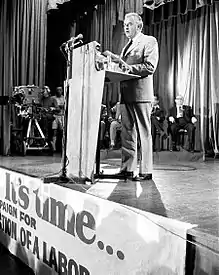
The Department of Social Security (the DSS) was a government department in Australia, which administered the Social Security system between 1972 to 1998.[3] The Department was one of several new departments established by the Whitlam Government and was managed by the Minister for Social Security. [3]
 | |
| Department overview | |
|---|---|
| Formed | 19 December 1972[1] |
| Preceding Department |
|
| Dissolved | 21 October 1998[1] |
| Superseding agency | |
| Jurisdiction | Commonwealth of Australia |
| Headquarters | Canberra |
| Employees | 11,494 (in 1981)[2] |
| Annual budget | $7.7 billion per year (estimate in 1981)[2] |
| Department executives |
|
| Website | dss.gov.au |
History
Establishment
The DSS largely filled the same functions as the previous Department of Social Services, while taking over some programs from the Department of Health.[4]
The Department's delivery of payments and services functions was taken over by Centrelink in 1997.[5] The creation of Centrelink meant significant changes to DSS, with the Department shrinking in size to approximately 700 staff who were tasked with policy formulation and advisory functions.[6]
Dissolution
In October 1998, the DSS was dissolved with the new Department of Family and Community Services, which took on all remaining DSS functions.[1] The Department of Family and Community Services brought together the DSS, child care management, crisis assistance, partnership and disability services from the former Department of Health and Family Services (including the Commonwealth Rehabilitation .. the family relationships area from the Attorney-General's Department; and .. the Child Support Agency, Office.https://www.dss.gov.au/sites/default/files/documents/05_2012/asp_2000_2.pdf
Accounting and Accountability
To ensure the DSS was viewed as a legitimate department, the DSS was one of the few Commonwealth departments in Australia to publish annual reports.[3] This new method of accounting was attributed to the end of postwar period which was characterised by relative economic stability in the 1970s, pressures within in the government led to new methods of public administration that aligned with the broader agenda of New Public Management.
Given the DSS's responsibility of the distribution of large amounts of taxpayer’s money and NPM's emphasis upon the reduction of government, ensuring the DSS appeared legitimate was critical.[7]
Initiatives
Support Network for Aboriginal and Torres Strait Islander Parents (SNAP) Program
Announced in the 1989 Federal Budget, the SNAP Program aimed to better coordinate and to improve the efficiency and effectiveness of the range of government assistance programs available to Aboriginal and Torres Strait Islander and was. [8] It was developed with two main objectives. The first objective was to ensure Aboriginal and Torres Strait Islander families were receiving their DSS entitlements. Providing correct entitlements to these families was fundamental to raise their standard of living.
The second objective was to improve the knowledge of the range of family and child-related services and funding programs available to Aboriginal and Torres Strait Islander families and linking family and community groups. To improve this knowledge, the SNAP Program aimed to actively involve families and community groups in identifying their needs and the solutions to them by use of appropriate funding programs and community action.[8]
Evaluation
In an inquiry into access and equity implementation by Commonwealth government agencies. This Committee's Rhetoric or Reality? conducted by Parliament Department's 1990-1993 Access and Equity Plan and the Parliamentary Committee's 1993.
The report made several references to DSS's good reputation among Aboriginal and Torres Strait Islander people and its responsive approach to service delivery including, for example: The Department of Social Security (DSS) has made considerable advances in access and equity for Aboriginal and Torres Strait Islander peoples.... It was almost universally accepted that there is a strong commitment by DSS to achieving access and equity for Aboriginal and Torres Strait Islander peoples. (p xvi) The Department [of Social Security] was almost universally identified as being the most responsive to the needs of Aboriginal and Torres Strait Islander people. (p 82)
In evidence to the Committee, the then Chief Executive Officer of ATSIC acknowledged the leading role taken by DSS in ensuring access and equity in its delivery of services to Aboriginal and Torres Strait Islander people:
"I should say also that ATSIC itself has scarcely led the Commonwealth Public Service in access and equity. I think it is fair to say that we are only now appreciating its importance in our own organisation. To be frank with you, I believe we have a lot to learn from a mainstream agency like the Department of Social Security...(p 99)
While not being seen generally by SNAP Officers as the major focus of their role, the original first objective of the Program, concerned with ensuring that Aboriginal and Torres Strait Islander families are receiving their correct DSS family- and child-related entitlements, remains an ongoing activity for SNAP Officers, given that a continuing stable source of family income is fundamental to addressing family poverty
In an evaluation of the SNAP Program it was found that
- Family and community groups clearly appreciated the assistance SNAP Officers provide.
- The practical and tangible nature of this assistance, the way in which it is offered and provided (ie in response to the group's or community's expressed needs) and the ongoing involvement and commitment of SNAP Officers in working with the community/group are all highly valued.
- Communities were empowermed through the intervention of SNAP Officers in their lives came through as a continuing theme throughout the evaluation.
- Support for the SNAP Program among the staff of other agencies with whom SNAP Officers have worked and among DSS managers and other DSS Aboriginal and Torres Strait Islander field staff.
SNAP Program has been successful in meeting the objectives originally set for it and has established itself as a model for the efficient and effective coordination, delivery and implementation of government programs aimed at assisting Aboriginal and Torres Strait Islander communities to deal with the effects of long-term poverty and disadvantage.
Blind Pension
The DSS provides a blind pension if the individual:
- has visual acuity less than 6/60 in both eyes on the Snellen Test Scale after correction by suitable glasses, or
- the vision is better than 6/60 but concommitant eye defects and other physical and mental disabilities need to be considered.
This assessment is recorded on a specific form by a Commonwealth Medical Officer using clinical information supplied by an eye specialist. The information is protected by legislation to safeguard the privacy of the individual, and the strict enforcement of this has determined the method of the present study.
Research Projects
In 1995 the DSS commissioned Peter Travers and Frances Robertson from Flinders University of South Australia were commissioned by the DSS to conduct a pilot survey of 110 DSS recipients. The researches assessed incidence of deprivation among DSS clients and explored relationship between levels of relative deprivation and other factors such as DSS payment type, full or part-rate benefit and demographic characteristics. Their study conlcuded that:
- Income was a poor indicator of deprivation;
- Aged recipients were less deprived than other social security recipients;
- Unemployed on full-rate payment were most deprived
Developing a Framework for Benchmarks of Adequacy for Social Security Payments: Policy Discussion Paper No. 6 (May,1995) was the departmenfs first attempt to assess conceptual and methodological issues in assessing adequacy of social security payments.
Following the outcome of this report the DSS, created the Budget Standards Project (BDS). BDS was a two-year exploratory project that began in 1995 with financial support of the DDS, conducted by the Social Policy Research Centre (SPRC) of the UNSW.
During this time, the DSS was also collaborating with the Australian Bureau of Statistics (ABS) on a 'Living Standards' approach. The BDS identifies indicative income requirements of different households, while the 'Living Standards' approach concentrated on client outcomes, not in a comparative framework that asses relative living standards of different groups by considering cash and non-cash factors.
The Health Insurance Planning Commission proposed Medibank, providing universal coverage for a full spectrum of hospital and ambulatory services, eventually financed by general revenues. The program was implemented by the Department of Social Security beginning in July 1975.
Other programs
- Jobs, Education and Training (JET) program for sole parent pensioners
- Jobsearch/Newstart programs for unemployed people and the Disability Support program for people with disabilities
Minister for Social Services
| Minister | Party | Prime Minister | Term Start | Term End | Term in Office |
| Bill Hayden | Labor | Whitlam | 19 December 1972 | 6 June 1975 | 2 years, 169 days |
| John Wheeldon | 6 June 1975 | 11 November 1975 | 158 days | ||
| Don Chipp | Liberal | Fraser | 12 November 1975 | 22 December 1975 | 40 days |
| Margaret Guilfoyle | 22 December 1975 | 3 November 1980 | 4 years, 317 days | ||
| Fred Chaney | 3 November 1980 | 11 March 1983 | 2 years, 128 days | ||
| Dom Grimes | Labor | Hawke | 11 March 1983 | 13 December 1984 | 1 year, 277 days |
| Brian Howes | 13 December 1984 | 4 April 1990 | 5 years, 112 days | ||
| Graham Richardson | 4 April 1990 | 20 December 1991 | 1 year, 267 days | ||
| 20 December 1991 | 27 December 1991 | ||||
| Neal Blewett | Keating | 20 December 1991 | 27 December 1991 | 1 year, 87 days | |
| Peter Baldwin | 24 March 1993 | 11 March 1996 | 2 years, 353 days | ||
| Jocelyn Newman | Liberal | Howard | 11 March 1996 | 21 October 1998 | 2 years, 224 days |
Notes
- CA 1482: Department of Social Security, Central Office, National Archives of Australia, retrieved 15 December 2013
- Andrews, Ross (1 March 1981). "Lanigan: the man and his methods". The Canberra Times. p. 7.
- Davis 2017, p. 427.
- National Archives of Australia, Gough Whitlam: In Office, National Archives of Australia, archived from the original on 19 April 2013
- Everett, Nick (1 October 1997). "Centrelink launched, staff strike". Green Left Weekly. Retrieved 26 April 2012.
- Department of Social Security (16 January 1998), The New DSS, Department of Social Security, archived from the original on 6 February 1998
- Cooke 2008, p. 39.
- Fuery 1994, p. 118
References and further reading
- Secretariat Branch, Department of Social Security (1987), One big family : a short history of the Department of Social Security, Department of Social Security
- Fuery, Michael (1994). "The Department of Social Security's Support Network for Aboriginal and Torres Strait Islander Parents Program". Journal of Social Security.
- Davis, Nicholas (2017). "The annual reporting practices of an Australian Commonwealth Government department: An instance of deinstitutionalisation". Accounting History.
- Cooke, M.K.; K.L., Martin (2008). "Change from within? social work proposals to change centrelink policy in cases of suspected child abuse". Australian Social Work.
