Deçan
Deçan[lower-alpha 2] or Dečani,[lower-alpha 3] is a town and the seat of the eponymous municipality in Kosovo[a]. According to the 2011 census, the town of has 3,803 inhabitants, while the municipality has 40,019 inhabitants.[1]
Deçan
| |
|---|---|
_-_by_Pudelek..jpg.webp) Visoki Dečani Monastery | |
 Seal | |
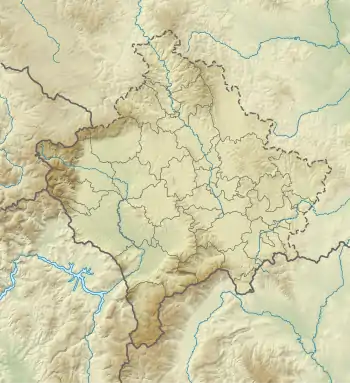  Deçan  Deçan | |
| Coordinates: 42°32′N 20°17′E | |
| Country | Kosovo[lower-alpha 1] |
| District | District of Gjakova |
| Municipality | Deçan |
| Elevation | 550 m (1,800 ft) |
| Population (2011) | |
| • Total | 3,803 |
| Time zone | UTC+1 (CET) |
| • Summer (DST) | UTC+2 (CEST) |
| Postal code | 51000 |
| Area code(s) | +383 |
| Vehicle registration | 03 |
| Website | kk |
During the Kosovo War, Deçan was one of the strongholds of the Kosovo Liberation Army (KLA). The KLA regularly smuggled weapons from Albania across the border to Deçan and as a result, the area saw significant fighting between the KLA and Yugoslav army and police.[2] The medieval Serbian Orthodox Visoki Dečani monastery stands around 2 km to the west of the town.
Geography
Geographically, Deçan is located in the Bjeshkët e Nemuna mountain region. It is surrounded by the Beleg Mountain.
History
Deçan was first recorded in 1330 as being a village with a population of 89 households, consisting of 623 people.[3] The village was one of many feudal holdings of the Visoki Dečani monastery which was exempt from state obligations. As part of their feudal obligations, the local population of Deçan supported the Visoki Dečani monastery through the provision of goods and services.[4] Following the great migration of the Serbs in the 17th and 18th century, much of the ethnic Serbs living in Deçan left.[5] The local Albanian population of Deçan who remained continued to maintain and protect the local Visoki Dečani monastery from destruction by Ottoman authorities.[5]
Culture
Annotations
- Kosovo is the subject of a territorial dispute between the Republic of Kosovo and the Republic of Serbia. The Republic of Kosovo unilaterally declared independence on 17 February 2008. Serbia continues to claim it as part of its own sovereign territory. The two governments began to normalise relations in 2013, as part of the 2013 Brussels Agreement. Kosovo is currently recognised as an independent state by 97 out of the 193 United Nations member states. In total, 112 UN member states have recognised Kosovo at some point, of which 15 later withdrew their recognition.
- Albanian: Deçan, pronounced [dɛˈtʃan]
- Serbian Cyrillic: Дечани, pronounced [dɛ̌t͡ʃani];
or Dečane Serbian Cyrillic: Дечане
References
- "Kosovo Census". Retrieved February 24, 2021.
- "PROSECUTOR v. SLOBODAN MILOSEVIC - DECISION ON MOTION FOR JUDGEMENT OF ACQUITTAL". International Criminal Tribunal for the former Yugoslavia: 10. 16 June 2004.
- Novak 1954, p. 218.
- Novak 1954, p. 226.
- Novak 1954, p. 216.
- Novak, Viktor (1954). Историјски часопис 4 (1952-1953). Istorijski institut.
External links
| District of Ferizaj |  | |
|---|---|---|
| District of Gjakova | ||
| District of Gjilan | ||
| District of Mitrovica | ||
| District of Peja | ||
| District of Pristina | ||
| District of Prizren | ||
1 Kosovo is the subject of a territorial dispute between the Republic of Kosovo and the Republic of Serbia. The Republic of Kosovo unilaterally declared independence on 17 February 2008. Serbia continues to claim it as part of its own sovereign territory. The two governments began to normalise relations in 2013, as part of the 2013 Brussels Agreement. Kosovo is currently recognised as an independent state by 97 out of the 193 United Nations member states. In total, 112 UN member states have recognised Kosovo at some point, of which 15 later withdrew their recognition. | ||
Authority control: National libraries  |
|---|