Dialog im Kamptal
The Dialog im Kamptal (Dialogue in Kamptal) is a political platform and discussion meeting founded in 2019 in Gars am Kamp, Austria. It is organized as a private, non-partisan initiative and platform based on a purely voluntary basis in the tradition of a "citizens' salon".[1] In terms of content, the dialogues deal with aspects of European politics and history as well as purely Austrian.[2]
.png.webp) | |
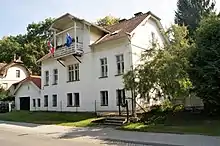 Art studio Gräff, Gars am Kamp, Austria | |
| Formation | May 2019 |
|---|---|
| Founder | Georgia Kazantzidu and Matthias Laurenz Gräff |
| Type | Non-partisan platform |
| Legal status | Foundation |
| Headquarters | Art studio Gräff in Gars am Kamp, Austria |
Official language | German |
Organisators | Georgia Kazantzidu and Matthias Laurenz Gräff |
| Website | https://www.matthiaslaurenzgraeff.com/dialog-im-kamptal/ |
History
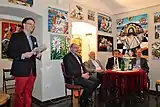
.jpg.webp)
The Dialogue in Kamptal is founded and organized by Matthias Laurenz Gräff in cooperation with Georgia Kazantzidu in the Art studio Gräff in Gars am Kamp. The location was chosen to demonstrate the importance of Art in Europe politics and society such as the closeness to citizens. For both, the Greek-born Kazantzidu and Gräff, reasons for starting the dialogue are also the common European history, the philosophical and political values since the time of Ancient Greece, humanism and the resulting shared responsibility in society.
The Dialog im Kamptal was launched on the occasion of the European Parliament elections in 2019 to inform citizens about Europe, to increase interest in the European Union, the history, values and tasks of Europe, and to act as a pro European initiator in the Kamptal and Waldviertel region.[3] Subsequently, the platform advanced as a place for information and discourse in politics, diplomacy and intercultural exchange, which tries to explain and promote social issues, as well as a contribution to a better understanding of our society and its diversity, cooperation and exchange.[2]
Modus Operandi
The events take place without fixed dates, but would like to give a certain continuity with two to four events per year. The dialogues also take place regularly before national and European elections. The participants are candidates or representatives from the participating parties.
At each Dialogue, politicians from opposing parties and diplomats are invited to discuss a topic. Set goals, topics and books of the participants are discussed under the guidance of the moderator. The dialogue ends with the involvement of the audience present, where certain factual issues are discussed with the discussants.
Dialogues
Europe dialogue in the Kamptal
"It is respect and trust that hold Europe together despite all its diversity. If this Europe is to assert itself, we must move closer together to hold our own against the United States, China and Russia. It is important to have a well-equipped police force and an army, but that must not affect freedom. We must all work together to build a fair and social Europe"

The first dialogue took place on May 6 on the occasion of the upcoming elections to the European Parliament. The subject of the European Union is not only topical because of the upcoming European elections, but a common denominator of different parties. The advocating parties do not treat the European idea in an antagonistic or monopolized way, and so they enter into a constructive dialogue.
The European idea of peace and the unification of the people living in Europe, the possible further development and improvements of the bureaucratic system, the economic strength, the need for a higher awareness of the EU and its achievements in the respective member states as well as the importance of the right to vote were the topics dealt with.
The discussion included:
- Wolfgang Petritsch, ambassador, former international High Representative for Bosnia and Herzegovina
- Douglas Hoyos-Trauttmansdorff, member of the National Council
- Werner Groiß, politician
- Christian Schuh, politician
- Walter Kogler-Strommer, politician
- presenter Josef Wiesinger
Wolfgang Petritsch presented his current book "Epochsenwechsel - Unser digital-autoritäres Jahrhundert" ("Change of Epochs - Our digital-authoritarian century").[5]
Dialogue in the Kamptal - bringing politics closer
"The technologies will evolve over the next few years. I would like to see closer cooperation between politics and science. Robot operations are already being carried out, autonomous driving is already available in pilot projects in the USA and works without accidents. In some countries, court rulings are sometimes made by computers to some degree of punishment"
The sequel took place on September 10 on the occasion of the upcoming 2019 Austrian legislative election with the top candidates from the regional constituency of Waldviertel.
The discussen included: In addition to the top candidates and members of the National Council -
- Martina Diesner-Wais
- Alois Kainz
- Martin Litschauer
- Günter Steindl
- Herbert Kolinsky
- the physicist Werner Gruber as a guest of honor on the podium.
The moderation was again led by the member of the state parliament, Josef Wiesinger.[7][8]
Politics, diplomacy in the 21st century
.jpg.webp)
"I see three main concerns for a lasting peace policy: human rights, resources and climate policy. Here Europe must differ from other powers"
The third dialogue took place on January 27 on the subject of politics, diplomacy and intercultural exchange in the 21st century. The dialogue provide insights into modern developments and challenges in politics, diplomacy and society as well as the importance of intercultural. A main theme of the event was the role of nationalism, which is growing in strength today, as well as its characteristics and disadvantages, especially in the European Union.
The dialogue included:
- Emil Brix, ambassador, director of the Diplomatic Academy of Vienna
- Hannes Swoboda, former president of the group of the Progressive Alliance of Socialists and Democrats in the European Parliament
- Philipp Jauernik, historian and board member from the Pan-European Movement
- presenter Eric Frey from Der Standard.[10][9]
Dialogue of the books - finding what is common
_05.jpg.webp)
"Nations must remain in conversation under all circumstances, negotiations must take place discreetly. Far too much is published in diplomatic negotiations these days. That is one of the reasons for the many stalemates between states"
The fourth dialogue took place on September 12. Thematically, the dialogue spanned the range from the important position, the current development of diplomacy, the problems and new challenges of security policy in connection with globalization and geopolitics to the problems of the use of neo-energies in relation to mobility and environmental protection. A separate topic also presented the tasks and challenges of the high diplomatic service from the past to the present. The dialogue included:
- Karin Kneissl, former Minister of Foreign Affairs
- Michael Breisky, ambassador
- Georg Vetter, politician
- presenter Georgia Kazantzidu
The participants presented their books on this topic.[12]
Our Europe. Who are we, where are we from and where are we going?

"In Europe we are faced with the challenge of maintaining what we have achieved. But we didn't understand what globalization meant. It means mutual responsibility, it requires solidarity. But we wage trade and customs wars. I don't mean to sound pessimistic, but I'm afraid we're facing a third world war.."
The fifth dialogue took place on September 28. Topics included the development of Europe, the current COVID-19 crisis, migration and the tight as a business location. The dialogue included:
- Erhard Busek, former Vice-Chancellor of Austria
- Sebastian Prinz von Schoenaich-Carolath, ambassador
- Helmut Brandstätter, member of the National Council
- Willi Mernyi, managing director of the Austrian trade unions, president of the Austrian Mauthausen Committee
- presenter Daniel Lohninger, chief journalist of the NÖN[13][14]

References
- Donau Universität Krems an der Donau. Research Lab Democracy and Society in Transition
- Website
- Austrian newspaper article: NÖN, Gräff-Atelier empfängt zu „Europa-Dialog“ im Kamptal
- Europa Dialog im Kamptal
- Austrian newspaper article: Bezirksblätter, Europa Dialog im Kamptal
- Dialog im Kamptal - Politik näher bringen
- Austrian newspaper article: NÖN, Was braucht das Waldviertel?
- Austrian newspaper article: Bezirksblätter, Spitzenkandidsaten des Regionalwahlkreises und Ehrengast Werner Gruber diskutieren im Atelier Gräff
- Austrian newspaper article: Bezirksblätter, Politik, Diplomatie im 21. Jahrhundert mit hochkarätigen Gästen
- Austrian newspaper article: NÖN, Dialog im Kamptal. Friede zentrales Thema in Zitternberg
- Dialog der Bücher - Das Gemeinsame finden
- Austrian newspaper article Bezirksblätter, Dialog der Bücher - Das Gemeinsame finden
- Austrian newspaper article: NÖN, Dialog im Kamptal. EU braucht Bildung
- Austrian newspaper article: Bezirksblätter, Unser Europa, Wer sind wir, woher kommen wir und wohin gehen wir?