Diffiety
In mathematics, a diffiety (/dəˈfaɪəˌtiː/) is a geometrical object playing the same role in the modern theory of partial differential equations that algebraic varieties play for algebraic equations. It was introduced in 1984 by Alexandre Mikhailovich Vinogradov, who coined this word as portmanteau from differential variety.[1]
Intuitive definition
In algebraic geometry the main objects of study (varieties) model the space of solutions of a system of algebraic equations (i.e. the zero locus of a set of polynomials), together with all their "algebraic consequences". This means that, applying algebraic operations to this set (e.g. adding those polynomials to each other or multiplying them with any other polynomials) will give rise to the same zero locus. In other words, one can actually consider the zero locus of the algebraic ideal generated by the initial set of polynomials.
When dealing with differential equations, apart from applying algebraic operations as above, one has also the option to differentiate the starting equations, obtaining new differential constraints. Therefore, the differential analogue of a variety should be the space of solutions of a system of differential equations, together with all their "differential consequences". Instead of considering the zero locus of an algebraic ideal, one needs therefore to work with a differential ideal.
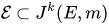
An elementary diffiety will consist therefore of the infinite prolongation of a differential equation , together with an extra structure provided by a special distribution. Elementary diffieties play the same role in the theory of differential equations as affine algebraic varieties do in the theory of algebraic equations. Accordingly, just like varieties or schemes are composed of irreducible affine varieties or affine schemes, one defines a (non-elementary) diffiety as an object that locally looks like an elementary diffiety.

Formal definition
The formal definition of a diffiety, which relies on the geometric approach to differential equations and their solutions, requires the notions of jet of submanifolds, prolongations, and Cartan distribution, which are recalled below.
Jet space of submanifolds
|
Let be an -dimensional smooth manifold. Two -dimensional submanifolds , of are tangent up to order at the point if one can locally describe both submanifolds as zeroes of functions defined in a neighbourhood of , whose derivatives agree up to order . One can show that being tangent up to order is a coordinate-invariant notion and an equivalence relation.[2] One says also that and have same -th order jet at , and denotes their equivalence class by or .
As any given jet is locally determined by the derivatives up to order of the functions describing around , one can use such functions to build local coordinates and provide with a natural structure of smooth manifold.[2] |
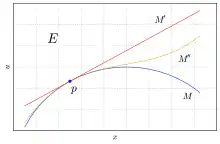 and have the same 1-jet at while and have the same 3-jet. |








As a particular case, when has a structure of fibred manifold over an -dimensional manifold , one can consider submanifolds of given by the graphs of local sections of . Then the notion of jet of submanifolds boils down to the standard notion of jet of sections, and the jet bundle turns out to be an open and dense subset of .[3]


Differential equations
A differential equation of order on the manifold is a submanifold of a jet space, .
If one defines solutions as below, then this geometric definition of PDEs in local coordinates gives rise to expressions that are usually used to define PDEs and their solutions in mathematical analysis.
Prolongation




Furthermore, one can define prolongations of equations, i.e. of submanifolds of Jet spaces. Given a differential equation of order , one would like its -th prolongation to be an equation of order , i.e. a submanifold of the jet space . To achieve this, one first constructs the -jet space of -dimensional submanifolds of . As is embedded in , one can always naturally embed into . But since the latter is the space of repeated jets of submanifolds of , one can also always embed into . As a result, when considering both and as subspaces of , their intersection is well-defined. This is used for the definition of the prolongation of .
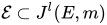




Note however that such an intersection is not necessarily a manifold again. One therefore usually requires to be nice enough such that at least its first prolongation is indeed a submanifold of .

It can also be shown that this definition still makes sense, even when goes to infinity.
Cartan distribution
An -plane at a point is a subspace of the tangent space of the form , where is any submanifold of whose prolongation contains the point .

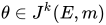
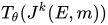


The Cartan distribution on is the distribution defined by


where is the span of all -planes at a point .

The Cartan distribution is important in the algebro-geometric approach to differential equations because it allows to define generalized solutions of differential equations in purely geometric terms.


One can also look at the Cartan distribution of a submanifold of without the need to consider it inside . To do so, one defines the restriction of the distribution to a submanifold of as follows.

In this sense, the pair encodes the information about the (generalized) solutions of the differential equation .

Definition of a diffiety
An elementary diffiety is a pair where is a -th order differential equation, its infinite prolongation and its Cartan distribution.


Note that when considering a differential equation , then one can show that the Cartan distribution is exactly -dimensional unlike in the case of finitely many prolongations.
A diffiety is a triple , consisting of a (generally infinite-dimensional) manifold , the algebra of its smooth functions and a finite-dimensional distribution , which is locally of the form , where is an elementary diffiety and denotes the algebra of smooth functions on . Here locally means a suitable localization with respect to the Zariski topology corresponding to the algebra .





The dimension of is called dimension of the diffiety and its denoted by , with a capital D (to distinguish it from the dimension of as a manifold).

Morphisms of diffieties
A morphism between two diffieties and consists of a smooth map whose pushforward preserves the Cartan distribution, i.e. such that, for every point , one has .




Diffieties together with their morphisms define the category of differential equations.[3]
Applications
Vinogradov sequence
The Vinogradov -spectral sequence (or, for short, Vinogradov sequence) is a spectral sequence associated to a diffiety, which can be used to investigate certain properties of the formal solution space of a differential equation by exploiting its Cartan distribution .[4]

Given a diffiety , consider the algebra of differential forms over
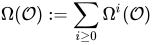
and the corresponding de Rham complex:

Its cohomology groups contain some structural information about the PDE; however, due to the Poincaré Lemma, they all vanish locally. In order to extract much more and even local information, one thus needs to take the Cartan distribution into account and introduce a more sophisticated sequence. To this end, let


be the submodule of differential forms over whose restriction to the distribution vanishes, i.e.

Note that is actually a differential ideal since it is stable w.r.t. to the de Rham differential, i.e. .


Now let be its -th power, i.e. the linear subspace of generated by . Then one obtains a filtration




and since all ideals are stable, this filtration completely determines the following spectral sequence:


The filtration above is finite in each degree, i.e. for every


so that the spectral sequence converges to the de Rham cohomology of the diffiety. One can therefore analyse the terms of the spectral sequence order by order to recover information on the original PDE. For instance:[5]

- corresponds to action functionals constrained by the PDE . In particular, for , the corresponding Euler-Lagrange equation is .
- corresponds to conservation laws for solutions of .
- is interpreted as characteristic classes of bordisms of solutions of .


Many higher-order terms do not have an interpretation yet.
Variational bicomplex
As a particular case, starting with a fibred manifold and its jet bundle instead of the jet space , instead of the -spectral sequence one obtains the slightly less general variational bicomplex. More precisely, any bicomplex determines two spectral sequences: one of the two spectral sequences determined by the variational bicomplex is exactly the Vinogradov -spectral sequence. However, the variational bicomplex was developed independently from the Vinogradov sequence.[6][7]
Similarly to the terms of the spectral sequence, many terms of the variational bicomplex can be given a physical interpretation in classical field theory: for example, one obtains cohomology classes corresponding to action functionals, conserved currents, gauge charges, etc.[8]
Secondary Calculus
Vinogradov developed a theory, known as secondary calculus, to formalise in cohomological terms the idea of a differential calculus on the space of solutions of a given system of PDEs (i.e. the space of integral manifolds of a given diffiety).[9][10][11][3]
In other words, secondary calculus provides substitutes for vector fields, differential forms, differential operators, etc., on a (generically) very singular space where these objects cannot be defined in the usual (smooth) way.[12]
Secondary calculus can also be related to the covariant Phase Space, i.e. the solution space of the Euler-Lagrange equations associated to a Lagrangian field theory.[13]
See also
- Secondary calculus and cohomological physics
- Partial differential equations on Jet bundles
- Differential ideal
- Differential calculus over commutative algebras
Another way of generalizing ideas from algebraic geometry is differential algebraic geometry.
References
- Vinogradov, A. M. (March 1984). "Local symmetries and conservation laws". Acta Applicandae Mathematicae. 2 (1): 21–78. doi:10.1007/BF01405491. ISSN 0167-8019.
- Saunders, D. J. (1989). The Geometry of Jet Bundles. London Mathematical Society Lecture Note Series. Cambridge: Cambridge University Press. doi:10.1017/cbo9780511526411. ISBN 978-0-521-36948-0.
- Vinogradov, A. M. (2001). Cohomological analysis of partial differential equations and secondary calculus. Providence, R.I.: American Mathematical Society. ISBN 0-8218-2922-X. OCLC 47296188.
- Vinogradov, A. M. (1978). "A spectral sequence associated with a nonlinear differential equation and algebro-geometric foundations of Lagrangian field theory with constraints". Soviet Math. Dokl. (in Russian). 19: 144–148 – via Math-Net.Ru.
- Symmetries and conservation laws for differential equations of mathematical physics. A. V. Bocharov, I. S. Krasilʹshchik, A. M. Vinogradov. Providence, R.I.: American Mathematical Society. 1999. ISBN 978-1-4704-4596-6. OCLC 1031947580.CS1 maint: others (link)
- Tulczyjew, W. M. (1980). García, P. L.; Pérez-Rendón, A.; Souriau, J. M. (eds.). "The Euler-Lagrange resolution". Differential Geometrical Methods in Mathematical Physics. Lecture Notes in Mathematics. Berlin, Heidelberg: Springer: 22–48. doi:10.1007/BFb0089725. ISBN 978-3-540-38405-2.
- Tsujishita, Toru (1982). "On variation bicomplexes associated to differential equations". Osaka Journal of Mathematics. 19 (2): 311–363. ISSN 0030-6126.
- "variational bicomplex in nLab". ncatlab.org. Retrieved 2021-12-11.
- Vinogradov, A.M. (1984-04-30). "The b-spectral sequence, Lagrangian formalism, and conservation laws. I. The linear theory". Journal of Mathematical Analysis and Applications. 100 (1): 1–40. doi:10.1016/0022-247X(84)90071-4.
- Vinogradov, A. M. (1984-04-30). "The b-spectral sequence, Lagrangian formalism, and conservation laws. II. The nonlinear theory". Journal of Mathematical Analysis and Applications. 100 (1): 41–129. doi:10.1016/0022-247X(84)90072-6. ISSN 0022-247X.
- Henneaux, Marc; Krasil′shchik, Joseph; Vinogradov, Alexandre, eds. (1998). Secondary Calculus and Cohomological Physics. Contemporary Mathematics. 219. Providence, Rhode Island: American Mathematical Society. doi:10.1090/conm/219. ISBN 978-0-8218-0828-3.
- Vitagliano, Luca (2014). "On the strong homotopy Lie–Rinehart algebra of a foliation". Communications in Contemporary Mathematics. 16 (06): 1450007. doi:10.1142/S0219199714500072. ISSN 0219-1997.
- Vitagliano, Luca (2009-04-01). "Secondary calculus and the covariant phase space". Journal of Geometry and Physics. 59 (4): 426–447. doi:10.1016/j.geomphys.2008.12.001. ISSN 0393-0440.
External links
- The Diffiety Institute (frozen since 2010)
- The Levi-Civita Institute (successor of above site)
- Geometry of Differential Equations