Digital nomad
Digital nomads are people who conduct their life in a nomadic manner while engaging in remote work using digital telecommunications technology.[1] Such people generally have minimal material possessions and work remotely in temporary housing, hotels, cafes, public libraries, co-working spaces, or recreational vehicles, using Wi-Fi, smartphones or mobile hotspots to access the Internet.[2][3][4][5][6] Some digital nomads are perpetual travelers, while others are only nomadic for a short period of time. While some nomads travel through various countries, others focus on one area. Some may engage in vandwelling.[7] In 2020, a research study found that 10.9 million American workers described themselves as digital nomads, an increase of 49% from 2019.[7]
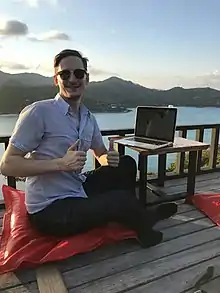
Digital nomads are often younger remote workers, backpackers, retired or semi-retired persons, snowbirds, and/or entrepreneurs.
Etymology
One of the first digital nomads was Steve Roberts, who in 1983 rode on a computerized recumbent bicycle and was featured in Popular Computing magazine.[4]
One of the earliest known uses of the term digital nomad was in the 1997 book Digital Nomad by Tsugio Makimoto and David Manners, which describes how technology allows for a return of societies to a nomadic lifestyle.[8] It is unknown if the phrase was coined in this book or if they took a term that had already existed.[4]
Benefits
People typically become digital nomads due to a desire to travel and location independence. Compared to living in expensive cities, a digital nomad lifestyle also has cost advantages.[9]
Challenges
Although digital nomads enjoy advantages in freedom and flexibility, they report loneliness as their biggest struggle, followed by burnout.[10]
Other challenges include maintaining international health insurance with coverage globally, abiding by different local laws including payment of required taxes and obtaining work visas, and maintaining long-distance relationships with friends and family back home.[11] In some cases, the digital nomad lifestyle leads to misunderstanding and miscommunication between digital nomads and their clients or employers.[12] Other challenges may also include time zone differences, the difficulty of finding a reliable connection to the internet, and the absence of delineation between work and leisure time.[13][5]
Feelings of loneliness are often present in the practice of nomadic lifestyle, since nomadism often requires freedom from personal attachments such as marriage.[14] The importance of developing face-to-face quality relationships has been stressed to maintain mental health in remote workers.[11] The need for intimacy and family life may be a motive to undertake digital nomadism as an intermittent or temporary activity as in the case of entrepreneur and business developer Sol Orwell.
Resources
- Conferences and festivals centering on the digital nomad lifestyle include "The Nomad Cruise",[15] DNX Festival, Nomad City, Freedom x Fest, Freedom Business Summit, and Nomad Summit.[16][17][18][19]
- A documentary film about the digital nomad lifestyle by Christine and Drew Gilbert, titled The Wireless Generation, earned $37,000 in funding through Kickstarter.[4]
- Books that focus on the lifestyle include Tim Ferriss' The 4-Hour Workweek, David Allen's Getting Things Done methodology, and the work of Mark Manson.[20][21]
Popular destinations
WorkMotion publishes a list of the The Cities Best Facilitating Remote Work; the top ten cities are Melbourne, Montreal, Sydney, Wellington, Prague, Toronto, Tallinn, Zagreb, Singapore, and Dublin.[22]
Legality
Many digital nomads tend to come from more developed nations with passports allowing a greater degree of freedom of travel. As a result, many tend to travel on a travel visa, which can be technically illegal and controversial.[23]
Several visa programs are targeted at digital nomads such as the e-Residency in Estonia and a SMART visa program in Thailand. Estonia has also announced plans of a digital nomad visa.[24] Other countries such as Bermuda, Barbados, Georgia, and Croatia offer similar digital nomad visa programs.[25] Some digital nomads have used Germany's residence permit for the purpose of freelance or self-employment[26] to legalize their stay, but successful applicants must have a tangible connection and reason to stay in Germany.
References
- Mohn, Tanya (March 19, 2014). "How To Succeed At Becoming A Digital Nomad". Forbes.
- Colella, Kristin (July 13, 2016). "5 'digital nomads' share their stories from around the world". TheStreet.com.
- Lamarque, Hannah (June 3, 2015). "The Rise of the Digital Nomad". HuffPost.
- Schlagwein, Daniel (December 6, 2018). "The History of Digital Nomadism". International Workshop on the Changing Nature of Work (CNOW).
- Nash, Caleece (February 2018). "Digital nomads beyond the buzzword: Defining digital nomadic work and use of digital technologies". Lecture Notes in Computer Science. iConference 2018: 207–217. doi:10.1007/978-3-319-78105-1_25. ISBN 978-3-319-78104-4 – via Springer.
- Adams, R. Dallon (January 29, 2021). "The future of business travel: Digital nomads and "bleisure" define the new high-tech take on work trips". TechRepublic.
- "COVID-19 and the Rise of the Digital Nomad" (PDF). MBO Partners. 2020.
- Makimoto, Tsugio; Manners, David (1997). Digital Nomad. John Wiley & Sons.
- Kadet, Anne (February 16, 2021). "Manhattan Couple Ditch Apartment, Buy RV. Was It Worth It?". The Wall Street Journal. ISSN 0099-9660.
- Moss, Jennifer (November 30, 2018). "Helping Remote Workers Avoid Loneliness and Burnout". Harvard Business Review. ISSN 0017-8012.
- Snedden, Meggan (30 August 2013). "When work is a nonstop vacation". BBC News.
- Kong, David; Schlagwein, Daniel; Cecez-Kecmanovic, Dubravka (2019). Issues in Digital Nomad-Corporate Work: An Institutional Theory Perspective. European Conference on Information Systems. Sweden.
- Wasserman, Todd (November 10, 2014). "Digital nomads travel the world while you rot in your office". Mashable.
- Wang, Blair; Schlagwein, Daniel; Cecez-Kecmanovic, Dubravka; Cahalane, Michael C. (2018). "Digital Work and High-Tech Wanderers: Three Theoretical Framings and a Research Agenda for Digital Nomadism". acis2018.org.
- "The Nomad Cruise".
- Hynes, Casey. "Why Digital Nomads & Entrepreneurs Keep Choosing Chiang Mai". Forbes. Retrieved 2017-09-20.
- Steven Melendez (23 March 2015), Work From Anywhere But Home: Startups Emerge to Turn You Into a Globetrotting Digital Nomad, Fast Company
- Rosie Spinks (16 June 2015), Meet the 'digital nomads' who travel the world in search of fast Wi-Fi, The Guardian
- Kavi Guppta (25 February 2015), Digital Nomads Are Redefining What It Means To Be Productive, Forbes
- Wang, Blair; Schlagwein, Daniel; Cecez-Kecmanovic, Dubravka; Cahalane, Michael (2018). Digital Work and High-Tech Wanderers: Three Theoretical Framings and a Research Agenda for Digital Nomadism (PDF). Australasian Conference in Information Systems. Sydney, Australia.
- Schlagwein, Daniel (2018). "Escaping the Rat Race": Justifications in Digital Nomadism. European Conference on Information Systems. Portsmouth, UK.
- "The Cities Best Facilitating Remote Work: A Global Index". WorkMotion.
- Hall, Grant; Sigala, Marianna; Rentschler, Ruth; Boyle, Stephen (2019). "Motivations, Mobility and Work Practices; The Conceptual Realities of Digital Nomads". Information and Communication Technologies in Tourism: 437–449. doi:10.1007/978-3-030-05940-8_34. ISBN 978-3-030-05939-2. S2CID 59616398.
- Morrison, Geoffrey (August 12, 2020). "Estonia's Digital Nomad Visa Now Available". Forbes.
- "The Complete List of Digital Nomad Visas". The Anywhere Company. 28 August 2020.
- "Residence permit for the purpose of freelance or self-employment - Issuance". service.berlin.de.