Dilip Kumar: The Substance and the Shadow
Dilip Kumar: The Substance and the Shadow is a book by the film journalist Udaya Tara Nayar, about the filmmaker and politician Dilip Kumar. It is divided into two parts: the first chronicles his life and career and has 25 chapters. Using the first-person narrative, the autobiography chronicles his birth in 1922 in Peshawar, British India (present-day Pakistan), his school and college days, his 62-year-long cinematic and political career, and his two marriages. The other part contains recollections from 43 people who collaborate with or know him. It was released on 20 June 2014 by Hay House.
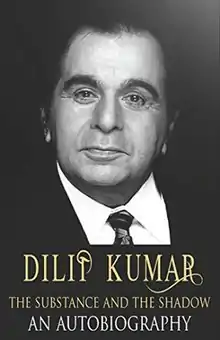 | |
| Author | Udaya Tara Nayar |
|---|---|
| Country | India |
| Language | English |
| Subject | Dilip Kumar |
| Genre | Autobiography |
| Published | 20 June 2014 |
| Publisher | Hay House |
| Media type | |
| Pages | 450 |
| ISBN | 978-93-81398-86-9 |
The ideas for the book came up in the midsummer of 2004, when Nayar was helping to rearrange Kumar's bookshelf. She picked up a biography from an undisclosed author who claimed knowing him personally; he, however, found some information in the book to be distorted and was suggested by his wife, Saira Banu, to write an autobiography instead. Dilip Kumar: The Substance and the Shadow is based on a series of conversations between Nayar and Kumar in Bandra starting that year. Critical reviews to the book were generally positive; the writing and the photographs garnered praise, but his selectiveness was criticised.
Summary
The book is divided into two parts. The first one, divided into 25 chapters, focuses on Dilip Kumar's life and career; he was born Yousuf Khan on 11 December 1922 in Peshawar, British India (now Pakistan). He was educated at the Barnes School and the Khalsa College, and moved to Bombay (now Mumbai) following the partition of India in 1947. His acting debut with the drama Jwar Bhata (1944), in which he used the stage name "Dilip Kumar", his commercially and critically successful films including Andaz (1949), Tarana (1951), Aan (1952), Azaad (1955), Devdas (1955), Naya Daur (1957), Madhumati (1958), Kohinoor (1960), Mughal-e-Azam (1960), Gunga Jumna (1961), and Ram Aur Shyam (1967), his six-year and well-publicised relationship with the actress Madhubala, and his marriages (with Saira Banu in 1966 and Asma Rehman in 1982—the latter ended with a divorce), and his political career are also detailed. The second part of the book contains commentary from 43 people who have collaborated with, or know, him.
Development and release
"It has always been an arduous task to prevail upon him to talk about himself ... I understand it is neither proper nor right for me to extol the virtues of the book ... the primary reason being my widely known admiration for my husband and the ardent pride ... I have always hung on to every word he has uttered to me or to anyone ... "
—Saira Banu in the foreword of the book[1]:1
In the midsummer of 2004, Udaya Tara Nayar (a film journalist and former editor of Screen)[2] was helping Saira Banu to rearrange the latter's husband Dilip Kumar's bookshelf in his bedroom. Occasionally, Nayar would also read his collection of English- and Urdu-language poetry. Kumar picked up a book that is a biography of his from an undisclosed author; he said that the information in it are mostly incorrect, though the author claimed to know him personally. Banu, who had always wanted him to write an autobiography, asked him doing so enthusiastically. She believed his story would motivate younger generations "in any walk of life who have chased dreams of making it big in their chosen professions".[1]:11
Concurring with her idea, Kumar wanted someone to compile his own words, and Banu recommended Nayar to do so. She recounted in the book's foreword that this left her happy and, at the same time, frightened as he rarely talked on his personal life nor his achievements publicly, adding, "Can this be reality or is it a dream, I asked myself since I was not in the fray of renowned writers who were pursuing Dilip Sahab to tell the story of his life to them." She thought that his introversion was the main reason why all authors who write books on him and asseverate to know him are actually using his interviews with the media or information from people who admitted to be his close friends.[1]:11–12 Writing an analytical column in Scroll.in, Gautam Chintamani observed any previous publications of his are focused more on his career rather than his pre-acting and private life.[3]
The writing started in the same day, using tape recorders and writing pads (in case the former are not working). Banu suggested to them to sit in the lawns during the process, not wanting her husband being disturbed by the house phone's ring. She also thought that open spaces was able to make his mood better so he would not "lose interest on any account". Nayar recalled that his "real picture began to emerge" as the writing continued,[1]:12–13 finding his marriage to Banu the most interesting part of his life.[4] The book was subsequently titled Dilip Kumar: The Substance and the Shadow. According to Nayar, the title was made by Kumar; the Substance means him as "Yousuf Khan" and the Shadow is him as "Dilip Kumar" because "when we walk our shadow grows larger than our actual image".[4] The Press Trust of India announced the book in 2012,[5] and it was released on 20 June 2014 by Hay House as a hardcover book.[6] Its Amazon Kindle version was released on 28 July 2014.[1]
Critical reception
Dilip Kumar: The Substance and the Shadow was praised for the writing and photographs, while Kumar's selectiveness was generally panned. Deepa Gahlot concluded: "The book is readable, but it has the informality of a diary rather than a serious memoir. Still, it is a precious addition to the Bollywood bookshelf—at least it all comes from the star himself and the words are not recycled."[7] Arvind Gigoo of Daily News and Analysis commended Nayar's writing and said she "has performed the role of an understanding Father Confessor". He praised the book's contents and photographs, describing it as a "a captivating literary tour de force".[8] The News International's Sarwat Ali was more critical, believing it should be written when he was younger and "would have had the energy to pay more attention to the final product which suffers badly from supervision in editing and graphic design." Ali stated that some events of his life are not explained detailly such as his second marriage and his affair with and Madhubala.[9]
Madhu Jain from India Today called the writing "measured, evidently calibrated and impossibly calm",[10] while Shahabuddin Gilani from The Express Tribune referred to the book as "not an entirely honest memoir" due to many aspects that are not revealed in detail.[11] Sanjukta Sharma, in her review for Mint, elaborated, "The first few chapters ... have the architecture and visual breadth of a novel. He writes about his youth with self-deprecating honesty. Given the tone of the book until it reaches the phase of his youth, middle age and late life read like parodies. A voice so different, it seems someone else took over the project entirely. The last section of the book is a series of tributes by close friends—a strange section to have in an autobiography."[12] Characterising its narration is easy to understand, Mahbubar Rahman of The Independent asserted that the book "exceeds all expectations of readers" and is a "lucid reminiscence" that "is intricately laced with candid observation and comments which are uniquely his own".[13]
The British economist and author Meghnad Desai, who had previously written a biography on Kumar titled Nehru's Hero: Dilip Kumar in the Life of India (2004), published a review for Dilip Kumar: The Substance and the Shadow in the newspaper The Indian Express, in which he praised Nayar for doing a well job.[14] Asif Noorani of Dawn opined that the book is a "worth reading" and saw the photographs adding its value;[15] writing in the same publication, Jawed Naqvi argued that it is "crammed with ... abiding sentiment".[16] Raza Rumi from The Friday Times stated that Nayar "has done a great job of putting this book together. But it is Dilip Kumar’s reflective tone and tender voice that makes it a book worth reading. In a way it also sums up the history of Indian cinema for at least a few decades of the twentieth century." Rumi felt Nayar's writing is "mellow and somewhat dispassionate"; she further said that the "Reminiscences" part is interesting but believed it needs more edits, and that the photographs make the book to be more "captivating".[17]
S. Nanda Kumar of Deccan Herald wrote, "This, and other tales, are told with attention to the tiniest details, speaking volumes of his powers of observation and remarkable memory. He is a master raconteur, the opening of the book is like the beginning of a film."[18] Baradwaj Rangan described the book as "a lopsided autobiography" that "sheds light on his early life and career, but skimps on what we really want to know",[19] and Ziya Us Salam—sharing similar thoughts—considered it "sheds fair light on the person he is".[20] In The Free Press Journal, P. P. Ramachandran commented that the narration is "authentic, heartfelt and compelling", and called the whole work "outstanding".[21] Saibal Chatterjee from Tehelka declared the book as a "goldmine of information and insight on a luminous career".[22] Another Daily News and Analysis review, this time by Boski Gupta, labelled it a "treat for every cinema lover".[23] Sangeetha Devi Dundoo included it in her "Reading List" of the year in The Hindu.[24]
References
- Nayar 2014, Amazon Kindle version.
- Beegum 2017, Meet Bollywood's no-gossiping.
- Chintamani 2014, Star biographies.
- P. 2014, Interview.
- Press Trust of India 2012, Dilip Kumar's biography.
- Nayar 2014, Paperback version.
- Gahlot 2014, Dilip Kumar's autobiography.
- Gigoo 2014, Book review.
- Ali 2014, The man behind.
- Jain 2014, Dilip Kumar.
- Gilani 2014, Book review.
- Sharma 2014, Amma's boy.
- Rahman 2015, Dilip Kumar.
- Desai 2014, Dilip Kumar's autobiography.
- Noorani 2014, Cover story.
- Naqvi 2014, Looks like the.
- Rumi 2014, The legend's shadow.
- Kumar 2014, A tale of.
- Rangan 2014, The king of.
- Salam 2015, Of Cinema Excelsior.
- Ramachandran 2014, Dilip Kumar.
- Chatterjee 2014, Thespian declares.
- Gupta 2014, Book review.
- Dundoo 2014, Their stories.
Sources
- Ali, Sarwat (27 July 2014). "The man behind the star". The News International. Archived from the original on 22 October 2021. Retrieved 21 October 2021.
- Beegum, Naseem (8 November 2017). "Meet Bollywood's no-gossiping journalist". Khaleej Times. Archived from the original on 10 March 2018. Retrieved 22 October 2021.
- Chatterjee, Saibal (30 June 2014). "Thespian declares". Tehelka. Archived from the original on 27 September 2020. Retrieved 22 October 2021.
- Chintamani, Gautam (30 November 2014). "Star biographies: can a film-star's life be an open book?". Scroll.in. Archived from the original on 3 May 2021. Retrieved 21 October 2021.
- Desai, Meghnad (17 September 2014). "Dilip Kumar's autobiography reveals his journey from Peshawar to Bombay". The Indian Express. Archived from the original on 15 July 2021. Retrieved 21 October 2021.
- "Dilip Kumar's biography to be launched". The Times of India. Press Trust of India. 27 June 2012. Archived from the original on 22 October 2021. Retrieved 22 October 2021.
- Dundoo, Sangeetha Devi (23 November 2014). "Their stories, their voices". The Hindu. Archived from the original on 21 October 2021. Retrieved 21 October 2021.
- Gahlot, Deepa (9 August 2014). "Dilip Kumar's autobiography is a precious addition to Bollywood bookshelf". Hindustan Times. Archived from the original on 27 September 2016. Retrieved 21 October 2021.
- Gigoo, Arvind (20 July 2014). "Book review: The Substance and the Shadow – An Autobiography". Daily News and Analysis. Archived from the original on 9 July 2021. Retrieved 21 October 2021.
- Gilani, Shahabuddin (7 December 2014). "Book review: The Substance and the Shadow – no holds barred". The Express Tribune. Archived from the original on 8 January 2016. Retrieved 21 October 2021.
- Gupta, Boski (17 September 2014). "Book review: More shadow than substance". Daily News and Analysis. Archived from the original on 19 September 2014. Retrieved 22 October 2021.
- Jain, Madhu (26 June 2014). "Dilip Kumar: Legend on the couch". India Today. Archived from the original on 30 July 2020. Retrieved 21 October 2021.
- Kumar, S. Nanda (3 August 2014). "A tale of his own". Deccan Herald. Archived from the original on 22 October 2021. Retrieved 22 October 2021.
- Naqvi, Jawed (29 July 2014). "Looks like the work of the wife". Dawn. Archived from the original on 15 June 2019. Retrieved 21 October 2021.
- Nayar, Udaya Tara (20 June 2014). Dilip Kumar: The Substance and the Shadow. Hay House. ISBN 978-93-81398-86-9.
- Nayar, Udaya Tara (28 July 2014). Dilip Kumar: The Substance and the Shadow. Hay House. ISBN 978-93-81398-96-8.
- Noorani, Asif (28 July 2014). "Cover story: Dilip Kumar: The Substance and the Shadow". Dawn. Archived from the original on 28 May 2015. Retrieved 21 October 2021.
- P., Nidhi (6 June 2014). "Interview: Udaya Tara Nayar". Glamsham. Archived from the original on 18 January 2021. Retrieved 22 October 2021.
- Rahman, Mahbubar (19 June 2015). "Dilip Kumar: The Substance And The Shadow An Autobiography". The Independent. Archived from the original on 21 October 2021. Retrieved 21 October 2021.
- Ramachandran, P. P. (29 June 2014). "Dilip Kumar". The Free Press Journal. Archived from the original on 22 October 2021. Retrieved 22 October 2021.
- Rangan, Baradwaj (28 July 2014). "The king of tragedy". The Hindu. Archived from the original on 11 July 2021. Retrieved 21 October 2021.
- Rumi, Raza (21 November 2014). "The legend's shadow". The Friday Times. Archived from the original on 21 October 2021. Retrieved 21 October 2021.
- Salam, Ziya Us (13 March 2015). "Of Cinema Excelsior and a star without peer". The Hindu. Archived from the original on 14 July 2015. Retrieved 22 October 2021.
- Sharma, Sanjukta (28 June 2014). "Amma's boy". Mint. Archived from the original on 24 July 2016. Retrieved 21 October 2021.