Dipankar Borah
Dipankar Borah (born 1994) is an Indian field botanist from the North-eastern state of Assam.
Dipankar Borah | |
|---|---|
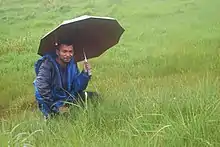 Dipankar Borah with Peristylus densus in the grasslands of Meghalaya | |
| Born | 11 October 1994[1][2][3] |
| Nationality | Indian |
| Occupation | |
| Academic background | |
| Alma mater | |
| Academic work | |
| Main interests |
|
| Website | Ethnobotany of Northeast India |
| Signature | |
 | |
Personal life
Dipankar Borah is a botanist of the region and belongs from Monabarie TE, one of the largest tea plantations in the country located in the Biswanath District of Assam.[3]He did his BSc from Biswanath College (affiliated to Gauhati University) in 2015 and his MSc in 2017 from Rajiv Gandhi University.[3] He conducted majority of his plant explorations in Arunachal Pradesh, Assam and Meghalaya states of Northeast India.[4][5][3] Since 2020, he has been an assistant professor in the department of botany, Goalpara College, Assam, India.[6]
Work
Borah is best known for his studies on Begonias,[7][8][9] Gesneriads,[10][11][12][13] Aristolochia[14] (Pipeworts) and Chlorophytum[15] of Northeastern India (in the Himalayas and Indo-Burma biodiversity hotspots) apart from several other genera. So far he has described more than 10 new plant names.[1]
In February 2021, Borah along with his two fellow scientists discovered a new alpine plant species named Cremanthodium indicum from Penga Teng Tso of Arunachal Pradesh's Tawang district.[16][17][18][19]
He was also into the discovery of Pedicularis khoiyangii, a plant species that was discovered in alpine regions of the Eastern Himalayas. Its common name is Hawtoo’s lousewort.[20][21]
In December 2020, three Indian scientists, V.S. Hareesh, M. Sabu and Dipankar Borah, discovered a new species named Amomum arunachalense from Nirjuli in Papum Pare district, Arunachal Pradesh.[22]
Borah has worked extensively in Behali Reserve Forest and raised his voice for its protection and upgradation.[23][24]
Doctoral research
He is pursuing his PhD on floristic studies of Behali Reserve Forest from Rajiv Gandhi University, Arunachal Pradesh.[25][3] Borah is also the creator of the public website "Ethnobotany of Northeast India", database of names of useful plants of Northeast India.[26]
References
- "Borah, Dipankar | International Plant Names Index". www.ipni.org. Retrieved 2021-09-05.
- "Dipankar Borah". www.wikidata.org. Retrieved 2021-09-02.
- "ORCID". orcid.org. Retrieved 2021-08-28.
- "Dipankar BORAH | Professor (Assistant) | Master of Science | Botany". ResearchGate. Retrieved 2021-08-28.
- "Scopus preview - Borah, Dipankar - Author details - Scopus". www.scopus.com. Retrieved 2021-08-28.
- "Teaching Staff – Science". www.goalparacollege.ac.in. Retrieved 2021-08-28.
- Taram, Momang; Borah, Dipankar; Hughes, Mark (2021-04-07). "Begonia kekarmonyingensis (Begoniaceae), a new species from Arunachal Pradesh, Northeast India". Phytotaxa. 494 (3): 268–272. doi:10.11646/phytotaxa.494.3.2. ISSN 1179-3163.
- Borah, Dipankar; Taram, Momang; Wahlsteen, Eric (2021). "Begonia dicressine (Begoniaceae): a new record for India". Nature Conservation Research. 6 (4). doi:10.24189/ncr.2021.044. ISSN 2500-008X.
- Pskhun (2021-03-11). "Species New to Science: [Botany • 2020] Begonia oyuniae (Begoniaceae, sect. Monophyllon) • A Remarkable New Species from Northeast India". Species New to Science. Retrieved 2021-08-28.
- Taram, Momang; Borah, Dipankar; Taku, Ojar; Tag, Hui (2020-09-08). "Henckelia siangensis (Gesneriaceae): a remarkable new species from Northeast India". PhytoKeys. 160: 1–6. doi:10.3897/phytokeys.160.54459. ISSN 1314-2003. PMC 7492194. PMID 32982548.
- Taram, Momang; Borah, Dipankar; Singh, Rajeev Kumar; Tag, Hui. "Two new species of Henckelia (Gesneriaceae) from the Eastern Himalayan state Arunachal Pradesh, India". Feddes Repertorium. n/a (n/a). doi:10.1002/fedr.202100006. ISSN 1522-239X.
- Taram, Momang; Borah, Dipankar; Nampy, Santhosh (2020-01-24). "Boeica multinervia K.Y. Pan (Gesneriaceae): a new record for India". Check List. 16 (1): 89–92. doi:10.15560/16.1.89. ISSN 1809-127X.
- Borah, Dipankar; Singh, Rajeev Kumar; Taram, Momang; Das, A. P. (2020-09-01). "Boeica arunachalensis (Gesneriaceae), a New Species from Indian Eastern Himalaya and Typification of five names in Boeica". Indian Forester. 146 (9): 871–874. ISSN 2321-094X.
- Borah, Dipankar; Taram, Momang; Das, Abhaya Prasad; Tangjang, Sumpam; Do, Truong Van (2019). "Aristolochia assamica (Aristolochiaceae), a New Species from the East Himalayas". Annales Botanici Fennici. 56 (4–6): 253–257. doi:10.5735/085.056.0410. ISSN 0003-3847.
- BORAH, DIPANKAR; KAFLEY, PARIXIT; DAS, ABHAYA P.; TANGJANG, SUMPAM; AVERYNOV, LEONID (2019-02-25). "Chlorophytum assamicum (Asparagaceae), a new species from Northeast India". Phytotaxa. 394 (1): 123. doi:10.11646/phytotaxa.394.1.12. ISSN 1179-3163.
- PTI (2021-02-24). "New Alpine Plant Species Discovered in Arunachal's Tawang District". The Wire Science. Retrieved 2021-09-05.
- "New species of alpine plant discovered, endemic to Tawang district in Arunachal Pradesh-India News , Firstpost". Firstpost. 2021-02-24. Retrieved 2021-09-05.
- PTI (2021-02-24). "New alpine plant species discovered in Arunachal Pradesh". The Hindu. ISSN 0971-751X. Retrieved 2021-09-02.
- "New alpine plant species discovered in Arunachal Pradesh's Tawang district". Hindustan Times. 2021-02-24. Retrieved 2021-09-02.
- "Plant honour for young researcher of Arunachal Pradesh and Botanical Survey of India". www.telegraphindia.com. Retrieved 2021-09-02.
- BORAH, DIPANKAR; GAP, NEELAM; SINGH, RAJEEV KUMAR (2020-02-03). "
Pedicularis khoiyangii (Orobanchaceae), a new species from the Eastern Himalaya, India
". Phytotaxa. 430 (4): 287–293. doi:10.11646/phytotaxa.430.4.3. ISSN 1179-3163. - Correspondent, Special (2020-12-29). "Two new species of ginger found from northeast". The Hindu. ISSN 0971-751X. Retrieved 2021-09-02.
- "Biswanath's only forest is on verge of extinction, but locals aren't giving up". EastMojo. 2021-08-01. Retrieved 2021-09-05.
- "Neglect shrouds Behali Reserve Forest's biodiversity along Assam-Arunachal border". Mongabay-India. 2021-07-23. Retrieved 2021-09-05.
- "Biodiversity of Behali Reserve Forest, Assam, India". Research Gate. D.Borah. Retrieved 2 September 2021.
- Ghosh, Sahana (2020-10-15). "A Budding Botanist's Quest for Plant-Indigenous Community Relations". The Wire Science. Retrieved 2021-09-05.
- IPNI. D.Borah.
External links
- "Author Details for Dipankar Borah" (HTML). International Plant Names Index. International Organization for Plant Information (IOPI).
 Data related to Dipankar Borah at Wikispecies
Authority control  | |
|---|---|
| General | |
| Scientific databases | |