Dipleurula
Dipleurula is a hypothetical larva of the Echinoderms. It represents the type of basis of all larva forms of the Eleutherozoa, to which the starfish, sea urchins, sea cucumbers and sand stars belong. The Dipleurula is a bilaterally symmetrical, ciliated echinoderm larva.
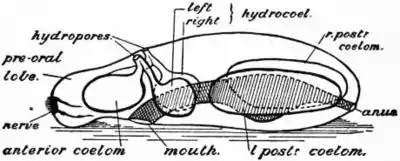
Dipleurula represents an ancestral form for these primitive ambulacrarians.
We can see that all well-known forms of larvae of Echinodermata are derived from the hypothetical dipleurula. Among them fall the Bipinnaria and the Brachiolaria of the starfish, the Auricularia of the sea cucumbers and the pluteus larvae of the sea urchins, and the sand stars. Also the Doliolaria of the Pelmatozoa (sea-lilies and feather stars) can be attributed to the same basic pattern, even if they do not have a mouth opening.
References
External links
- Information on forn
- "Dipleurula". de:Lexikon der Biologie (in German). Spektrum Akademischer Verlag. Heidelberg. 1999. Retrieved 2019-12-30.