Direction – Slovak Social Democracy
Direction – Slovak Social Democracy, formerly and legally called Direction – Social Democracy (Slovak: Smer – sociálna demokracia, SMER–SD), is a social democratic[12][lower-alpha 1] political party in Slovakia[13] led by the former prime minister Robert Fico.[19][20][21] A second-generation social democratic party in Slovakia, it is ideologically diffuse, claiming to be a social democratic party with Slovak national characteristics.[22]
Direction – Slovak Social Democracy Smer – slovenská sociálna demokracia | |
|---|---|
 | |
| Abbreviation | SMER–SD |
| Leader | Robert Fico |
| Presidium | See list
|
| Founder | |
| Founded | 8 November 1999 |
| Split from | Party of the Democratic Left |
| Headquarters | Bratislava |
| Newspaper | SMER Newspapers |
| Youth wing | Young Social Democrats |
| Women's wing | Slovak Union of Women |
| Membership (2020) |  13,284 13,284 |
| Ideology | |
| Political position | Centre-left to left-wing[11] |
| European affiliation | Party of European Socialists |
| International affiliation | |
| European Parliament group | Progressive Alliance of Socialists and Democrats |
| Colours | Red |
| National Council | 26 / 150 |
| European Parliament | 3 / 14 |
| Self-governing regions | 2 / 8 |
| Regional parliaments | 41 / 408 |
| Local councils | 3,692 / 20,646 |
| Website | |
| strana-smer | |
Robert Fico founded the party after leaving the post-communist Party of the Democratic Left. From the foundation, it was led mainly by former members of the SDĽ, but also of the national-populist Movement for a Democratic Slovakia. Direction claimed that it is third way party and was characterized by centrist and populist rhetoric. After the merger of several social-democratic and left-wing populist parties into the Direction, changed its name to Direction – Social Democracy and shifted its political positions to the center-left.
In the 2006 parliamentary election, the party won the election, formed a coalition government and Robert became the Prime Minister for the first time. During this election term, the party was characterized by social-democratic, left-wing nationalist and social-conservative policies. After another election victory in the 2010 parliamentary election, the party remained in opposition for less than 2 years and subsequently, after the 2012 snap parliamentary election, the party formed a one-party majority government again led by Robert Fico. This cabinet has once again been associated with a number of corruption scandals and violation of the rule of law. In the 2016 parliamentary election, the party lost more than a third of its original support. Nevertheless, formed a coalition government led by Robert Fico. After the 2020 elections, the party again lost more than a third of its support and all its coalition partners did not cross the threshold. The party returned to the opposition after 8 years.
At the end of the 2010s and especially after the departure of the faction around Peter Pellegrini from the party in 2020, the party became radicalized. The party's original positions were pro-European and left-leaning, but after Pellegrini later left the party and founded the Voice – Social Democracy, now (as of 2021) the party is dominated by practical motives of the patriotic left (the dominance of national-state interests and national sovereignty),[23][24][25] conservative social and ethical views (dominated by Christian values);[26] criticism of immigration (opposition to mandatory quotas);[27][28] a geopolitical orientation accepting the position of the Russian Federation;[29] partial Euroscepticism[lower-alpha 2] and criticism of the Western European left[lower-alpha 3] in the field of focus on minorities.[30]
By 2006, small parties on the social democratic left merged with the party, which rebranded itself as social democratic and joined the Socialist International, as membership rates doubled.[14] As of 2020, it has 13,284 members.[31]
SMER–SD won the 2006 Slovak parliamentary election when the party on 29.14% of the popular vote and continued to serve as Slovakia's ruling party until 2020, with a break between 2010 and 2012. In the 2020 Slovak parliamentary election, SMER–SD dropped their title for being the largest party in the parliament.[13] Afterwards, the party was affected by the formation of Voice – Social Democracy (HLAS–SD) by the former prime minister SMER–SD's Peter Pellegrini.[32] Europe Elects characterized SMER–SD as centrist, with HLAS–SD being centre-left and more pro-European.[33]
History
Foundation and early years (1999–2006)
Originally named Direction (Slovak: Smer), the party was founded on 8 November 1999, emerging as a breakaway from the post-Communist Party of the Democratic Left (SDL'), the successor of the original Communist Party of Slovakia and the governing party from 1998 to 2002. Under Robert Fico, at the time one of the most popular politicians in the country, it quickly became one of the most popular parties in Slovakia, while the SDĽ experienced a constant decrease within popularity. In the 2002 Slovak parliamentary election, its first formal election period, it became the third-largest party in the National Council of the Slovak Republic, with 25 out of 150 seats. In 2003, it changed its formal name to Direction (Third Way), or Smer (tretia cesta) in Slovak.[34]
In 2005, the party absorbed the SDĽ and the Social Democratic Alternative, a small social democratic party that split from the original SDĽ somewhat later than Direction did, in addition to the Social Democratic Party of Slovakia. Founded in 1990, the party became known for the leadership of Alexander Dubček, and Direction adopted the SMER–SD name. Following the party's victory in 2006, SMER–SD entered into a coalition with the nationalist Slovak National Party (SNS) and was readmitted into the Party of European Socialists (PES) in 2008. It later formed another coalition with the SNS in 2016.
Government (2006–2010)
In the 2006 Slovak parliamentary election, the party won 29.1% of the popular vote and 50 out of 150 seats. Following that election, Smer-SD formed a coalition government with the People's Party – Movement for a Democratic Slovakia (HZDS) and the SNS,[35] an extremist nationalist party.[36][37][38]
On 12 October 2006, the party was temporarily suspended from membership in the PES.[39] The resolution to suspend the party referred specifically to the PES Declaration "For a modern, pluralist and tolerant Europe", adopted in Berlin by the PES congress in 2001, which states that "all PES parties adhere to the following principles ... [and] to refrain from any form of political alliance or co-operation at all levels with any political party which incites or attempts to stir up racial or ethnic prejudices and racial hatred." In The Slovak Spectator, the PES chairman Poul Nyrup Rasmussen commented: "Most of our members stood solidly behind our values, according to which forming a coalition with the extreme right is unacceptable."[40] The party was readmitted on 14 February 2008 after its chairman Fico and SNS leader Jan Slota pledged in a letter to respect European values, human rights, and all ethnic minorities.[41]
Opposition (2010–2012)
Although the party won the most votes in the 2010 Slovak parliamentary election, with a lead of 20% over the second-place Slovak Democratic and Christian Union – Democratic Party (SDKÚ),[42] they had not been able to form a government because of losses sustained by their coalition partners. Their result, 34.8%, gave them 62 seats in the National Council, but the HZDS failed to cross the 5% threshold, losing all their seats, and the SNS was reduced to nine seats. The four opposition centre-right parties (the Christian Democratic Movement, Freedom and Solidarity, Most–Híd, and SDKÚ) were able to form a new government.[43]
Government (2012–2020)

In the 2012 Slovak parliamentary election, Smer–SD won 44.4% of the votes and became the largest party in the National Council, with an absolute majority of 83 seats (out of 150).[44] Fico's Second Cabinet was the first single-party government in Slovakia since 1993. In the 2014 European Parliament election in Slovakia, Smer–SD came in first place nationally, receiving 24.09% of the vote and electing 4 Members of the European Parliament.[45]
Despite suffering a significant loss in support as a result of strikes by teachers and nurses earlier in the year,[46] Smer–SD won the 5 March 2016 parliamentary election with 28.3% of the vote and 49 out of 150 seats, and subsequently formed Fico's Third Cabinet in a coalition government with Most–Híd, Network, and the Slovak National Party,. Prime Minister Fico resigned in the wake of the political crisis following the murder of Ján Kuciak and was replaced by Peter Pellegrini, with the same majority; however, Fico remained leader of Smer-SD.
Back into opposition and departure of the Pellegrini group (2020–present)
The party managed to score 18.29% in the 2020 Slovak parliamentary election, which was 2 to 3 percent more than the latest polls showed, but it was still a decrease of 10% compared to previous elections, the party occupied 38 seats in parliament. Pellegrini, the chairman of the Fico parliamentary group, became the vice-chairman of the National Council for the Opposition on the basis of post-election negotiations. In May 2020, two deputies for SMER–SD (Ján Podmanický and Marián Kéry) founded a value policy platform with deputies from KDŽP, elected as a candidate of the Kotlebists – People's Party Our Slovakia. Because of this, Pellegrini sharply criticized them, while Fico defended Podmanický. In May 2020, Podmanický also left the SMER–SD parliamentary group for criticism from his own ranks.
As early as April 2020, party vice-chairman Pellegrini announced his ambition to run for party chairman as the party's most popular politician, winning 170,000 more votes than the chairman. Fico reacted strongly, saying that he did not intend to resign and wanted to remain at the head of the party, while Pellegrini gradually began to tighten his criticism of Fico and the party's situation. Pellegrini criticized the fact that the party's presidency had not met since the election and the date of the parliament was unknown. Pellegrini demanded that the assembly be held as soon as possible, while Fico insisted that the nomination assembly take place only at a ceremonial assembly in December.
At a press conference in Banská Bystrica in June 2020, Pellegrini announced that he would resign as Vice-Chairman of the SMER–SD party and leave the party in the near future. He also outlined the establishment of a new party, Voice – Social Democracy, which he said should be social democratic, but refused to be liberal; at a similar time, Fico had already offered Pellegrini the position of party chairman, provided that he maintained his influence in the party, an offer which was rejected via Pellegrini. In the first FOCUS survey, 21.4% of respondents would vote for the new Pellegrini party, while the original SMER-SD remained at 9.6%. At a press conference one week following the announcement of Pellegrini's departure, another 10 deputies announced the party, including Vice-Presidents Peter Žiga and Richard Raši, Bureau member Denisa Saková and long-standing deputies and party members. At the same time, together with Pellegrini, they announced the creation of a new social-democratic party at the press conference, which they would join. Political scientist Grigory Mesezhnikov postulated that after the departure of the Pellegrini group, the SMER-SD could move further to the left into the spectrum of the radical to communist left.
Ideology
At the end of the 2010s, and especially after the departure of the faction around Peter Pellegrini (HLAS) in 2020, the party turn from pro-European left to national or patriotic left.
Since the Covid-19 Pandemic in 2020, anti-lockdown or anti-vaccination rhetoric was observed in the party's ideology. The top officials, including Robert Fico, began to actively appear in some alternative and conspiracy media and also actively spread or create hoaxes and conspiracies several times.
Leadership
Prime ministers
| No. | Name (birth–death) |
Portrait | Term start | Term end | Duration |
|---|---|---|---|---|---|
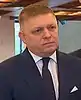
| 4 | Robert Fico (born 1964) |
 |
4 July 2006 4 April 2012 |
8 July 2010 22 March 2018 |
9 years, 11 months and 22 days |
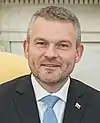
| 6 | Peter Pellegrini (born 1975) |
 |
22 March 2018 | 21 March 2020 | 1 year, 11 months and 28 days |
Party chairman
| No. | Name (birth–death) |
Portrait | Term start | Term end | Duration |
|---|---|---|---|---|---|
| 1 | Robert Fico (born 1964) |
|
8 November 1999 | Incumbent | 22 years, 1 month and 6 days |
Controversy
Corruption
The party is associated with many corruption cases in Slovakia. During the 12 years during which it ruled, the media revealed more than 30 alleged corruption cases in which Slovakia was to lose a total of 20 billion euros.[47][48]
As no corruption case has yet been proven in court, and no conviction resulting from a party member's complicity in corruption cases been attained, the party strongly rejects the fact that it has a number of corruption scandals. Its chairman Fico usually points to the cases of his opponents when asked about specific corruption cases; more than once, Fico verbally attacked the medium or the journalist himself who asked this question.[49][50] Some prominent members of the party to the corruption case, especially in the 2010s, have admitted that it is a thing of the past and made mistakes, while denying that corruption in the state is high.[51]
Election results
National Council
| National Council | |||||||
| Election | Leader | Votes | % | Seats | +/– | Government | |
|---|---|---|---|---|---|---|---|
| 2002 | Robert Fico | 387,100 | 13.46 (3rd) | 25 / 150 |
New | Opposition | |
| 2006 | 671,185 | 29.14 (1st) | 50 / 150 |
 25 25 |
Coalition | ||
| 2010 | 880,111 | 34.79 (1st) | 62 / 150 |
12 |
Opposition | ||
| 2012 | 1,134,280 | 44.41 (1st) | 83 / 150 |
21 |
Majority | ||
| 2016 | 737,481 | 28.28 (1st) | 49 / 150 |
34 |
Coalition | ||
| 2020 | Peter Pellegrini[lower-alpha 4] | 527,172 | 18.29 (2nd) | 38 / 150 |
11 |
Opposition | |
European Parliament
| European Parliament | |||||||
| Election | Group | Leader | Votes | % | Seats | +/– | |
|---|---|---|---|---|---|---|---|
| 2004 | S&D | Monika Beňová | 118,535 | 16.89 (3rd) | 3 / 14 |
New | |
| 2009 | Boris Zala | 264,722 | 32.01 (1st) | 5 / 13 |
2 | ||
| 2014 | Maroš Šefčovič | 135,089 | 24.09 (1st) | 4 / 13 |
1 | ||
| 2019 | Monika Beňová | 154,996 | 15.72 (2nd) | 3 / 14 |
1 | ||
Presidential
| President of Slovakia | |||||||
| Election | Candidate | First round | Second round | Result | |||
|---|---|---|---|---|---|---|---|
| Votes | % | Votes | % | ||||
| 2004 | Endorsed Ivan Gašparovič | 442,564 | 22.28 | 1,079,592 | 59.91 | Won | |
| 2009 | Endorsed Ivan Gašparovič | 876,061 | 46.71 | 1,234,787 | 55.53 | Won | |
| 2014 | Robert Fico | 531,919 | 28.01 | 893,841 | 40.61 | Lost | |
| 2019 | Endorsed Maroš Šefčovič | 400,379 | 18.66 | 752,403 | 41.59 | Lost | |
See also
Notes
- While nominally social democratic,[13] and described as partially or fully social democratic,[12][14] its orientation has been disputed by some observers[15][16] due its national-populism.[17][18]
- A member of the Socialist International and the Party of European Socialists (PES), like other like-minded parties in Eastern Europe, it reflects the more Eurosceptic and conservative nature on social issues of the region within the otherwise pro-European, progressive PES.
- Over time, it has adopted a nationalist-populist stance, coupled with Russophilia, and stances associated with the political right, including anti-immigration, antiziganist, and anti-LGBT rhetoric
- Pellegrini was the election leader, while Fico remained the party chairman.
Footnotes
- Bradová, Klára (2015). "Národní populismus Roberta Fica". Plzeň: Západočeská univerzita v Plzni. Retrieved 11 July 2021. Cite journal requires
|journal=(help) - Chamulová, Barbora (2009). "Populizmus HZDS a SMER" (PDF). old.bisla.sk.
- Gyárfášová, Oľga; Mesežnikov, Grigorij (2008). Národný populizmus na Slovensku. Bratislava: IVO. ISBN 978-80-89345-12-0.
- Sekerák, Marián (October 2019). "Towards conservatism? Party politics in Slovakia at the end of the 2010s". European View. 18 (2): 233–241. doi:10.1177/1781685819883965.
- "Fico hovorí o LGBTI ľuďoch čoraz vulgárnejšie, jeho štátna tajomníčka pritom podporila Pride". dennikn.sk (in Slovak). Denník N. 11 May 2021.
- "Komentár: Za to naše manželstvo". aktuality.sk (in Slovak). Aktuality. 26 February 2014.
- "Slovak PM Fico wins election but faces tough task to form majority". Reuters. 5 March 2016.
- Marek Payerhin, ed. (2017). Nordic, Central, and Southeastern Europe 2017-2018. Rowman & Littlefield. p. 391.
- "Spor medzi premiérom a šéfom eurovýboru. Blaha tvrdí, že nie všetko, čo napíše, treba brať vážne".
- Dangerfield, Martin (2013). "Czech Republic, Hungary and Slovakia". In David, Maxine; Gower, Jackie; Haukkala, Hiski (eds.). National Perspectives on Russia: European Foreign Policy in the Making?. Routledge. p. 181. ISBN 978-1-135-04967-6.
- "Uznávam porážku, reagoval Fico na výsledky volieb. Funkciu šéfa strany Pellegrinimu neponúkne". hnonline.sk (in Slovak). Hospodárske noviny. 1 March 2020.
- De Waele, Jean-Michel; Escalona, Fabien; Vieira, Mathieu (2016). The Palgrave Handbook of Social Democracy in the European Union. Springer. pp. 553, 568–569. ISBN 9781137293800. Retrieved 4 November 2021 – via Google Books.
- Nordsieck, Wolfram (February 2020). "Slovakia". Parties and Elections in Europe. Retrieved 31 October 2021.
- Brandal, Nik; Bratberg, Øivind; Thorsen, Dag Einar (2021). Social Democracy in the 21st Century. Emerald Group Publishing. p. 45. ISBN 9781839099540. Retrieved 4 November 2021 – via Google Books.
- Deegan-Krause, Kevin (April 2003). "Slovakia's Second Transition". Journal of Democracy. 14 (2): 65–79. doi:10.1353/jod.2003.0036. S2CID 154928637. Retrieved 2 November 2021. At p. 74.CS1 maint: postscript (link)
- Almeida, Dimitri (2012). The Impact of European Integration on Political Parties: Beyond the Permissive Consensus. Taylor & Francis. p. 61. ISBN 9781136340390. Retrieved 2 November 2021 – via Google Books.
- Bálint, Tomas (25 May 2021). "The Struggle Over the Soul of Slovakia's Social Democracy". Europe Elects. Retrieved 31 October 2021.
- Skolkay, Andrej (July 2021). "Impact of Populism on the Party System in Slovakia 2000–2020". Democratic Efficacy and the Varieties of Populism in Europe. doi:10.13140/RG.2.2.24007.01444. Retrieved 31 October 2021 – via ResearchGare. Cite journal requires
|journal=(help) - Želinský, Dominik. "Great Expectations: Slovak Nationalist initiatives in the light of Communal Elections 2014" (PDF). Ceeidentity.eu. CEE Idenitity - National Identities.
- "Boris Zala: Vedenie Smeru už treba vymeniť". 24 July 2016.
- "Prečo je Smer pravicová až krajnepravicová strana". 6 March 2016.
- Archived at Ghostarchive and the Wayback Machine: "R. FICO: SMER-SD JE SLOVENSKÁ SOCIÁLNA DEMOKRACIA". YouTube.
- "Fica podporili aj matičiari". slovensko.hnonline.sk (in Slovak).
- "Fico: Vyzývam médiá, politikov a cirkvi na objektívnejší pohľad na SR". TERAZ.sk (in Slovak). 17 July 2018.
- "Fico: Ak pôjde o národné záujmy, nikto ma nezastaví". Pravda.sk (in Slovak). 7 June 2015.
- https://www.unipo.sk/public/media/17464/ASP%201-2012%20Cirner.pdf
- "Tlačová agentúra Slovenskej republiky - TASR.sk". www.tasr.sk.
- "MIGRÁCIA". strana-smer.sk.
- "Smer vyzýva na opatrnosť voči vyhláseniam k Rusku: Slovensko by malo pomôcť situáciu vyšetriť". Topky.sk. 19 April 2021.
- "Ficova politická strana Smer mení zaužívané meno aj logo. Vracia sa k červenej ruži a do popredia chce posúvať slovenské témy". refresher.sk (in Slovak).
- "Smer sa prvýkrát po 15 rokoch výraznejšie zmenšil. Veľká väčšina členov však nešla za Pellegrinim". Aktuality.sk (in Slovak). 18 August 2021. Retrieved 18 October 2021.
- Bariak, Ladislav (29 June 2020). "Pellegriniho jedenástka končí. Nastupuje Hlas – sociálna demokracia" [Pellegrini's eleven exit. HLAS – Social Democracy is coming]. Aktuality (in Slovak). Retrieved 24 April 2021.
- "Slovakia". Europe Elects. 2021. Archived from the original on 22 October 2021. Retrieved 26 October 2021.
- "Register of Political Parties and Political Movements". Archived from the original on 15 July 2012. Retrieved 3 July 2015.
- "The Study of Contemporary Racism and Antisemitism", The Steven Roth Institute, Tel Aviv University. Tau.ac.il. Archived 31 May 2013 at the Wayback Machine Retrieved on 15 October 2011.
- Zoltan D. Barany (2002). The East European gypsies: regime change, marginality, and ethnopolitics. Cambridge University Press. pp. 313, 408. ISBN 0-521-00910-3. Retrieved 22 May 2009.
- Cas Mudde (2005). Racist Extremism in Central & Eastern Europe. Routledge. pp. xvi, 314. ISBN 0-415-35593-1. Retrieved 22 May 2009.
- Juliana Sokolova (2 April 2009). "Slovakia: in search of normal". openDemocracy.net. Archived from the original on 30 August 2009. Retrieved 22 May 2009.
- SMER suspended from PES political family Archived 6 January 2011 at the Wayback Machine, Party of European Socialists, 12 October 2006
- Petit Press a.s. (16 October 2006). "Euro-socialists suspend Fico's Smer party". spectator.sme.sk. Retrieved 3 July 2015.
- "Slovak PM's party rejoins European socialists". Retrieved 3 July 2015.
- Voľby do Národnej rady Slovenskej republiky Archived 16 June 2010 at the Wayback Machine. Volbysr.sk. Retrieved on 15 October 2011.
- Fico vyhral a predsa končí | Voľby 2010. volby.sme.sk. Retrieved on 15 October 2011.
- a.s, Petit Press (11 March 2012). "ELECTION 2012: UVK officially confirms Smer's landslide victory in general election". spectator.sme.sk.
- "Archived copy". Archived from the original on 28 May 2014. Retrieved 18 May 2017.CS1 maint: archived copy as title (link)
- Cunningham, Benjamin (6 March 2016). "5 takeaways from Slovakia's election". Politico.eu. Politico. Retrieved 14 November 2017.
- Aktuality.sk. "Najväčšie korupčné kauzy od roku 2006". Aktuality.sk (in Slovak). Retrieved 12 August 2020.
- Čikovský, Konštantín (24 November 2015). "Päť miliardových káuz Smeru". Denník E (in Slovak). Retrieved 12 August 2020.
- Števkov, Peter. "Ficova vojna s novinármi. Slizkí hadi, hyeny, prostitútky a idioti | Parlamentné Listy". parlamentnelisty.sk/ (in Slovak). Retrieved 12 August 2020.
- a.s, Petit Press. "Vláda nechce odpovedať novinám, naposledy to urobil Mečiar". ekonomika.sme.sk (in Slovak). Retrieved 12 August 2020.
- "Pellegrini volá po zmene, pripúšťa svoj odchod". trend.sk (in Slovak). 29 May 2019. Retrieved 12 August 2020.
External links
- Official party website (in Slovak)
- Entry in Slovak Interior Ministry's Register of Parties (in Slovak)
European Parliament group: Progressive Alliance of Socialists and Democrats | |||||||||||||
| Parties |
| ||||||||||||
| Presidents |
| ||||||||||||
| Leaders in the European Parliament |
| ||||||||||||
| European Commissioners |
| ||||||||||||
| Heads of government |
| ||||||||||||
| Heads of state |
| ||||||||||||


| In the National Council (150 seats) |
| ||||
|---|---|---|---|---|---|
| In the European Parliament (13 seats) | |||||
| Extra-parliamentary parties |
| ||||
| Defunct parties (since 1990) | |||||
| |||||
Authority control  | |
|---|---|
| General | |
| National libraries | |