Doenjang-guk
Doenjang-guk (된장국) or soybean paste soup is a guk (soup) made with doenjang (soybean paste) and other ingredients, such as vegetables, meat, and seafood.[1][2] It is thinner, lighter, and milder than doenjang-jjigae (soybean paste stew).[3] It is similar to the Japanese miso soup.
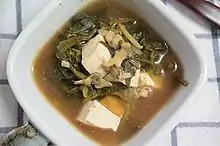 Sigeumchi-doenjang-guk (soybean paste soup with spinach) | |
| Alternative names | Soybean paste soup |
|---|---|
| Type | Guk |
| Place of origin | Korea |
| Associated national cuisine | Korean cuisine |
| Main ingredients | Doenjang |
| Similar dishes | Miso soup |


| Korean name | |
| Hangul | 된장국 |
|---|---|
| Hanja | -醬- |
| Revised Romanization | doenjang-guk |
| McCune–Reischauer | toenjang-kuk |
| IPA | [twen.dʑaŋ.k͈uk̚] |
The soul of Korea can be considered to be Doenjang-guk. It is sometimes mild, sometimes strong, and accompanied with rice most of the time.[4]
When you go to a restaurant in Korea, you can easily see your table filled very soon from your arrival with doenjang-guk, sesame leaves, lettuce, chiles and garlic, shredded ginger, radish kimchi, cabbage kimchi, bean sprouts, sesame leaves prepared in soy sauce, pickled onions, sweet vines and flowers, yellow radish, and the pickled intestines of a swordfish.[4] This soup is perhaps the cheapest meal in Korea.[5]
History
On the Joseon period, the royals had five meals (called sura), and in three of those they had Doenjang-guk as a side dish (banchan 반찬), specifically in a small table on the right side of the main table, together with other various korean traditional foods such as vegetables (chaeso 채소), meat dish (Kogi 고기), egg, sesame-seed oil (chamgireum 참기름), Jang.[6]
Ingredients
The most simple form of this soup is clear soybean paste soup (Malgeun-doenjangguk 맑은 된장국). It is mainly composed of a good fermented soybean paste and stock. Used to accompany more complex one-bowl rice dishes that have a lot of ingredients, like Bibimbap with Sliced Raw Fish and Avocado, Mushroom, and Vegetable Bibimbap. To make this type of soup you basically only need: Anchovy-Kelp Stock, Vegetable Stock, or unsalted chicken broth, Korean fermented soybean paste and maybe some scallion.[7]
Now, the most commonly eaten form of this dish is Soybean Paste Soup with Cabbage (Baechu-doenjangguk 배추된장국) and it is eaten at any time of the day. And the broth has a deep, comforting flavor, and the cabbage adds texture and sweetness. It’s light, since there is no grease in it. To prepare it you only need dried anchovies, napa cabbage leaves, white-stemmed chard, or bok choy, Korean fermented soybean paste (doenjang), garlic, chili peppers, all-purpose flour or rice water and fish sauce.[7]
To make the broth for a doenjang based soup or stew, it is common to begin with the water used to wash rice, ssalddeumul (쌀뜨물). This rice water adds starch to the soup and works as a binding agent between the soybean paste and the broth, while improving the flavor of the doenjang. If you don’t have it, you can mix in a teaspoon of flour or rice flour.[8]
Types
- Mu-doenjang-guk (무된장국) is light yet very flavorful. Prepared with korean radish (mu 무), and also some basic aromatic vegetables, such as onion, garlic, scallion, chilli peppers, dried kelp (dashima 다시마), ssalddeumul (쌀뜨물), and dried shiitake mushrooms (which are common ingredients used to make a traditional Korean broth).[8]
- Paraetguk / parae-doenjangguk (파랫국 / 파래된장국) Grassy Seaweed Soup with Soybean Paste. A soup of grassy seaweed in a broth made of dried anchovies and soybean paste (doenjang). A regional specialty of Jeju-do.[9]
- Cheonggyeongchae dubu-doenjangguk (청경채 두부된장국) is made with tofu and bok choy, gochujang (Korean hot pepper paste) in addition to the regular ingredients used to make the broth.[10]
- Naeng-i Guk (냉이국) (Shepherd’s Purse Soup) is very similar to mugwort soup ssuk-guk (쑥국) made with Nangyi (냉이), soup soy sauce gukkanjang (국간장), wild sesame powder and the rest of the common ingredients for the Doenjang-guk base broth. In this version you can add a lot of vegetables to accompany the main ingredients.[11]
Gallery
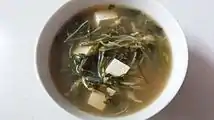 Dallae-doenjang-guk (soybean paste soup with Korean wild chives)
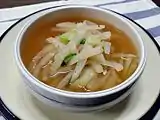 Dongchimi-doenjang-guk (soybean paste soup with dongchimi)
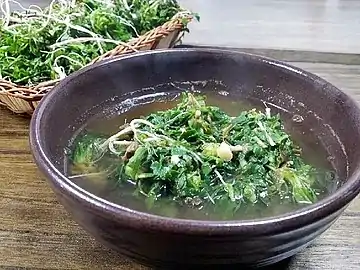 Naengi-doenjang-guk (soybean paste soup with shepherd's purse)
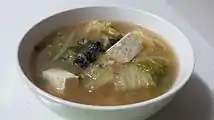 Ugeoji-ureong-doenjang-guk (soybean paste soup with ugeoji and river snails)
References
- National Institute of Korean Language (30 July 2014). "주요 한식명(200개) 로마자 표기 및 번역(영, 중, 일) 표준안" (PDF) (in Korean). Retrieved 20 June 2017. Lay summary – National Institute of Korean Language.
- "doenjang-guk" [Soybean Paste Soup]. Korean Food Foundation. Retrieved 20 June 2017.
- Ro, Hyo-sun (10 January 2014). "Baechu doenjang guk (Napa cabbage doenjang soup)". The Korea Herald. Retrieved 20 June 2017.
- Holliday, Graham (2017). Eating Korea: reports on a culinary renaissance. New York, Ny: Ecco, An Imprint Of HarperCollinsPublishers. p. 139. ISBN 9780062400765.
- Fuhr, Michael (2015). Globalization and popular music in South Korea : sounding out K-pop. New York: Routledge, Taylor & Francis Group, June. p. 237. ISBN 9781315733081.
- Pettid, Michael J (2008). Korean cuisine: an illustrated history. London: Reaktion Books. pp. 134–136. ISBN 9781861893482.
- Kim, Emily; Shulman, Martha Rose (2019). Maangchi's big book of Korean cooking: from everyday meals to celebration cuisine. Boston: Houghton Mifflin Harcourt. ISBN 9781328988126.
- Doo, Rumy (2 December 2017). "[Korean Bapsang] Mu doenjang guk (Radish soybean paste soup) - The Korea Herald". The Korea Herald. Retrieved 16 October 2021.
- Foundation, The Korea (2003). Korean food guide in English. Seoul, Korea: Cookand, Best Home. p. 332. ISBN 9788989782100.
- Kim, Emily (8 October 2019). "Doenjang soup with bok choy and tofu". Cooking Korean food with Maangchi. Retrieved 16 October 2021.
- "Naeng-i Guk (Shepherd's Purse Soup) - everyday eunhae". everyday eunhae. 2 April 2020.
|first=missing|last=(help)