Dominion (card game)
Dominion is a deck-building game created by Donald X. Vaccarino and published by Rio Grande Games. It was the first game of its kind, and inspired a genre of games building on its central mechanic.[1] Each player begins with a small deck of cards, which they improve by purchasing cards from a common supply that varies from game to game. Cards can help the player's deck function, impede their opponents, or provide Victory Points.
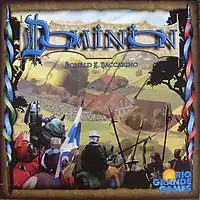 Box cover art | |
| Designers | Donald X. Vaccarino |
|---|---|
| Publishers | Rio Grande Games |
| Players | 2 to 4 (up to 6 with additional base cards) |
| Setup time | 5–10 minutes |
| Playing time | ~30 minutes |
| Random chance | Medium |
| Skills required | Resource management, Planning |
The game has a medieval theme with card names referencing pre-industrial, monarchical, and feudal social structures. Comparisons about the game's feel are often drawn with collectible card games such as Magic: The Gathering.[2] Vaccarino, however, denies that Magic was the inspiration.[3]
When Dominion was released at Spiel 2008, it was voted "best game of the fair" by the Fairplay polls.[4] The next year it won the Spiel des Jahres[5] and Deutscher Spiele Preis awards. It was one of five winning games in American Mensa's 2009 MindGame competition.
By 2017, more than 2.5 million copies of Dominion and its expansions had been sold worldwide.[6] Dominion's success has led to multiple expansions being released; as of March 2020, there were thirteen.
Gameplay
Cards and Setup
In a game of Dominion, two to four players compete to gather the most Victory Points by strategically building a deck of cards.[7] Each player starts with a small deck containing a few weak cards, with which they acquire more cards with different and more powerful abilities. Some provide more of the in-game currency; others let the player perform more actions or buy more cards per turn; others let them draw more cards, harm the other players, remove unwanted cards from their decks, or do other things. As players improve their decks, they also think about how to improve their scores; a powerful deck may be worth no Victory Points. The game has been compared to the "draft" gameplay style of collectible card games where players vie for the best deck from a common pool of cards.
Cards are classified into types, which are listed at the bottom of each card. The six types in the base set are:
- Victory cards have a Victory Point value at the end of the game but usually have no use while the game is actually in progress.
- Curse cards are like Victory cards but have a negative Victory Point value.
- Treasure cards generate Coins which can be used to buy other cards during the Buy phase.
- Action cards have many kinds of effects.
- Attack cards hurt other players, such as by forcing them to discard cards from their hand or gain Curse cards.
- Reaction cards can be triggered out of turn in response to certain events, such as other players' Attacks.
Cards may have more than one type, such as Action and Attack. Certain cards are affected by other cards' types; for instance, some Reactions are triggered when another player uses an Attack card.
In addition, cards are divided into two groups: Base cards, which are present in every game, and Kingdom cards, of which each game has a different assortment. The Base cards consist of Curse cards, three kinds of Treasure, and three kinds of Victory cards. Kingdom cards are mostly Actions, but some have other types, including Treasure and Victory. There is one pile of each card in the game; once the pile is empty, players can no longer buy that card. Together, these cards form the Supply. Note that a few cards from expansions change these rules.
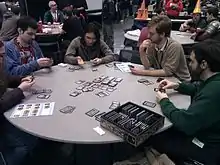
To begin a game, players decide on the Kingdom cards they are going to use, either selecting them or choosing randomly, and setting out the Supply. Cards from any sets of Dominion can be mixed freely, creating a large number of possible setups. Then, each player gets the same starting deck of ten cards, consisting of seven Copper cards (low-value Treasure) and three Estate cards (low-value Victory). Each player shuffles their deck and draws the top five cards to form their hand.
During Play
Each turn, the player gains one Action and one Buy and performs the following phases in order (abbreviated as "ABC" as a mnemonic for newer players):
- Action phase: The player can play one Action card from their hand, following the card's printed instructions. By default only one Action card may be played, but some Action cards have instructions that give the player permission to play additional Action cards that same turn.
- Buy phase: The player can play any Treasure cards they want from their hand, generating Coins. Then they may use the Coins they have generated in their Action phase and Buy phase to buy a card from the Supply; if the player has no Coins, they may still buy a card with a zero Coin cost. By default only one card may be bought, but if a player has generated additional Buys earlier in the turn, they may divide their Coins among multiple purchases. Bought cards are added to the player's discard pile (from which they will later be shuffled into their deck).
- Clean-up phase: The player collects their hand and all played cards and places those into their discard pile. They then draw five new cards from their deck. Unused Actions, Buys, and Coins do not carry over to future turns.
If the player must draw a card from their deck, but their deck is empty, they shuffle their discard pile to create a new deck. Some Action cards can trash cards, removing them from players' decks and into the "trash", where they are out of the game (though a few Actions from expansions can recover them).
The game usually ends under one of two conditions: when the stack of Province cards (the highest-value Victory card in the base game) has been exhausted, or when any three stacks in the Supply have been exhausted. Players then count the number of Victory Points in their decks, and the player with the highest score wins. Other end-game conditions have been introduced in the game's expansions.
Since possessing Victory cards is often necessary to win the game, but they usually have no value during gameplay itself, players must balance the acquisition of Victory cards with useful Action and Treasure cards that maintain the player's ability to play effective turns. Usually, the game's main strategy is to build a deck that maximizes the player's ability to draw hands that can buy the Province card (worth 6 Victory Points and costing 8 Coins).[8]
Expansions
Due to the game’s commercial success, several expansions have been released.[6] The basic set is simple,[9][10] but each expansion adds more complexity, typically through the addition of new Kingdom cards but may be through additional rule implementations, such as adding new card types or changing the composition of each players' starting deck when using that expansion.
Some expansions have added "landscapes" to the game setup. These are distinguished from cards by having landscape orientation rather than portrait, and do not enter the players' hand or deck, but are either resolved immediately or placed in the players' play area for later use. These have different effects on the game; for example, the Adventures expansion introduced the ability to buy Events, which provide immediate bonuses but never enter a player's deck. Other expansions have introduced tokens for tracking game progression. The Prosperity expansion introduced Victory Point tokens, which can be earned by playing certain Kingdom cards; these increase players' scores but do not dilute their decks with Victory cards. If players use Kingdom cards that require these non-Supply card stacks or tokens, those are set up alongside the Supply prior to play.[11][12]
Many reviews recommend buying expansions to increase the variety of the game, as cards from different sets may be freely mixed with each other.[13]
Intrigue
This set introduced cards with multiple uses, which the player must choose between when they play the card, and Victory cards which have another type and provide an ability or bonus, making them useful before the game ends. Intrigue has been recommended as the first expansion to purchase after the base set for play.[1][14]
Seaside
This set's theme is the player's next turn. It introduced Duration cards, which have effects that last more than one turn. It also includes the first cards to have mats and tokens which track their effects.[15]
Alchemy
This was the first set to introduce a new Base card: Potion, a Treasure card which is needed to buy most of the expansion’s Kingdom cards.[16]
Prosperity
This set's theme is wealth. It introduced two more new Base cards: a Victory card and a Treasure card. It also introduced the first Treasures that are Kingdom cards, and Victory Point tokens, which increase the players’ score but are not part of their deck.[17]
Cornucopia
This set has a theme of variety; there are cards that reward players for having different cards in their deck. It includes a card which causes an extra Kingdom pile to be added to the game. It also introduced a way to get cards from outside the Supply that cannot otherwise be gained.[18]
Hinterlands
This set introduced cards which have special effects when players gain or buy them.[19]
Dark Ages
This set has two mechanical themes: trashing cards, and upgrading them to better ones. It introduced new ways to gain non-Supply cards, ways to play cards from the Supply without needing to buy them, cards which can replace players’ starting Victory cards, and cards which have effects when they are trashed. Two piles contain copies of several differently-named cards.[20]
Guilds
This set introduced Coffers, which are tokens that players can use to help pay for cards later. It also introduced cards which provide a bonus if players spend extra money when they buy them.[18]
Adventures
This set introduced more ways to gain non-Supply cards, and Reserve cards, which do little when played but may be triggered later for a more significant effect. It also introduced Events, which provide an instant effect when bought rather than entering the player’s deck. These are printed on landscape-style cards and are added to the game’s setup in a similar way to a stack of Kingdom cards, but in game terms are not cards.[21]
Empires
This set introduced cards with a Debt cost; instead of paying Coins for them, the player receives Debt tokens, which they may later pay to return. There are also split piles, which comprise an expensive card beneath a cheaper one, all copies of which must be removed from the Supply before the other can be gained. It also includes more Events, and Landmarks, which are added to the game setup like Events and provide additional ways to gain and lose Victory Points.[22]
Nocturne
This set introduced Night cards and a Night phase to the game, which occurs after the Buy phase. It also introduced Fate and Doom cards, which provide random bonuses and penalties. There are also cards which play cards in the trash; States, which have lingering effects on a player; and cards which replace players’ starting Coppers.[23]
Renaissance
This set introduced Projects, which are similar to Events but provide a permanent bonus if bought; Artifacts, which are like States; and Villagers, which are used to gain extra actions.[24]
Menagerie
This set introduced Exile, a way to temporarily remove cards from the player's deck. It also introduced Ways, which provide additional uses for Action cards.[25]
History
Initial Development
Vaccarino was a software developer in the 1980s and 1990s.[2] At this time, he created supplements for Dungeons and Dragons and created games based on existing board games.[26] After the release of Magic: The Gathering in 1993, he began designing more seriously and created a 90-card fan expansion, Edge of the World, and became an informal contributor towards additional Magic works; he is credited in the official Magic rulebook. Later, he developed several game ideas and discussed them with Magic's creator, Richard Garfield.[2]
In 2006, Vaccarino invented the deck-building mechanic while working on a fantasy adventure card game called "Spirit Warriors II".[27] He struggled with the mechanics before a deadline of showing the game to his gaming group, and spent a weekend stripping it down to its core elements; specifically, having problems with introducing new cards over the course of the game, Vaccarino opted to simply have all cards available at the start. The game immediately became popular with his gaming group, overshadowing the usual staples, including Magic, for the next two years.[2]
With this success, Vaccarino began looking to refine and publish the game. During the 2007 Origins Game Fair, Vaccarino demonstrated the game and gained the interest of Rio Grande Games.[28] Shortly after he signed with Rio Grande, BoardGameGeek's columnists Valerie Putman and Dale Yu requested permission from Rio Grande to develop the game. During development, Dominion was called "Castle Builder", owing to its theme of building rooms in a castle, and then, later, "Game X". Yu came up with the final name of Dominion.[28][29] Vaccarino had, early on, planned for the game to grow through expansions, though focused these on maintaining the core functionality of the game instead of immediately adding "exotic things"; this was to ensure that, if the game did take off, early expansions would not create incompatible sets of cards: one focused on the normal Dominion play, and others with a strange new mechanic.[2] In a post to BoardGameGeek, Vaccarino suggested that he had originally planned seven different expansions,[2] and, tuning the core game for release, brought cards into the base game that were originally planned for later expansions.[30]
After Release
As more expansions were released, Vaccarino added new rules to prevent undesirable game situations and permit new mechanics.[31][32] In 2016, Rio Grande Games began releasing a second edition of the game, which improved layout and adjusted some card effects. The base game and Intrigue were most affected, as some cards were removed, more powerful ones were added, and the Base cards were removed from Intrigue. Upgrade packs for players who already owned the first editions of these sets were also sold.[33]
Releases
Numerous expansions have been released for Dominion,[13] and mini-expansions, most consisting of a set of a single kind of Kingdom card, have been released as promotional items. Intrigue has been recommended as the first expansion to purchase after the base set for play.[1] Vaccarino originally planned to stop expanding the game after Guilds, though he conceded:[26]
"Still, it’s likely that at some point the publishers will want another expansion and, well, I like to be friendly. So I can’t guarantee that Guilds is the end of the line, but you can at least think of it as a dividing point between regular expansions and occasional expansions."
Two "Big Box" sets have been released. The first contained Dominion First Edition, Alchemy, Prosperity, and the promotional cards Envoy and Black Market. Later editions included alternate promotional cards: Walled Village and Governor. This was released in 2010 and is no longer available. Big Box II was released in 2016, and contains Dominion Second Edition, Intrigue Second Edition, and additional base cards for 5 and 6 player games.
After the release of Menagerie, Dominion included 585 differently named cards and landscape-shaped cards (such as Events), and there were 366 Kingdom card piles, including the 6 each in the 1st Edition Base and Intrigue releases that were later replaced. In 2021, researchers calculated that there were over 66 sextillion possible unique game combinations.[34]
Since the game and its expansions feature over 4,000 individual cards, Rio Grande Games has licensed manufacturers' creation of containers to store all the cards into one or two boxes.[35]
| Name | Release Date | Type | Cards | Kingdom Card Piles | |
|---|---|---|---|---|---|
| Dominion | October 2008 (1st ed) / October 2016 (2nd ed) | Base game | 500 | 25 (1st ed) / 26 (2nd ed) | |
| Envoy[36][37] | November 2008 | Promotional card | 11 | 1 | |
| Black Market[38] | March 2009 | Promotional card | 11 | 1 | |
| Intrigue | July 2009 (1st ed) / October 2016 (2nd ed) | Expansion | 500 (1st ed) / 300 (2nd ed) | 25 (1st ed) / 26 (2nd ed) | |
| Seaside | October 2009 | Expansion | 300 | 26 | |
| Stash[39] | February 2010 | Promotional card | 11 | 1 | |
| Alchemy | May 2010 | Expansion | 150 | 12 | |
| Prosperity | October 2010 | Expansion | 300 | 25 | |
| Cornucopia[18] | June 2011 | Expansion | 150 | 13 | |
| Walled Village[40] | June 2011 | Promotional card | 11 | 1 | |
| Hinterlands | October 2011 | Expansion | 300 | 26 | |
| Governor[41] | October 2011 | Promotional card | 11 | 1 | |
| Base Cards[42] | June 2012 | Replacement cards | 250 | 0 | |
| Dark Ages | August 2012 | Expansion | 500 | 35 | |
| Guilds[18] | June 2013 | Expansion | 150 | 13 | |
| Prince[43] | June 2014 | Promotional card | 11 | 1 | |
| Adventures[21] | April 2015 | Expansion | 400 | 30 | |
| Summon[44] | Autumn 2015 | Promotional Event | 1 | 0 | |
| Empires[22] | June 2016 | Expansion | 300 | 24 | |
| Dominion Update Pack | October 2016 | Replacement cards | 77 | 7 | |
| Dominion Intrigue Update Pack | October 2016 | Replacement cards | 77 | 7 | |
| Sauna/Avanto[45] | October 2016 | Promotional card (split pile) | 11 | 1 | |
| Nocturne[23] | November 2017 | Expansion | 500 | 33 | |
| Dismantle | December 2017 | Promotional card | 11 | 1 | |
| Renaissance[24] | November 2018 | Expansion | 300 | 25 | |
| Captain | July 2019 | Promotional card | 11 | 1 | |
| Church | July 2019 | Promotional card | 11 | 1 | |
| Menagerie[25] | March 2020 | Expansion | 400 | 30 | |
| Allies[46] | January 2022 | Expansion | 400 | 31 |
Digital versions
Several unofficial online implementations of Dominion existed before there was a licensed online version; Rio Grande Games requested that these be discontinued once the official online implementation was released.[47] One of these unofficial implementations, however, located at dominion.isotropic.org, was used by Dominion designer Donald X. Vaccarino and his playtesters during the development of new cards, even long after the site was closed to the public.[48]
A licensed browser-based online implementation of Dominion, hosted by Goko, went live in early March 2013. It was originally intended to be released to the public on August 16, 2012, but because of bugs and server overload, it was withdrawn from public release and returned to beta testing.[49] The official app provided the base Dominion game free to play, and cards from the expansions available for a fee.[50] In October 2015, the official Goko online implementation of Dominion transitioned to a new official 2.0 online implementation developed by Making Fun.[51] Making Fun honored all purchases made by customers from the original Goko implementation, but in February 2016, John Welch, CEO of Making Fun announced that the license granted to Making Fun by Rio Grande Games to develop the official online Dominion game would expire at the end of 2016, and would not be renewed with Making Fun.[52] From January 1, 2017, development of the official online Dominion game is licensed to Shuffle iT, a company formed by two high-ranked Dominion players. They were dissatisfied with all prior online implementations of Dominion and proposed their new approach to Vaccarino, who was impressed with what the two developers were able to do and gave them the license.[53]
Temple Gate Games released a licensed version of Dominion for Microsoft Windows, iOS and Android devices in early access in October 2021. This game was developed using artificial intelligence and neural networks to provide viable computer opponents, which the developers claim was advanced enough to be able to learn new cards that were not used in training. The game is offered as a free-to-play game that includes the original base Dominion game, with paid downloadable content for each of the card game's expansions.[54]
Reception
The original Dominion set won several awards, including the Spiele des Jahres, the Deutscher Spiele Preis, an Origins award and a Diana Jones Award. In addition, it and the expansions have sold more than 2.5 million copies[6] and been translated into 18 languages: Chinese, Czech, Dutch, Finnish, French, German, Greek, Hungarian, Italian, Japanese, Korean, bokmål Norwegian, Polish, Portuguese, Romanian, Russian, Spanish and Swedish.
Moreover, as the game that invented deckbuilding,[1] many other games owe their existence to it. Other games, such as the Mage Knight Board Game, use deckbuilding as one game mechanic among others.
Dominion has been praised for its speed and simplicity, as well as its strategic depth; there are many ways to win. Other reviewers have noted the game’s replayability.[8] However, it has been criticised as "almost abstract" for its weak theme, described as "multiplayer solitaire", and the theme has been criticised as generic, though a minor issue in the playability.[10][1]
Awards
- 2008 Origins Award for Best Traditional Card Game[55]
- 2008 Meeples Choice Awards
- 2009 Spiel des Jahres[5]
- 2009 Deutscher Spiele Preis
- 2009 Mensa Select
- 2009 Golden Geek Award (Game of the Year & Card Game of the Year)
- 2009 Diana Jones Award for Excellence in Gaming
- 2009 Origins Award, Best Card Game
- 2009 BoardGamer.ru (Russia), Best Card Game of the Year
- 2009 Boughtalot.ru, best game of the year
References
- Furino, Giaco (28 March 2019). "Dominion Review - The Game That Launched A Genre". TechRaptor. Retrieved 7 November 2021.
- Varney, Allen. "Dominion Over All". Escapist.com. Retrieved 24 November 2021.
- Derek Thompson (2012-02-29). "Game Designer Interview: Donald X. Vaccarino… Again!". MeepleTown. Retrieved 2014-01-06.
- Eingestellt von Harald (26 October 2008). "Die beliebtesten Spiele der Spiel '08 – die Top Ten der Scouts". Fairplay online (in German). Retrieved 3 June 2012.
- "Dominion". www.spiel-des-jahres.de. Retrieved 24 November 2021.
- "Table-top Generals". economist.com. Retrieved 6 November 2021.
- "Dominion Second Edition Rulebook" (PDF). riograndegames.com. Rio Grande Games. Retrieved 6 November 2021.
- Herny, David (18 February 2009). "Review of Dominion". RPGnet. Retrieved 3 June 2012.
- "Review - Dominion (2nd Edition)". geeksundergrace.com. Retrieved 10 November 2021.
- Liu, Jonathan (February 7, 2011). "Dominion: Quality Deck-Building Since 2008". Wired. Retrieved November 6, 2021.
- "Dominion: Prosperity Rulebook" (PDF). riograndegames.com. Rio Grande Games. Retrieved 6 November 2021.
- "Dominion: Adventures Rulebook" (PDF). riograndegames.com. Rio Grande Games. Retrieved 6 November 2021.
- Desatoff, Sam (August 9, 2017). "A Complete Buyer's Guide to Dominion Board Game". IGN. Retrieved November 25, 2021.
- "Dominion: Intrigue". riograndegames.com. Retrieved 10 November 2021.
- "Dominion: Seaside". riograndegames.com. Retrieved 10 November 2021.
- "Dominion: Alchemy". riograndegames.com. Retrieved 10 November 2021.
- "Dominion: Prosperity". riograndegames.com. Retrieved 10 November 2021.
- "Dominion: Cornucopia & Guilds". riograndegames.com. Retrieved 10 November 2021.
- "Dominion: Hinterlands". riograndegames.com. Retrieved 10 November 2021.
- "Dominion: Dark Ages". riograndegames.com. Retrieved 10 November 2021.
- "Dominion: Adventures". riograndegames.com. Retrieved 10 November 2021.
- "Dominion: Empires". riograndegames.com. Retrieved 10 November 2021.
- "Dominion: Nocturne". riograndegames.com. Retrieved 10 November 2021.
- "Dominion: Renaissance". riograndegames.com. Retrieved 10 November 2021.
- "Dominion: Menagerie". riograndegames.com. Retrieved 10 November 2021.
- Ligabue, Andrea. "The Art of Design: interviews to game designers #19 – Donald X Vaccarino". The Opinionated Gamers. Retrieved 24 November 2021.
- "The Secret History of Dominion". BoardGameGeek. 2013-06-24. Retrieved 2014-01-06.
- Martin, W. Eric (2008-10-17). "Game Preview/Review: Dominion". BoardGameGeek. Archived from the original on 2008-10-20. Retrieved 2012-10-15.
- Valerie Putman: Game X = Dominion Archived December 5, 2008, at the Wayback Machine
- Vaccarino, Donald X. (2008-11-13). "The Secret History of the Dominion Cards". BoardGameGeek. Retrieved 2012-10-15.
- "Dominion: Hinterlands Rulebook" (PDF). riograndegames.com. Retrieved 9 November 2021.
- "Dominion 2019 Errata and Rules Tweaks". forum.dominionstrategy.com. Retrieved 9 November 2021.
- "The Secret History of the Dominion 2nd Editions". forum.dominionstrategy.com. Retrieved 9 November 2021.
- "Classic card game Dominion is getting a scary good new AI". polygon.com. Retrieved 12 November 2021.
- "Origins Summer Preview: Dominion". 18 June 2013. Retrieved 23 August 2013.
- "Dominion: Envoy Promo Card". BoardGameGeek. Retrieved 3 July 2012.
- "Spielefest Wien 28.-30.11.2008" (in German). Spieletest. Retrieved 3 July 2012.
- "Dominion: Black Market Promo Card". BoardGameGeek. Retrieved 3 July 2012.
- "Dominion: Stash Promo Card". BoardGameGeek. Retrieved 3 July 2012.
- "Dominion: Walled Village Promo Card". BoardGameGeek. Retrieved 3 July 2012.
- "Dominion: Governor Promo Card". BoardGameGeek. Retrieved 3 July 2012.
- "BoardGameGeek". BoardGameGeek News.
- "Dominion: Prince Promo Card". BoardGameGeek. Retrieved 22 July 2014.
- "Dominion: Summon Promo Card". BoardGameGeek. Retrieved 24 November 2021.
- "Dominion: Sauna / Avanto Promo Card". Retrieved 31 August 2017.
- "Dominion: Allies". Rio Grande Games.
- "Online Dominion Closure FAQ". Retrieved 21 May 2015.
- "Isotropic". forum.dominionstrategy.com. Retrieved 24 November 2021.
- Duryee, Tricia (21 August 2012). "Goko's HTML5 Game Portal Goes Back to Beta After Failed Launch". All Things D. Retrieved 9 September 2012.
- Squires, Jim (16 August 2012). "HTML5 games get their own Dominion: Goko.com". GameZebo. Retrieved 9 September 2012.
- "Transitioning to 2.0". 7 October 2015. Archived from the original on 18 March 2016. Retrieved 19 March 2016.
- "2016 Plan + Future". 2 February 2016. Archived from the original on 9 March 2016. Retrieved 19 March 2016.
- Soave, Robby (November 9, 2021). "Dominion Online". Reason. Retrieved November 9, 2021.
- Hall, Charlie (May 18, 2021). "Classic card game Dominion is getting a scary good new AI". Polygon. Retrieved November 5, 2021.
- "35th Origins Awards". GAMA. 2009. Archived from the original on June 14, 2012. Retrieved August 6, 2012.
External links
 |
Wikimedia Commons has media related to Dominion. |